

Architectural Epistemologies at Famine Relief Camps, India, ca. 1890
April 13, 2026
12:15 pm
Uris Hall, G08
Talk by Ateya Khorakiwala (Architecture, Columbia University)
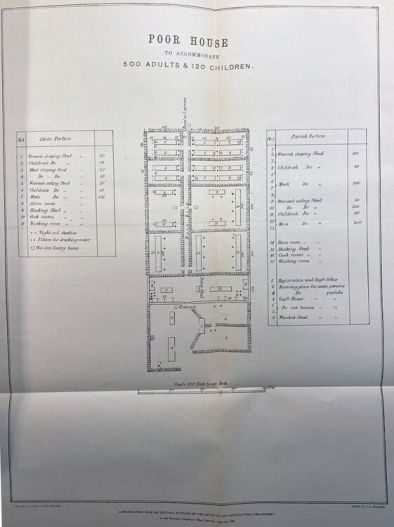
What architectural technologies were deployed in response to colonial famine? A history of food is, at its most radical, a history of the production of poverty as a systematic condition and an institutional discourse. This paper seeks to locate famine and starvation, not as a colonial event of economic neglect, but rather as a central methodology of extracting labor knowledge from the bodies of colonial subjects. Focusing on the two famines that took place in quick succession in colonial Punjab in 1896 and 1899, this paper looks at two types of documents: the Punjab Famine Code and the Famine Commission Reports. Both documents outline how famine camps and relief works were deployed to manage populations affected by food scarcity. The famine camp and the relief work are two architectural embodiments of famine epistemology. Both typologies claimed to be humanitarian interventions towards famine relief, but were instead, this paper argues, methods of extracting knowledge from the bodies of rural laborers. Knowledge such as: how little grain did a person need to survive? What minimum quantity of grain enabled a person to still labor? How bad did starvation conditions need to be before a landowner worked alongside a peasant? In this way, the Revenue Department used architectural technologies to produce a racialized, gendered, and caste-based epistemology of famine. This paper aims to argue that architectural thought on minimum space and famine thought on minimum sustenance share an infernal history that manifests in relief works where technologies of policing the rural poor were perfected.
Ateya Khorakiwala is a historian of modernity in its colonial and postcolonial guises in South Asia and of the aesthetics and materiality of its postcolonial infrastructure and ecological and political landscapes. Her current book project, Famine Landscapes, is an infrastructural and architectural history set in India’s postcolonial countryside. The book shows how infrastructures of the developmental decades can be traced back to colonial famine policies, physiocratic theories of land management, and utilitarian theories of governance, even as these architectural interventions emerge in a contested field of Cold War techno-scientific thinking. She is also researching the labor politics and environmental histories of architectural materials like concrete, bamboo, and plastic. Khorakiwala has received grants and fellowships from the MacDowell Foundation, the Volkswagen Foundation, and the American Institute of India Studies. Her essays and articles have appeared in e-flux Architecture, Comparative Studies of South Asia, Africa, and the Middle East (CSSAAME), Grey Room, and the Journal of Architectural Education (JAE). She coedited Architecture in Development: Systems and the Emergence of the Global South (Routledge, 2022). Khorakiwala received her Ph.D. from Harvard University, her MS in Architecture Studies from MIT, and was trained as an architect at KRVIA in Mumbai, India.
Additional Information
Program
Einaudi Center for International Studies
South Asia Program