
Book Talk - ILR Global Labor and Work Workshop - From Popular Front to Cold War: The Interracial Left and the International Workers Order, 1930–1954
February 18, 2026
4:00 pm
Ives Hall, Doherty Lounge, 281 Faculty Wing
The Jewish Studies Program invites you to come join our colleagues at the School of Industrial and Labor Relations (ILR) Global Labor and Work Workshop in welcoming a new book from Cornell University Press at a book launch with Elissa Sampson and Robert Zecker. The Global Labor and Work series has a longstanding tradition of hosting panels and individual presentations that foster rich and stimulating discussions at the cutting edge of the study of work, labor, and employment—all within a collegial setting.
The room capacity of Doherty Lounge is limited to 36.
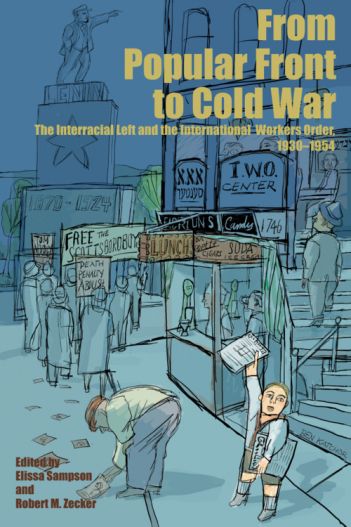
Co-editors Elissa Sampson and Robert Zecker will discuss their new book, "From Popular Front to Cold War," which tells the story of the International Workers Order (IWO). Originally a left-wing Yiddish-speaking fraternal organization founded in 1930 as a mutual benefit insurance society, the IWO uniquely became interracial and multiethnic, championing early civil-rights campaigns, battling for labor unions and needed social reforms during the Great Depression and World War II, while pushing the boundaries of multiracial social democracy. Although the postwar Red Scare sentenced the IWO to liquidation in 1954, this organization remains a vital reminder in our current distressing times that another world was possible.
At its height, the pro-Soviet IWO had almost 200,000 members drawn from a broad ethnic and racial spectrum of the working class--Jews, Blacks, Poles, Slovaks, Italians, Hispanics, and others. It operated summer camps, published foreign-language newspapers, and supported a wide range of cultural activities; its multilingual archives are housed at Cornell's Kheel Center. An early advocate for the US's entry into World War II, the IWO was ahead of its time in championing the nascent Civil Rights movement and Black leadership. Its leaders and activists included Clara Lemlich Shavelson, Paul Robeson, Langston Hughes, Louise Thompson Patterson, and Vito Marcantonio. The IWO was declared a subversive organization during the Cold War although its membership was not connected to the Communist Party. Its legacy as a model for working-class cooperation across racial and ethnic differences endures to this day.
Dr. Elissa Sampson is an urban geographer who studies how the past is actively used to create new spaces of migration, memory, heritage and activism. Her life-long interest in migration, diaspora, re-diasporization and immigrant culture has been pursued in the Lower East Side, Brooklyn, Jerusalem, Paris and elsewhere and points to the dynamic interactions among diasporas in shared spaces/places. She has worked extensively with Cornell University’s, Kheel Center archives on the International Workers Order (IWO) and is responsible for its partial digitization. She co-organized a public, online academic conference, “Di Linke,” (the Left) based largely on its Jewish Section holdings: a weeklong series of webcasts in December 2020 attracted more than six hundred attendees. She is a Research Associate in Cornell’s Jewish Studies Program where she has taught labor and gender history, including the 1911 Triangle Shirtwaist Fire, its memorialization, and its relationship to current activism. She has published in the fields of urban geography and memory studies as well as on the IWO and is the co-editor of "From Popular Front to Cold War: The Interracial Left and the International Workers Order, 1930–1954" from Cornell University Press.
Robert M. Zecker is a professor of history at Saint Francis Xavier University, Nova Scotia, Canada, where he teaches courses in race, immigration, social movements, and US history. His research includes immigration, radicalism, and the popular culture of immigrants on the left. He is the author of many articles in journals such as the Journal of American Ethnic History, American Communist History, the Journal of Popular Culture, and the Journal of Transnational American Studies. He is the author of four books, most recently “A Road to Peace and Freedom”: The International Workers Order and the Struggle for Economic Justice and Civil Rights, 1930–1954 (Temple University Press, 2018). He is currently writing a history of the workers’ schools of the CPUSA.
Sponsors: Jewish Studies Program, ILR School Global Labor and Work
Co-sponsors: Mario Einaudi Center for International Studies, Reppy Institute for Peace and Conflict Studies, Department of Government, Institute for Comparative Modernities, Department of Anthropology, Feminist, Gender, & Sexuality Studies Program, American Studies Program, Department of History, Africana Studies & Research Center
Additional Information
Program
Einaudi Center for International Studies
Reppy Institute for Peace and Conflict Studies