
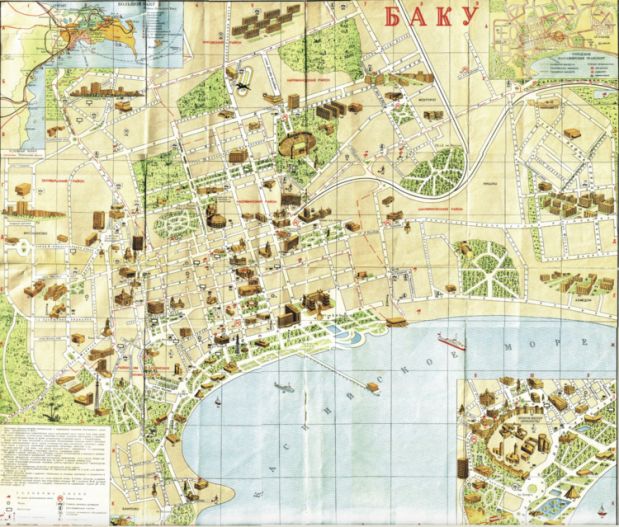
In the Neighborhood of Empire: Baku Communities After World War II
October 16, 2025
2:00 pm
Kennedy Hall, 461
What did Soviet empire look like in intimate terms—as experienced and perceived through the lens of interpersonal relations? Despite many decades of scholarship on Soviet society and subjectivity, we have very few neighborhood-level studies of sociability and materiality, although interpersonal experience and relations undoubtedly played a key role in defining belonging, identity, and/or alienation. In other words, to make sense of the legacies of Russian colonialism, we need to think not only of top-down policies and myths of the “friendship of peoples” (although these cannot be excluded, of course), but also of how people applied, adjusted, and lived within this system—something shaped, as this talk shows, by the very material, economic, and geographic conditions of their day-to-day lives.
Attendees are invited to join discussion afterwards 3:30-4:20 on neighborhoods of Soviet and post-Soviet Tbilisi “ with Heather DeHaan, Dr. Maria C Taylor and students in LA6930 course on Second World Urbanism.
Speaker
Heather DeHaan is Associate Professor of History and Director of the Russian, East European and Eurasian Studies Program at Binghamton University. Her research has focused on the making of Soviet cities, but whereas her first book (Stalinist City Planning, Professionals, Performance and Power [U. Toronto Press, 2013]) focused primarily on urban planning, her current research explores the contributions of ordinary urban denizens. This research has been supported by the National Endowment for the Humanities, Fulbright, and the Kennan Institute.
Host
The Institute for European Studies, part of the Einaudi Center for International Studies
Additional Information
Program
Einaudi Center for International Studies
Institute for European Studies