
Workshop: Ancient Copies, Modern Methods: Replication, Translation, and Reception in the Work of Margarete Bieber
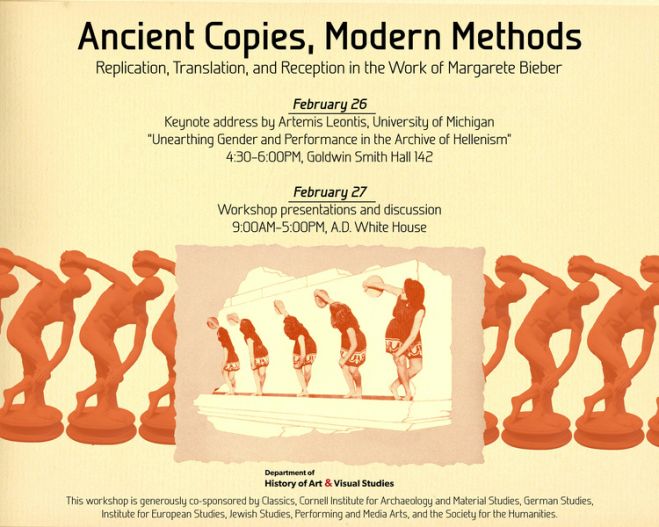
February 27, 2026
9:00 am
A. D. White House
Margarete Bieber is a prominent yet enigmatic figure in the history of classical art and archaeology. She was pathbreaking in many respects: Bieber was the second woman in Germany to earn a doctorate in archaeology in 1907, and only the second woman across all fields of study in Germany to receive her habilitation in 1919. In 1932 Bieber was appointed associate professor of classical archaeology at the University of Giessen, an unprecedented accomplishment for women scholars of the ancient Mediterranean. Yet, in the 1930’s she and countless other scholars of Jewish heritage were summarily dismissed from their university posts, leading Bieber to join a growing surge of German refugee academics fleeing the Nazi regime for communities in the United Kingdom and United States. She eventually joined the faculty at Barnard College and Columbia University. Despite officially retiring in 1948, she continued to pursue a prolific career until her death in 1978.
Her vast body of scholarship on the Greek and Roman theater, Hellenistic sculpture, ancient dress, and Roman copies of Greek art continues to enjoy a place of authority within classical scholarship. However, in its development across her intellectual youth in Germany and later career in New York, Bieber’s work exhibits generative tensions between traditional and innovative disciplinary approaches. In her endeavors to translate, literally and culturally, her foundational research for a broader, American audience, Bieber and her biography pose a number of implicit questions regarding the transformation and transmission of knowledge within the contexts of exile, emigration, and assimilation.
Beginning in 2018, a team of researchers collaborating between Cornell University and Columbia University came together to explore how the academic, cultural, and social milieu of American academia transformed Margarete Bieber’s intellectual trajectory, writing style, and attitudes toward her field. While recent scholarship continues to examine the consequences of Nazi rule on the German intellectual class, the opportunities and challenges of women in 20th-century archaeology, and even the idiosyncratic collecting habits of Bieber herself, no project has yet to critically analyze how Bieber’s personal biography and intellectual methods illuminate processes of translation and reception at the heart of her oeuvre. By focusing primarily on Bieber’s scholarship concerning sculpture and artistic copying, this one-day workshop aims to address the following goals:
-to explore the enduring relevance of her research on replication and copying in the study of sculpture and historical dress, especially her embrace of photographic technologies.
-to more firmly contextualize her scholarly contributions in light of her biography as a Jewish refugee scholar forced to emigrate in response to early 20th-century authoritarianism.
-to advance a reconciliation of her conservative or traditional style of art history with her more experimental and innovative scholarly methods.
-to integrate unpublished correspondences held by the Tulane University Special Collections into the recovery of Bieber’s intellectual milieu.
The workshop will begin with a keynote address on Thursday, February 26, by Artemis Leontis (Michigan) entitled, “Unearthing Gender and Performance in the Archive of Hellenism” beginning at 4:30PM in Goldwin Smith Hall 142.
This workshop is hosted by the Department of the History of Art and Visual Studies and generously co-sponsored by Classics, Cornell Institute for Archaeology and Material Studies, German Studies, Institute for European Studies, Jewish Studies, Performing and Media Arts, and the Society for the Humanities.
Additional Information
Program
Institute for European Studies