
East Asia Program
Information Session: Travel Grants & Global PhD Research Awards

November 15, 2023
4:45 pm
Uris Hall, G02
The Mario Einaudi Center for International Studies funds international graduate student research!
Research travel grants provide international travel support for graduate and professional students to conduct short-term research or fieldwork outside the United States. Global PhD Research Awards fund fieldwork for 9 to 12 months of dissertation research.
Contact einaudi_center@einaudi.cornell.edu for more information.
Register for the information session.
***
The Mario Einaudi Center for International Studies hosts info sessions for graduate and for undergraduate students to learn more about funding opportunities, international travel, research, and internships. View the full calendar of fall semester sessions.
Additional Information
Program
Einaudi Center for International Studies
Reppy Institute for Peace and Conflict Studies
East Asia Program
Southeast Asia Program
Latin American and Caribbean Studies
Institute for African Development
Institute for European Studies
South Asia Program
IAD seminar: Chinese Investment and African Industrialization: from Farms to Factories

September 13, 2023
2:30 pm
Uris Hall, G-08
Register
The seminar series for fall 2023 explores the future of African land, agriculture and food, digging into the contestations, conflicting and converging visions from a wide range of perspectives. How might land be used, valued and lived in, across cities, rural communities, forests, deserts and grasslands on the continent in the future? Who is proposing different visions of land futures in Africa, what are the histories, politics, socio-cultural, environmental and economic implications of these potential visions? In one of the regions with the most youthful populations, how are young people considering possible futures? What are ways that land, agriculture and food systems could be resilient, healthy, ecological, thriving and just?
Additional Information
Program
Einaudi Center for International Studies
East Asia Program
Institute for African Development
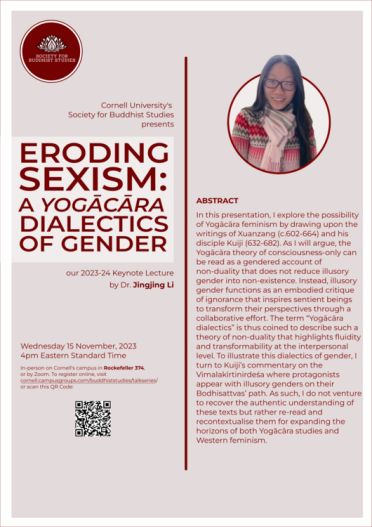
Eroding Sexism: A Yogācāra Dialectics of Gender
November 15, 2023
4:00 pm
Rockefeller Hall, 374
Cornell's Society for Buddhist Studies welcomes you to our 2023-24 Keynote Lecture, delivered by Dr. Jingjing Li (Universiteit Leiden).
In this presentation, Dr. Li explores the possibility of Yogācāra feminism by drawing upon the writings of Xuanzang (c.602-664) and his disciple Kuiji (632-682). As she will argue, the Yogācāra theory of consciousness-only can be read as a gendered account of non-duality that does not reduce illusory gender into non-existence. Instead, illusory gender functions as an embodied critique of ignorance that inspires sentient beings to transform their perspectives through a collaborative effort. The term “Yogācāra dialectics” is thus coined to describe such a theory of non-duality that highlights fluidity and transformability at the interpersonal level. To illustrate this dialectics of gender, Dr. Li turns to Kuiji’s commentary on the Vimalakīrtinirdeśa where protagonists appear with illusory genders on their Bodhisattvas’ path. As such, she do not venture to recover the authentic understanding of these texts but rather re-read and recontextualise them for expanding the horizons of both Yogācāra studies and Western feminism.
This talk is co-sponsored by the Departments of Asian Studies and Philosophy, by the Religious Studies, East Asia, and Southeast Asia Programs, and by the GPSA.
The talk is open to all interested parties, either in-person in Rockefeller 374 or via Zoom.
Additional Information
Program
East Asia Program
Southeast Asia Program
South Asia Program
Information Session: Dissertation Proposal Development Program

October 23, 2023
4:45 pm
The Einaudi Dissertation Proposal Development Program (DPD) supports 12 PhD students annually by offering seminars, workshops, mentoring sessions, and up to $5,000 for summer research. Applicants’ research projects must focus on global issues, but the proposed research setting may be international or domestic.
In this session, you'll learn more about the details of the program and advice on the application process.
Register for event here.
***
The Mario Einaudi Center for International Studies hosts info sessions for graduate and for undergraduate students to learn more about funding opportunities, international travel, research, and internships. View the full calendar of fall semester sessions.
Additional Information
Program
Einaudi Center for International Studies
Reppy Institute for Peace and Conflict Studies
East Asia Program
Southeast Asia Program
Latin American and Caribbean Studies
Institute for African Development
Institute for European Studies
South Asia Program
Information Session: Fulbright for Undergraduates

October 26, 2023
4:45 pm
The Fulbright U.S. Student Program supports U.S. citizens to study, conduct research in any field, or teach English in more than 150 countries. Students who wish to begin the program immediately after graduation are encouraged to start the process in their junior year. Recent graduates are welcome to apply through Cornell.
The Fulbright program at Cornell is administered by the Mario Einaudi Center for International studies. Applicants are supported through all stages of the application and are encouraged to start early by contacting fulbright@einaudi.cornell.edu.
Register for the info session.
***
The Mario Einaudi Center for International Studies hosts info sessions for graduate and for undergraduate students to learn more about funding opportunities, international travel, research, and internships. View the full calendar of fall semester sessions.
Additional Information
Program
Einaudi Center for International Studies
Reppy Institute for Peace and Conflict Studies
East Asia Program
Southeast Asia Program
Latin American and Caribbean Studies
Institute for African Development
Institute for European Studies
South Asia Program
Information Session: East Asia Program Graduate Fellowships

October 25, 2023
4:45 pm
Uris Hall, G-08
The East Asia Program (EAP) offers one-semester fellowships for doctoral students working on East Asia-related projects, travel grants for graduate students conducting field research in China, Japan, South Korea, and Taiwan, and a small number of East Asian language study grants.
At this info session, EAP staff and recent fellowship recipients will provide an overview of the application process and guidance on putting together a strong application.
Register for the info session here.
***
The Mario Einaudi Center for International Studies hosts info sessions for graduate and for undergraduate students to learn more about funding opportunities, international travel, research, and internships. View the full calendar of fall semester sessions.
Additional Information
Program
Einaudi Center for International Studies
East Asia Program
Southeast Asia Program
Information Session: Southeast Asia Program Undergraduate Opportunities

October 23, 2023
4:45 pm
Uris Hall, 153
The Southeast Asia Program (SEAP) gives students multiple ways to engage with Southeast Asia. Undergraduates who minor in Southeast Asian Studies are advised by SEAP faculty advisors who collaborate with them to construct a course of study based upon their area of interest. SEAP also runs the CU in Cambodia program for students interested in international travel.
Affiliate with our program to be informed of all SEAP events and activities.
Register for the information session here!
***
The Mario Einaudi Center for International Studies hosts info sessions for graduate and for undergraduate students to learn more about funding opportunities, international travel, research, and internships. View the full calendar of fall semester sessions.
Additional Information
Program
Einaudi Center for International Studies
East Asia Program
Southeast Asia Program
Institute for African Development
Information Session: Fulbright for Graduate Students

October 18, 2023
4:45 pm
In this info session for graduate students, learn about Fulbright at Cornell.
The Fulbright U.S. Student Program provides full funding for graduate and professional students conducting research in any field or teaching in more than 150 countries. Open to U.S. citizens only.
The Fulbright-Hays Doctoral Dissertation Research Abroad program supports doctoral students conducting research in modern languages or area studies for six to 12 months. Open to U.S. citizens and permanent residents of the United States. Travel to Western European countries is not eligible.
Register for the information session.
***
The Mario Einaudi Center for International Studies hosts info sessions for graduate and for undergraduate students to learn more about funding opportunities, international travel, research, and internships. View the full calendar of fall semester sessions.
Additional Information
Program
Einaudi Center for International Studies
Reppy Institute for Peace and Conflict Studies
East Asia Program
Southeast Asia Program
Latin American and Caribbean Studies
Institute for African Development
Institute for European Studies
South Asia Program
Information Session: Laidlaw Research and Leadership Program

November 2, 2023
4:45 pm
Uris Hall, 153
Learn more about the Laidlaw Leadership and Research Program for undergraduates, tips for connecting with faculty research mentors, and advice for writing a successful application.
Laidlaw promotes ethical leadership and international research around the world—starting with the passionate leaders and learners found on campuses like Cornell.
Open to first- and second-year students, the two-year program provides generous support to carry out internationally focused research, develop leadership skills, engage with community projects overseas, and become part of a global network of like-minded scholars from more than a dozen universities.
Register for the information session here.
***
The Mario Einaudi Center for International Studies hosts info sessions for graduate and for undergraduate students to learn more about funding opportunities, international travel, research, and internships. View the full calendar of fall semester sessions.
Additional Information
Program
Einaudi Center for International Studies
Reppy Institute for Peace and Conflict Studies
East Asia Program
Southeast Asia Program
Latin American and Caribbean Studies
Institute for African Development
Institute for European Studies
South Asia Program
Information Session: Migration Studies & International Relations Minors

November 1, 2023
5:00 pm
Uris Hall, G-08
Learn more about the migration studies minor and international relations minor—offered by the Mario Einaudi Center for International Studies. Both minors are open to all Cornell undergraduates and include courses from across the university.
With a focus on global migration experiences, the migration studies minor prepares students to understand the historical and contemporary contexts and factors that drive international migration.
The international relations minor offers students the chance to study the politics, economics, history, languages, and cultures of the world.
Register here.
***
The Mario Einaudi Center for International Studies hosts info sessions for graduate and for undergraduate students to learn more about funding opportunities, international travel, research, and internships. View the full calendar of fall semester sessions.
Additional Information
Program
Einaudi Center for International Studies
Reppy Institute for Peace and Conflict Studies
East Asia Program
Southeast Asia Program
Latin American and Caribbean Studies
Institute for African Development