
Einaudi Center for International Studies
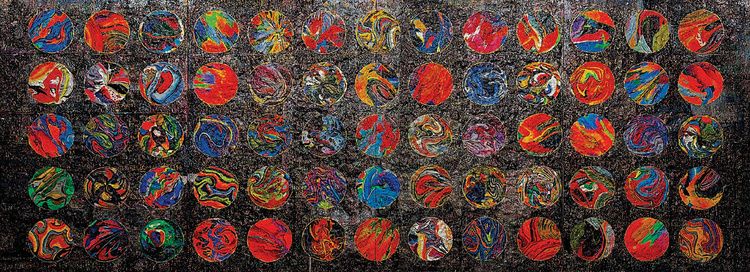
Stoikov Lecture on Asian Art: Thasnai Sethaseree
October 30, 2025
5:15 pm
Johnson Museum of Art, Robinson Lecture Hall
Thasnai Sethaseree will discuss his work in conversation with Dr. Tamara Loos in conjunction with the exhibition Cold War: The Mysterious.
An artist and professor of media arts and design at Chiang Mai University, Sethaseree holds a master’s degree in visual arts from the University of Chicago and a PhD in social sciences from Chiang Mai University. In the series Cold War: The Mysterious (2019–22), Sethaseree focuses on specific authoritarian actors, freedom-fighters, political uprisings, and violent crackdowns, but also those that draw more generally from the press and popular culture to convey the complications and chaos of this period.
All are encouraged to visit the exhibition (in the Gold Gallery, also on Floor 2L) prior to the program. The exhibition will also be open after the talk during a public reception, free and open to all.
The annual Stoikov Lecture on Asian Art at the Johnson Museum is funded by a generous gift from Judith Stoikov, Class of 1963, and is cosponsored this year by the Southeast Asia Program.
Additional Information
Program
Einaudi Center for International Studies
Southeast Asia Program
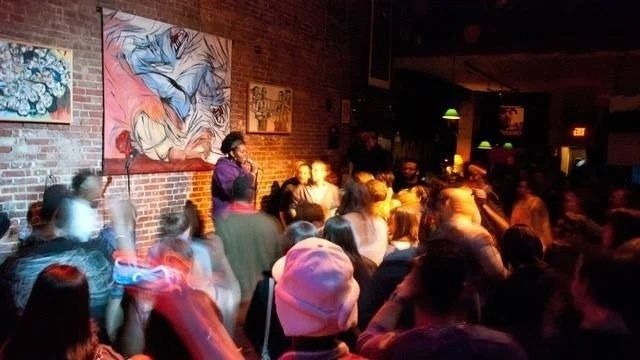
Karen Jaime, "Digital Poetics: HIDVL and Queer Nuyorican Performance"
October 24, 2025
12:00 pm
Olin Library, 703
Please join us for an event in our Digital Humanities Initiative Colloquium Series: a presentation by and conversation with Karen Jaime, Associate Professor of Performing and Media Arts and Latina/o Studies at Cornell. Professor Jaime's talk will focus on the Hemispheric Institute Digital Video Library (HIDVL), the first major digital video library of performance practices in the Americas, and queer Nuyorican performance and poetry.
Lunch will be served! All are welcome.
Additional Information
Program
Einaudi Center for International Studies
Latin American and Caribbean Studies
Faculty: Apply for Global Hubs Seed Grants
Proposals due Oct. 15
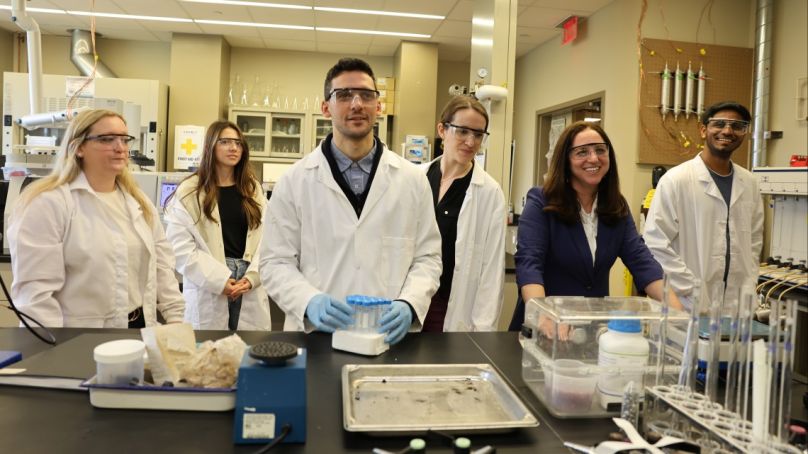
Up to 20 early-stage Hubs collaborations will receive funding from this year’s Global Hubs Research Seed Grants.
Additional Information
Laidlaw Scholars Q+A Webinar with Pachaysana
November 5, 2025
12:00 pm
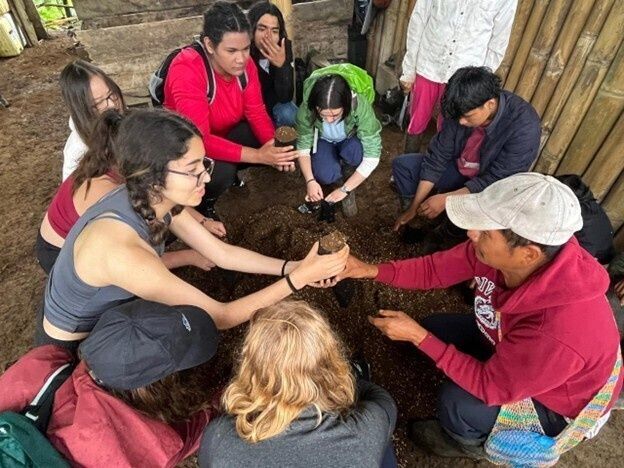
For the summer 2026 Leadership in Action experience, students will be placed with the Pachaysana Foundation exploring what it means to be an intercultural leader in today’s complex, fractured world. Please attend this Q+A webinar with Pachaysana Foundation to learn more about their work and how the Laidlaw Scholars explore leadership as something we live—grown in relationship and rooted in the wisdom of agrarian, Indigenous, and activist communities.
Attendance and participation in the Q+A are highly recommended for Laidlaw Scholars applicants. Applications are due January 12, 2026.
Register here. Can’t attend? Another Q+A webinar is scheduled for November 6.
Contact programs@einaudi.cornell.edu with questions.
***
The Mario Einaudi Center for International Studies hosts info sessions for graduate and for undergraduate students to learn more about funding opportunities, international travel, research, and internships. View the full calendar of fall semester sessions.
Additional Information
Program
Einaudi Center for International Studies
Reppy Institute for Peace and Conflict Studies
East Asia Program
Southeast Asia Program
Latin American and Caribbean Studies
Institute for African Development
Institute for European Studies
South Asia Program
Migrations Program
Democratic Leadership in a New World: Costa Rica’s Former President Laura Chinchilla in Conversation
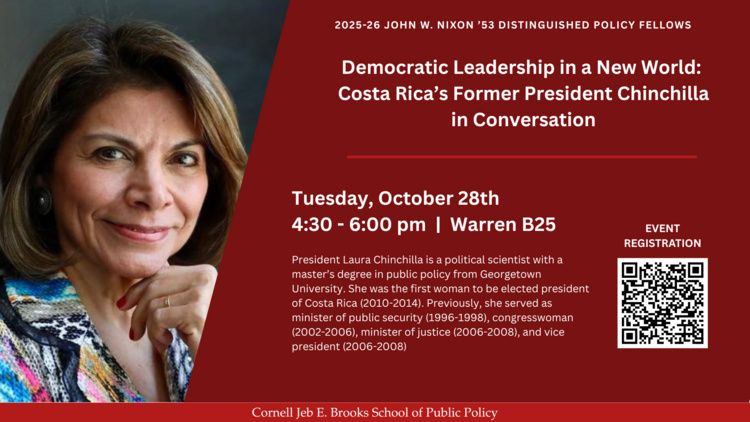
October 28, 2025
4:30 pm
Warren Hall, B25
You are warmly invited to join us for a special event with President Laura Chinchilla, 2025-2026 John W. Nixon ’53 Distinguished Policy Fellow, in conversation with Professor Rachel Riedl, Peggy J. Koenig ’78 Director of the Center on Global Democracy, and Zarifa Ghafari, Human Rights Activist, former Afghan mayor, and Cornell MPA ’26.
Event registration: Please scan the QR code on the attached flyer or register via this link.
We hope you will join us for this timely and engaging conversation.
Additional Information
Program
Einaudi Center for International Studies
Latin American and Caribbean Studies
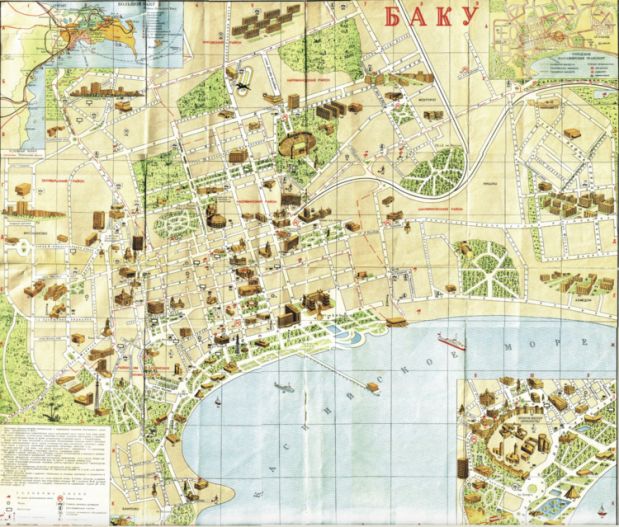
In the Neighborhood of Empire: Baku Communities After World War II
October 16, 2025
2:00 pm
Kennedy Hall, 461
What did Soviet empire look like in intimate terms—as experienced and perceived through the lens of interpersonal relations? Despite many decades of scholarship on Soviet society and subjectivity, we have very few neighborhood-level studies of sociability and materiality, although interpersonal experience and relations undoubtedly played a key role in defining belonging, identity, and/or alienation. In other words, to make sense of the legacies of Russian colonialism, we need to think not only of top-down policies and myths of the “friendship of peoples” (although these cannot be excluded, of course), but also of how people applied, adjusted, and lived within this system—something shaped, as this talk shows, by the very material, economic, and geographic conditions of their day-to-day lives.
Attendees are invited to join discussion afterwards 3:30-4:20 on neighborhoods of Soviet and post-Soviet Tbilisi “ with Heather DeHaan, Dr. Maria C Taylor and students in LA6930 course on Second World Urbanism.
Speaker
Heather DeHaan is Associate Professor of History and Director of the Russian, East European and Eurasian Studies Program at Binghamton University. Her research has focused on the making of Soviet cities, but whereas her first book (Stalinist City Planning, Professionals, Performance and Power [U. Toronto Press, 2013]) focused primarily on urban planning, her current research explores the contributions of ordinary urban denizens. This research has been supported by the National Endowment for the Humanities, Fulbright, and the Kennan Institute.
Host
The Institute for European Studies, part of the Einaudi Center for International Studies
Additional Information
Program
Einaudi Center for International Studies
Institute for European Studies
Venezuelan Drug Boat Strikes

Oct. 7 World in Focus Talk
Don't miss the fall kickoff of World in Focus Talks on global events in the news and on your mind. This week: Is the U.S. violating international law?
Additional Information
How Communities Can Bridge the Digital Divide

Mildred Warner, IES/LACS
A new book highlights innovative state and local approaches to eliminating “digital deserts,” which persist despite billions in federal subsides promoting universal access.
Additional Information
Jonathan Lam '27 Receives Trailblazer in Organizing and Activism Award
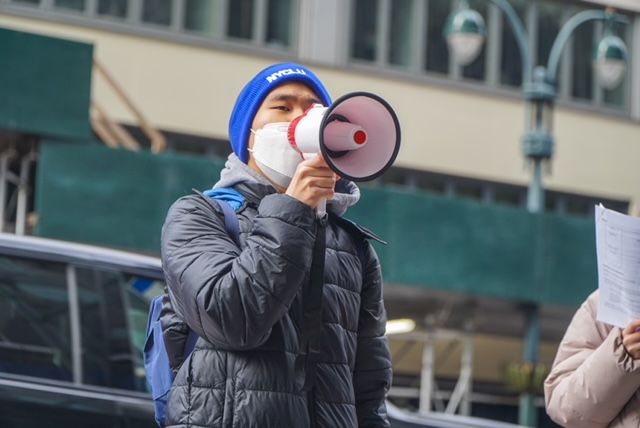
Jonathan Lam, Migrations scholar and Laidlaw scholar at Einaudi, is the inaugural recipient of the “Trailblazer in Organizing and Activism” award for his efforts in Refugee and Migrant Rights, which were recognized at the Amnesty International USA Human Rights Conference in late February.
Additional Information
World in Focus: Venezuelan Drug Boat Strikes

October 7, 2025
4:00 pm
Uris Hall, G08
Join Einaudi Center experts for World in Focus Talks on global events in the news and on your mind. Our faculty's research and policy insights put the world in focus.
This year we’re hosting informal campus discussions on many Tuesday afternoons. This week’s topic:
Following a military buildup in the Caribbean, the U.S. government has confirmed multiple airstrikes on Venezuelan boats suspected of drug smuggling—killing at least 17 in September. The U.S. claims these actions are “armed conflict” against narcoterrorist organizations. The Venezuelan government condemns the attacks as illegal.
Is the U.S. violating international law? What may happen if tensions continue to escalate?
***
Featured Faculty
Oumar Ba (PACS) | Government Pedro M. R. Barbosa (LACS) | Visiting ScholarKen Roberts (LACS) | GovernmentDavid Bateman | GovernmentAleida Sandoval | Visiting Scholar
***
Conversations Matter at Einaudi
This conversation is hosted by the Mario Einaudi Center for International Studies and its regional and thematic programs. Find out what's in store for students at Einaudi!
Additional Information
Program
Einaudi Center for International Studies
Reppy Institute for Peace and Conflict Studies
East Asia Program
Southeast Asia Program
Latin American and Caribbean Studies
Institute for African Development
Institute for European Studies
South Asia Program
Migrations Program
Southwest Asia and North Africa Program