
Institute for African Development
IAD Spring 2025 Seminar: "Decolonizing African Agriculture: Food Security, Agroecology and the Need for Radical Transformation" - Bill Moseley, Dewitt Wallace Prof. of Geography and Director of the Program for Food, Agr. and Society, Macalester College

March 13, 2025
11:15 am
115 Sibley Hall
This presentation summarizes a new book analyzing the history of food security and agricultural development initiatives in post-colonial Africa and outlining a vision for future prosperity. The basic argument has three parts. First, development organizations and governments will only begin to seriously address food insecurity in Africa when they more fully question the assumption that production agriculture is the solution, an idea that is central to crop science or agronomy. Second, agricultural development must be seen as more than the first step in an industrial development process, but as a sustainable livelihood that has value in and of itself. Third, an agroecological approach, combined with good governance, will allow people to have greater control over their food systems, produce healthy food more sustainably, and enhance access to food by the poorest of the poor. Following a broad conceptual introduction emphasizing political agronomy and political ecology, the author reviews past food security and agricultural development experiences in four countries where he has undertaken research: Mali, Burkina Faso, South Africa and Botswana. He then examines successful efforts in each of the aforementioned countries and outlines future directions that emphasize agroecology, the application of ecological principles to agricultural systems. He concludes with some ideas about institutions at the national, regional and international levels. To build more resilient food systems and a different kind of development, new institutions will need to emerge that support agroecology and vibrant rurality.
Public Registration
Additional Information
Program
Einaudi Center for International Studies
Institute for African Development
IAD Spring 2025 Seminar: "Street Traders’ Associations and Collective Action in Politically Volatile and Contested Cities"

March 6, 2025
11:15 am
115 Sibley Hall
In this presentation, I discuss how street traders’ associations in Harare (Zimbabwe) mobilize and organize to defend the interests of traders operating in a politically volatile and contested urban environment. I demonstrate how external political dynamics, and institutional constraints shape the strategies and outcomes of these associations. Drawing on qualitative research, including interviews with municipal officials, civil society leaders and focus groups with street traders, the findings reveal that while some associations engage in episodic activism, responding to immediate crises like harassment or eviction, their efforts often lack sustained impact. This is due to challenges in maintaining legitimacy, fostering long-term member engagement, and navigating a politically polarized context. I argue that despite their actions leading to incremental gains, they fail to catalyze structural changes in urban policy and planning. The fragmentation and political polarization within the associations weaken their bargaining power to influence policy agendas or propose alternative policies for negotiation with urban authorities.
Public Registration
Additional Information
Program
Einaudi Center for International Studies
Institute for African Development
IAD Spring 2025 Seminar: "Becoming 'Unlawful': Homeownership, housing bureaucracy, and the production of precarity in Eastridge, Cape Town, South Africa"

February 27, 2025
11:15 am
115 Sibley Hall
Becoming 'Unlawful': Homeownership, housing bureaucracy, and the production of precarity in Eastridge, Cape Town, South Africa
Public Registration
Additional Information
Program
Einaudi Center for International Studies
Institute for African Development
Politics, Markets, and Governance - A conference in honor of Nicolas van de Walle
May 8 - 9, 2025 Cornell University Ithaca, NY
This conference honors the legacy of Nic van de Walle who has shaped the field of political science, and African politics in particular, in substantial and important ways. His insights into the politics of economic policymaking and “permanent crisis”, the driving forces of regime dynamics, electoral politics, and democratic transitions continue to underpin the foundations of comparative politics.
Call for Papers
We welcome colleagues to submit proposals on these core themes of African political economy, regimes, and modes of electoral and social participation and contestation. We also welcome the extension of these foundational principles into new domains that they shine light on, but did not take up directly, such as the security challenges and roles of international organizations.
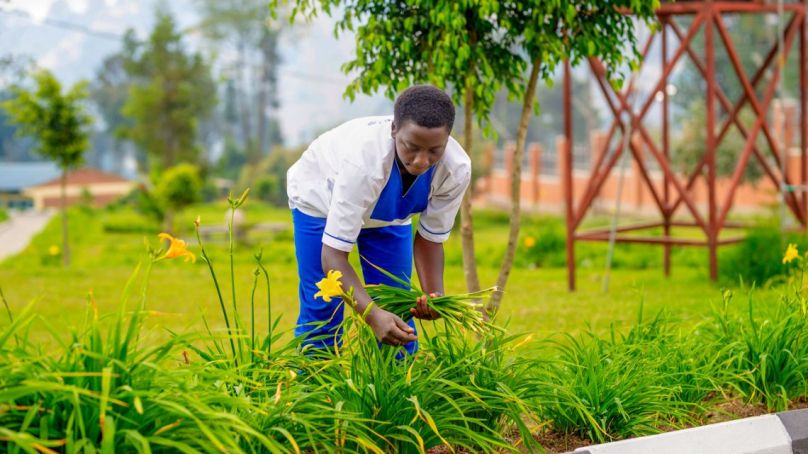
With NGO, Alums Boost Rwandan Smallholder Farmers
Edward Mabaya, IAD
“It’s truly rewarding to see Walisha come to fruition,” said Edward Mabaya, research professor in global development in the College of Agriculture and Life Sciences and adviser for Annan and Corkern’s capstone project. “It’s a pleasure to support such bright and driven young minds who share a passion for making a meaningful impact on Africa’s agricultural value chains.”
Additional Information
Demographic and Health Survey Program and The New Nutrition Team - Thursday, Nov. 21 11:15am 109 Ives Hall

Rukundo Kambarami Benedict is an experienced nutrition researcher currently serving as the Lead Nutrition Research Associate at The Demographic and Health Surveys (DHS) Program since August 2017. In this role, Rukundo analyzes national datasets and authors reports to guide nutrition policy and programs. Prior to this, she was a Postdoctoral Research Associate at Cornell University, where research focused on breastfeeding practices in South Asia and the quality of maternal nutrition counseling. Rukundo's academic journey includes a PhD from Cornell University, where teaching and research on nutrition and health were key components, and a Master of Science in Public Health from Johns Hopkins University. Early experiences included a role as a Research Assistant for a WHO/Johns Hopkins collaboration and various research positions at the Zvitambo Institute, further emphasizing Rukundo's dedication to advancing nutrition and public health interventions.
Shifting Landscapes: A Conversation with the Cornell Community on Migration and Trump-Era Policy Changes

November 21, 2024
12:00 pm
The recent U.S. election is likely to have significant impacts on immigration policy and practices. Based on experience with the previous Trump administration and standing efforts among Republicans in Congress, these changes may impact Cornell students, staff, and faculty. Join Cornell’s Migrations Program in a conversation about the current state of immigration policy.
This is a virtual-only meeting open to Cornell faculty, staff, and students. Registration is required.
Panelists
Shannon Gleeson, School of Industrial and Labor Relations and Brooks School of Public PolicyLaura Taylor, Director of International ServicesStephen Yale-Loehr, Cornell Law SchoolModerator
Wendy Wolford, Vice Provost for International Affairs and Robert A. and Ruth E. Polson Professor of Global Development in the College of Agriculture and Life SciencesHost and Sponsors
The Migrations Program, part of the Mario Einaudi Center for International Studies, builds upon the work of Migrations: A Global Grand Challenge to inform real-world policies and outcomes for populations that migrate.
Additional Information
Program
Einaudi Center for International Studies
Migrations Program
Reppy Institute for Peace and Conflict Studies
East Asia Program
Southeast Asia Program
Latin American and Caribbean Studies
Institute for African Development
Institute for European Studies
South Asia Program
The Demographic and Health Survey Program and The New Nutrition Team
November 21, 2024
11:15 am
109 Ives Hall
Rukundo Kambarami Benedict is a highly experienced nutrition researcher currently serving as the Lead Nutrition Research Associate at The Demographic and Health Surveys (DHS) Program since August 2017. In this role, Rukundo analyzes national datasets and authors reports to guide nutrition policy and programs. Prior to this, Rukundo was a Postdoctoral Research Associate at Cornell University, where research focused on breastfeeding practices in South Asia and the quality of maternal nutrition counseling. Rukundo's academic journey includes a PhD from Cornell University, where teaching and research on nutrition and health were key components, and a Master of Science in Public Health from Johns Hopkins University. Early experiences included a role as a Research Assistant for a WHO/Johns Hopkins collaboration and various research positions at the Zvitambo Institute, further emphasizing Rukundo's dedication to advancing nutrition and public health interventions.
Public Registration
Additional Information
Program
Einaudi Center for International Studies
Institute for African Development
Information Session: Laidlaw Research and Leadership Program

December 4, 2024
5:00 pm
Uris Hall, G08
The Laidlaw Undergraduate Leadership and Research Program promotes ethical leadership and international research around the world—starting with the passionate leaders and learners found on campuses like Cornell. Open to first- and second-year students, the two-year Laidlaw program provides generous support to carry out internationally focused research, develop leadership skills, engage with community projects overseas, and become part of a global network of like-minded scholars from more than a dozen universities. We’ll also share tips for approaching potential faculty research mentors and writing a successful application.
Can’t attend? Contact laidlaw.scholars@cornell.edu.
***
The Mario Einaudi Center for International Studies hosts info sessions for graduate and for undergraduate students to learn more about funding opportunities, international travel, research, and internships. View the full calendar of fall semester sessions.
Additional Information
Program
Einaudi Center for International Studies
Reppy Institute for Peace and Conflict Studies
East Asia Program
Southeast Asia Program
Latin American and Caribbean Studies
Institute for African Development
Institute for European Studies
South Asia Program
Migrations Program
Global Internships and Laidlaw

Students Showcase International Work
Over 70 undergraduates learned career-shaping lessons in the field last summer. Find out how to apply for 2025 Global Internships and Laidlaw.