
Institute for African Development
How the UN Trusteeship Council might have shaped a substantive decolonization—and why it didn’t
April 28, 2022
11:25 am
Uris Hall, G08
This is a hybrid event. Registration information is below.
This talk sheds light on what various actors engaged with the United Nations trusteeship system wanted decolonization to mean, what they thought, or hoped, it should mean, and their contests of power over normalizing its meaning. The speaker will explain the importance of the UN trusteeship system in establishing decolonizing norms, particularly the meaning of universal rights within those norms. In opting not to address land claims and abuse of power complaints that petitioners brought to its attention, the Trusteeship Council created a precedent for excluding substantive rights from decolonization’s meaning in international law. This talk will elucidate what decolonization could mean within the trusteeship system, by examining the making of Italian Somaliland’s trusteeship agreement within the Trusteeship Council.
About the speakers
Meredith Terretta, is Professor of History at the University of Ottawa. She examines transregional legal and rights activism, both past and contemporary. Professor Terretta is now co-editing, with Dr. Samuel Moyn, The Cambridge World History of Rights, Volume 5: The Twentieth and Twenty-First Centuries. Her work appearing this academic year includes a special issue on African Refuge for the Canadian Journal of African Studies, co-edited with Dr. Philip Janzen, as well as single-authored articles on rights, international law, and decolonization in The Law and History Review; the Comparative Studies of South Asia, Africa and the Middle East; and the Humanity Journal: An International Journal of Human Rights, Humanitarianism, and Development.
This seminar is part of the spring seminar series with the Reppy Institute for Peace and Conflict Studies (PACS).
Register here
In accordance with university event guidance, all campus visitors who are 12 years old or older must also present a photo ID, as well as proof of vaccination for COVID-19 or results of a recent negative COVID-19 test. If you are not currently participating in the Cornell campus vaccination/testing program, please bring proof of vaccination or the results of a recent negative test.
Additional Information
Program
Einaudi Center for International Studies
Reppy Institute for Peace and Conflict Studies
Institute for African Development
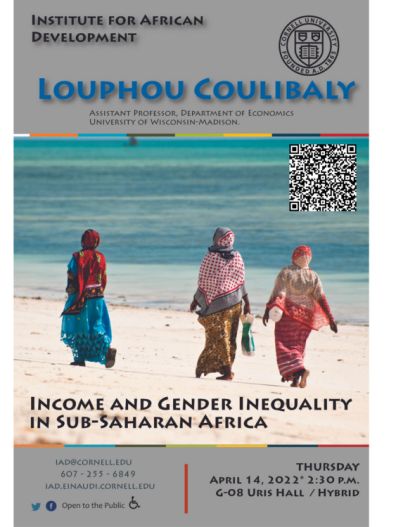
Institute for African Development Seminar Series: Income and Gender Inequality in Sub-Saharan Africa
April 14, 2022
2:40 pm
Uris Hall, G-08
Registeration link
Speaker's details
Additional Information
Program
Einaudi Center for International Studies
Institute for African Development
What the War in Ukraine Means for Energy, Climate, and Food

Chris Barrett, IAD/SEAP
“One of the big casualties of the Russian invasion will be people who are already teetering on the edge in other places,” says Chris Barrett, professor of applied economics and management. “It’s not just Ukrainians. It’s Yemenis, and Syrians and Nigerians.”
Additional Information
Nobel Peace Laureate Leymah Gbowee

May 3: Bartels Lecture and Reception
Join us on May 3 at 5:00 for Leymah Gbowee, "Forging Lasting Peace: Movements for Justice in a Pluralist World." Reserve your free ticket today!
Additional Information
Nobel Laureate Leymah Gbowee: Forging Lasting Peace

May 3, 2022
5:00 pm
Alice Statler Auditorium
Forging Lasting Peace: Movements for Justice in a Pluralist World (Bartels World Affairs Lecture)
In our ethnically, racially, linguistically, and religiously diverse world, how do we find common ground? Amid ongoing conflict and violence, how do we foster lasting peace? In our world full of inequalities, what practices of activism and solidarity lead to transformative change? Drawing on her experiences of mobilizing, demanding, and brokering peace, 2011 Nobel Peace Prize winner Leymah Gbowee shares how action and activism can shape a just world.
A book signing and reception with refreshments will follow the lecture.
Lecture: 5:00–6:30 p.m. | Alice Statler AuditoriumBook signing and reception: 6:30–7:30 p.m. | Park AtriumFree ticket required for in-person attendance: Reserve your ticket. Join the lecture virtually by registering at eCornell.
***
Learn more about our distinguished speaker by reading her book, Mighty Be Our Powers: How Sisterhood, Prayer, and Sex Changed a Nation at War. Pick up your copy from The Cornell Store and bring it to the book signing! Buffalo Street Books will also have copies for sale at the event.
***
How did Leymah Gbowee's protests lead to lasting peace? Read a Bartels explainer by Naminata Diabate.
***
About Leymah Gbowee
Nobel Peace laureate Leymah Gbowee is a Liberian peace activist, trained social worker, and women's rights advocate. She currently serves as executive director of the Women, Peace, and Security Program at Columbia University's Earth Institute and is the founder and current president of the Gbowee Peace Foundation Africa, founding head of the Liberia Reconciliation Initiative, and cofounder and former executive director of the Women, Peace, and Security Network Africa. She is also a founding member and former Liberian coordinator of Women in Peacebuilding Network/West Africa Network for Peacebuilding.
Host and Sponsors
The Bartels World Affairs Lecture is a signature event of the Mario Einaudi Center for International Studies. Part of Einaudi's work on Inequalities, Identities, and Justice, this year's lecture is cosponsored by Einaudi's Institute for African Development and Reppy Institute for Peace and Conflict Studies, in cooperation with Peace is Loud. To learn more about Peace is Loud and discover other empowering women peacebuilders, visit www.peaceisloud.org.
Bartels World Affairs Lecture
The Einaudi Center’s flagship event brings distinguished international figures to campus each academic year to speak on global topics and meet with Cornell faculty and students, particularly undergraduates. The lecture and related events are made possible by the generosity of Henry E. Bartels ’48 and Nancy Horton Bartels ’48.
Additional Information
Program
Einaudi Center for International Studies
Reppy Institute for Peace and Conflict Studies
Institute for African Development
East Asia Program
Southeast Asia Program
Latin American and Caribbean Studies
Institute for European Studies
South Asia Program
Film Screening: Pray the Devil Back to Hell

April 26, 2022
7:00 pm
Willard Straight Theatre
Pray the Devil Back to Hell (2008) is the inspiring account of a group of ordinary women—Muslim and Christian, rich and poor, urban and rural—who came together to bring peace to their beloved but war-torn Liberia. The story of their protest's historic achievement is suspenseful and ultimately incredibly satisfying. According to Desmond Tutu, the film “eloquently captures the power each of us innately has within to make this world a far better, safer, more peaceful place.”
Join the Institute for African Development (IAD) at Cornell Cinema for a free screening of this documentary about the women's peace movement led by Leymah Gbowee, Nobel Peace laureate and speaker at this year's Bartel's World Affairs Lecture. Part of the Einaudi Center's work on Inequalities, Identities, and Justice, this year's lecture and film screening are cosponsored by Einaudi's IAD and Reppy Institute for Peace and Conflict Studies.
Find out about the Bartels lecture and reserve your ticket to see Leymah Gbowee in person on May 3.
***
How did Leymah Gbowee's protests lead to lasting peace? Read a Bartels explainer by Naminata Diabate.
***
Discussants:
N’Dri Thérèse Assié-Lumumba, Director, Institute for African Development; Professor, Africana Studies and Research Center, College of Arts & Sciences
Muna B. Ndulo, William Nelson Cromwell Professor of International and Comparative Law; Elizabeth and Arthur Reich Director, Leo and Arvilla Berger International Legal Studies Program, Cornell Law School
Additional Information
Program
Einaudi Center for International Studies
Institute for African Development
Reppy Institute for Peace and Conflict Studies
Structural Transformation of African Agriculture and Rural Spaces (STAARS) Seminar Series
April 13, 2022
8:30 am
Mann Library, 102
Presented in partnership with Cornell Global Development and the Institute for African Development
Overview
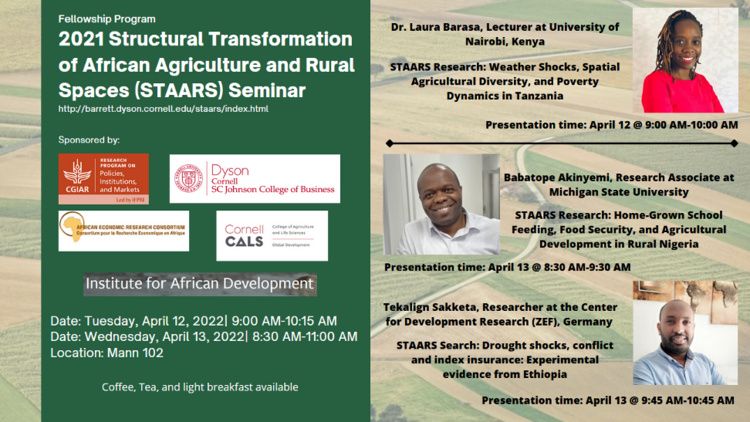
The 2021 STAARS Fellows will present their research projects. Each Fellow will get 40 minutes to present followed by 15 minutes for questions. Coffee, tea, and light breakfast fare will be available during each session.
Tuesday, April 12, 2022
Location: 102 Mann LibraryRegistration for Zoom9:00 – 9:05: Welcome9:05 – 10:00: Laura Barasa, University of Nairobi, Kenya: Weather Shocks and Household Consumption in Tanzania: Does Crop Diversification Matter?10:00 – 10:05: Closing remarksWednesday, April 13, 2022
Location: 102 Mann LibraryRegistration for Zoom8:30 – 8:35: Welcome8:35 – 9:30: Babatope Akinyemi, Michigan State University: Impact of Home-Grown School Feeding on Household Food Security in Nigeria9:30 – 9:45: Coffee/tea break9:45 – 10:40: Tekalign Sakketa, German Development Institute: Insuring against drought, protection from conflict: Evidence from Ethiopia and Kenya10:40 – 10:45: Closing remarksWant to learn more about the STAARS Fellows? Check out more information on the Chris Barrett website.
The Structural Transformation of African Agriculture and Rural Spaces (STAARS) project is a collaborative venture between the African Development Bank (AFDB), CGIAR Research Program on Policies Institutions and Markets (PIM), Partnership for Economic Policy (PEP), African Economic Research Consortium (AERC), World Bank, and Cornell University.
Additional Information
Program
Institute for African Development
Institute for African Development Seminar Series: Climate Change and Action in Africa
March 31, 2022
2:40 pm
Uris Hall, G-08
Register
Zainab Usman is a senior fellow and director of the Africa Program at the Carnegie Endowment for International Peace in Washington, D.C. Her fields of expertise include institutions, economic policy, energy policy, and emerging economies in Africa. Her forthcoming book, Economic Diversification in Nigeria: the Politics of Building a Post-Oil Economy, is set to be published by Zed/Bloomsbury Press in June 2022.
Additional Information
Program
Einaudi Center for International Studies
Institute for African Development
Institute for African Development Seminar Series

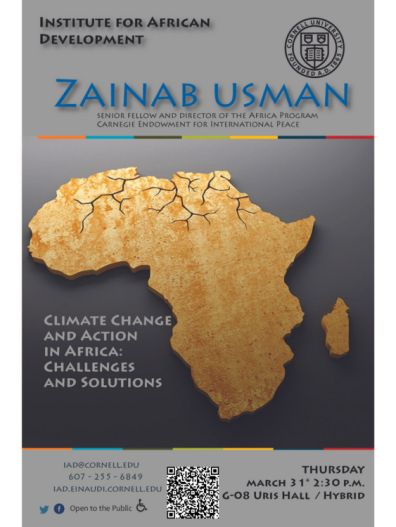
Climate Change and Action in Africa: Challenges and Solutions
Zainab Usman is a senior fellow and director of the Africa Program at the Carnegie Endowment for International Peace in Washington, D.C. Her fields of expertise include institutions, economic policy, energy policy, and emerging economies in Africa. Her forthcoming book, Economic Diversification in Nigeria: the Politics of Building a Post-Oil Economy, is set to be published by Zed/Bloomsbury Press in June 2022.
Read more about the speaker here
Issues in African Development Seminar Series examines critical concerns in contemporary Africa using a different theme each semester. The seminars provide a forum for participants to explore alternative perspectives and exchange ideas. They are also a focal activity for students and faculty interested in African development. In addition, prepares students for higher level courses on African economic, social and political development. The presentations are designed for students who are interested in development, Africa’s place in global studies, want to know about the peoples, cultures and societies that call Africa home, and explore development theories and alternate viewpoints on development. -
Additional Information
Ukraine War Pushing Food Prices Even Higher

Chris Barrett, IAD/SEAP
“It’s kind of a perfect storm,” says Chris Barrett, professor of applied economics and management. “It’s not just a matter of, food prices are going high. It’s food prices are going high at a moment when many places are already crippled by the challenges posed by COVID, by political disruptions elsewhere, by droughts and floods and other natural disasters.”
Additional Information
Topic
- Development, Law, and Economics