
Institute for European Studies
IES Fellowships and Awards 2025

IES awarded more than $150,000 in graduate and undergraduate fellowships and grants in 2024-25.
Undergraduate students from Public Policy, History, Anthropology, and Information Science will use IES funds to travel for research to the United Kingdom, Italy, France, Poland, Spain, and the Netherlands. Graduate awardees also span Cornell disciplines, with students from Government, History, Architecture, Anthropology, Near Eastern Studies, Global Development, City and Regional Planning, and Romance Studies using research awards to study various aspects of European cultures, societies, and politics in Spain, Germany, Poland, Italy, the United Kingdom, Russia, France, and Bosnia Herzegovina. Our largest award, the IES Luigi Einaudi Dissertation Fellowship, will fully fund one semester of field research for two graduate students: Frances Cayton (Government), who will travel to Poland in Fall 2025 for research on her project on civil society and backsliding incumbents, and Christopher Mingo (History), who will spend Spring 2026 in Italy researching the domestic and international political origins of Fascist Italy’s wars of imperial expansion. Find more information about the winners of our awards on our Recent Awardees page. We congratulate all IES awardees and wish them a productive summer and year ahead.
Additional Information
Program
The High Cost of Our GDP Obsession

Economic Inequality, Threats to Democracy, and Climate Crisis
Kaushik Basu (IES/SAP) writes about the limitations of GDP as an indicator of economic well-being.
Additional Information
Topic
- Development, Law, and Economics
Program
European Studies Minor Graduates Celebrated on May 20

This year, 36 students graduated with a European studies minor!
A record number of students are graduating this year with a minor in European studies. Our minors have taken classes, at Cornell and abroad, in European politics, history, art, and ideas, and have studied various European languages, from French and Spanish, the most popular European languages at Cornell, to Turkish, Hungarian, Polish, and Greek. The most popular major for European studies minors is government, but our minor also attracted students majoring in history, information science, anthropology, biology and society, Near Eastern studies, labor studies, astronomy, and computer science.
Several students have taken advantage of opportunities offered by IES or across Global Cornell, such as IES Global Internships in Spain, Hungary, and Bosnia Herzegovina, our undergraduate Harum, Conger Wood, and Susan Tarrow fellowships, and study abroad in places like Paris, London, Turin, Barcelona, Scotland, and Copenhagen.
We are delighted that our students have had the chance to pursue such varied courses of study and opportunities and have confidently embraced knowledge about European cultures, histories, and societies. European studies offer a perspective through which we can understand ourselves, here in America, as well as understand the whole world better. This perspective will be useful to our students as they venture into the wide world beyond college.
We wholeheartedly congratulate all of our minor students on their graduation, and wish them all the best of luck in their post-college adventures.
Learn more about the European studies minor here.
Additional Information
Program
Information Session: Undergraduate Global Scholars

September 4, 2025
5:00 pm
Uris Hall, G08
Undergraduate Global Scholars are student leaders in the campus community. This competitive fellowship program is open to students from all colleges and majors with a passion for big global questions and speaking across differences. The Global Scholars program provides a toolkit of resources for weighing challenging questions and builds your practical skills in public debates. For the 2025-26 school year, scholars will bring their skills as writers, scholars, activists and artists, poets, hands-on practitioners, and more to study and promote the impacts of international aid. By the end of the program, you'll be an active global citizen and champion for social impact.
Applications are due Sunday, September 14.
Can’t attend? Contact programs@einaudi.cornell.edu.
***
The Mario Einaudi Center for International Studies hosts info sessions for graduate and for undergraduate students to learn more about funding opportunities, international travel, research, and internships. View the full calendar of fall semester sessions.
Additional Information
Program
Einaudi Center for International Studies
Reppy Institute for Peace and Conflict Studies
East Asia Program
Southeast Asia Program
Latin American and Caribbean Studies
Institute for African Development
Institute for European Studies
South Asia Program
Migrations Program
Southwest Asia and North Africa Program
International Research Matters for the U.S.

How Cornell Research Makes People's Lives Better
This digital magazine features research led by numerous Einaudi faculty. Their groundbreaking international work turns bold ideas into solutions and improves lives at home and abroad.
Additional Information
Topic
- World in Focus
Program
CANCELED - International Studies Summer Institute: Global Media Literacy

July 1, 2025
9:00 am
Africana Studies and Research Center
Please join the Cornell University Mario Einaudi Center for International Studies and the South Asia Center at Syracuse University for the 2025 International Studies Summer Institute (ISSI)! ISSI is a professional development workshop for practicing and pre-service K-12 educators. This year we will explore the theme of global media literacy.
Participants will engage in sessions that explore both the challenges that new media technologies and practice have enabled globally, as well as how to assist students in the US to understand and analyze information from around the world. Scholars from Cornell University and Syracuse University will share their research and expertise from across different regions of the world, including Africa, East Asia, Europe, Latin America and the Caribbean, South Asia, and Southeast Asia. Sessions will include a workshop that will introduce K -12 educators to the key principles and practices related to media literacy education from a global perspective, connecting it to questions of power structures, global flows of media, and democratic practices. Another session will focus on the role of artificial intelligence and cultural bias in social media content moderation in international contexts. This year’s ISSI will also feature presentations by staff from the Johnson Museum of Art and the Cornell University Library, sharing resources for teachers.
Speakers include:
Wunpini Mohammed, Assistant Professor of Comunication, Cornell Univesity
Srivi Ramasubramanian, Newhouse Professor and Endowed Chair, Newhouse School of Public Communications, Syracuse University
Hannah Toombs, Engaged Learning Librarian and Librarian for Latin American & Caribbean Studies, Olin Library, Cornell University
Farhana Shahid, PhD Candidate, Information Science, Cornell University
Carol Hockett, Hintsa Family Manager of School and Family Programs, & Krystyna Piccorossi, Post-Baccalaureate Fellow in Pre-K–12 Museum Education, Johnson Museum of Art, Cornell University
Brian Sengdala, PhD Candidate, Performing & Media Arts, Cornell University
EXTENDED deadline: 20
ISSI program schedule:
Morning
8:30 - Check-in & breakfast
9:00 - Welcome: Dr. Ellen Lust, Einaudi Center Director
9:15 - Hannah Toombs, PhD, Engaged Learning & LACS Librarian, Cornell University
10:00 - Dr. Srivi Ramasubramanian, Newhouse School, Syracuse University
11:00 - Breakout sessions with Code^Shift team
11:40 - Report out with Dr. Srivi Ramasubramanian
Afternoon
12:10 - Lunch offered to all participants
1:15 - Carol Hockett & Krystyna Piccorossi, Johnson Museum, Cornell University
2:00 - Dr. Wunpini Mohammed, Dept of Communication, Cornell University
3:05 - Farhana Shahid, PhD Cand, Information Science, Cornell University
3:50 - Brian Sengdala, PhD Cand, PMA, Cornell University
4:30 - Closing: Sarah Pattison, PhD, Einaudi’s Assoc Director of Academic Programs
(photo credit: Adam Cohn)
Additional Information
Program
Einaudi Center for International Studies
East Asia Program
Southeast Asia Program
Latin American and Caribbean Studies
Institute for African Development
Institute for European Studies
South Asia Program
Aisha Fuenzalida Butt

LACS Graduate Fellow '25-'26; IES Graduate Fellow 2026-27
Aisha Fuenzalida Butt is a PhD student in the Department of Anthropology and a CIAMS affiliate. Her research examines marine waste and plastic, conservation, tourism and heritage in the Canary Islands.
Additional Information
Putin Eyes Bigger Piece of Ukraine Than Trump Offered, Report Says

Bryn Rosenfeld, IES
Bryn Rosenfeld, associate professor of government, says “Even if Ukraine is forced to cede significant territory, the Ukrainian state that remains will be more European in orientation, more anti-Russian, and more determined to build functioning democratic institutions.”
Additional Information
Even if a ‘Peace’ Deal Is Reached, Russia Won’t Give up on Ukraine

Bryn Rosenfeld, IES
Even if a long-term ceasefire is reached, says Bryn Rosenfeld, Ukraine and its supporters should be concerned with more than just the threat of a new Russian invasion.
Additional Information
Apply to be an IES Graduate Fellow for 2026-2027!
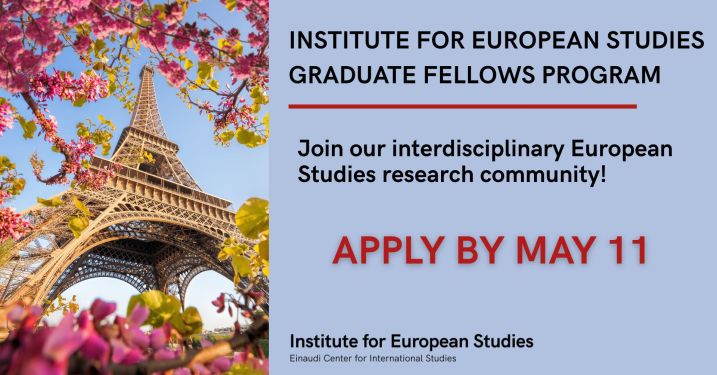
The IES Fellows will advance their research and contribute to the European Studies community by attending and engaging in IES-hosted talks, and by organizing and taking part in collective activities such as a graduate research workshop or discussion group.