
Institute for European Studies
Sanctioning Russia Is a Form of War. We Need to Treat it Like One.

Nicholas Mulder, IES
Nicholas Mulder, assistant professor of history, discusses sanctions on Russia on the Ezra Klein Show.
Additional Information
The Biden Official Who Pierced Putin’s “Sanction-Proof” Economy

Nicholas Mulder, IES
Nicholas Mulder, assistant professor of history, characterizes the sanctions of Russia.
Additional Information
The Ukrainian Time Machine
March 29, 2022
7:30 pm
Willard Straight Theatre
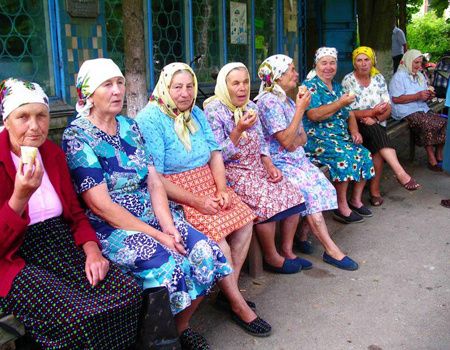
2008 > Ukraine > Directed by Naomi Uman In 2006, filmmaker Naomi Uman retraced her great grandparents’ emigration from Eastern Europe in reverse, settling in the tiny village of Legedzine, Ukraine (about 350 miles south of Kyiv), where she lived for four years. The result of her adventures was “a quietly picaresque quintet of 16mm films, The Ukrainian TimeMachine. In capturing the joys and hardships of her neighbors’ centuries-old way of life…Uman created a new kind of living history, fresh with curiosity and verve.” (School of the Art Institute of Chicago) Tonight we’ll show three of the films. Unnamed Film (55 mins) is a beautiful documentary about life in Legedzine, cataloging its inhabitants’ various strategies of labor and resourcefulness, their heartiness and warmth. It will be bookended by Kalendar (12 mins), a poetic collection of shots, one for each month of an entire year; and Coda, a black-and-white epilogue encapsulating the themes of the series as a whole. At a time when we are witnessing the senseless destruction of Ukraine and its people on a daily basis, we offer a glimpse of what life was like not so long ago, and a window into the soul of a nation that is fighting for its very existence. In Ukrainian. Paraphrased subtitles in English. Cosponsored with the Institute for European Studies.More at https://creative-capital.org/projects/the-ukrainian-time-machine/ 1 hr 11 min
Additional Information
Program
Einaudi Center for International Studies
Institute for European Studies
How the U.S. and EU Cut Russia Off from the Global Economy

Nicholas Mulder, IES
“The risk now is that these sanctions have a grave impact on the world economy because of their size and the role of the Russian economy in global markets,” says Nicholas Mulder, assistant professor of history. “It is going to be a pretty serious drag on global growth and could lead to recession.”
Additional Information
Dmitry Bykov in Conversation
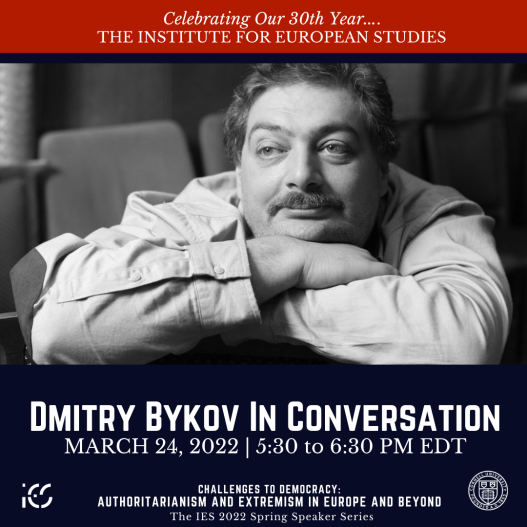
Dmitry Bykov is one of Russia’s leading public intellectuals, and a Visiting Scholar at the Institute for European Studies. Meet with Dmitry for an hour of public conversation with Mabel Berezin, Director of the Institute for European Studies. Prof. Berezin will ask him about the role of dissent in intellectual life in Russia, what drove him to becoming a poet and satirist, and his views on the current situation in Ukraine and Russia.
Additional Information
Imagining Peace in Ukraine
Nicholas Mulder, IES
This article references the work of Nicholas Mulder, assistant professor of history, who finds that in the 20th century, sanctions achieved at least part of their aim about a third of the time.
Additional Information
First, We Did Too Little to Oppose Russia. Now Do We Risk Going Too Far the Other Way?
Nicholas Mulder, IES
“How in no time the west has gone from targeted sanctions to financial war against the post-Soviet economic space, without unified aims nor clear conditions for lifting restrictions, all while an impetuous nuclear-armed tyrant is waging a war of aggression, is quite terrifying,” tweeted Nicholas Mulder, assistant professor of history. This piece also references Mulder’s book, “The Economic Weapon”.
Additional Information
Dmitry Bykov in Conversation
March 24, 2022
5:30 pm
Uris Hall, G08
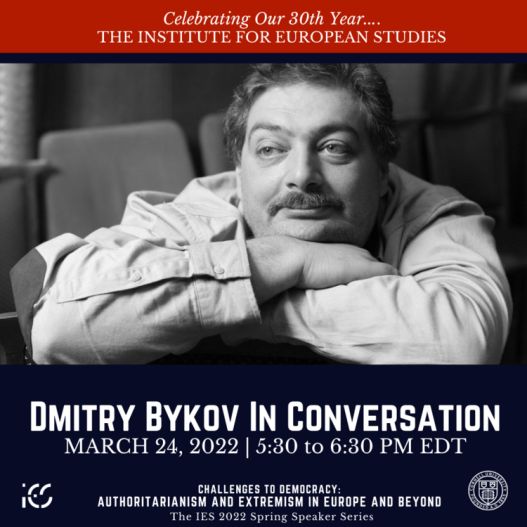
Dmitry Bykov is one of Russia’s leading public intellectuals, and a Visiting Scholar hosted by Cornell’s Institute for European Studies, under the auspices of the Open Society University Network. Meet with Dmitry for an hour of public conversation with Mabel Berezin, Director of the Institute for European Studies. Prof Berezin will ask him about the role of dissent and intellectual life in Russia, what drove him to becoming a poet and satirist, and his views on the current situation in Ukraine and Russia.
Speaker bios:
Russian dissident Dmitry Bykov is an Open Society University Network fellow and visiting critic based in the Einaudi Center’s Institute for European Studies (IES). One of Russia’s best-known public intellectuals, he is a novelist, poet, critic, satirist, and university professor. Bykov has authored more than 80 books, including novels, poetry, biographies, and literary criticism. He is a three-time winner of the Bolshaya Kniga (Big Book) award, one of Russia’s most prestigious literary prizes. A popular lecturer and public speaker, he has also served as the host of numerous television and radio programs.
Mabel Berezin is Professor of Sociology at Cornell University and the Director of the Institute for European Studies. Her expertise lies in the area of extreme and exclusionary forms of nationalism, such as fascism and right-wing populist politics, and the threats that these phenomena pose to democratic political culture and governance. Berezin has written books on Italian fascism; on territorial politics in Europe; and on contemporary French and Italian right-wing politics, including Making the Fascist Self: The Political Culture of Interwar Italy, which was awarded the J. David Greenstone Prize by the American Political Science Association. In addition, Prof. Berezin has also published numerous articles and review essays, and has edited collaborative volumes on democratic culture, emotions and the economy, qualitative methods, and health and culture.
This event is a hybrid event. Those who are not from the Cornell community can attend via Zoom. Register here.
Additional Information
Program
Einaudi Center for International Studies
Institute for European Studies
Faculty and Students on the War in Ukraine

Experts, Experiences, and Discussion
Faculty experts and Ukrainian students will speak about the Russian invasion of Ukraine at an event on March 17 at 4:30 p.m.
Additional Information
Faculty and Students on the War in Ukraine
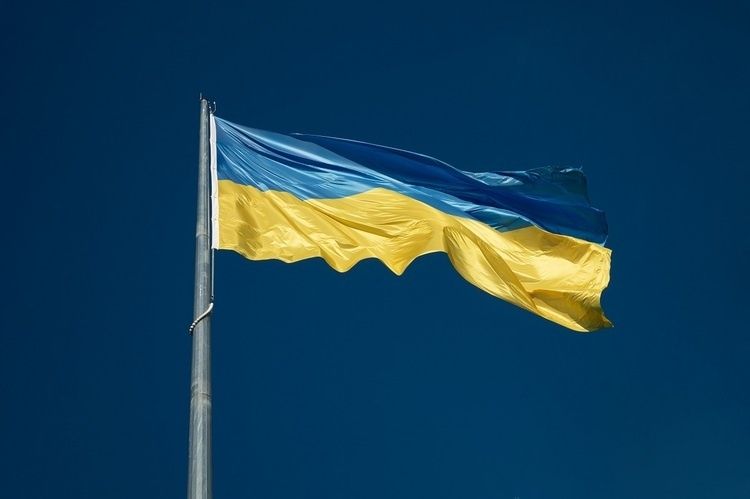
March 17, 2022
4:30 pm
Experts, Experiences, and Discussion
Hosted by Global Cornell, this virtual forum gives Cornell faculty, staff, and students a time to come together, learn more about the unprovoked invasion—and stand with the Ukrainian people.
Join scholars based in Ukraine, and Cornell faculty and students, as they speak about how the Russian invasion of Ukraine threatens lives, the post–Cold War international order, and the stability of the global economy. Following a panel discussion, participants will connect in breakout rooms, share experiences, and receive further resources.
Faculty in Ukraine
Tymofii Brik (Professor and wartime Acting Vice President of International Affairs, Kyiv School of Economics)Yuliya Bidenko (Associate Professor, Political Science, Karazin Kharkiv University)Natalia Kudriavtseva (Professor, Translation and Slavic Studies, Kryvyi Rih State University)Cornell Faculty
Matthew Evangelista (Professor, Department of Government/A&S)Cristina Florea (Assistant Professor, Department of History/A&S)Steve Israel (Director, Institute of Politics and Global Affairs/BPP; Professor of Practice, Department of Government/A&S)Stephen Yale-Loehr (Migrations faculty fellow; Professor of Immigration Law Practice/Cornell Law)Eswar Prasad (Tolani Senior Professor of Trade Policy, Dyson/JCB/CALS)Bryn Rosenfeld (Assistant Professor, Department of Government/A&S)Cornell Community Members
Ivan Kosyuk (Operations Research and Information Engineering, MEng ’22)Olaf de Rohan Willner (Computer Science and Government/A&S ’24)Olga Zimina (Postdoctoral Associate, School of Integrative Plant Science/CALS)This event is open to the Cornell community only and intended as a protected space for learning and discussion. NetID authentication is required to register and attend. Please register with your Cornell NetID email address (not an alias email address).
Additional Information
Program
Einaudi Center for International Studies
Reppy Institute for Peace and Conflict Studies
Institute for European Studies