Latin American and Caribbean Studies
Apply for RAD Languages, FLAS

Fellowships Support Students Learning Uncommon Languages
PhD students Frances Cayton and Jarvis Fisher received Einaudi fellowships to study “rare and distinctive” modern languages. Apply now!
Additional Information
Apply by Jan. 10: Undergraduate Global Scholars

Speak Up for Global Free Speech
Make your voice heard as a student leader in Cornell's freedom of expression theme year. We welcome applications from writers, scholars, activists and artists, poets and podcasters, hands-on practitioners, and more.
Additional Information
Francis Akutey-Baffoe: Teaching Twi as a Second Language Using Progressive Learning

November 9, 2023
5:00 pm
Stimson Hall, G25
"An Approach To Teaching Twi As A Second Language Using Progressive Learning"
Francis Akutey-Baffoe
African Language Program Preceptor, Harvard University
People are becoming increasingly dependent on languages other than their native tongues because of globalization. Because of this, the need for learning second languages has significantly increased over the past few decades as research has established that it broadens the mind (Archibald, 2004). In recent times, the teaching of African languages as second language in tertiary institutions in the United States has taken a significant boost, and one of such languages is Twi, a richly cultural Akan dialect. In this talk, a progressive learning approach will be explored for teaching Twi as a second language. However, teaching Twi as a second language, when learners come from different backgrounds and cultures, pedagogy becomes more challenging. A major focus of this talk will be progressive learning, which encompasses several key strategies, such as understanding learners' needs, establishing a solid foundation, encouraging communication, and the integration of technology. With the strategies outlined, it is more important to determine how they can be implemented practically and effectively. This talk examines a typical syllabus as an example for teaching Twi as a second language through a progressive learning approach.
Bio: Francis Akutey-Baffoe is from Kumasi in Ghana. He is a Preceptor of African Languages in the Department of African and African American Studies at Harvard University. He holds a bachelor’s degree in Twi and Sociology and a master’s degree in Ghanaian Languages (Twi) from the University of Cape Coast. He was a Teaching Assistant and later a Demonstrator in the Department of Ghanaian Languages and Linguistics at the University of Cape Coast between 2012 and 2018. He has also been a language instructor for non-Twi-speaking foreigners at the University of Cape Coast-Ghana. During the 2017/2018 academic year, Francis taught as a part-time lecturer for the University of Cape Coast’s Institute of Education Sandwich program. He was also an assistant examiner for the Institute of Education, University of Cape Coast, between 2016 and 2018. Mr. Akutey-Baffoe has an interest in Akan literature, Akan cultural studies, Akan language and linguistics, and translations from English to Twi and Twi to English. He has worked with the Bible Society of Ghana as a reviewer and a translator. He has also transcribed and translated many research data from Twi to English.
This event will be held in person in G25 Stimson Hall.
The event is free and open to the public. Campus visitors and members of the public must adhere to Cornell's public health requirements for events.
Co-sponsored by the Language Resource Center.
Additional Information
Program
Einaudi Center for International Studies
Latin American and Caribbean Studies
Institute for African Development
Boren Awards Info Session

November 13, 2023
4:45 pm
276 Caldwell Hall
Learn about the prestigious Boren Scholarships that fund study abroad outside Western Europe, Canada, Australia, or New Zealand. Boren Awards focus on developing linguistic and cultural knowledge among aspiring federal government employees. Boren Awards are funded by the federal government and are open to U.S. citizens who are currently matriculated students. Maximum undergraduate awards are determined by duration of study: up to $25,000 for 25-22 weeks and up to $8,000 for 8-11 weeks (STEM majors only).
Additional Information
Program
Einaudi Center for International Studies
East Asia Program
Southeast Asia Program
Latin American and Caribbean Studies
Institute for African Development
Institute for European Studies
South Asia Program
Support for Times of Crisis

Campus Resources for Cornell's Global Community
On this new page, Global Cornell gathers campus services to help students, faculty, and staff cope with international conflict and turbulent times.
Additional Information
Laidlaw Scholars Symposium

November 8, 2023
5:00 pm
Klarman Hall Auditorium & Atrium
Laidlaw Scholars at Cornell will share their summer research and leadership-in-action experiences at this annual symposium.
Beginning in the Klarman Hall Auditorium, a panel of scholars will share their work and experiences. The presentation will be followed by poster presentations throughout the Groos Family Atrium.
The Laidlaw Undergraduate Leadership and Research Scholarship Program provides generous funding to first- and second-year undergraduates over two years as they pursue internationally focused research, engage in leadership training and a leadership-in-action experience, and join a global network of like-minded peers.
Learn more about the program, which is administered by the Mario Einaudi Center for International Studies with leadership training support from the David M. Einhorn Center for Community Engagement.
Additional Information
Program
Einaudi Center for International Studies
Reppy Institute for Peace and Conflict Studies
East Asia Program
Southeast Asia Program
Latin American and Caribbean Studies
Institute for African Development
Institute for European Studies
South Asia Program
Berger International Speaker Series with Muzaffar Chishti – The Migrant Surge: What’s Different About It This Time?
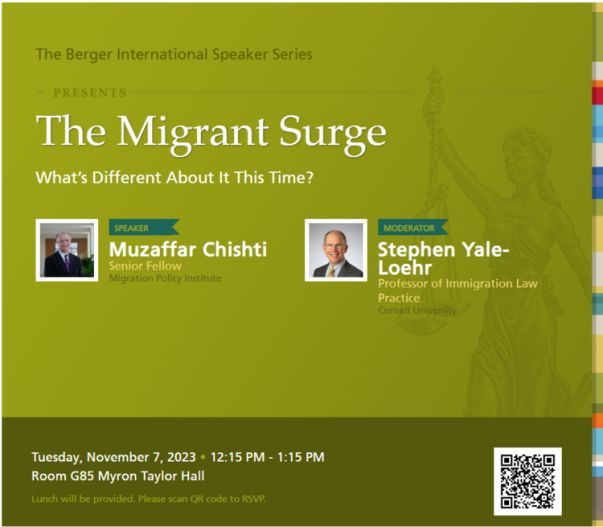
November 7, 2023
12:15 pm
Cornell Law School, MTH G85
A conversation between Muzaffar Chishti, senior fellow at the Migration Policy Institute, and Stephen Yale-Loehr, Professor of Immigration Law Practice, Cornell Law School.
Join Mr. Chishti and Professor Yale-Loehr as they discuss the history of migration to the United States, the current migrant surge at the border, the impact on cities and states beyond the border, and possible impacts on federal immigration policy.
Additional Information
Program
Latin American and Caribbean Studies
South Asia Program
Jean Bernard Cerin

Assistant Professor, Music
Jean Bernard Cerin is a multifaceted artist and scholar who produces and performs in projects ranging from film, recital, oratorio, opera, and folk music. Praised for his “burnished tone and focused phrasing” (Chestnut Hill Local). Cerin performs extensively as a baritone with leading early music ensembles across the United States. He founded the Lisette Project in 2021, a research and performance platform focusing on early Haitian classical music, beginning with the oldest song in Haitian Creole, Lisette quitté la plaine.
Additional Information
La Ilusión Viaja en Tranvía

November 9, 2023
5:00 pm
Uris Hall, G08, Uris Hall, G08
LACS Film Series
La ilusión viaja en tranvía (1954) is a wry social comedy from renowned filmmaker Luis Buñuel's Mexican period. Heartbroken that their favorite streetcar has been decommissioned, two Mexico City transit workers get drunk and take the streetcar out for a final—eventful—joyride. The film reveals a less well known side of Buñuel's work. Often thought of as a touchstone of surrealist and avant-garde filmmaking who floundered in commercial movie systems, Buñuel shows his deft and mischievous mastery of the tropes and conventions of Mexican popular cinema.
Director's Bio:
Born in 1900 in Calanda, Spain, Luis Buñuel is widely regarded as one of the most important filmmakers of the 20th century. Together with Salvador Dalí, he is credited with having pioneered surrealist filmmaking. From 1946-1953, Buñuel worked primarily on commercial films in Mexico. He died in Mexico City in 1983, having become a Mexican citizen in 1949.
Additional Information
Program
Einaudi Center for International Studies
Latin American and Caribbean Studies
An Orphan, Three Terrorists, and the Origin of Patrimonial Khipus,

November 4, 2023
4:30 pm
Klarman Hall, Rhodes-Rawlings Auditorium
Note: Register for the lecture/conference at the following link by October 22: https://forms.gle/hEZsdEDGomtZgqo47
The lower Lurín Valley of central coastal Peru is the area most abundant in archaeological khipus. The montane upper Lurín is the area most abundant in patrimonial khipus. What could this mean? The Quechua-language mythohistory of the Lurín Valley written c.1608 limelights high-Andean herders as protagonist yauyos. Fighting down the Lurín Valley they master lower- and mid-valley yunca settlements, even to the outliers of Pachacámac, where their Inka allies would build religious hegemony. Yet the Huarochirí Manuscript is really more a yunca-oriented work than a yauyo-centric one; yuncas get 38 mentions, Inkas 33, and Yauyos 11. Now that the archaeology of the Lurín and nearby rivers has become profuse, we wonder who ‘conquered’ (atiy) whom. Was khipu use imposed on late prehispanic Yauyos by the Incas of Pachacámac? I will argue instead for a more complex, earlier history involving the coastal culture known as Ychsma. Ychsma also created khipus – “anomalous” khipus, whose peculiarities give clues about ethnographic khipus’ puzzling non-Inka attributes.
Frank Salomon, ethnographer and ethnohistorian of the Andes, is the author of At the Mountains’ Altar: Anthropology of Religion in an Andean Community (2017) as well as other books including The Huarochiri Manuscript, a Testament of Ancient and Colonial Andean Religion (1991), the Cambridge History of the Native Peoples of the Americas – South America (1999), The Cord Keepers (2004), and a forthcoming book on the Quechua-language songs of Rapaz village. A past president of the American Society for Ethnohistory, he has held NSF, Guggenheim, SAR, and NSF fellowships. He received the 2018 Lifetime Achievement Award of the American Society for Ethnohistory.
Frank Salomon is the John V. Murra Professor Emeritus of Anthropology, University of Wisconsin-Madison.
Additional Information
Program
Einaudi Center for International Studies
Latin American and Caribbean Studies