
Latin American and Caribbean Studies
Lingua Mater Alumni Competition Deadline
November 8, 2021
5:00 pm
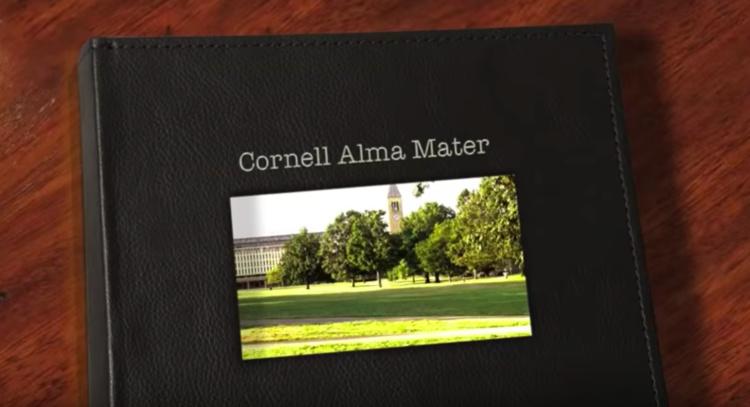
The Lingua Mater competition invites alumni to translate Cornell's Alma Mater into a different language and submit a video of the performed translation. The inaugural Lingua Mater alumni competition took place in 2018 as part of Cornell's Global Grand Challenges Symposium. Winners included the Cornell Club of Thailand 2018 and the Cornell Club of Gaeta, Italy in 2019, and won financial support of a local alumni event.
2021 competition details
Can you translate Cornell’s Alma Mater into your mother tongue (or a language you learned at Cornell) and sing it? We invite you to translate “Far Above Cayuga’s Waters” and submit a video of you (and your friends!) performing it, wherever you may be!
Translations do not need to be exact or perfectly in meter but should capture the feel and tune of our university’s Alma Mater. As is customary, include the first verse, refrain, second verse, and refrain in your video submission (for guidance, listen to a performance and read the lyrics).
Video submissions need to be MP4 files at 1920 x 1080 (1080p), in landscape mode with an aspect ratio of 16:9. Please ensure that you have copyright permission for any images/videos you use.
Entries will be reviewed by a panel of judges. Submissions will be judged equally on the translation, the musical quality, and the creativity in visual presentation.
The top entry will receive financial support and Cornell swag for a local alumni event.
Winners will be announced during International Education Week (November 15-19, 2021) via Noteworthy, and the top video will be posted online that week. Be sure to subscribe to our weekly newsletter to stay in the know of this competition and international alumni activities.
Entries may be submitted by any Cornell alumni groups outside of the United States and Canada.
Submission deadline: Monday, November 8, 2021 at 5 pm ET
SUBMIT YOUR VIDEO AND LYRICS HERE
Please contact the International Alumni Relations team if you have any questions.
The Lingua Mater competition is co-sponsored by the Office of International Alumni Relations, the Language Resource Center, and the Office of the Vice Provost for International Affairs.
Additional Information
Program
Einaudi Center for International Studies
East Asia Program
Southeast Asia Program
Latin American and Caribbean Studies
South Asia Program
ICM Global South Translation Symposium: Theory and Practice

December 4, 2021
11:00 am
The Institute for Comparative Modernities' first Global South Translation Symposium, featuring presentations by our inaugural cohort of translators (see below), remarks by translation theorist Naoki Sakai and commentary by Brett DeBary and Jan Steyn. Registation is required for this online event. Registration link:
https://cornell.zoom.us/webinar/register/WN_YiMmRJfJQPOUmiR4hK561g
With presentations from the following ICM Global South Translation fellowship recipients:
Wendy Call, on the poetry collection Stolen Flower (Guie’ ni zinebe / La flor que se llevó), from the Isthmus Zapotec and Spanish, by Irma Pineda
Guie’ ni zinebe / La flor que se llevó (Stolen Flower) is a collection of 45 poems by Irma Pineda, originally published in 2013 in a bilingual Isthmus Zapote/Spanish edition. Selected poems have been published in three languages in The Chicago Review. The collection explores gender-based violence against Indigenous communities, through multiple poetic voices. The author, Irma Pineda, is a spokesperson for the rights and autonomy of Indigenous Peoples, as well as for the families of disappeared persons.
Chamini Kulathunga, on selected poetry from Next Sweet Wines (Mīḷaṅga Mīvita), from the Sinhala, by Ruwan Bandujeewa
The work of contemporary Sri Lankan poet Ruwan Bandujeewa is highly acclaimed, particularly as writing that addresses class inequity, and describes the harsh realities groups living on the economic margins of an exploitative capitalist system. His popularity in Sri Lanka uniquely cuts across class boundaries. The poems in this collection comprise a selection of his most celebrated writing, as well as unpublished work.
David McKay, on the text We Slaves of Suriname (Wij slaven van Suriname), from the Dutch, by Anton de Kom
Wij slaven van Suriname (We Slaves of Suriname), is a classic anti-colonial work first published in 1934, but never published in English until David McKay’s translation. The author, Anton de Kom, was an Afro-Surinamese writer and left-wing political organizer who later lost his life resisting the German occupation of the Netherlands in World War II. De Kom’s historiographical book has been compared to the work of American authors such as W.E.B. Du Bois and to the anti-colonial writings of Frantz Fanon. In the Caribbean context, historians have likened We Slaves of Suriname to groundbreaking studies such as Capitalism and Slavery by Eric Williams and The Black Jacobins by C.L.R. James.
Quyen Nguyen-Hoang, on the prose poem collection Midseason Moonplay (Chơi Giữa Mùa Trăng), from the Vietnamese, by Hàn Mặc Tử
Hàn Mặc Tử is a symbolist inspired major modern Vietnamese poet as yet untranslated into English. Midseason Moonplay, published posthumously in Vietnam in 1941 is a wildly experimental and virtuosic series of prose-poems that expands the canon of Vietnamese literature. Quyen Nguyen-Hoang writes that his work “stands apart from the stereotypical body of poetry that encloses Vietnam as a country attached to the US-Vietnam war legacies or a nation under the yoke of colonization and oppressive regimes.”
Jennifer Shyue, on the short novel The Illumination of Katzuo Nakamatsu (La iluminación de Katzuo Nakamatsu), from the Spanish, by Augusto Higa Oshiro
Augusto Hiro Oshiro is a contemporary Peruvian writer born to immigrants from Okinawa. His short novels are considered vital and mesmerizing, some of the best contemporary writing in Spanish. This 2008 short novel La iluminación de Katzuo Nakamatsu invokes the complexities of Japanese-Peruvian histories, and exemplifies the writer at the height of his powers.
Remarks by Naoki Sakai, Distinguished Professor of Asian Studies Emeritus, Cornell University and commentary by Brett de Bary, Professor Emeritus, Departments of Asian Studies and Comparative Literature; and Jan Steyn, Lecturer in Literary Translation at the University of Iowa. Moderated by Natalie Melas, ICM Resident Director and Associate Professor, Department of Comparative Literature, Cornell University.
Additional Information
Program
Latin American and Caribbean Studies
South Asia Program
Southeast Asia Program
Visiting Critic Pedro X. Molina

Nicaraguan Cartoonist Finds Refuge at Einaudi
The award-winning political cartoonist joined LACS this fall as a visiting critic and IIE-Artist Protection Fund fellow.
Additional Information
Pedro X. Molina

Visiting Critic
Additional Information
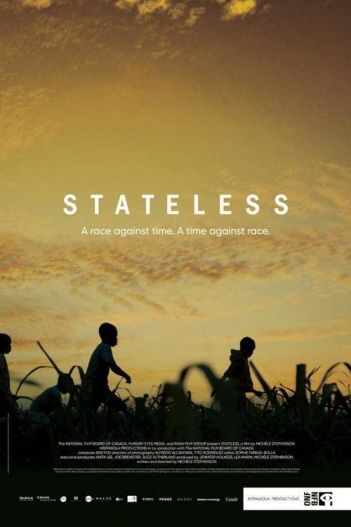
"STATELESS: A race against time. A time against race” LACS FILM SERIES with Zoom Q&A with Director Michele Stephenson
October 21, 2021
6:00 pm
Kaufmann Auditorium , G64 Goldwin Smith Hall
LACS FILM SERIES with Zoom Q&A with Director Michele Stephenson
Kaufmann Auditorium (G64 Goldwin Smith Hall) 6 PM
Stateless looks at the complex politics of immigration and race in the Dominican Republic and Haiti, using a combination of magical realism and hidden camera techniques.
Additional Information
Program
Einaudi Center for International Studies
Latin American and Caribbean Studies
Humor vs. Power: Cartooning in Latin America and the Caribbean
October 28, 2021
5:00 pm
G01 , Stimson Hall
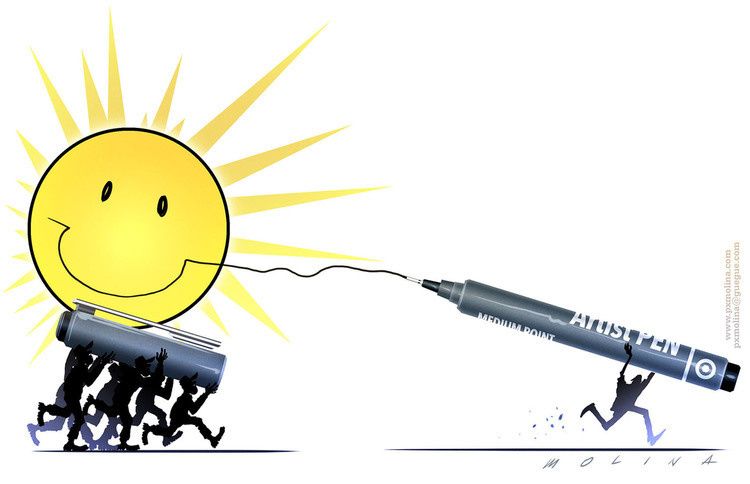
Hear from four Latin American and Caribbean political cartoonists on the challenges of their craft and creativity across the region. The session will be moderated by Nicaraguan political cartoonist Pedro X. Molina, IIE Artist Protection Fund Fellow and Visiting Critic at the Einaudi Center's Latin American and Caribbean Studies Program (LACS). A hybrid event.
Panelists
Angel Boligan (Boligán – Cartooning for Peace), Cuba/Mexico
Rayma Suprani (RAYMA – Cartooning for Peace), Venezuela
Xavier Bonilla (BONIL – Cartooning for Peace), Ecuador
Moderator
Pedro X Molina (PxMolinA), Nicaragua/USA, winner of the 2021 Gabo Award for Excellence
Join us in person in G-01 Stimson Hall (to the right of Day Hall) at 5:00 pm. Portions will be in Spanish with simultaneous translation available on Zoom.
Join us online by registering at: https://cornell.zoom.us/webinar/register/WN_F90ezDImTkiMkxFJ7jhA8w
Additional Information
Program
Einaudi Center for International Studies
Latin American and Caribbean Studies
Info Session: Africa Summer Internships and Summer '21 Presentations
October 22, 2021
4:00 pm
Uris Hall, G-08
Join us for an informative information session on Africa summer internships on October 22, 2021 from 4:00-6:00 p.m. in G-08 Uris Hall. Summer 2021 interns will also be presenting on their summer research projects, so it will be a great opportunity to learn about what our Africa summer internships entail!
Register here: https://cornell.zoom.us/meeting/register/tJEtd-6opj8pGtWmcjCUTsXHcne-3p…
Additional Information
Program
Einaudi Center for International Studies
Latin American and Caribbean Studies
Institute for African Development
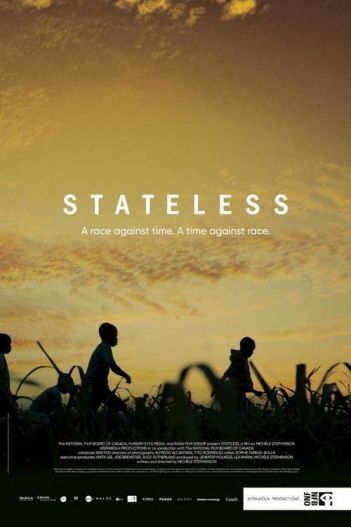
STATELESS
October 21, 2021
6:00 pm
Kaufmann Auditorium, Goldwin Smith Hall, G64
The new film from the critically acclaimed filmmaker of American Promise, looks at the complex politics of immigration and race in the Dominican Republic and Haiti, using a combination of magical realism and hidden camera techniques. Director Michèle Stephenson will do a Q&A session via Zoom with the audience.
Co-sponsored by the Migrations Initiative, Department of Anthropology, and Department of History
Additional Information
Program
Einaudi Center for International Studies
Latin American and Caribbean Studies
"Struggles over Land and Power in the Newest Sugarcane Region of Brazil: A case study with global implications," by Fernanda Ayala, LACS Weekly Seminar Series

October 18, 2021
1:00 pm
G-01 Stimson Hall
Please register through the following link:
https://cornell.zoom.us/webinar/register/WN_5jrGp_7CRniDXYgvKp_s7g
Sugarcane was one of the first crops introduced into Brazil by the Portuguese, and it has dominated the country’s political and economic formation since. In recent years, the highly modern, input-intensive ethanol industry has taken hold in a new region of Brazil, the former soybean fields of Mato Grosso do Sul. In this talk, Fernanda will outline her research into conflicts in this new sugarcane region between large-scale, highly-capitalized agro-industrialists and indigenous peoples who claim historic rights to the land in Mato Grosso do Sul. Through a case study of the Raízen-Caarapó ethanol plant, she will examine changing land use patterns, livelihoods and norms as expressed through claims to the land.
Fernanda Santa Roza Ayala Martins is a PhD student in the Social Sciences Graduate Program on Development, Agriculture and Society (CPDA) in the Federal Rural University of Rio de Janeiro (UFRRJ). She is a visiting PhD student with Global Development in CALS with a scholarship from the Brazilian Federal Foundation for Support and Evaluation of Graduate Education (CAPES).
Additional Information
Program
Einaudi Center for International Studies
Latin American and Caribbean Studies
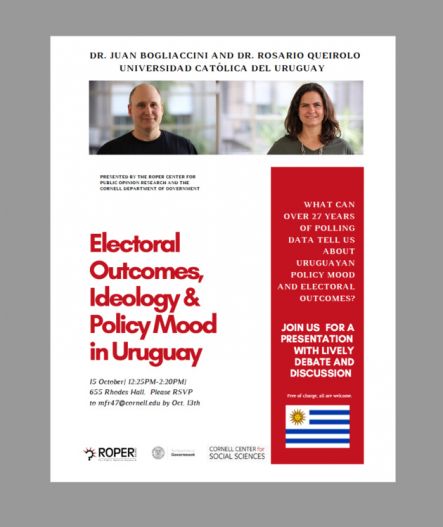
Electoral Outcomes, Ideology & Policy Mood in Uruguay
October 15, 2021
12:25 pm
Rhodes Hall 655, 655
Abstract
The dynamics of aggregate public opinion|particularly Stimson's (1991) measure of policy mood|have been long used to explain electoral outcomes and government responsiveness in the United States. However, we still know little about policy mood outside the US and a few Western European countries. Understanding the relationship between policy and electoral preferences outside the pool of advanced democracies is crucial as voters outside that particular context are often depicted as outcome-oriented. This paper extends the study of opinion dynamics by estimating Uruguayans' policy mood between 1993 and 2019, using 79 different questions administrated 297 times. In doing so, we first show that Uruguay's policy mood is largely thermostatic, responding to changes in government, suggesting that movements in aggregate policy preferences are relevant in an other-wise outcome-oriented region as Latin America. Second, we provide strong evidence in favor of the distinctiveness of operational and symbolic preferences in a new and previously unexplored context. Overall, the article contributes to the scarce literature on aggregated public opinion measures of policy preferences, ideology and political preferences in Latin America and shows the relevance to measure preferences in public opinion studies.
Additional Information
Program
Latin American and Caribbean Studies