
Latin American and Caribbean Studies
Watch: The Protests and U.S. Democracy (Democracy 20/20)

Protests against police violence and racial inequality have spread across the United States, attracting large crowds not only in major cities, but also in smaller cities and towns. Three experts on U.S. politics analyze the protests and their implications for U.S. democracy, moderated by LASP director Ken Roberts.
Additional Information
Language Resource Center Speaker Series - Christopher Hromalik

November 5, 2020
3:30 pm
"Inclusive by Design: Universal Design for Learning and the World Language Classroom"
Christopher Hromalik
Professor of Spanish and Coordinator of Spanish and French, Onondaga Community College
Universal Design for Learning (UDL) is a research-based framework for designing instruction to be more accessible to all learners. By following the principles and guidelines of the UDL framework, instructors can design a more inclusive learning environment that will provide an improved experience for all students.
This talk will provide both a theoretical introduction to the UDL framework and practical suggestions for applying it to the language classroom. First, a brief introduction to UDL and information on learner variability (i.e., the diversity in how everyone learns) will be provided. Next, results of research that has investigated the effects of an annual UDL training for faculty, staff, and administrators will be briefly shared. Finally, the main focus of the presentation will be on specific strategies that faculty can employ as they seek to universally design their language instruction. Given the current global health crisis and the importance of including all learners when teaching a language at a distance, specific strategies for synchronous and asynchronous online language instruction will be provided.
Bio: Dr. Hromalik is Professor of Spanish and Coordinator of Spanish and French in the World Languages Department at Onondaga Community College. He is also the Chair of the ACTFL Distance Learning Special Interest Group. His main area of research is the role of self-regulated learning in second language acquisition, with a focus on community college students studying a language online. From 2016-2019, he was the Faculty Coordinator of the Universal Design for Learning (UDL) Academy, which was funded as part of the Onondaga Pathways to Careers (OPC) project through a grant from the U.S. Department of Labor’s Office of Disability Employment Policy. In this role, he served as the lead instructional designer and principal investigator studying the impact of UDL training on community college faculty, staff, and students. Since 2011, he has given presentations and conducted trainings for faculty, staff, and administrators on how to create accessible digital instructional materials and how to apply the Universal Design for Learning framework. He has also been a presenter for workshops on the design and development of online language instruction since 2015.
Join us live on Zoom.
Additional Information
Program
Einaudi Center for International Studies
Latin American and Caribbean Studies
Southeast Asia Program
South Asia Program
Language Resource Center Speaker Series - Kate Paesani

October 7, 2020
4:30 pm
"Multiliteracies Pedagogy and Teacher Professional Development: From Research to Practice"
Kate Paesani
Director of the Center for Advanced Research on Language Acquisition (CARLA), University of Minnesota
Recent scholarship foregrounds multiliteracies pedagogy as a viable approach for developing students' language literacies, yet few resources exist to assist teachers in implementing this approach. Following a brief overview of multiliteracies pedagogy, I summarize research findings related to teachers' understandings and applications of multiliteracies pedagogy in postsecondary language programs. This research base then serves as a point of departure for identifying teachers' professional development needs. Based on these needs, I present two tools for teachers that were developed for CARLA's Foreign Language Literacies project: an infographic featuring multiliteracies and other meaning-based approaches and a lesson analysis checklist. Both tools bring together research and practice by helping teachers explain multiliteracies concepts, distinguish multiliteracies from other approaches, and scaffold multiliteracies lesson plans.
Bio: Kate Paesani (Ph.D., Indiana University) is Director of the Center for Advanced Research on Language Acquisition (CARLA) and affiliate Associate Professor in the College of Liberal Arts at the University of Minnesota. Her research focuses on literacy-based curriculum and instruction and world language teacher development, couched within the frameworks of multiliteracies pedagogy and sociocultural theory. Her work has appeared in journals such as Annual Review of Applied Linguistics, Foreign Language Annals, L2 Journal, Language, Culture, and Curriculum, Language Teaching Research, and Reading in a Foreign Language. She is co-author of the book A Multiliteracies Framework for Collegiate Foreign Language Teaching (Pearson, 2016), and is co-editor of Second Language Research & Practice (slrpjournal.org), the open-access journal of the American Association of University Supervisors and Coordinators (AAUSC).
Join us live on Zoom.
Additional Information
Program
Einaudi Center for International Studies
Latin American and Caribbean Studies
Southeast Asia Program
South Asia Program
Big Red Data: Crunching Numbers to Fight COVID-19

Alex Flecker, professor of ecology and evolutionary biology in the College of Agriculture and Life Sciences, is working with Carla Gomes to understand how and where hydroelectric dams could be placed in the Amazon River basin to deliver the highest possible benefits with the least environmental downsides.
Additional Information
Op-Ed: Trump’s Hardball Tactics Could Implode Mexico’s Immigration System
Gustavo Flores-Macias, associate vice provost of international affairs, writes in the LA Times about Mexico and immigration.
Additional Information
Introducing Democracy 20/20

Webinar on Protests Launches Virtual Event Series
The American Democracy Collaborative series continues through November, examining election-year politics and threats to U.S. democracy.
Additional Information
LRC Summer Happy Hour

August 11, 2020
12:00 pm
Join us on Zoom throughout the summer for LRC Summer Happy Hour. We'd love to hear how it’s going! All of it.
Bring your (language instruction) stories whether they be good, bad, amazing, or unusual. It takes all kinds of stories to make a Happy Hour great!Bring your own coffee, tea, or mystery beverage.While we can't serve lunch, the LRC will provide fun, jokes, and laughs free of charge.Also, we just want to see your smiling faces, because we miss you.
More details and link posted on our website: https://lrc.cornell.edu/online-hybrid#live-help-sessions
Additional Information
Program
Einaudi Center for International Studies
Southeast Asia Program
Latin American and Caribbean Studies
South Asia Program
Democracy 20/20: The Protests and U.S. Democracy

June 26, 2020
1:00 pm
Protests against police violence and racial inequality have spread across the United States in recent weeks, attracting large crowds not only in major cities, but also in smaller cities and towns. The demonstrations place racial justice and civil rights at the center of political debate heading into the November 2020 elections. In this session of our webinar series, three experts on U.S. politics will analyze the protests and their implications for U.S. democracy.
Moderator:
Kenneth Roberts, Government, Cornell University. He teaches comparative and Latin American politics, with an emphasis on political parties, populism, and labor and social movements.
Panelists:
Megan Ming Francis, Political Science, University of Washington. She specializes in the study of American politics, including criminal punishment, black political activism, philanthropy, and the post-Civil War South.
Daniel Gillion, Platt Presidential Distinguished Professor, University of Pennsylvania. His research focuses on racial and ethnic politics, political behavior, political institutions, public policy, and the American presidency.
Lara Putnam, History, University of Pittsburgh. She researches U.S. social movements and political participation in local, national, and transnational dimensions.
REGISTER NOW
Democracy 20/20
A webinar series sponsored by the American Democracy Collaborative, Mario Einaudi Center for International Studies, and the Institute of Politics and Global Affairs
Recent global and national events—including the COVID-19 pandemic and mass antiracist protests in the wake of the highly publicized police killings of George Floyd, Breonna Taylor, and Ahmaud Arbery—have deepened what was already a looming crisis for American democracy.
The American Democracy Collaborative is a group of scholars of American political development and comparative politics who have come together to examine the state of democracy in the United States today. We aim to integrate insights from previous crises in American political history with understanding of the conditions that have threatened democracies around the world, to foster discussion and writing around these topics, and to provide analysis and commentary that is useful for fellow scholars, teachers, journalists, and citizens.
The Democracy 20/20 webinar series brings together historical and comparative experts to promote deeper understanding of the challenges these unsettling times pose for American democracy. The series goes beyond the day-to-day rush of events to convene conversations that help us understand the broader context of our times and advance the search for constructive answers to our society’s most urgent questions.
Beginning in June 2020, the series will continue through the 2020 election. It will consider topics such as:
Can the United States Have Free and Fair Elections This Fall?
Already Authoritarian? Policing and the Use of Force
Evaluating the Health of Checks and Balances
Polarization, Political Parties, and the Health of Democracy
Whither the “Deep State”? Administration, Expertise, and Democracy
The stakes for American democracy have never been higher—so please join us for these critical conversations.
Additional Information
Program
Einaudi Center for International Studies
Latin American and Caribbean Studies
Reppy Institute for Peace and Conflict Studies
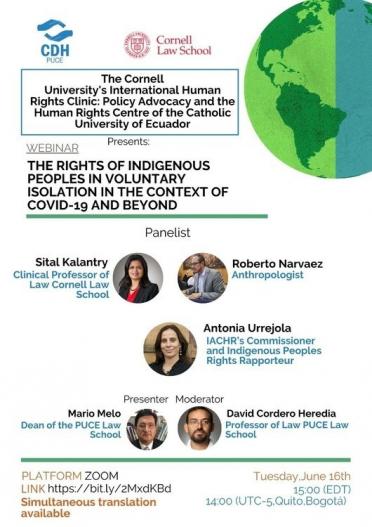
The Rights of Indigenous Peoples in Voluntary Isolation in the Context of COVID-19 and Beyond
June 16, 2020
3:00 pm
The Cornell International Human Rights Clinic (Policy Advocacy) submitted an amicus brief for a case filed in the Inter-American Commission on Human Rights on behalf of a community in Ecuador that has been in voluntary self-isolation (even before COVID-19). How does one represent a community that you cannot communicate with? What does right to health mean for indigenous communities for whom contact could mean death? We will discuss these and other questions in this panel co-sponsored by the Human Rights Centre at the Catholic University of Ecuador. Participants include a lawyer who filed the case, the Special Rapporteur on Indigenous Peoples in the Inter-American Commission, and a human rights professor from Cornell Law School. There will be simultaneous English and Spanish interpretations. For a copy of the amicus brief, click here.
The webinar will be conducted through Zoom: https://bit.ly/2MxdKBd
Additional Information
Program
Latin American and Caribbean Studies
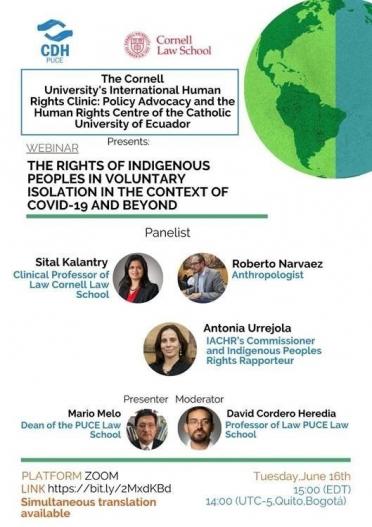
The Rights of Indigenous Peoples in Voluntary Isolation in the Context of Covid-19 and Beyond
June 16, 2020
3:00 pm
The Rights of Indigenous Peoples in Voluntary Isolation in the Context of Covid-19 and Beyond with Cornell Professor Sital Kilantry and Cornell Alum David Cordero Heredia.
Additional Information
Program
Latin American and Caribbean Studies