
South Asia Program
Reaching Women in the Workplace: Improving the Sexual and Reproductive Health and Family Planning Outcomes of Young Women Working in the Ready-Made Garment Sector in South and Southeast Asia

April 27, 2022
12:25 pm
Emerson Hall, 135
Perspectives in Global Development Seminar Speaker: Ashish Bajracharya, deputy director at Population Council Location: Emerson 135 and Zoom. In recent years, the garment industries of countries in South and Southeast Asia, including Bangladesh, Cambodia, and Vietnam have grown to provide economic opportunities to millions and become significant contributors to their economies. The workforce in the garment sector across the region is dominated by women, typically under the age of 30, who have significant unmet need for sexual and reproductive health (SRH) and family planning (FP) information and services. There has recently been a growing recognition of these needs and the vulnerability of women from development actors, governments, donors and industry stakeholders. In this talk, I will share the experience of the Population Council and our work on improving the health and wellbeing of women working in the garment sectors of Cambodia and Bangladesh, with support from the United States Agency for International Development. Between 2013-2019, the Population Council conducted rigorous implementation science research, and engaged with government and industry stakeholders to co-lead the implementation of one of the most comprehensive women’s health focused interventions in the garment sector. Our worked combined policy advocacy, improved service delivery and rigorous research to drive prioritization of women’s health in the garment sectors of these countries. I will discuss lessons learned through the evidence we that we generated and ways forward for this work. About the speaker Dr. Ashish Bajracharya is the Deputy Director for Country Strategy in the International Programs Division at the Population Council, and its Regional Representative for South and East Asia. Dr. Bajracharya is a social demographer and behavioral scientist who specializes in issues related to gender, transitions to adulthood, maternal, sexual and reproductive health, family planning and HIV & AIDS outcomes of vulnerable populations, and rigorous evaluations of health financing and health systems strengthening interventions in low- and middle-income countries. Over the last decade, Dr. Bajracharya has lived and worked in South and East Asia, with bases in Hanoi, Vietnam, Phnom Penh, Cambodia and Dhaka, Bangladesh, where he is currently based, with research engagements in Lao PDR, Myanmar, Nepal, the Philippines, Tanzania, Tajikistan, and Vietnam among others. Between 2015 and 2019 co-led WorkerHealth, a $3.8 million USAID initiative aimed at improving access to reproductive health and family planning services among female garment factory workers in Cambodia. Dr. Bajracharya received his Ph.D. in Policy Analysis and Management from Cornell University in 2008 where he specialized in social demography and human development. He was also a Bixby Postdoctoral Fellow at the Population Council in New York. He is a native of Nepal. About the seminar series The Perspectives in Global Development seminars are held Wednesdays from 12:25 – 1:15 p.m. eastern time during the semester. The series will be presented in a hybrid format with some speakers on campus and others appearing via Zoom. All seminars are shown in Emerson 135. Students, faculty and the general public are welcome to attend. The series is co-sponsored by the Department of Global Development, the Department of Natural Resources and the Environment, the Charles H. Dyson School of Applied Economics and Management, and the School of Integrative Plant Science as part of courses IARD 6960, NTRES 6960, PLSCS 6960 and AEM 6960.
Additional Information
Program
South Asia Program
Southeast Asia Program
U.S. Weighs China Factor in Drafting Plans to Punish Russia

Eswar Prasad, SAP
“Undoubtedly, China will have the ability to soften the blow on Russia’s economy,” says Eswar Prasad, professor of economics and international trade policy.
Additional Information
Digital Currencies Carry Threats As Well As Promises

Eswar Prasad, SAP
Eswar Prasad, professor of economics, writes this opinion piece about digital currencies calling for better cross-border regulation and supervision.
Additional Information
Urdu Conversation Hour

May 6, 2022
11:30 am
Join us virtually this spring to practice your language skills and meet new people. Conversation Hours provide an opportunity to use the target language in an informal, low-pressure atmosphere. Have fun practicing a language you are learning! Gain confidence through experience! Just using your new language skills helps you learn more than you might think. Conversation Hours are are open to any learner, but are probably most useful to those at an intermediate level or above. Open to the public. Join Urdu Conversation Hour on Zoom!
Additional Information
Program
South Asia Program
CIPA Colloquium: Perspectives on Development Diplomacy

April 28, 2022
12:00 am
Guest Speaker:
Fatema Sumar, Vice President of Compact Operations, Millennium
Leveraging her expertise in international development, foreign policy, diplomacy, and advocacy, Fatema Z. Sumarleads efforts to fight poverty by transforming global systems in reaching vulnerable populations. As Vice President of Compact Operations at the U.S. Millennium Challenge Corporation (MCC), Ms. Sumar oversees all compacts which are MCC’s signature grant investment vehicle to reduce poverty through economic growth. In this role, she manages all of MCC’s technical and regional divisions working on infrastructure, the environment and climate change, the private sector, gender and social inclusion, human and community development, land and agriculture, procurement, financial management, strategic partnerships, and contracts and grant management globally.
She previously served as MCC’s Deputy Vice President for Europe, Asia, the Pacific, and Latin America whereshe managed all MCC compacts in these regions. Ms. Sumar returned to MCC after working in civil society as the Vice President of Global Programs at Oxfam America where she oversaw regional development and humanitarian response to fight the injustice of poverty. Her work contributed to initiatives on gender justice, climate justice, local humanitarian leadership, strategic monitoring and evaluation, digital rights, and grant management systems.
Ms. Sumar has a distinguished career in the U.S. government in both executive and legislative branches. She previously served as the Deputy Assistant Secretary for South and Central Asia at the U.S. Department of State where she led U.S. efforts to expand regional economic and energy connectivity and as a Presidential Management Fellow (PMF). In Congress, she was a Senior Professional Staff Member on the U.S. Senate Foreign Relations Committee focused on Afghanistan, Pakistan, and the broader region.
Ms. Sumar sits on Advisory Boards for Princeton, Cornell, and Indiana universities. Her work has been published in the Stanford Social Innovation Review, The New Republic, The Hill, and other outlets. She is a frequent guest speaker and has testified before the U.S. House of Representatives and U.S. Senate. Ms. Sumar graduated with a Master of Public Affairs from Princeton University’s School of Public and International Affairs, where she received the prestigious Stokes Award, and a Bachelor of Arts in Government from Cornell University. She studied abroad at the AmericanUniversity in Cairo.
Additional Information
Program
Einaudi Center for International Studies
South Asia Program
A Tale of an Afghan Interpreter: A Conversation with Farid Ferdows
March 10, 2022
7:00 pm
Congregation L’dor V’dor in Oyster Bay, Long Island
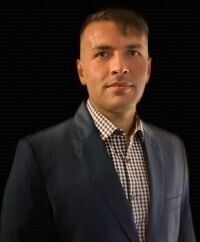
The Biden Administration’s withdrawal from Afghanistan on August 31, 2021 focused attention on the plight of Afghans who supported U.S. and allied forces. In December 2001, shortly after the 9/11 attacks, Farid was hired by the U.S. Army to work as an interpreter/translator. He received a special immigration visa in 2007 and enlisted in the U.S. Army. He was awarded the bronze star and became a student at Cornell University in 2017. Mr. Ferdows' family, however, remained in Afghanistan at the time of the withdrawal. This special event offers unique insight and perspective on how the withdrawal impacted men and women who supported the global war on terror in Afghanistan. Co-sponsored by Congregation L’dor V’dor.
Check out the feature article in the Cornell Chronicle to learn more: Farid Ferdows ’21: ‘For those who dream, Cornell is your place’.
Speaker
Farid Ferdows, Afghan interpreter/translator serving from 2001-2017, Cornell University '21
Moderators
Mariah Smith, Director of Government Affairs, Accrete AI Government, Retired Military Police Lt. Colonel, Army, and Vice Chairman of No One Left Behind
Steve Israel, Director, Institute of Politics and Global Affairs at Cornell University and former U.S. Representative (D-NY)
Additional Information
Program
Einaudi Center for International Studies
South Asia Program
Food for all: International organizations and the transformation of agriculture
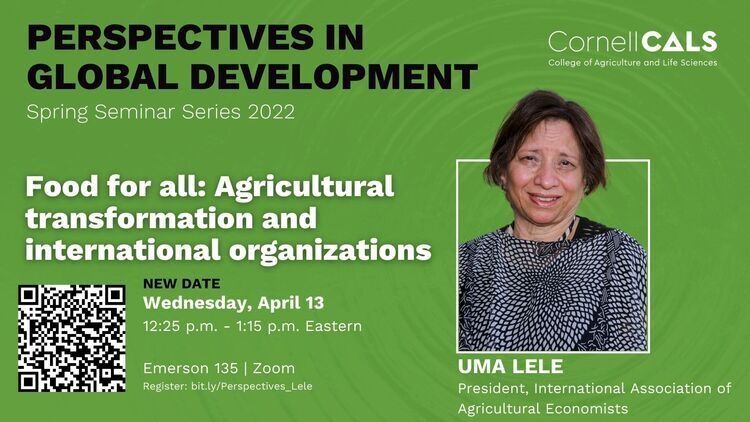
April 13, 2022
12:25 pm
Emerson Hall, 135
Perspectives in Global Development Seminar
Speaker: Uma Lele, president of the International Association of Agricultural Economists (IAAE)
Note: The original seminar date has change. The seminar will now be held April 13
Location: Emerson 135 and Zoom
Registration: https://bit.ly/Perspectives_Lele
The Sustainable Development Goals are off track. The prospects of the SDGs being realized by 2030 are bleak. The rapid pace of consistent decline in poverty and hunger until 2015 had slowed even before COVID-19. Often overlooked is the fact that much of that reduction in poverty and hunger occurred in China and Southeast Asia. A once-in-a-century global tragedy, COVID has been particularly hard on the world’s poor, compounded by severe impacts of climate change. collectively their resources are now miniscule compared to the trillions of dollars needed annually in investments to achieve transformational change in food and agriculture to reduce poverty and hunger. While developing-countries’ own resources are increasingly important, they are also nowhere near sufficient for such transformational change. In her talk Uma Lele will identify transformative changes needed at multiple levels to achieve the worthy goal of healthy food for all.
About the speaker
Uma Lele was the first woman to be awarded a PhD in Applied Economics by Cornell University, at age 24. She has decades of experience in research, operations, policy analysis, and evaluation. A significant part of her experience was acquired in developing regions, from a base at the World Bank, as well as in US universities and other international organizations. Currently she is affiliated with the Institute of Economic Growth, University of Delhi, India. Since August 31, 2021, she is President of the International Association of Agricultural Economists (IAAE). The first woman to be elected to this position in IAAE’s 92-year history, she was responsible for planning the first-ever, all virtual 31st International Conference of Agricultural Economists held August 17 and August 31, 2021.
Her co-authored book, Food for All: International Organizations and the Transformation of Agriculture, was published by Oxford University Press in October 2021. She served on the Science Advisory Committee of the UN Food Systems Summit. She has published extensively on agriculture and rural development, including independent evaluation reports from the World Bank, contributing well over 130 book chapters, papers, articles, and other writings on food and agriculture, the environment, public health, science and technology, aid and finance, and evaluation in Asia, Africa, and Latin America. In 2016, she co-chaired an inter-agency Food Security Information Network (FSIN) report with Professor William Masters on Measuring Food and Nutrition Security, and in 2000–2002, she co-chaired (with Professor Shen Gao Fang of the Chinese Academy of Engineering) the Task Force on Forests and Grasslands in the Development of the West, commissioned by the China Council for International Cooperation on Environment and Development (CCICED).
Her honors include: Fellow of India’s National Academy of Agricultural Sciences (NAAS); American Agricultural & Applied Economic Association (AAEA, 1999); a Distinguished Alumnus of Cornell University (2008); Lifetime Achievement Award of the Indian Society of Agricultural Economics (ISAE 2017); “Honorary Life Member” of the International Association of Agricultural Economists (IAAE); B. P. Pal Award (2015–2016) of India’s National Academy of Agricultural Sciences; the M. S. Swaminathan Award of the Trust for the Advancement of Agricultural Sciences, India (2017); the Clifton Wharton Award (Emerging Markets Program, Cornell University, 2018); Honorary Fellow by the African Association of Agricultural Economists in 2019; and an honorary Doctor of Agricultural Sciences at Stellenbosch University in South Africa, as “the leading rural development scholar of her generation.”
She has established three Mentorship Programs at the Agricultural & Applied Economic Association (AAEA) for students from developing countries, and an award for Best Research on Gender at the International Association of Agricultural Economists (IAAE). At the IAEA, she is actively promoting women in the agricultural economics profession and expanding opportunities for their professional advancement.
About the seminar series
The Perspectives in Global Development seminars are held Wednesdays from 12:25 – 1:15 p.m. eastern time during the semester. The series will be presented in a hybrid format with some speakers on campus and others appearing via Zoom. Students, faculty and the general public are welcome to attend. The series is co-sponsored by the Department of Global Development, the Department of Natural Resources and the Environment, the Charles H. Dyson School of Applied Economics and Management, and the School of Integrative Plant Science as part of courses IARD 6960, NTRES 6960, PLSCS 6960 and AEM 6960.
Additional Information
Program
South Asia Program
Policymaker's Journal: From New Delhi to Washington D.C.
March 31, 2022
4:00 pm
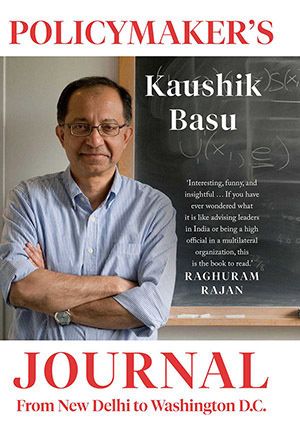
What is it like to move from the cloisters of academia to the high-profile sector of global markets and monetary policy? In his new book, Policymaker’s Journal: From New Delhi to Washington DC, (Simon & Schuster India, 2021)
Economist Kaushik Basu chronicles the years he spent working in the frenetic world of economic policymaking, first as chief economic advisor to the Indian government and later as the chief economist at the World Bank. In a live, virtual, Chats in the Stacks talk, Basu will discuss how he documented his day-to-day experiences over seven years of high-level, international economic policy work and share what he learned during that time.
Sponsored by Mann Library, the talk is followed by a live Q&A.
Basu is Cornell’s Carl Marks Professor of International Studies and a professor of economics. A former senior vice president and chief economist of the World Bank, from 2017 to 2021 he served as president of the International Economic Association and he was chief economic adviser to the Indian government from 2009 to 2012.
Dial-In Information
Please register through the following link:
https://cornell.zoom.us/webinar/register/WN_OOBc_FOKSravdzhWeK3k3A
Additional Information
Program
Einaudi Center for International Studies
South Asia Program
Roundtable: Bruno Shirley and Tyler Wolford, "Monasteries as Administrative Centers in a (more) Global Perspective"

March 18, 2022
2:30 pm
Spring 2022 Medieval Studies Graduate Student Roundtable
Please join us at the Medieval Studies Graduate Student Roundtable this semester! The Roundtable is a community space where everyone's voice and presence are valued whether or not they have expertise on the topic being presented. It is both a space for graduate students to receive feedback on their works in progress and an opportunity for faculty and graduate students to learn more about the wide range of specialties represented in the Cornell medievalist community.
This month, Bruno Shirley and Tyler Wolford will be engaging in a collaborative/comparative discussion in a Roundtable session called “Monasteries as Administrative Centers in a (more) Global Perspective,” during which Bruno and Tyler will each be giving presentations on the roles of medieval monasteries in their areas of expertise–Sri Lanka and the Byzantine empire, respectively.
**The Roundtable will be held via Zoom this semester. Zoom links and any papers will be distributed 1 to 2 weeks in advance.**
Additional Information
Program
South Asia Program
Climate Resilience for the Poorest Three Billion

March 9, 2022
12:25 pm
Emerson Hall, 135
Perspectives in Global Development Seminar
Speaker: V. Ram Ramanathan, Distinguished Research Professor of climate sustainability at the University of California at San Diego; Cornell Climate Solutions Scholar, Cornell University
Location: Emerson 135 and Zoom
Registration: https://bit.ly/Perspectives_Ram
Climate Change has already reached unprecedented levels with record breaking weather extremes. Over the last two decades when the mean warming was around 0.9 C, about 606000 people perished and 4.1 billion displaced due to weather extremes. In about eight to eleven years, global warming will cross the dangerous threshold of 1.5 C warming. As we recover from the COVID crisis by 2025, the evidence for the oncoming 1.5 C warming will be prevalent worldwide. I will show, how due to two way human-natural systems interactions, there is very little that society can do to avoid crossing the threshold of 1.5 C.
The world's poorest three billion, whose contributions to the global warming emissions is about 5% or less, are likely to suffer the worst consequences of the more than 50% amplification of the warming within a decade. I will explore, with mathematical models and practical field studies in rural areas of India, the actions the rest of society can take in response to this huge ethical dilemma and build resilience among the poorest three billion. In so doing, it is remarkable that the wealthiest one billion can also bend the warming curve well below 2 C within the next 25 years.
About the speaker
Ramanathan is Distinguished Research Professor of climate sustainability at the University of California at San Diego and Cornell Climate Solutions Scholar, Cornell University. He discovered the greenhouse effect of chlorofulorocarbons and other heat trapping pollutants gases. His findings on Non-CO2 global warming pollutants have led to several successful climate mitigation actions worldwide. He is the recipient of the prestigious 2021 Blue Planet Prize and the 2018 Tang Prize. He was Listed as Foreign Policy Magazine’s Top 100 Global Thinkers of 2014 and named 2013 Champion of the Earth Laureate for the Science and Innovation category, by the United Nations Environment Program. He served as the science advisor for Pope Francis' Holy See delegation to the UN's 2015 Paris climate summit. He leads University of California's Bending the Curve: Climate solutions education protocol, taught at many campuses around the world. He is elected to the Pontifical Academy of Science (council member); Royal Swedish Academy of Science, the US National Academy of Science and the World Academy of Sciences.
About the seminar series
The Perspectives in Global Development seminars are held Wednesdays from 12:25 – 1:15 p.m. eastern time during the semester. The series will be presented in a hybrid format with some speakers on campus and others appearing via Zoom. Students, faculty and the general public are welcome to attend. The series is co-sponsored by the Department of Global Development, the Department of Natural Resources and the Environment, the Charles H. Dyson School of Applied Economics and Management, and the School of Integrative Plant Science as part of courses IARD 6960, NTRES 6960, PLSCS 6960 and AEM 6960.
Additional Information
Program
South Asia Program