
Southeast Asia Program
Unwritten Rule: A GETSEA Community Book Read by Alice Beban
November 16, 2023
7:00 pm
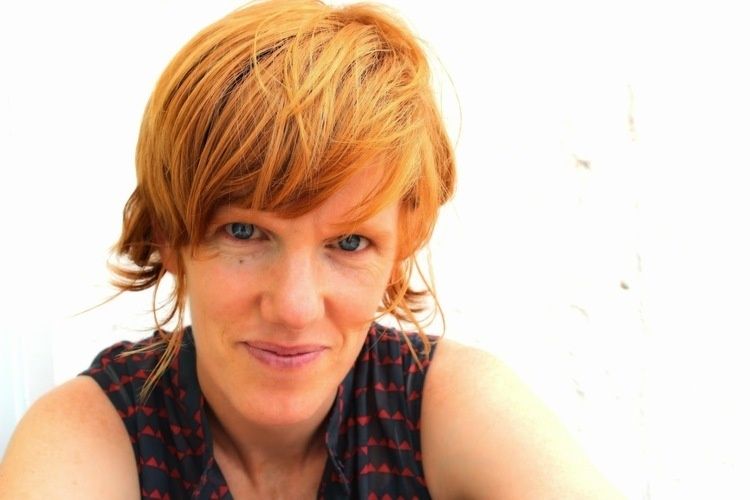
A community book read with Alice Beban, author of Unwritten Rule: State-Making through Land Reform in Cambodia and winner of the 2023 Benda Prize.
This event is open to current graduate students at any university, but participants must read the book first to facilitate an active conversation!
Alice Beban’s Unwritten Rule: State-Making through Land Reform in Cambodia is a first-rate study of the politics of land redistribution. Challenging the idea that land reform strengthens land tenure, Unwritten Rule shows that instead it entangles citizens in patron-client relations, creates anxiety, and actually undermines title to land. Citizens in Cambodia must contend with a state that, Beban argues, is not so much lacking in state capacity but actively making things illegible through obfuscation, secrecy, and unwritten rules. Through multiple methods, including in-depth ethnography, survey research, as well as comparative analysis within Cambodia, Unwritten Rule provides a sharp, unique, and counterintuitive perspective on land reforms in an autocratic regime. This is a superb book from which political scientists, sociologists, anthropologists, and historians can all gain deep and grounded insights.
Additional Information
Program
Einaudi Center for International Studies
Southeast Asia Program
Across the Archives: Southeast Asian Manuscripts
November 7, 2023
3:00 pm
Join us for an online discussion on Southeast Asian Manuscript collections held by institutions around the United States, including the University of California, Berkeley and the Library of Congress.
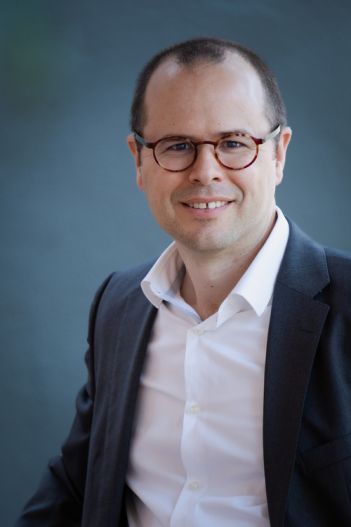
Dr. Trent Walker will share his experiences navigating the archival landscape of Southeast Asian Studies, covering how manuscript traditions from Cambodia, Laos, and Thailand appear in American libraries and the divergent approaches that researchers can take to incorporate these collections into their own scholarship. This webinar is hosted by the Committee on Research Materials on Southeast Asia (CORMOSEA), the Southeast Asia Program (SEAP), and the Southeast Asia Digital Library (SEADL).
Trent Walker is Assistant Professor of Southeast Asian Studies in the Department of Asian Languages and Cultures at the University of Michigan–Ann Arbor. A specialist in Buddhism, literature, and music in Cambodia, Laos, Thailand, and Vietnam, he is the author of Until Nirvana’s Time: Buddhist Songs from Cambodia and co-edited a major anthology, Out of the Shadows of Angkor: Cambodian Poetry, Prose, and Performance through the Ages. Recent publications include articles on Thai literary history, Lao and Shan exegesis, Theravada nuns, Pali-vernacular homiletics, Khmer epigraphy, and Vietnamese Buddhist translation. Trent also served as Director of Preservation and Lead Scholar for the Khmer Manuscript Heritage Project, a initiative of the Buddhist Digital Resource Center, in collaboration with the École française d'Extrême-Orient and with generous support from A Khmer Buddhist Foundation, to digitize over 1.5 million pages of Khmer, Pali, and Thai manuscripts from Cambodia.
Additional Information
Program
Einaudi Center for International Studies
Southeast Asia Program
The October 6 Massacre through the eyes of Thongchai Winichakul
October 25, 2023
5:00 pm
Goldwin Smith Hall, G64
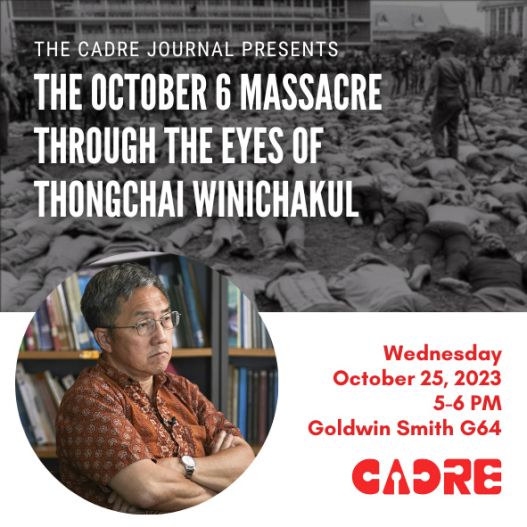
The Cadre Journal presents a discussion with Thongchai Winichakul—former Thai student leader and historian—on the Thai social movement in the 70s, the rise of socialism and anti-imperialism, American influence over Thai politics, and the atrocities that followed.
About the October 6 Massacre
On October 14, 1973, the Thai people succeeded in throwing out the military dictatorship that had been ruling Thailand for 16 years. The victory allowed for unprecedented freedom of expression and assembly. Interests in socialism and anti-imperialism flourished. Students, workers, and farmers joined forces to continue their struggle for a better future.
The right fought back through propaganda and violence. Paramilitary groups were set up. Assassinations were rampant. This concluded on the morning of October 6, 1976, during a sit-in at Thammasat University where people were protesting the return to the country of the previously ousted dictators. Police started shooting into where students were before advancing onto the campus. The massacre left at least 41 dead, with other estimations going up to hundreds
About the Speaker
Thongchai Winichakul was a student organizer in the 70s. He was one of the people arrested and later imprisoned on October 6, 1976. He and other student leaders were released 1978 on the condition that he was not involved in further political activities.
He is now Emeritus Professor of History at University of Wisconsin-Madison, a Research Fellow Emeritus at Institute of Developing Economies (IDE-JETRO), Japan, and currently a Visiting Professor at the Pridi Banomyong International College (PBIC), Thammasat University. His book, Siam Mapped (University of Hawaii Press, 1994), was awarded the Harry J Benda Prize from the Association for Asian Studies (AAS, USA) and the Grand Prize from the Asian Affairs Research Council (Japan). His other book, Moments of Silence: The Unforgetting of the October 6, 1976, Massacre in Bangkok (University of Hawaii Press, 2020) was awarded the humanities book prize by the European Association for Southeast Asian Studies in 2022.
His research interests are in the intellectual foundations of modern Siam under colonial conditions (1880s-1930s) including modern geography and sovereignty, historical ideology, and the legal system. He has published eight books and several articles in Thai. He is also a well-known critic of Thai political and social issues.
Additional Information
Program
Einaudi Center for International Studies
Southeast Asia Program
The Uyghurs Forced to Process the World’s Fish
Sarosh Kuruvilla, SAP/SEAP
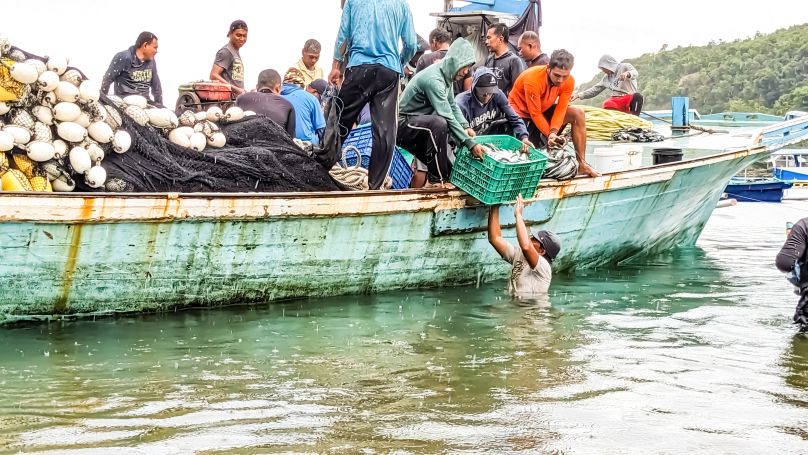
Sarosh Kuruvilla, a professor of industrial relations, analyzed more than forty thousand labor audits from around the world and found that almost half were unreliable. “The tool is completely broken,” he said.
Additional Information
Ethical International Engagement: The Role of the University

October 30, 2023
5:30 pm
Biotechnology Building, G10
Part of Cornell’s yearlong exploration of freedom of expression, this event from Global Cornell brings together the campus community to discuss how Cornell can protect academic freedom while collaborating with institutions and scholars in places with different political realities and views on free speech.
Allan Goodman, chief executive officer of the Institute of International Education, joins Vice Provost for International Affairs Wendy Wolford to discuss:
How can universities like Cornell provide a safe haven for scholars whose right to free expression is threatened?How can universities act to promote scholarship, free expression, and global collaboration?Cornell has worked with the Institute of International Education’s Scholar Rescue Fund (IIE-SRF) for over a decade to provide yearlong fellowships for displaced academics and human rights defenders. IIE also supports the Humphrey Fellows Program in the Department of Global Development and Fulbright fellowships for undergraduate students from across the university.
Goodman and Wolford will be joined by these panelists:
Sharif Hozoori (Afghanistan) | IIE-SRF fellow in the Einaudi Center’s South Asia ProgramPeidong Sun (China) | Einaudi Center’s East Asia Program and Associate Professor of History, A&SAzat Gündoğan (Turkey) | Florida State University, former IIE-SRF fellow in the Einaudi Center’s Institute for European Studies***
If you can't attend in person, register for a Zoom link to join the livestream here.
***
About Allan Goodman
IIE’s CEO Allan E. Goodman is a Council on Foreign Relations member and serves on the selection committees for the Rhodes and Schwarzman Scholars and the Yidan Prize. He also serves on the Council for Higher Education Accreditation International Quality Group advisory council and the Education Above All Foundation board of trustees. Goodman has a PhD in government from Harvard, MPA from Harvard’s John F. Kennedy School of Government, and BS from Northwestern University.
About the Institute of International Education
For more than 100 years, the Institute of International Education has promoted the exchange of scholars and researchers and rescued scholars, students, and artists from persecution, displacement, and crises. IIE conducts research on international academic mobility and administers the U.S. Department of State’s Fulbright Program.
Supporting Scholars Under Threat
Learn more about how Global Cornell supports Scholars Under Threat.
Additional Information
Program
Einaudi Center for International Studies
Reppy Institute for Peace and Conflict Studies
East Asia Program
Southeast Asia Program
Latin American and Caribbean Studies
Institute for African Development
Institute for European Studies
South Asia Program
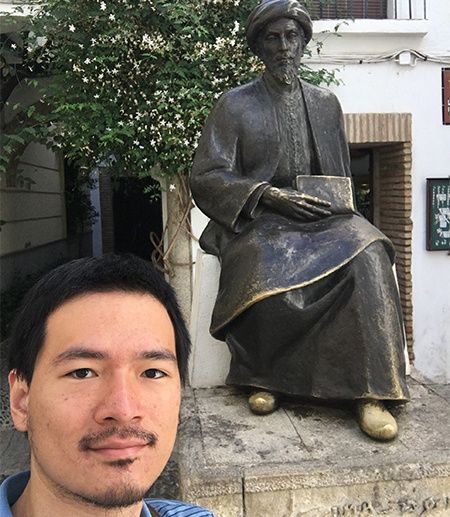
Anthropology Colloquium: Xinyu Guan
November 3, 2023
3:00 pm
McGraw Hall, 165
You Can Dig a Well in China: The Borders of Citizenship in Singapore's State-Constructed Housing Estates
Xinyu examines how state-constructed housing shapes notions and practices of citizenship in Singapore. He is especially interested in how forms of coloniality and unevenness in the wider region are folded into the everyday affective landscapes of life in the housing estates. His research interrogates the forms of racialization and sexual discipline in the built environment, and explores the possibility for a queer decolonial anthropology of Singapore.
Xinyu has a BA in Comparative Literature from Columbia University and an MSc in Urban Studies from University College London.
Additional Information
Program
Southeast Asia Program
Lingua Mater Competition

Translate the Alma Mater into another language for cash prizes!
Can you translate Cornell’s Alma Mater into your mother tongue (or a language you are learning/have learned at Cornell) and sing it? We invite you to translate “Far Above Cayuga’s Waters” and submit a video of you (and your friends!) performing it somewhere on any of Cornell’s campuses or anywhere in the world. Are you on an education abroad program right now? Show us your Cornell love from afar.
Additional Information
Shaoling Ma
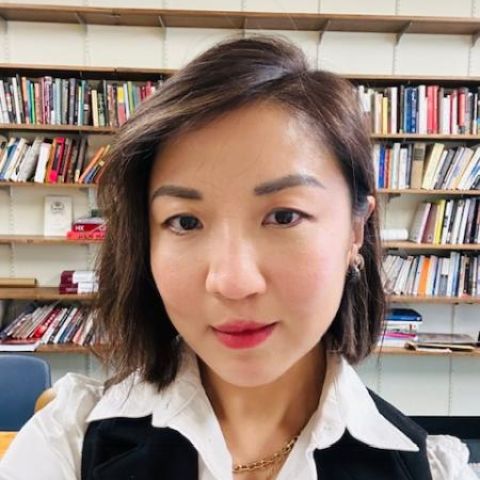
Associate Professor, Asian Studies
Shaoling Ma is an interdisciplinary scholar and critical theorist of global Chinese history, literature, and media. At the broadest level, she is drawn to historical periods when geopolitical, socio-economic, and technological developments appear to provide external vantage points from which to navigate the landscape of cultural production, while, in fact, being resolutely embedded in the latter. Ma's teaching and research interests include late nineteenth-century to contemporary Chinese and Southeast Asian cultural productions, media studies, and critical theory.
Additional Information
The Thai Establishment Strikes Back

Tamara Loos, SEAP
Tamara Loos writes in Foreign Affairs about a new governing coalition in Thailand.
Additional Information
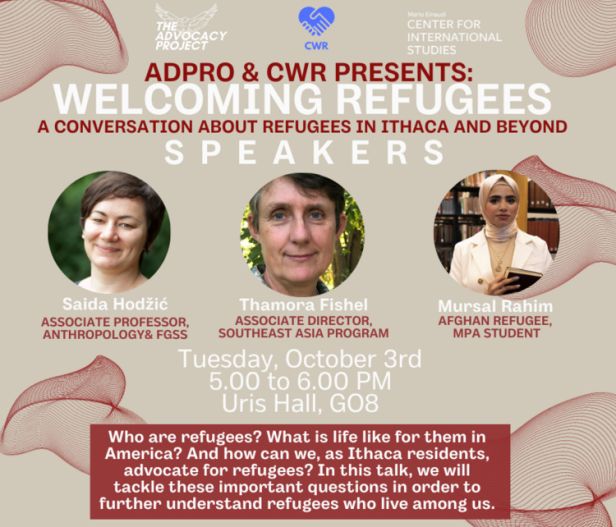
Welcoming Refugees: A Conversation About Refugees in Ithaca and Beyond
October 3, 2023
5:00 pm
Uris Hall, G08
Cornell Welcomes Refugees and the Advocacy Project present
Welcoming Refugees: A Conversation About Refugees in Ithaca and Beyond
Who are refugees? What is life like for them in America? And how can we, as Ithaca residents, advocate for refugees? In this talk, we will tackle these important questions in order to further understand refugees who live among us.
Speakers include Professor Saida Hodžić, Associate Professor of Anthropology and Feminist, Gender and Sexuality Studies, Thamora Fishel, Associate Director of the Southeast Asia Program, and Mursal Rahim, an Afghan refugee and an MPA student.
This event is co-sponsored by the Mario Einaudi Center for International Studies.
Additional Information
Program
Einaudi Center for International Studies
Southeast Asia Program
South Asia Program