
Southeast Asia Program
Information Session: Southeast Asia Program Undergraduate Opportunities

October 23, 2023
4:45 pm
Uris Hall, 153
The Southeast Asia Program (SEAP) gives students multiple ways to engage with Southeast Asia. Undergraduates who minor in Southeast Asian Studies are advised by SEAP faculty advisors who collaborate with them to construct a course of study based upon their area of interest. SEAP also runs the CU in Cambodia program for students interested in international travel.
Affiliate with our program to be informed of all SEAP events and activities.
Register for the information session here!
***
The Mario Einaudi Center for International Studies hosts info sessions for graduate and for undergraduate students to learn more about funding opportunities, international travel, research, and internships. View the full calendar of fall semester sessions.
Additional Information
Program
Einaudi Center for International Studies
East Asia Program
Southeast Asia Program
Institute for African Development
Information Session: Fulbright for Graduate Students

October 18, 2023
4:45 pm
In this info session for graduate students, learn about Fulbright at Cornell.
The Fulbright U.S. Student Program provides full funding for graduate and professional students conducting research in any field or teaching in more than 150 countries. Open to U.S. citizens only.
The Fulbright-Hays Doctoral Dissertation Research Abroad program supports doctoral students conducting research in modern languages or area studies for six to 12 months. Open to U.S. citizens and permanent residents of the United States. Travel to Western European countries is not eligible.
Register for the information session.
***
The Mario Einaudi Center for International Studies hosts info sessions for graduate and for undergraduate students to learn more about funding opportunities, international travel, research, and internships. View the full calendar of fall semester sessions.
Additional Information
Program
Einaudi Center for International Studies
Reppy Institute for Peace and Conflict Studies
East Asia Program
Southeast Asia Program
Latin American and Caribbean Studies
Institute for African Development
Institute for European Studies
South Asia Program
NIGHT LIFE
September 23, 2023
7:45 pm
FR Newman Arboretum- Treman Woodland Walk
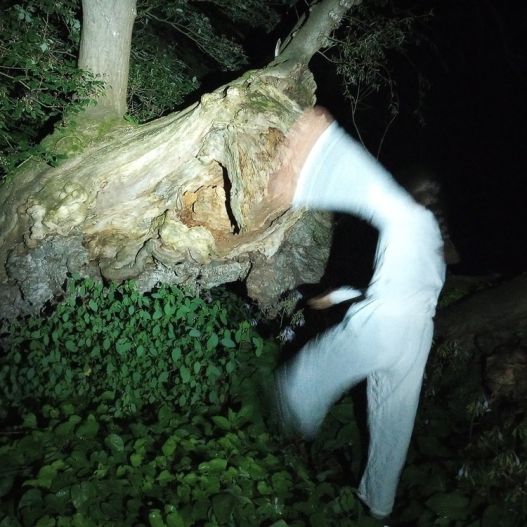
You're invited to the premiere performances of NIGHT LIFE, created for the Newman Arboretum at twilight, combining dance, subtle lighting and a soundscape played on Indonesian Gamelan instruments that features the plants and trees of the Treman Woodland Walk, especially the magnificent Willow at its center.At the turn of the season, night grows longer and we move into darkness: lights on dancers’ bodies play across the garden, shapes, sounds and movements appear and fade at the edge of perception. Shadows and light mingle and skew plants and humans.
Night Life is a collaboration between choreographer/dancer Cynthia Stevens, and composer and improviser Christopher J. Miller, along with dancer Emily Healy and musicians Jack Neiberg, Wyatt Westerkamp and Caleb Levitt.
Cornell’s FR Newman Arboretum- Treman Wooodland Walk, Ithaca, NY
Friday September 15Saturday, September 16Saturday, September 23
8:00 pm performance; please arrive at 7:45 to park and find the site.
Free
Reservations are Recommended
For Reservations and Further Information: info@insitudance.org This half hour performance is geared for college students and adults. Please wear insect repellent and seasonally appropriate clothing for your comfort, including shoes for damp grass.You have the option to stand or bring portable lawn chairs. Special Thanks to Cornell's Southeast Asia Program and to Emily Detrick of the Cornell Botanic Gardens. Directions: Use the Arboretum entrance on Forest Home Drive across from Flat Rock.Enter and turn right, there are two parking options (see map below):
Parking Lot One will be on the right very close to the entrance. From here, face away from the entrance, and walk to your left following the edge of the road to the performance site.
Parking Lot Two: Continue on the same road in a loop till you eventually turn left and head back down the hill towards the entrance. There will be a parking lot on your left adjacent to the performance site.
We look forward to sharing this performance!
Additional Information
Program
Southeast Asia Program
NIGHT LIFE

September 16, 2023
7:45 pm
FR Newman Arboretum- Treman Wooodland Walk
You're invited to the premiere performances of NIGHT LIFE, created for the Newman Arboretum at twilight, combining dance, subtle lighting and a soundscape played on Indonesian Gamelan instruments that features the plants and trees of the Treman Woodland Walk, especially the magnificent Willow at its center.At the turn of the season, night grows longer and we move into darkness: lights on dancers’ bodies play across the garden, shapes, sounds and movements appear and fade at the edge of perception. Shadows and light mingle and skew plants and humans.
Night Life is a collaboration between choreographer/dancer Cynthia Stevens, and composer and improviser Christopher J. Miller, along with dancer Emily Healy and musicians Jack Neiberg, Wyatt Westerkamp and Caleb Levitt.
Cornell’s FR Newman Arboretum- Treman Wooodland Walk, Ithaca, NY
Friday September 15Saturday, September 16Saturday, September 23
8:00 pm performance; please arrive at 7:45 to park and find the site.
Free
Audience size is limited, Reservations are recommendedFor Reservations and Further Information: info@insitudance.org This half hour performance is geared for college students and adults. Please wear insect repellent and seasonally appropriate clothing for your comfort, including shoes for damp grass.You have the option to stand or bring portable lawn chairs. Special Thanks to Cornell's Southeast Asia Program and to Emily Detrick of the Cornell Botanic Gardens. Directions: Use the Arboretum entrance on Forest Home Drive across from Flat Rock.Enter and turn right, there are two parking options (see map below):
Parking Lot One will be on the right very close to the entrance. From here, face away from the entrance, and walk to your left following the edge of the road to the performance site.
Parking Lot Two: Continue on the same road in a loop till you eventually turn left and head back down the hill towards the entrance. There will be a parking lot on your left adjacent to the performance site.
We look forward to sharing this performance!
Additional Information
Program
Southeast Asia Program
Information Session: Laidlaw Research and Leadership Program

November 2, 2023
4:45 pm
Uris Hall, 153
Learn more about the Laidlaw Leadership and Research Program for undergraduates, tips for connecting with faculty research mentors, and advice for writing a successful application.
Laidlaw promotes ethical leadership and international research around the world—starting with the passionate leaders and learners found on campuses like Cornell.
Open to first- and second-year students, the two-year program provides generous support to carry out internationally focused research, develop leadership skills, engage with community projects overseas, and become part of a global network of like-minded scholars from more than a dozen universities.
Register for the information session here.
***
The Mario Einaudi Center for International Studies hosts info sessions for graduate and for undergraduate students to learn more about funding opportunities, international travel, research, and internships. View the full calendar of fall semester sessions.
Additional Information
Program
Einaudi Center for International Studies
Reppy Institute for Peace and Conflict Studies
East Asia Program
Southeast Asia Program
Latin American and Caribbean Studies
Institute for African Development
Institute for European Studies
South Asia Program
Information Session: Migration Studies & International Relations Minors

November 1, 2023
5:00 pm
Uris Hall, G-08
Learn more about the migration studies minor and international relations minor—offered by the Mario Einaudi Center for International Studies. Both minors are open to all Cornell undergraduates and include courses from across the university.
With a focus on global migration experiences, the migration studies minor prepares students to understand the historical and contemporary contexts and factors that drive international migration.
The international relations minor offers students the chance to study the politics, economics, history, languages, and cultures of the world.
Register here.
***
The Mario Einaudi Center for International Studies hosts info sessions for graduate and for undergraduate students to learn more about funding opportunities, international travel, research, and internships. View the full calendar of fall semester sessions.
Additional Information
Program
Einaudi Center for International Studies
Reppy Institute for Peace and Conflict Studies
East Asia Program
Southeast Asia Program
Latin American and Caribbean Studies
Institute for African Development
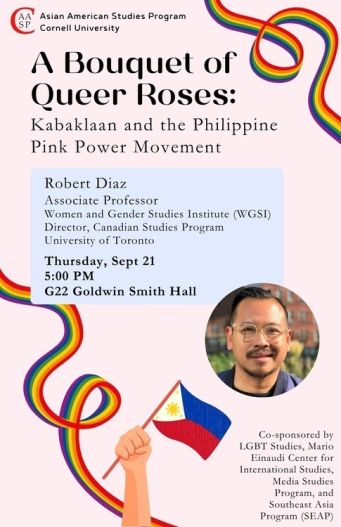
“A Bouquet of Queer Roses: Kabaklaan and the Philippine Pink Power Movement,” Robert Diaz (University of Toronto)
September 21, 2023
5:00 pm
Goldwin Smith Hall, G22
This talk emphasizes the significance of kabaklaan, or irreverent queer performances often dismissed as lower class, to the Philippine Pink Power Movement (PPM). The PPM was comprised of nationwide rallies, viral new media, and other forms of solidarity building that sought to elect former Vice-President Leni Robredo to the Philippine presidency. Crucial to PPM’s longevity were expressions of kabaklaan, including drag shows, campy videos, and beauty pageant satires. These wayward performances inspired diverse Filipinos to participate in national politics and to memorialize martial law. They also cultivated “queer echo chambers,” or systems of informational exchange that foregrounded sexual minority histories, cultures, and knowledges. PPM’s kabaklaan served as a fitting response to the scenes of normative domesticity that Ferdinand Marcos Jr. celebrated. They also critiqued the forms of toxic masculinity that Rodrigo Duterte's administration espoused. At its core, this talk offers a reparative reading of the 2022 presidential elections. It argues that despite Robredo’s loss, much can be learned from "Pink revolutions" that center queer pleasure, joy, and hope. Such revolutions can continue to fuel demands for social change and continue to replenish dreams of better worlds.
Dr. Robert Diaz is Associate Professor in the Women and Gender Studies Institute (WGSI) and Director of the Canadian Studies Program at University of Toronto. His research examines how queer cultures in the United States, Canada, Asia, and the Philippines negotiate and resist marginalization. He is co-editor of Diasporic Intimacies: Queer Filipinos and Canadian Imaginaries (Northwestern University Press, 2017) and Beauty and Brutality: Manila and Its Global Discontents (Temple University Press, 2023). His writing has also appeared in Signs, GLQ, TSQ, Journal of Asian American Studies, Asian Diasporic Visual Culture and the Americas, and Canadian Literature. Dr. Diaz has also collaborated with diverse artists, activists, and community organizations to address the systemic barriers to access and equity.
Additional Information
Program
Southeast Asia Program
Einaudi Center for International Studies
Vietnamese Conversation Hour

December 1, 2023
4:00 pm
Stimson Hall, G25
Come to the LRC to practice your language skills and meet new people. Conversation Hours provide an opportunity to use the target language in an informal, low-pressure atmosphere. Have fun practicing a language you are learning! Gain confidence through experience! Just using your new language skills helps you learn more than you might think. Conversation Hours are are open to any learner, including the public. Campus visitors and members of the public must adhere to Cornell's public health requirements for events.
Additional Information
Program
Southeast Asia Program
Thai Conversation Hour
December 5, 2023
7:00 pm
Join us on Zoom to practice your Thai skills and meet new people. Conversation Hours provide an opportunity to use the target language in an informal, low-pressure atmosphere. Have fun practicing a language you are learning! Gain confidence through experience! Just using your new language skills helps you learn more than you might think. Conversation Hours are are open to any learner, including the public.
Join Thai Conversation Hour on Zoom!
Additional Information
Program
Southeast Asia Program
Politics, Art, and Free Expression

September 22, 2023
3:30 pm
Herbert F. Johnson Museum of Art - Cornell University, Wing Lecture Room, Floor 2L
Artistic freedom is a fundamental democratic right.
Creative expression, from poetry to street art, theater, and literature, is often at the vanguard of political resistance and change, and so artists are some of the first to be silenced. In this panel, speakers discuss their own experiences as artists in authoritarian contexts where their ability to produce art was violently suppressed.
These artists have all found haven at Cornell. Their art speaks to the trauma of authoritarianism and the hope for change.
Speakers:
Sharifa “Elja” Sharifi, Afghan visiting scholar and 2022–23 Artist Protection Fund Fellow at the Herbert F. Johnson Museum of Art
Pedro X. Molina, Nicaraguan political cartoonist and visiting critic with the Mario Einaudi Center for International Studies
Khadija Monis '24, Afghan student, poet and artist
Rachel Beatty Riedl (moderator), director of the Mario Einaudi Center for International Studies and John S. Knight Professor of International Studies
The event is sponsored by the Johnson Museum and Global Cornell as part of the university’s theme this year on The Indispensable Condition: Freedom of Expression at Cornell. The event will be held in person and livestreamed.
Additional Information
Program
Einaudi Center for International Studies
Reppy Institute for Peace and Conflict Studies
East Asia Program
Southeast Asia Program
Latin American and Caribbean Studies
Institute for African Development
Institute for European Studies
South Asia Program