
Continuing Presence of Discarded Bodies with Eunjung Kim, Syracuse U
February 11, 2021
4:30 pm
Continuing Presence of Discarded Bodies: Occupational Harm, Necro-Activism, and Living Justice with Eunjung Kim, Syracuse University.
Starting from the two activist campsites set up in Seoul, one by the coalition of disability organizations and the other by the Supporters for the Health and Rights of People in the Semiconductor Industry, Kim explores a history of occupational health movements and their intersections with disability rights movements in South Korea. Against the bureaucratic technology of rating the degree of disability and harm, necro-activism emerges in the form of persistent involvements of dead bodies, mourning, and other-than-human presence, making claims for justice as an ongoing practice of everyday life and afterlife.
Bio: Eunjung Kim is an Associate Professor of women’s and gender studies and disability studies at Syracuse University.
Julia Chang (Assistant Professor in the Department of Romance Studies and core faculty in Feminist, Gender, and Sexuality Studies at Cornell) will be serving as respondent to Eunjung’s talk.
Andrew Campana (Associate Professor, Department of Asian Studies) hosts and moderates.
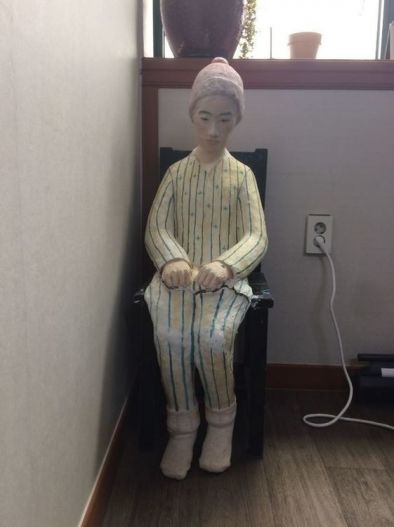
The event image is of a statue by Pak Yujin (박유진). Description: A statue of Hwang Yumi is sitting in a chair in the corner of the room below the window with daylight shining through. After working at a Samsung Electronics semiconductor plant, Hwang Yumi died of acute myeloid leukemia. She is wearing striped hospital pants, a top, a pink cap, and pink socks. She is looking down toward the floor and her two hands are on her thighs in fists. There are two potted plants on the windowsill. Next to the chair is an outlet with a single white plug and cord trailing out of the frame of the image.
(Co-)Sponsored by the Central New York Humanities Corridor from an award by the Andrew W. Mellon Foundation
Co-sponsored by the Society for the Humanities
Additional Information
Program
Einaudi Center for International Studies
East Asia Program