
Realism as an Attitude as an Attitude
December 11, 2020
8:00 pm
Part of the Ronald and Janette Gatty series
Roger Nelson, Curator, National Gallery Singapore
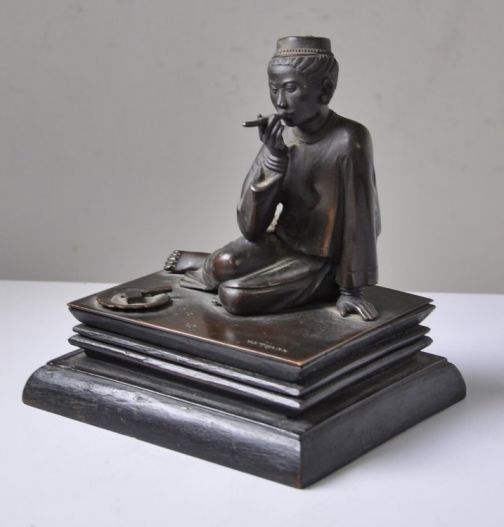
Image credit: Maung Tha Din. Not Titled (Seated Woman Smoking a Cheroot). c. 1920s-1930s. Bronze on wooden base. Collection of National Gallery Singapore.
A seated woman smoking a cheroot; a man chopping wood; a woman with a parasol: these are some common subjects found in cast metal figurines known as “Pegu bronzes.” Made in Bago, Myanmar in the 1920s and 1930s and shown in British imperial “handicrafts” exhibitions, “Pegu bronzes”—like many colonial-era “crafts”—have mostly escaped scholarly attention, and rarely been considered in relation to discourses of artistic modernity. But might “Pegu bronzes” reward closer scrutiny, for art historians studying the emergence of realism in the modern art of Southeast Asia? The figurines closely mirror compositions found in contemporaneous photographs made in Myanmar, and their finely detailed and lifelike forms emerged in parallel with Western-style representational painting in that context, which is often considered a milestone in histories of modern art in the region.
What might “realism” have comprised, in 19th and early 20th-century Southeast Asia? Curators of the 1994 exhibition Realism as an Attitude emphasised the importance of Asian artists in the 1990s “[taking] a stance that indicates a desire to actively interact with and express the reality in which they live.” This attitudinal realism was positioned in contradistinction to “realism in the narrow sense of the word, which denotes a formal style or the act of copying of something.” But might we now revisit the stylistic and mimetic forms of earlier realisms in the region?
This lecture asks if “Pegu bronzes” and other examples of metalwork, woodcarving, and other “crafts” might find a place within art-historical understandings of the emergence of Western-style naturalistic representation in Southeast Asian art. Drawing on curatorial approaches to the period at National Gallery Singapore, the lecture explores various intersections, including those between media, between representations in two and three dimensions, between Buddhist statuary and colonial commerce, between portraits and “types,” and between art and craft.
Additional Information
Program
Einaudi Center for International Studies
Southeast Asia Program