
The Revolutionary City: Urbanization and the Global Transformation of Rebellion | Einaudi Center “Author Meets Critics”
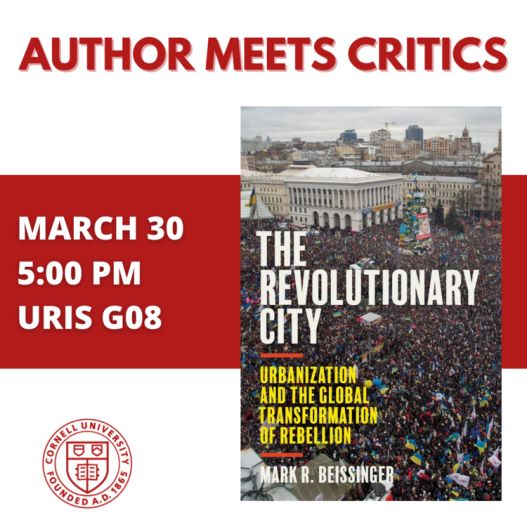
March 30, 2022
5:00 pm
Uris Hall, G08
Cities are changing sites of revolution and rebellion, contestations over forms of power and social relations. As historical and contemporary instances, revolutions present alternative views of world-making and contestations over the organization of society and relations of power. To better understand this phenomenon, the Mario Einaudi Center for International Studies has assembled a panel discussion of Professor Mark Beissinger’s book, The Revolutionary City: Urbanization and the Global Transformation of Rebellion (Princeton University Press, 2022). Join us for an exploration of how and why cities have become primary sites of revolutionary disruptions in the contemporary world.
Examining the changing character of revolution around the world, The Revolutionary City focuses on the impact that the concentration of people, power, and wealth in cities exercises on revolutionary processes and outcomes. Once predominantly an urban and armed affair, revolutions in the twentieth century migrated to the countryside, as revolutionaries searched for safety from government repression and discovered the peasantry as a revolutionary force. But at the end of the twentieth century, as urban centers grew, revolution returned to the city—accompanied by a new urban civic repertoire espousing the containment of predatory government and relying on visibility and the power of numbers rather than arms.
Using original data on revolutionary episodes since 1900, public opinion surveys, and engaging examples from around the world, Mark Beissinger explores the causes and consequences of the urbanization of revolution in the late twentieth and early twenty-first centuries. Beissinger examines the compact nature of urban revolutions, as well as their rampant information problems and heightened uncertainty. He investigates the struggle for control over public space, why revolutionary contention has grown more pacified over time, and how revolutions involving the rapid assembly of hundreds of thousands in central urban spaces lead to diverse, ad hoc coalitions that have difficulty producing substantive change.
Author of The Revolutionary City:
Mark R. Beissinger, Henry W. Putnam Professor of Politics, Princeton University
“Author Meets Critics” Expert Discussants:
Dina Bishara (Assistant Professor, School of Industrial and Labor Relations)Bryn Rosenfeld (Assistant Professor, Department of Government/A&S)Sidney Tarrow (Emeritus Maxwell Upson Professor, Department of Government/A&S; Adjunct Professor, Cornell Law School)
Moderator:
Rachel Beatty Riedl (Einaudi Center Director; Professor, Department of Government/A&S and Cornell Brooks School)
Co-Sponsors:
Institute for European Studies, Einaudi CenterSoutheast Asia Program, Einaudi CenterReppy Institute for Peace and Conflict Studies, Einaudi CenterInstitute of Politics and Global Affairs
About the Forum:
The “Author Meets Critics” forum stages scholarly conversations around the Einaudi Center’s research priority areas: Democratic Threats and Resilience, and Inequalities, Identities, and Justice.
Attendance Requirements:
In-person attendance is open to the Cornell community: Cornell ID and mask REQUIRED
Additional Information
Program
Einaudi Center for International Studies
Reppy Institute for Peace and Conflict Studies
Southeast Asia Program
Institute for European Studies