
To Russia with Love: Myanmar’s Turn to Russia and Its Consequences
September 17, 2026
12:15 pm
Kahin Center
Gatty Lecture Series
Join us for a talk by Michał Lubina, Associate Professor at the South and Southeast Asia Unit, Institute of Middle and Far East, Jagiellonian University (JU), Kraków, Poland
This Gatty Lecture will take place at the Kahin Center, 640 Stewart Ave. Lunch will be served. For questions, contact seap@cornell.edu.
Abstract
Moscow-Naypyitaw rapprochement represents one of the major consequences of the 2021 Myanmar coup and one of the unexpected outcomes of the Ukraine war. Until then, Russia-Myanmar relations remained good but limited (confined to arms trade, military training, diplomatic support, and nuclear dreaming). The breakthrough came with the fourth military coup in Myanmar, followed by the Russia’s full-scale aggression against Ukraine.
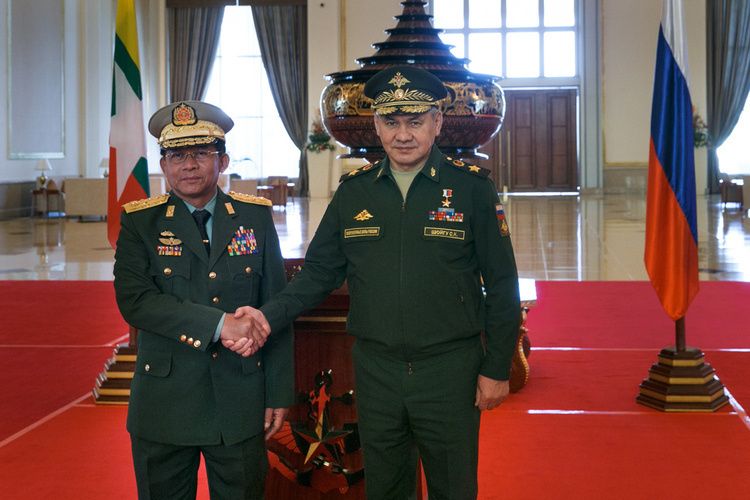
After February 2021, the isolated SAC turned to Moscow, and the Kremlin emerged as the primary international supporter of the Burmese military junta, acting as its political patron, with General Min Aung Hlaing now pilgrimaging to Russia (Moscow, Kazan and Vladivostok, and other places) almost on a routine basis. While Russia was initially still somewhat wary, Moscow’s global (semi-)isolation after the outbreak of the full-scale Ukraine war shifted this dynamic, elevating Myanmar's importance in Russian foreign policy calculations as well. Thus, a mutually convenient asymmetric relationship emerged, and Russia-Myanmar relations have reached an unprecedented level of closeness, unparalleled in their bilateral history. This is best illustrated by the personal chemistry between their leaders, even if expressed is such extraordinary ways as in March 2025, when Min Aung Hlaing compared Vladimir Putin to a rat king which was meant to be an unusual way to emphasize the political friendship with the Russian leader.
The unexpected and unusual combination of Russia and Myanmar caught observers by surprise. Why have these two countries, so geographically and culturally distant, with limited past contacts, became so close? What triggered their rapprochement? And what does it matter – to both Moscow and Naypyidaw, to the region, and even to the world? What are the consequences of this emerging partnership? And where is China in all this? What exact role does Beijing play in this unexpected Naypyidaw-Moscow rapprochement?
This talk will try to answer these questions.
About the Speaker
Michał Lubina is an associate professor at the Jagiellonian University, Kraków, Poland. He is the author of eleven books, including seven on Myanmar, and three on Russia-China relations. His most important English-language books are “A Political Biography of Aung San Suu Kyi: A Hybrid Politician” (Routledge, 2020) and “The Moral Democracy” (2019), translated into Burmese and published in Yangon in 2021.
Additional Information
Program
Einaudi Center for International Studies
Southeast Asia Program
Institute for European Studies
Reppy Institute for Peace and Conflict Studies