
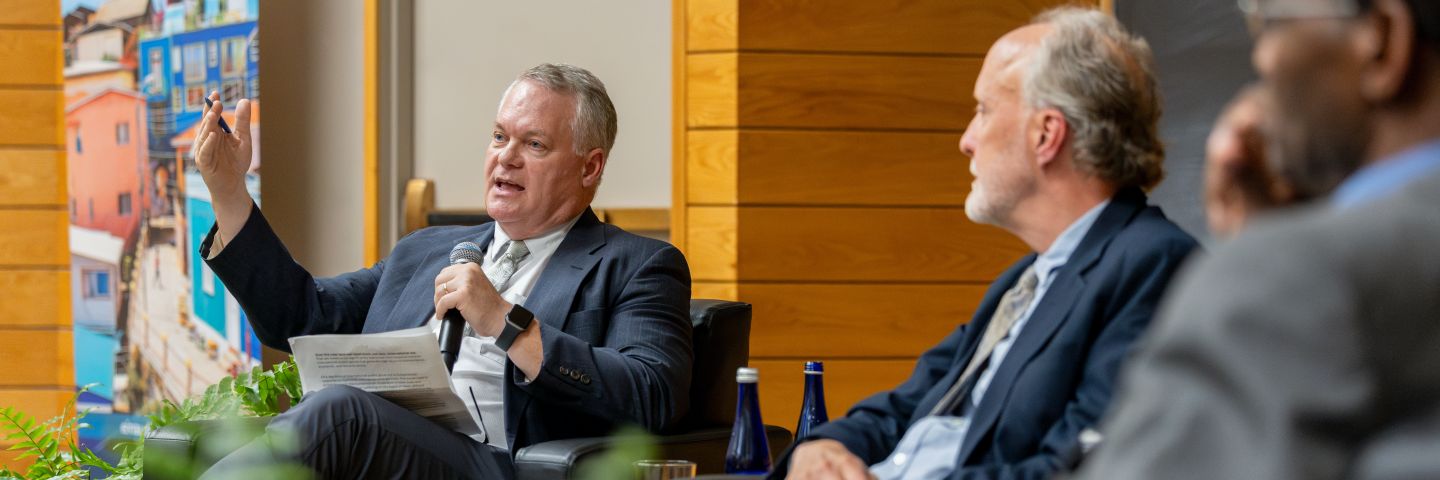
Obituary: George Lewis (1955-2026)
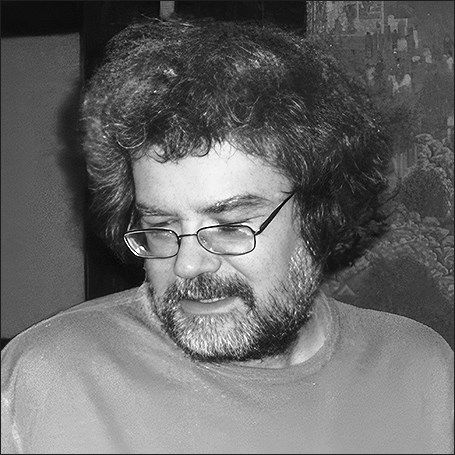
George Lewis III (1955-2026) was a visiting scholar at the Reppy Institute for Peace and Conflict Studies.
By David Wright (Cornell PhD, 1983)
George Lewis III (1955 – 2026) was born on May 10, 1955, in Orange, New Jersey to George Lewis II, an engineer in the aerospace industry, and Elizabeth (Connors) Lewis, a homemaker who later worked as voting registrar for Fairfax County, VA. He spent most of his childhood in Virginia and Florida.
George attended the University of Virginia as an undergraduate and started graduate school in physics at Cornell University in 1977. He received his PhD in experimental solid state physics in 1983 and then worked as a Research Associate in Cornell’s Applied Physics Department, researching ion-beam micro-fabrication technology.
During this time, he joined a group of Cornell graduate students involved in public education about nuclear weapons, and a group working on technical analyses of the Star Wars system, which had just been proposed. In 1987, he decided to switch fields and took a postdoctoral position in the Cornell Peace Studies Program (now the Reppy Institute for Peace and Conflict Studies). During the year he worked on the survivability of space-based components of the Star Wars system, and conventional force reductions in Europe.
The following year he was awarded an SSRC-MacArthur Foundation Fellowship on International Peace and Security, which he took to the Center for International Security and Arms Control (now the Center for International Security and Cooperation) at Stanford, and began working with Ted Postol. His research included arms control and verification for sea-launched cruise missiles and strategic early warning for cruise missiles.
In 1989, Ted took a professorship at MIT and George moved with him and became a researcher in the Defense and Arms Control Studies Program, now the Security Studies Program (SSP), as part of the Technology and Security Group. Within a couple of years, he became a Principal Research Scientist and Associate Director of SSP.
In 1989, George took part in the Black Sea Experiment, a verification project to measure radiation from a naval nuclear warhead on the Soviet cruiser Slava, which was set up by scientists from the Natural Resources Defense Council (NRDC) and the Kurchatov Institute of Atomic Energy to take advantage of glasnost.
In 1989 he also took part in the first of an annual series of meetings for young scientists around the world who were interested in research on security issues. Inspired by this meeting, he worked with three Physics colleagues from Cornell who had also switched fields (Valerie Thomas, Lisbeth Gronlund, and David Wright), to organize follow-on meetings aimed at increasing the international community of technical security researchers. The International Summer Symposiums on Science and World Affairs continued annually for 30 years. George attended 19 of the Symposiums and was actively involved in mentoring participants from more than 40 countries, many of whom went on to hold positions on technical security and arms control research in universities, at nongovernmental organizations, and for their governments and national laboratories.
In the 1990s, a major focus of his work with Ted Postol was investigating the performance of the Patriot missile defense system during the 1991 Gulf War, which included analyzing press videos of Patriot engagements. This work, which showed that Patriot had few, if any, successful intercepts, resulted in significant attention from Congress and the press.
George also worked on the proliferation of ballistic and cruise missiles and defenses against them, and the debate over the compatibility of new theater missile defenses and the Anti-Ballistic Missile Treaty. As part of this work, he testified to the Senate Foreign Relations Committee on May 3, 1994.
George also collaborated frequently throughout his career with Lisbeth Gronlund and David Wright of the Union of Concerned Scientists, primarily on issues related to ballistic missile defense.
In addition to research, George and Ted mentored a series of a dozen scholars who visited MIT from Russia, China, Germany, India, and Pakistan in the late 1990s and early 2000s.
In 2001, George, jointly with Lisbeth Gronlund and David Wright, was awarded the American Physical Society’s prestigious Joseph A. Burton Forum Award, “For creative and sustained leadership in building an international arms-control-physics community and for their own excellence in arms-control physics.”
In 2005, George moved back to Ithaca as a Senior Research Associate and Associate Director at Cornell’s Reppy Institute for Peace and Conflict Studies. In addition to continuing to follow missile defense and surveillance issues, his research included deep reductions in nuclear weapons, and security aspects of satellites and outer space. He also taught several courses in the engineering school on space and surveillance technology.
From 2012 to 2020, George published the blog Mostly Missile Defense, subtitled “Mostly missile defense (and some space surveillance), mostly from a technical perspective.” The blog was widely read in the technical community because George was fastidious about collecting information and press reports about these issues, and added technical details and analysis to his discussion. It continues to be a resource for researchers in the field.
In 2021, George moved back to the Boston area and became part of Prof. Scott Kemp’s Laboratory for Nuclear Security and Policy at MIT.
George was married to Hillary Rettig from 1992 through 2004, and they remained close friends until his death. Together, they fostered four South Sudanese refugee teenagers: Daniel Agok, Aleer Deng, Dau Nun, and Phillips Baguoot. Phillips soon emigrated to Australia, but George remained close to Daniel, Aleer, and Dau, and their wives and children. He greatly enjoyed being a grandfather.
George is survived by his sister and brother, Mary Johnson and Andrew Lewis, both of Virginia, and their families.
George was also a dog lover, who cherished his dogs Orbit, Comet, Elvis, Quasar, and Neutrino. His hobbies included science fiction, military history, and model making, and for many years he was an avid grower of African Violets.
Loved and respected for his kindness, generosity, personal and scientific integrity, and wonderful sense of humor, George was a unique and gentle soul who will be greatly missed.
Donations in George’s honor may be made to The Union of Concerned Scientists.
Security Publications
GN Lewis, SK Ride, JS Townsend,
Dispelling myths about verification of sea-launched cruise missiles
Science, 10 Nov 1989, Vol 246, Issue 4931, pp. 765-77.
GN Lewis, TA Postol,
Long‐range nuclear cruise missiles and stability
Science & Global Security, Vol. 3:1-2 1992.
GN Lewis, S Fetter, L Gronlund,
Casualties and damage from scud attacks in the 1991 Gulf war
MIT, March 1993.
S Fetter, GN Lewis, L Gronlund,
Why were Scud casualties so low?
Nature, 28 January 1993, pp. 293-296.
GN Lewis, TA Postol
Video evidence on the effectiveness of patriot during the 1991 gulf war
Science & Global Security 4:1, 1993.
Lisbeth Gronlund, George Lewis, Theodore Postol, and David Wright,
Highly Capable Theater Missile Defenses and the ABM Treaty
Arms Control Today (April 1994), p. 3.
Lisbeth Gronlund, George Lewis, Theodore Postol, and David Wright,
“The Weakest Line of Defense: Intercepting Ballistic Missiles,” in The Last 15 Minutes: Ballistic Missile Defense in Perspective, ed. J. Cirincione and F. von Hippel (Coalition to Reduce Nuclear Dangers, May 1996), pp. 45-60.
GN Lewis, TA Postol
Portrait of a bad idea
Bulletin of the Atomic Scientists, 1997.
GN Lewis, TA Postol
Future challenges to ballistic missile defense
IEEE Spectrum, 1997.
GN Lewis, TA Postol
Reply to 'Future challenges to ballistic missile defense' Paints wrong picture
IEEE Spectrum, 1997.
Lachlan Forrow, Bruce G. Blair, Ira Helfand, George Lewis, Theodore Postol, Victor Sidel, Barry S. Levy, Herbert Abrams, and Christine Cassel
Accidental nuclear war—A post–Cold War assessment
New England Journal of Medicine, April 30, 1998, 338:1326-1332.
GN Lewis, TA Postol, J Pike
Why national missile defense won't work
Scientific American, Vol. 281:2, 1999.
Harold A. Feiveson, Bruce G. Blair, Jonathan Dean, Steve Fetter, James Goodby, George N. Lewis, Janne E. Nolan, Theodore Postol, Frank N. von Hippel
The Nuclear Turning Point: A Blueprint for Deep Cuts and De-Alerting of Nuclear Weapons
Brookings Institution, 1999
George Lewis, Lisbeth Gronlund, and David Wright
National Missile Defense: An Indefensible System,
Foreign Policy (Winter 1999-2000), pp. 120-137. Reprinted in Nuclear Tensions in a New Era (Carnegie Endowment for International Peace, March 2000).
Andrew M. Sessler, John M. Cornwall, Bob Dietz, Steve Fetter, Sherman Frankel, Richard L. Garwin, Kurt Gottfried, Lisbeth Gronlund, George N. Lewis, Theodore A. Postol, David C. Wright
Countermeasures: A technical evaluation of the operational effectiveness of the planned US national missile defense system
Union of Concerned Scientists and MIT Security Studies Program, April 2000.
L. Gronlund, G. Lewis, and D. Wright,
Obsolete Before Deployment: Simple Countermeasures Could Defeat Planned NMD,
Guest Perspective, Inside Missile Defense, 28 June 2000.
Bob Dietz, Steve Fetter, Richard L. Garwin, Kurt Gottfried, Lisbeth Gronlund, George N. Lewis, Andrew M. Sessler, and David C. Wright
Response to Uzi Rubin's “Comments on the UCS Report on Countermeasures”
MIT, September 2000.
J.M. Cornwall, B. Dietz, S. Fetter, S. Frankel, R.L. Garwin, K. Gottfried, L. Gronlund, G.N. Lewis, T.A. Postol, A.M. Sessler, and D.C. Wright Response to Lt. Gen. Kadish’s testimony on missile defense (29 September 2000)
Inside Missile Defense, 4 October 2000, p. 1.
GN Lewis, TA Postol
Technical debate over patriot performance in the gulf war: American Physical Society panel correctly rejects criticisms of analysis showing patriot failed to destroy Scud warheads
Science & Global Security, Vol. 8:3, 2000.
L Gronlund, GN Lewis, DC Wright
The continuing debate on national missile defenses
Physics Today, 2000.
DC Wright, GN Lewis
Trading shots on missile defense
Foreign Policy, 2000.
DC Wright and GN Lewis
Comment on Deutch, Brown, and White article on boost-phase defense
Foreign Policy, Sept/Oct 2000, p. 6.
Lisbeth Gronlund, David Wright, George N. Lewis
Physics and National Security: Of Missiles, Mines, and Morality
Physics Today, Vol. 54:7, July 2001
G. Lewis, L. Gronlund, and D. Wright,
Will Missile Defense Work? Only Realistic Testing Will Tell
Guest Perspective, Inside Missile Defense, 31 October 2001, p. 12-14.
GN Lewis, L Gronlund
Debunking the missile defense agency's' endgame success' argument
Arms Control Today, 2002.
L Gronlund, DC Wright, GN Lewis, PE Coyle III
Technical realities: An analysis of the 2004 deployment of a US national missile defense system
Union of Concerned Scientists, 2004
GN Lewis, TA Postol
European missile defense: the technological basis of Russian concerns
Arms Control Today, 2007.
GN Lewis, TA Postol
The European missile defense folly
Bulletin of the Atomic Scientists, 2008.
GN Lewis, TA Postol
A flawed and dangerous US missile defense plan
Arms Control Today, 2010.
GN Lewis, TA Postol
How US strategic antimissile defense could be made to work
Bulletin of the Atomic Scientists, 2010.
GN Lewis and TA Postol
A Technically Detailed Description of Flaws in the SM-3 and GMD Missile Defense Systems Revealed by the Defence Department's Ballistic Missile Test Data
MIT, 2010.
GN Lewis, TA Postol
The Astonishing National Academy of Sciences Missile Defense Report
Bulletin of the Atomic Scientists, 2012.
TA Postol, GN Lewis
The Illusion of Missile Defense: Why THAAD Will Not Protect South Korea: Why THAAD Will Not Protect South Korea
Global Asia, 2016.
L Grego, GN Lewis, DC Wright
Shielded from Oversight: The Disastrous US Approach to Strategic Missile Defense,
Union of Concerned Scientists, 2016.
GN Lewis
Ballistic missile defense effectiveness
AIP Conference Proceedings, 2017.
George Lewis and Frank von Hippel
Limitations on ballistic missile defense—Past and possibly future
Bulletin of the Atomic Scientists, 2018.
George Lewis and Frank von Hippel
Improving U.S. Ballistic Missile Defense Policy
Arms Control Today, May 2018
These included Anatoli Diakov (10/94-1/95), He Yingbo (7/97-8/98), Timur Kadyshev (11/92-8/93, and 10/95-1/96), Li Bin (8/94-8/95), Eugene Miasnikov (11/91-8/92, 8/93-12/93, and 7/96-8/96), Pavel Podvig (3/92-12/92, 6/94-8/94, 7/95-8/95, and 7/97-12/98), M.V. Ramana (9/96-8/98), Alexei Romanov (2/93-8/93), A.H. Toor (6/01-1/02), Qui Yong (1/01-4/03), Alexander Glaser (9/01-8/03), Wu Chunsi.