
East Asia Program
Japan Warns Citizens in China About Safety as Diplomatic Crisis Deepens

Allen Carlson, EAP/SAP
Allen Carlson, a Cornell University expert on China's foreign policy, provided analysis on the worsening tensions between Japan and China.
Additional Information
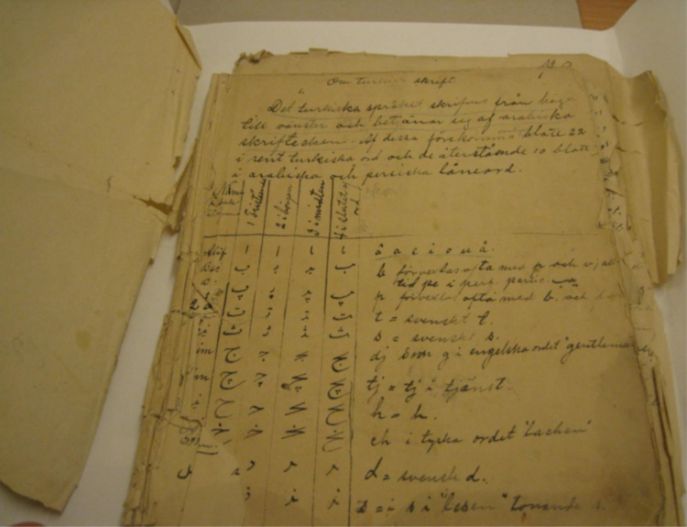
Protecting the Past, Present, and Future: Uyghur Culture and History in Swedish Archives and Museums
December 3, 2025
4:30 pm
Uris Hall, G-08
Speaker: Dr. Patrick Hällzon, Postdoctoral, Uppsala University, Department of Linguistics
Talk Description: Swedish archives host some of the world’s largest collections of early-20th-century Uyghur material culture and written sources. This consists of manuscripts, printed books, photographs, as well as artifacts including medicine and seed collections. Many of the sources have been digitized and are freely accessible online for the general public. In the presentation I will discuss how I have used these sources in my current research project and what they can tell us about oasis life in Eastern Turkestan before the area became incorporated into the People’s Republic of China under the term Xinjiang Uyghur Autonomous Region.
Additional Information
Program
Einaudi Center for International Studies
East Asia Program
Southwest Asia and North Africa Program
Zhen Huo
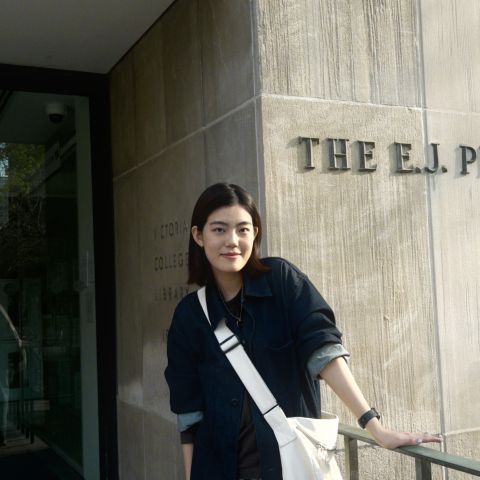
Graduate Student
Degree Pursued: MA
Anticipated Degree Year: 2027
Discipline: Asian Studies
Primary Countries: Japan
Research Interests: Modern Japanese History
Additional Information
Yuhua Zhou

Graduate Student
Degree Pursued: MA
Anticipated Degree Year: 2027
Discipline: Asian Studies
Research Interests: Contemporary Chinese Poetry in 1980s and 1990s
Additional Information
Arivan Shanmugaratnam
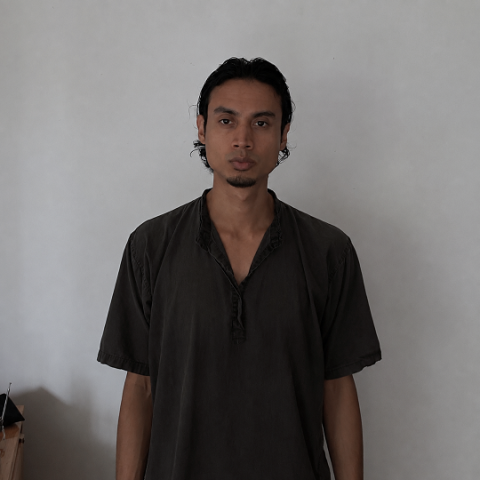
Graduate Student
Degree Pursued: PhD
Discipline: Sociology
Research Interests: Political Sociology, Social Change, Development, Economic Sociology, Cultural Sociology, Social Theory
Additional Information
East Asian Law Workshop Supports the Next Generation of Research Scholars
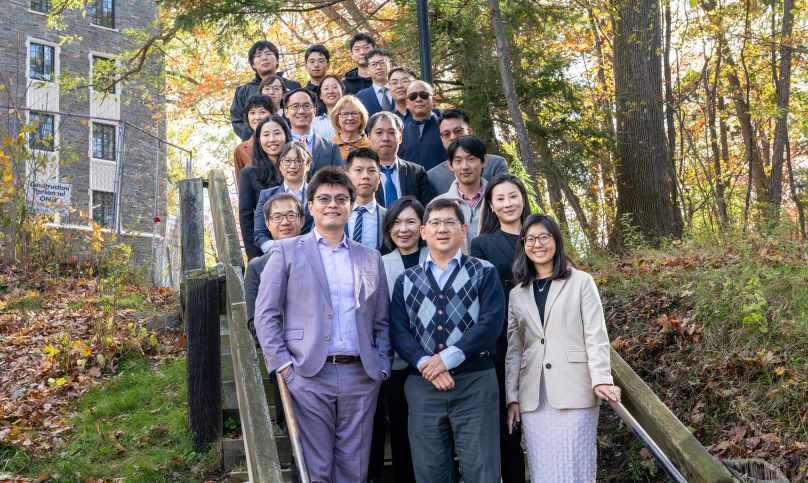
A two-day workshop entitled “Empirical Legal Studies in the Sinophone Region”
Additional Information
Multiple Diasporas: The Class and Geopolitical Dimensions of Chinese Migration to Malaya and Singapore

December 5, 2025
4:30 pm
281 Ives Faculty Wing, Doherty Room
This multi-disciplinary panel brings together scholars studying Chinese migration to 20th century Malaya and contemporary Singapore. The overarching concern is to assess how geopolitics and class differentiation have shaped the experiences of Chinese migrants to the region as well as their local reception. The speakers hail from anthropology, labor relations, and history, and will discuss the experiences of Chinese university students in Singapore amid a rapidly shifting geopolitical landscape; the responses and interactions of local industrial workers towards their migrant counterparts, including Chinese workers, in contemporary Singapore; and how racialized citizenship policies in Cold War-era Malaya and Singapore reshaped the Chinese diaspora's relationship to China.
Panelists:
Zach Howlett, Associate Professor, Sociology and Anthropology, National University of Singapore
Wen Li Thian, PhD student, ILR, Cornell University
Darren Wan, PhD student, History, Cornell University
Moderator: Shaoling Ma, Associate Professor, Asian Studies, Cornell University
Additional Information
Program
Einaudi Center for International Studies
Southeast Asia Program
East Asia Program
World in Focus: Gaza–Israel Conflict: Regional and International Impacts

November 11, 2025
4:00 pm
Uris Hall, G08
Join Einaudi Center experts for World in Focus Talks on global events in the news and on your mind. Our faculty's research and policy insights put the world in focus.
This year we’re hosting informal campus discussions on many Tuesday afternoons. This week’s topic:
The Gaza–Israel conflict escalated dramatically in October 2023, following Hamas's attack on Israel and Israel's subsequent military campaign in Gaza. After intense fighting that caused massive Palestinian casualties and displacement, a ceasefire and the outline of a peace agreement have been announced. These events will have far-reaching consequences for the region and the world: heightening political and security tensions in the Middle East, disrupting international humanitarian and legal systems, and straining international relations.
How is the Gaza–Israel conflict transforming the Middle East and challenging the international order?
***
Featured Speakers
Sandra Babcock (SEAP) | Law SchoolAlexandra Blackman (SWANA) | GovernmentEsam Boraey (PACS, Migrations) | GovernmentPeter Katzenstein (IES, PACS) | GovernmentJoseph Margulies (PACS) | GovernmentJake Silver | Near Eastern StudiesChantal Thomas (IAD) | Law School
***
Conversations Matter at Einaudi
This conversation is hosted by the Mario Einaudi Center for International Studies and its regional and thematic programs. Find out what's in store for students at Einaudi!
Additional Information
Program
Einaudi Center for International Studies
Reppy Institute for Peace and Conflict Studies
East Asia Program
Southeast Asia Program
Latin American and Caribbean Studies
Institute for African Development
Institute for European Studies
South Asia Program
Migrations Program
Southwest Asia and North Africa Program
Einaudi Kicks Off Yearlong Conversation on Foreign Aid
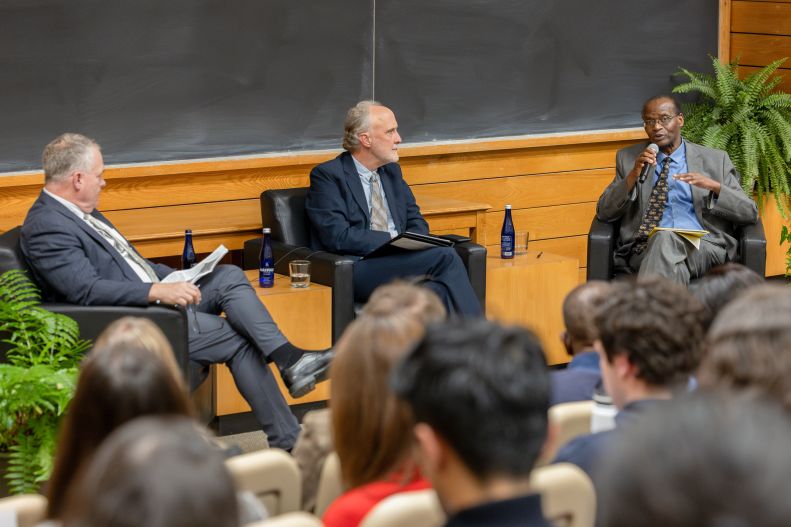
Lund Debate 2025
Undergraduate Global Scholars joined debaters to discuss “Is (Cutting) International Aid Good?”
For decades, international aid mainly flew under the radar of public opinion. Politicians from across the ideological spectrum lauded programs that saved lives, nurtured democracy, and promoted American values and interests. Except during wars and natural disasters, aid was rarely in the news.
That changed on January 20, 2025, when President Donald J. Trump issued an Inauguration Day executive order freezing all U.S. foreign assistance. Within weeks, Secretary of State Marco Rubio closed the headquarters of the U.S. Agency for International Development (USAID) and canceled 83% of the agency’s programs. Suddenly, foreign aid was at the center of an intense debate over national priorities and America’s place in the world.
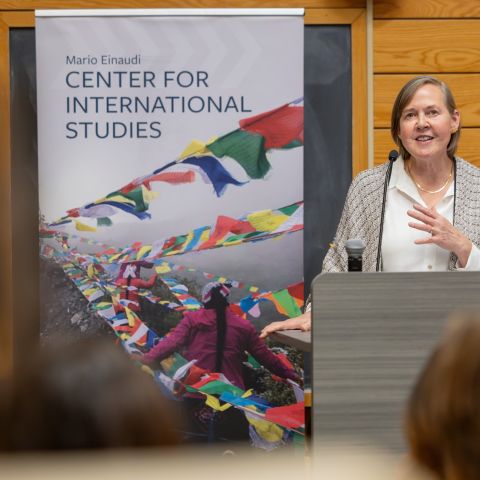
January 20 was also the day that political scientist Ellen Lust arrived at Cornell to direct the Mario Einaudi Center for International Studies as the John S. Knight Professor of International Studies. One of her first actions was selecting a theme to guide the center’s programming and provide a focus for its Undergraduate Global Scholars for the 2025–26 academic year.
Lust, who is also a professor in the Cornell Jeb E. Brooks School of Public Policy and the Department of Government in the College of Arts and Sciences, chose “Is (Cutting) International Aid Good?” She said she meant the simple, yes-or-no question to be provocative at a university where “everyone understands how complex these issues really are.”
“We have faculty, students, and staff engaged in food security, agriculture, development, public health, nutrition, education, economics, international relations, area studies, and so many other fields,” Lust said. “My hope was that this could provide an opportunity for us all to put our heads together and think about what can be done in the future.”
Lust recruited international development specialist Paul Kaiser to lead the conversation as the Einaudi Center’s practitioner in residence. Kaiser has worked on public policy and education reform in sub-Saharan Africa, South and Southeast Asia, and the Pacific Islands, with agencies including USAID, the Millennium Challenge Corporation, and the World Bank.
“There have always been legitimate questions about aid dependency and corruption and the effectiveness of aid, but we’re facing a much more existential question, which is should there be any aid at all?”
“For me, aid starts off as a moral issue, but it's also an economic issue, it's a political issue, it's a social issue,” Kaiser said. “There have always been legitimate questions about aid dependency and corruption and the effectiveness of aid, but we’re facing a much more existential question, which is should there be any aid at all?”
That question was on the table at Einaudi’s Lund Critical Debate, which Kaiser moderated on October 22 in a packed Lewis Auditorium in Goldwin Smith Hall. The debaters were Cornell faculty members Chris Barrett, an agricultural economist and food policy expert, and Muna Ndulo, an expert in international law and governance.
“We need more, not less aid,” argued Barrett, the Stephen B. and Janice G. Ashley Professor of Applied Economics and Management in the Dyson School of Applied Economics and Management and a professor in the Cornell Brooks School of Public Policy. “We need it for moral reasons, for security reasons, and for economic reasons. But it needs to be fundamentally different than it has been in the past.”
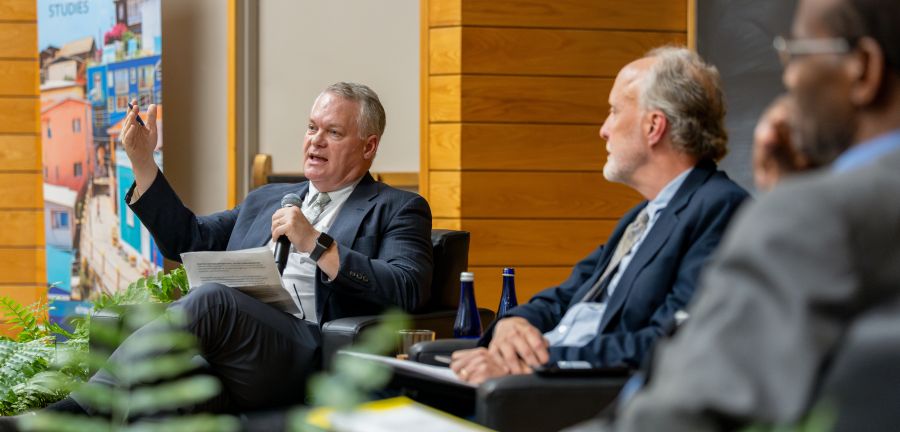
Specifically, he said, “we need less bilateral aid—that is, government-to-government aid to support country-specific things—and we need far more aid for what some of us term ‘international public goods’—for things that cut across the global community.”
“We need more, not less aid. We need it for moral reasons, for security reasons, and for economic reasons. But it needs to be fundamentally different than it has been in the past.”
Those include agricultural and biomedical research, infectious disease monitoring and prevention, emergency response, and climate change mitigation. “These are things that we underinvest in massively” despite their high long-term economic returns, Barrett said. Most are better delivered by multilateral agencies and organizations than by individual governments, he said.
Ndulo, the William Nelson Cromwell Professor of International and Comparative Law at Cornell Law School, agreed that aid can be helpful and sometimes essential, but he said it can also do damage. “A constant feature in the field of development is the firm belief that low-income countries will always be poor and desperately in need of foreign assistance,” he said. “This mentality shapes the sorts of solutions that get fostered in those countries.”
Ndulo and Barrett both observed that aid often prioritizes donor countries’ interests over those of the recipients. Increasingly, Ndulo said, donors are conditioning aid on recipients’ willingness to support their foreign policy objectives. Overall, Ndulo said, aid has less impact than international trade, foreign direct investment, or remittances from people working abroad.
“If we focus more on fairer ways of trading,” he said, “we might not need as much aid.”
The Future of Aid
Rethinking the future of aid is the assignment for the 15 Undergraduate Global Scholars selected by the Einaudi Center in October. Over the course of the year, they will meet with experts, conduct research, and take part in discussions and events.
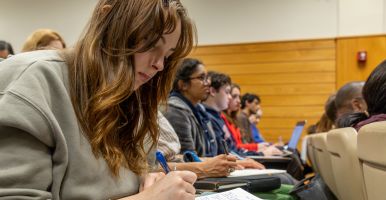
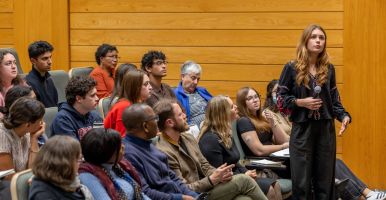
“For me, it’s personal,” said Sarvesh Prabhu ’28, who studies entomology and environmental sustainability in the College of Agriculture and Life Sciences. As a teenager, Prabhu worked at an international agricultural research center in his native India. He could see how important agriculture was to the nation’s development, but he also saw how aid could undermine the country’s sense of self-determination.
Ariela Asllani ’26 also feels a personal connection. A public policy major in the Brooks School, she grew up in Albania with parents who housed war refugees from Kosovo in the 1990s. She said Kosovars were grateful for U.S. aid, even erecting a statue of President Bill Clinton after the war ended. But many of the programs the Americans started collapsed after they left, and she has witnessed how aid can fuel corruption and crime. “My interest is the intersection of military, intelligence, law enforcement, and humanitarian aid actors,” she said.
“I’ve noticed a change in the conversation around aid,” said Iskander Khan ’26, a government major in the College of Arts and Sciences. “People will talk about it in a humanitarian sense, then when they’re pushed, they justify it as a security issue. I thought these were two very different things. But the discussions we’ve been having make me realize that they’re a lot more intertwined than I realized.”
The Einaudi Center’s Lund Critical Debate Series is made possible by the generosity of Judith Lund Biggs ’57. Watch the video of the debate below. The future of aid will also be the subject of Einaudi’s 2026 Bartels World Affairs Lecture, to be delivered by former USAID administrator Samantha Power in April.
Story by Jonathan Miller. All photos by Simon Wheeler.
Additional Information
Information Session: East Asia Program Funding

November 18, 2025
2:00 pm
Uris Hall, 153
The East Asia Program (EAP) offers several funding opportunities to support student research and study related to East Asia.
Applications open Friday, November 14, 2025.
In person or join virtually: https://cornell.zoom.us/j/96326164591?pwd=blycNanfjyZvIATeenFOxSKAfEFLv….
Can't attend? Contact eap@cornell.edu.
Additional Information
Program
Einaudi Center for International Studies
East Asia Program