
East Asia Program
International Fair

August 28, 2024
11:00 am
Uris Hall, Terrace
International Fair showcases Cornell's global opportunities for undergraduate and graduate students. Explore the fair and find out about international majors and minors, language study, study abroad, funding opportunities, global internships, Cornell Global Hubs, and more.
The International Fair is sponsored by the Mario Einaudi Center for International Studies and Office of Global Learning (both part of Global Cornell) in partnership with the Language Resource Center.
Register on CampusGroups to receive a reminder. Registration is not required.
Additional Information
Program
Einaudi Center for International Studies
Reppy Institute for Peace and Conflict Studies
East Asia Program
Southeast Asia Program
Latin American and Caribbean Studies
Institute for African Development
Institute for European Studies
South Asia Program
Tang Ao-qing and Lu Jiaxi: A Story of China and America
May 6, 2024
4:00 pm
Physical Sciences Building, 120
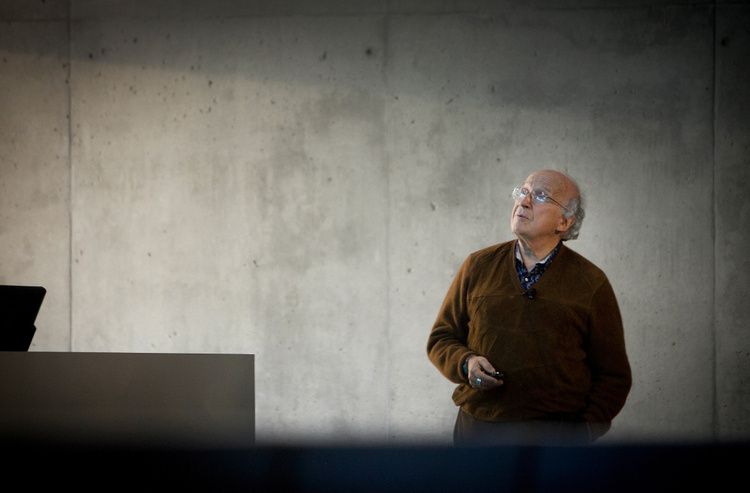
Join us for this talk by Roald Hoffmann, Nobel laureate in chemistry and Frank H. T. Rhodes Professor of Humane Letters, Emeritus, at Cornell.
At this event, Hoffmann pays tribute to his former colleagues Tang Ao-Qing (1915–2008, former president of Jilin University) and Lu Jiaxi (1915–2001, former president of the Chinese Academy of Sciences), who received their advanced degrees in the U.S. and became founders of theoretical and physical chemistry in the People’s Republic of China. Hoffmann discusses how they returned to their homelands during a period of uncertainty, and how they forged their lives and careers through political and social upheavals. Hoffmann also shares his experiences as a scientist who migrated to America, while recounting how he came to know and appreciate these remarkable chemists—including the role Cornell University Library played in first exposing him to their work.
Refreshments will be provided following the event at the West Pavilion.
Can't attend in person? Register for the livestream.
Additional Information
Program
Southeast Asia Program
East Asia Program
Biden's Tariff Warnings Signal Sharp Anti-China Election Battle

Allen Carlson, CMSP, EAP, SAP
"China is inevitably getting drawn into what's likely to be a little bit of a chaotic cycle. And I think really, right now, we're just seeing the beginnings of that," says Allen Carlson, professor of government and expert on U.S.-China relations.
Additional Information
Why Biden Wants to Raise Tariffs on Chinese Steel

Nancy Chau, CMSP, EAP, SAP
Allen Carlson, associate professor of government, and Nancy Chau, professor of economics, explain the rationale behind raising tariffs on Chinese steel.
Additional Information
Pandemic Archives: Media, Geopolitics, and Temporalities of Crisis
Belinda Kong (Asian Studies and English, Bowdoin College) explored the cultural archive of the 2003 SARS pandemic.
Book Talk with Vanessa Chan
April 26, 2024
12:00 pm
Kahin Center
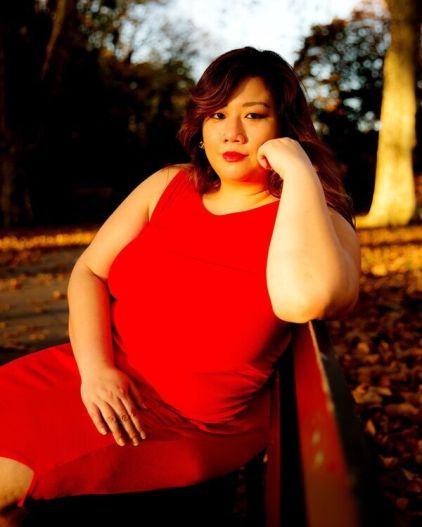
Join us for a discussion with Vanessa Chan about her book, “The Storm We Made” - a dazzling saga about the horrors of war; the fraught relationships between the colonized and their oppressors, and the ambiguity of right and wrong when survival is at stake.
Participants should ideally have read the book, where possible!
About the Speaker
VANESSA CHAN is the Malaysian author of internationally bestselling The Storm We Made (Marysue Rucci Books, Jan 2024), Good Morning America Book Club Pick and BBC Radio 2 Book Club pick. The novel, her first, will be translated into more than twenty languages worldwide. Her other work has been published in Vogue, Esquire, and more. Vanessa grew up in Malaysia and is now based mostly in Brooklyn.
Additional Information
Program
Einaudi Center for International Studies
East Asia Program
Southeast Asia Program
Uyghur Human Rights Project Bibliography

Magnus Fiskesjö in World in Focus
Magnus Fiskesjö recently updated the Uyghur bibliography he began in 2017. The bibliography is hosted by the Uyghur Human Rights Project, "one of the most active and well-known organizations dedicated to the issue," he says.
"I refer to the bibliography in my Cornell course Genocide Today: The Erasure of Cultures, which I have taught four times so far."
Since 2017, the Chinese government has imprisoned more than one million Uyghurs and Kazakhs in China's far-northwest region of Xinjiang and committed systematic human rights violations—including forced labor, religious restrictions, family separations, and sterilizations—against the region's mostly Muslim ethnic groups.
Fiskesjö launched the bibliography project to collect news reports, documents, and research on the abuses as they unfolded.
"I started the bibliography on a personal basis, just to keep track of important news on the issue," he said. "Then I was happy to have it hosted publicly so others can benefit."
The bibliography now runs to more than 2,300 pages. It is searchable by topics like eyewitness accounts, forced labor, heritage destruction, reproductive abuse, organ harvesting, and Chinese tourism as propaganda.
Magnus Fiskesjö is a Reppy Institute for Peace and Conflict Studies steering committee member and core faculty in the East Asia Program and Southeast Asia Program.
Featured in World in Focus Briefs
Additional Information
Critics Slam Apple CEO Tim Cook for Laudatory Remarks in China
Eli Friedman, EAP
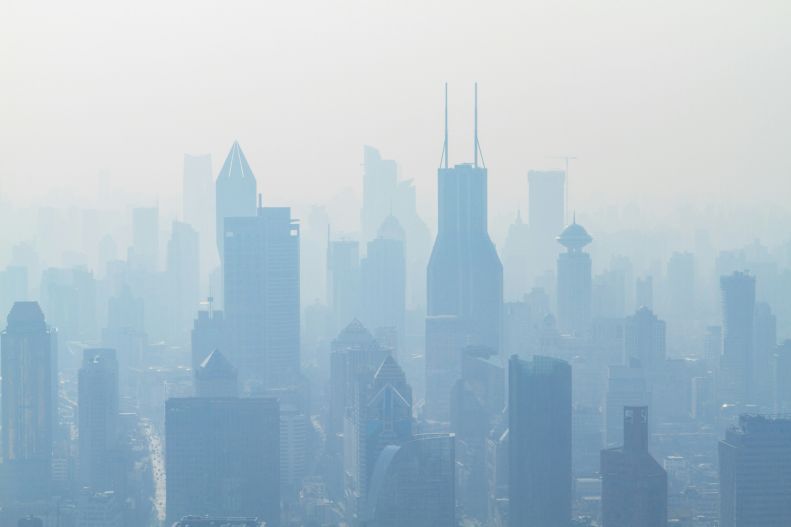
Eli Friedman, associate professor of global labor and work at Cornell University, said the past mutually beneficial relationship between Beijing and American companies is no longer playing a diplomatic role.
He wrote, "Throwing Apple some treats will not help stabilize the U.S.-China relationship, I promise."
Additional Information
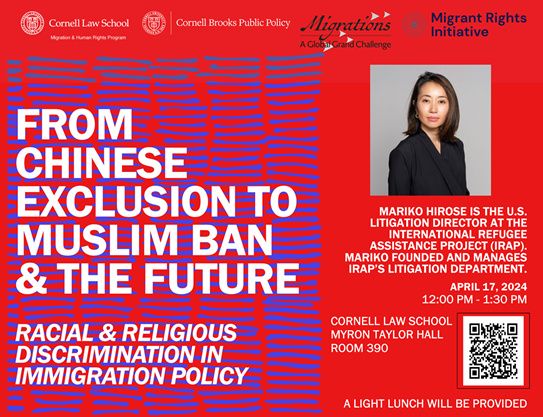
From Chinese Exclusion to Muslim Ban & The Future
April 17, 2024
12:00 pm
Myron Taylor Hall, 390
A light lunch will be provided.
Register in advanced to attend.
About the Speaker
Mariko Hirose is the U.S. Litigation Director at IRAP. In this role, Mariko founded and manages IRAP’s litigation department.
Prior to joining IRAP, Mariko worked at the New York Civil Liberties Union where she litigated a broad range of cases and coordinated integrated advocacy efforts. Her previous experiences also include litigating civil rights cases at Outten & Golden LLP and at the American Civil Liberties Union; teaching as an Adjunct Professor of Law at the New York University School of Law and at the Fordham University School of Law; and clerking for the Honorable Stephen Reinhardt of the U.S. Court of Appeals for the Ninth Circuit.
Mariko is a graduate of Stanford Law School and Yale University. She grew up primarily in Japan and spent time in China before law school as a Yale-China Teaching Fellow.
Mariko is a member of the New York bar.
Host and Sponsors
This event is hosted by Cornell Law School. Cosponsored by the Migrations initiative, part of Global Cornell.
Additional Information
Program
Einaudi Center for International Studies
East Asia Program
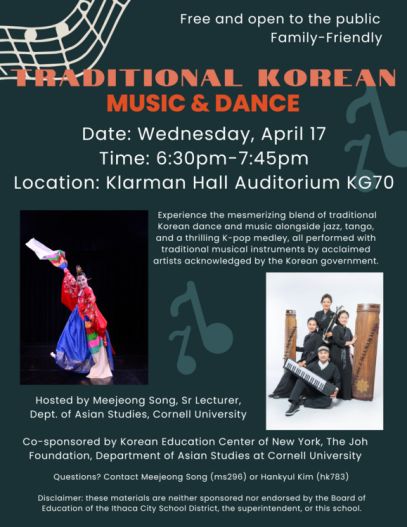
Traditional Korean Music and Dance
April 17, 2024
6:30 pm
Klarman Hall, Auditorium KG70
Immerse yourself in Korean culture!
The Korean Language Program invites you to a Traditional Korean Music and Dance Concert featuring acclaimed performers.
Join us for a dynamic evening of cultural fusion at Cornell University! Experience the mesmerizing blend of traditional Korean dance and music alongside jazz, tango, and a thrilling K-pop medley, all performed with traditional musical instruments by acclaimed artists acknowledged by the Korean government. This free event is open to all, so invite your friends and family to witness the seamless integration of diverse musical genres in a celebration of Korean heritage. Don't miss this unique opportunity to be transported through a captivating journey of dance, sound, and rhythm!
Hosted by Meejeong Song, Sr. Lecturer and Coordinator for the Korean Language Program at Cornell
Co-sponsored by Korean Education Center of New York, The Joh Foundation, Department of Asian Studies at Cornell University
Additional Information
Program
East Asia Program