
East Asia Program
Deprovincializing the Dhamma: Internal Conversions, and the Micropolitical Management of ‘Harmony’ via Inter-Asian Buddhist Movements."

April 15, 2022
12:00 pm
Rockefeller Hall, 374
Please join us for a talk by Neena Mahadev (Yale-NUS).
The Cornell Buddhist Studies Seminar Series is co-sponsored by the GPSA-FC, the Departments of Anthropology, Asian Studies and Philosophy, by the South Asia Program, and by the Society for the Humanities. The talk is open to all members of the Cornell community; for accessibility queries please contact buddhiststudies@cornell.edu
Additional Information
Program
East Asia Program
Southeast Asia Program
South Asia Program
Food and Field-work-Asia: Graduate Symposium
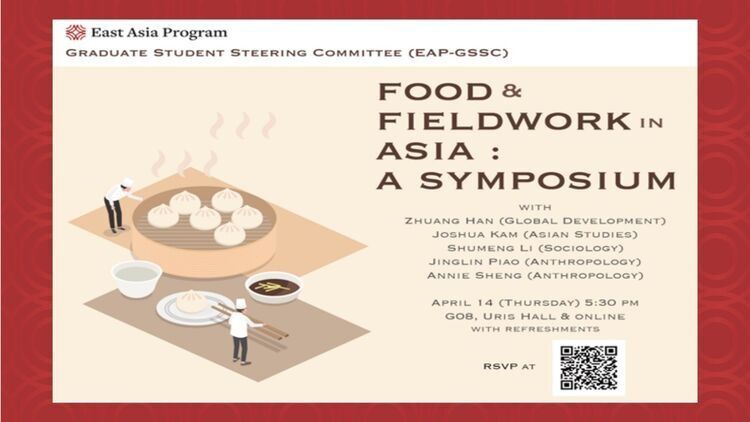
April 14, 2022
5:30 pm
Uris Hall G08, G08
When travel is restricted during the pandemic, join EAP-GSSC’s symposium on “Food and Fieldwork” for a fulfilling journey. Emerging Cornell scholars from anthropology, sociology, development, and Asian studies will share their methodologies of fieldwork and stories of food. After a food trip to borderland Yunnan with Zhuang Han (Global Development), get a taste of Hainanese "western" food in Malaysia with Joshua Kam (Asia Studies), then indulge in the realm of bread with Annie Sheng (Anthropology); explore how organic food has been brought from farm to table with Shumeng Li (Sociology), and head to Sichuan for rituals of food with Jinglin Piao (Anthropology). HYBRID event. The in-person location is Uris Hall G08. Light refreshments will be served but rsvp is required and limited only to Cornell community members. Please rsvp for in-person participation using https://cornell.ca1.qualtrics.com/jfe/form/SV_6hy6iNesrTXeZxk
For online participation, please see the Zoom registration link below.
Additional Information
Program
Einaudi Center for International Studies
East Asia Program
Nobel Laureate Leymah Gbowee: Forging Lasting Peace

May 3, 2022
5:00 pm
Alice Statler Auditorium
Forging Lasting Peace: Movements for Justice in a Pluralist World (Bartels World Affairs Lecture)
In our ethnically, racially, linguistically, and religiously diverse world, how do we find common ground? Amid ongoing conflict and violence, how do we foster lasting peace? In our world full of inequalities, what practices of activism and solidarity lead to transformative change? Drawing on her experiences of mobilizing, demanding, and brokering peace, 2011 Nobel Peace Prize winner Leymah Gbowee shares how action and activism can shape a just world.
A book signing and reception with refreshments will follow the lecture.
Lecture: 5:00–6:30 p.m. | Alice Statler AuditoriumBook signing and reception: 6:30–7:30 p.m. | Park AtriumFree ticket required for in-person attendance: Reserve your ticket. Join the lecture virtually by registering at eCornell.
***
Learn more about our distinguished speaker by reading her book, Mighty Be Our Powers: How Sisterhood, Prayer, and Sex Changed a Nation at War. Pick up your copy from The Cornell Store and bring it to the book signing! Buffalo Street Books will also have copies for sale at the event.
***
How did Leymah Gbowee's protests lead to lasting peace? Read a Bartels explainer by Naminata Diabate.
***
About Leymah Gbowee
Nobel Peace laureate Leymah Gbowee is a Liberian peace activist, trained social worker, and women's rights advocate. She currently serves as executive director of the Women, Peace, and Security Program at Columbia University's Earth Institute and is the founder and current president of the Gbowee Peace Foundation Africa, founding head of the Liberia Reconciliation Initiative, and cofounder and former executive director of the Women, Peace, and Security Network Africa. She is also a founding member and former Liberian coordinator of Women in Peacebuilding Network/West Africa Network for Peacebuilding.
Host and Sponsors
The Bartels World Affairs Lecture is a signature event of the Mario Einaudi Center for International Studies. Part of Einaudi's work on Inequalities, Identities, and Justice, this year's lecture is cosponsored by Einaudi's Institute for African Development and Reppy Institute for Peace and Conflict Studies, in cooperation with Peace is Loud. To learn more about Peace is Loud and discover other empowering women peacebuilders, visit www.peaceisloud.org.
Bartels World Affairs Lecture
The Einaudi Center’s flagship event brings distinguished international figures to campus each academic year to speak on global topics and meet with Cornell faculty and students, particularly undergraduates. The lecture and related events are made possible by the generosity of Henry E. Bartels ’48 and Nancy Horton Bartels ’48.
Additional Information
Program
Einaudi Center for International Studies
Reppy Institute for Peace and Conflict Studies
Institute for African Development
East Asia Program
Southeast Asia Program
Latin American and Caribbean Studies
Institute for European Studies
South Asia Program
2041: How Chinese Science Fiction Imagines Our Future
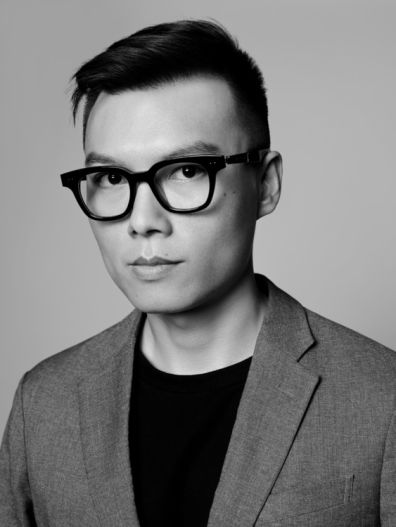
April 28, 2022
7:30 pm
Lecture and panel with Qiufan Chen.
The greatest value of science fiction is not providing answers, but rather raising questions.
Can AI help humans prevent the next global pandemic by eliminating it at the very root? How can we deal with future job challenges? How can we maintain cultural diversity in a world dominated by machines? How can we teach our children to live in a society where humans and machines coexist?
Welcome to 2041!
Qiufan Chen (Stanley Chan) is an award-winning Chinese speculative fiction author, translator, and curator. His major works include Waste Tide (Locus Best New Novel Finalist), as well as short story collections Future Diseases and Algorithms for Life, which have won him three Chinese Galaxy Awards and fifteen Chinese Nebula Awards. His recent works include AI 2041 (with Dr. Kai-Fu Lee), in which he imagines our world in 2041 and how it will be shaped by AI.
In dialogue with Prof. Andrea Bachner and Prof. Anindita Banerjee and facilitated by Song Han, PhD candidate in the Department of Comparative Literatures.
Co-sponsored by Comparative Literature and Asian Studies.
Additional Information
Program
East Asia Program
Einaudi Center for International Studies
Why China Won't Get Dragged Into Russia's War on Ukraine
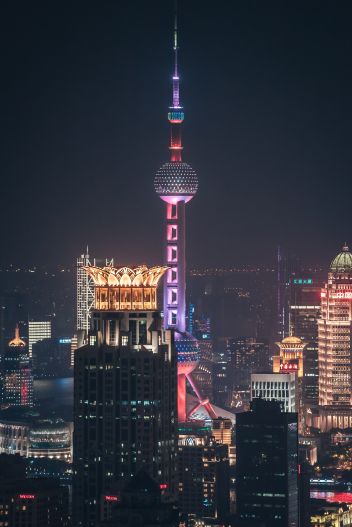
Allen Carlson, CMSP/EAP/SAP
“On the world stage, China appears to be the only friend that Russia has left. But it would be a mistake to overstate the strength of such seeming Sino-Russian friendship,” says Allen Carlson, associate professor of government. “President Xi Jinping is highly unlikely to allow China to get dragged into the conflict through providing direct military support to Russia.”
Additional Information
Survivor of Chinese Concentration Camp Urges Solidarity with Uyghur Women
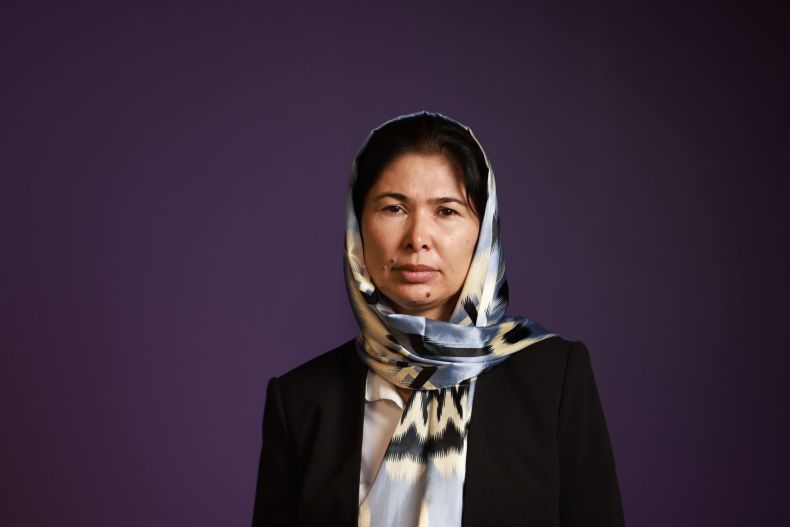
In honor of International Women’s Day
In a March 7 webinar, coinciding with International Women’s Day, Uyghur Muslim and Xinjiang concentration camp survivor Tursunay Ziyawudun spoke on the human rights violations against women she witnessed and survived during her two detentions. The event was hosted by the East Asia Program, moderated by Prof. Allen Carlson, Government and facilitated by Prof. Magnus Fiskesjö, Anthropology.
Additional Information
The 2022 Kyoko Selden Memorial Translation Prize in Japanese Literature, Thought, and Society

the eighth and final competition. The deadline for submissions for this year’s competition is August 1, 2022.
Deadline for submissions: August 1, 2022. The Department of Asian Studies at Cornell University wishes to announce the eighth and final Kyoko Selden Memorial Prize in Japanese Literature, Thought, and Society.
The 2022 Kyoko Selden Memorial Translation Prize in Japanese Literature, Thought, and Society
With gratitude to our many generous donors and all previous participants, The Department of Asian Studies at Cornell University wishes to announce the eighth and final Kyoko Selden Memorial Prize in Japanese Literature, Thought, and Society. The deadline for submissions for this year’s competition is August 1, 2022.
The prize, established in 2014 with contributions from former students, colleagues, and friends, honors the scholarly legacy of Cornell University’s Kyoko Selden (1936-2013). A scholar whose work as critic, editor, and translator ranged from engagement with courtly and medieval texts through contemporary Japanese writings addressing urgent social issues, Kyoko Selden was a beloved teacher of broad-ranging scope. By offering the award to translations still at the unpublished stage, the Kyoko Selden Translation Prize has been committed to supporting and encouraging translation and publication of Japanese language materials across a similarly broad range. Winning submissions have been made available online, when feasible, with the support of the Asia-Pacific Journal: Japan Focus.
The 2022 competition will offer one award in each of two categories noted below for unpublished translations:
- Translators who are previously unpublished (excluding work for commercial or professional translation services), $2,500.
- Translators of previously published work, $2,500.
Prize selections will take into account both the quality of the translation and the significance of the original work. In cases where a text already published in English is deemed worthy of retranslation, new translations of significant texts are accepted (please provide date and place of earlier publication).
Applicants are encouraged to submit translations electronically to seldenprize@cornell.edu. If you wish to submit hard copies, please send them to the Kyoko Selden Memorial Translation Prize, Department of Asian Studies, 350 Rockefeller Hall, Cornell University, Ithaca, NY 14853. The required documents are:
- One copy of the unpublished translation
- One copy of a statement of up to 1,000 words explaining the significance of the text. Please identify the category of award for which you are applying in this statement. Although we do not require that the translator has already obtained permission to publish the translation from the copyright holder, please include in the statement information about whether preliminary inquiries have been made or whether or not the work is in the public domain.
- One copy of the original Japanese text (if you are otherwise submitting electronically, but find it more convenient to submit this portion of the material in hard copy, please indicate that in your statement).
- A brief c.v. of the translator
The maximum length of a submission is 20,000 words. In case of translation of longer works, submit an excerpt of up to 20,000 words. Repeat submissions are welcomed. Please note again that the closing date for the prize competition this year will be August 1, 2022. The winners will be informed by November 1, 2022.
Please send questions to seldenprize@cornell.edu.
Additional Information
U.S. Response to Ukraine Invasion Sows Further Doubts about Defending Taiwan
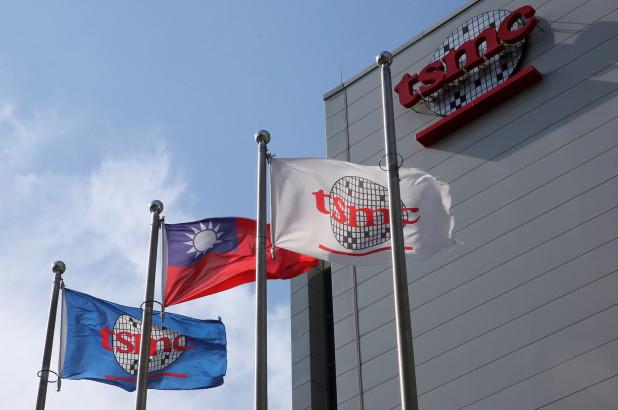
Allen Carlson, EAP/SAP/CMSP
“America’s abrupt and chaotic withdrawal from Afghanistan underscored worries as it raised questions about Washington’s commitment to its allies,” says Allen Carlson, associate professor of government. “Now, Vladimir Putin’s invasion of Ukraine has exacerbated all this anxiety as it is a direct challenge to Washington, and America’s deterrent capabilities.”
Additional Information
Cultural Imprints: War and Memory in the Samurai Age
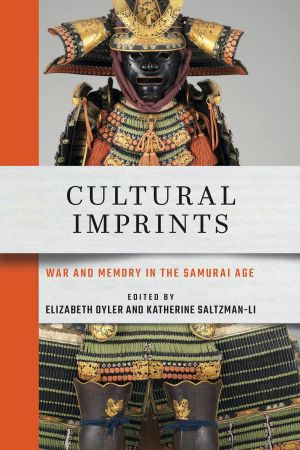
Cultural Imprints draws on literary works, artifacts, performing arts, and documents that were created by or about the samurai to examine individual "imprints," traces holding specifically grounded historical meanings that persist through time. The contributors to this interdisciplinary volume assess those imprints for what they can suggest about how thinkers, writers, artists, performers, and samurai themselves viewed warfare and its lingering impact at various points during the "samurai age," the long period f
Book
49.95
Additional Information
Program
Type
- Book
- Cornell East Asia Series
Publication Details
Publication Year: 2022
Publication Number: 211
ISBN: 9781501761621
The Ends of Meter in Modern Japanese Poetry

In The Ends of Meter in Modern Japanese Poetry, Scott Mehl analyzes the complex response of Meiji-era Japanese poets and readers to the challenge introduced by European verse and the resulting crisis in Japanese poetry. Amidst fierce competition for literary prestige on the national and international stage, poets and critics at the time recognized that the character of Japanese poetic culture was undergoing a fundamental transformation, and the stakes were high: the future of modern Japanese verse.
Book
49.95
Additional Information
Program
Type
- Book
- Cornell East Asia Series
Publication Details
Publication Year: 2022
Publication Number: 210
ISBN: 9781501761171