
East Asia Program
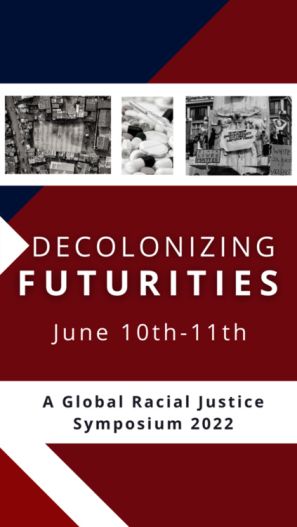
Decolonizing Futurities: A Global Racial Justice Symposium
June 10, 2022
9:00 am
Uris Hall, G08
This is a two-day symposium occurring on June 10th & 11th
The 2022 “Decolonizing Futurities” symposium will be hosted by the inaugural cohort of Global Racial Justice Fellows of the Mario Einaudi Center for International Studies at Cornell University. Through this symposium, we seek to critically analyze the construction of race and racial relations, and to reimagine a horizon of racial justice in contemporary life. Our aim is, thus, to decolonize existing anti-racist approaches, recognizing that decolonization is not a metaphor but an ongoing practice.
To this end, our panels on Friday, June 10th address key arenas of social life: how we think, how we live, and how we remember. In our first panel, we explore how elements of (settler-)colonial thought have endured—over time and across spaces—to shape postcolonial imaginaries. In our second panel, we consider the implications of racialization in access to healthcare, nutrition, and housing in contemporary life. In our third panel, we reassess our understanding of what constitutes “history” to reflect the complex global realities we currently inhabit. All three panels will then convene in a final roundtable on Saturday, June 11th to attempt a radical re-imagining of our futures—a novel solidarity framework that honors a politic of shared responsibility.
Free ticket required: Reserve your ticket
This symposium will take place in person at Uris Hall, and breakfast and lunch will be provided. Virtual attendees are also welcome to join us via Zoom. Please register here (day one, day two) if you wish to attend virtually.
Learn more about our symposium.
Please contact grjfellows@cornell.edu with any questions.
***
Detailed Schedule
Friday, June 10th
Breakfast & Opening Remarks | 9:00am – 10:00am
Keynote Address: Danika Medak-Saltzman | 9:30am – 10:00am
Panel 1 | How We Think: Colonial Thought | 10:00am – 11:30am
Panelists:
Oumar Ba | Cornell University, NY, USAReggie Jackson | University of Michigan, MI, USASarah Radcliff | Cambridge University, UKIn this panel, we propose to study how elements of colonial thought have endured or evolved, over time and across spaces. To this end, we ask the following questions: (1) How have colonial “ideas” and “symbols” been reformulated by non-Western actors in their own projects of domination? (2) How have these ideas been internalized and even co-opted by societies engaged in anti-colonial struggles or post-colonial nation-building? And (3) Given the persistence of colonial thought in the contemporary period, what would “decolonization” entail? In answering these questions, we hope to identify some underexplored mechanisms by which Western colonial thought has helped install other formations of essentialism and the processes by which colonial norms became institutionally, behaviorally, and rhetorically entrenched and came to shape postcolonial imaginaries. Ultimately, our aim is to reconsider today’s decolonizing frameworks.
Break | 1:30am – 12:00pm
Panel 2 | How We Live: Health and Housing | 12:00pm – 1:30pm
Panelists:
Jonathan Cohen | University of Southern California, CA, USATashara Leak | Cornell University, NY, USAAmali Lokugamage | University College, UKJill Stewart | Middlesex University, UKAt the local level, social injustices are highlighted in health, housing and quality-of-life disparities, and the sequelae of affected interpersonal experiences and development opportunities. In this subpanel we will explore the determinants and consequences of inequity and how the colonial building blocks of society have shaped our contemporary systems of environmental and human health. We aim to identify possible entry points and calls to action to address mechanisms that inhibit justice and obfuscate the ability to thrive within our communities. We will highlight the causes and implications of each issue, as well as important methodological obstacles to consider in understanding and communicating each facet.
Lunch | 1:30pm – 2:30pm
Panel 3 | How We Remember: Sites of Memory in Public Space | 2:30pm – 4:00pm
Panelists:
Durba Ghosh | Cornell University, NY, USAZayd Minty | Wits University, South AfricaJames Chase Sanchez | Middlebury College, VT, USAIn this panel we want to address how space and place are racially coded, and how institutionalized practices of collective remembering can often sustain assumptions of racial inequality. Public spaces continuously reflect back to us the history of the present, thereby necessitating political discussion about their role in maintaining assumptions regarding the limits of community. Referencing recent conflicts around contentious public monuments in the U.S. and elsewhere, we wish to examine symbols of public space– whether construed as ‘vandalism’ or ‘abolition’ – and consider what they say about current disconnects between state identity and the lived experiences of their diverse populations. In so doing, how might we rethink our relationship to the colonial past? How might we reconsider practices of commemoration to account for the living relationship between the present and our inheritances rather than consigning these legacies to a past that has always already been “overcome”? And finally, if authentic enfranchisement in the present necessitates a comparable enfranchisement in a collective past, how can we take action within our own institutions to have them serve as more effective interfaces between our inherited past and our contingent future?
Saturday, June 11th
Breakfast | 9:00am – 10:00am
Roundtable | How We Imagine: Decolonizing Futurities | 10:00am – 11:30am
This last conversation will include perspectives from each of the 3 panels, with outlooks on how to approach our future.
Closing remarks | 11:30am – 11:45am
Additional Information
Program
Einaudi Center for International Studies
East Asia Program
Latin American and Caribbean Studies
South Asia Program
Inequalities, Identities, and Justice - International Studies Summer Institute 2022

June 28, 2022
9:00 am
A.D. White House
The 2022 International Studies Summer Institute (ISSI), a professional development workshop for practicing and pre-service K–12 teachers hosted annually by the Cornell University Einaudi Center for International Studies in collaboration with the Syracuse University South Asia Center, will be exploring inequalities, identities, and justice.
During this cross-curriculum workshop, educators will engage in activities that integrate world-area knowledge from regions such as South Asia, Southeast Asia, Latin America, and Africa by exploring inequalities, identities, and justice, both historical and contemporary issues. Teachers will explore ideas on how to use the experience of the protests against racism and structural inequality, which crescendoed in the United States and more than 60 countries around the world in 2020. Doing so will grant them extensive knowledge about intersectional inequalities worldwide where marginalized groups struggle to access resources, health, rights, security, and well-being. Topics will address inequalities experienced across the globe, including cleavages in a society like race, religion, gender and sexuality, class, caste, language, and ethnicity.
The nature of this theme, the 2022 ISSI, will be suitable for elementary, middle, and high school teachers from various disciplinary backgrounds. Participating teachers will complete a lesson plan that incorporates content from the workshop with the support and guidance of our outreach staff.
Topics and list of presenters:
Social injustices vulnerabilities and climate change in the Brazilian Amazon, by Fabio ZukerFábio will present how climate change exacerbates already existing inequalities, injustices, and vulnerabilities, taking as a departing point his own fieldwork at the Tapajós River (Pará Brazilian amazon), and the questions around the denial of indigenous identity by soy farmers. He will also mention other examples of how environmental conflicts and soybean expansion in the savannah-like biome named cerrado have exacerbated the sanitary vulnerabilities of the Xavante people during the Covid-19 pandemic.
Education and Social Transformation of Africa: Historical and Contemporary Factors of Gender Inequality, by N’Dri Assie-Lumumba The contemporary European-inherited systems of formal education that were introduced to African societies during the colonial era, were at their inception imbued with inequality on various grounds. Among the grounds of inequality, the gender-based imbalance was the most persistent, with typical patterns of female under-representation in education. In the 20th century, after independence, there was considerable progress in female enrolment, due to robust policies. However, in many countries, a plateau had peaked dating decades back. However, numerous reforms that are in place, lack either consistent implementation or tend to reproduce and intensify gender inequality. The gaps, which exist at the basic level, tend to generally widen in higher education. Furthermore, post-secondary education tends to be characterized by gender-based disciplinary clusters that have negative implications for the female population. These distortions impede access to education for girls and women, a basic human right. Furthermore, considering the centrality of formal education that translates to socio-economic attainments of individuals, families, and ultimately national development of the State, it is imperative to undertake educational policies that are transformational.
Hindu Exceptionalism in India, by Mona Bhan In this talk, Bhan discusses how Narendra Modi and his right-wing Hindu allies’ from the BJP, India’s ruling Hindu majoritarian political party, have diligently promoted “Hindu exceptionalism” as a framework for everyday governance (Bhan and Bose 2020). A vital goal of the BJP government since it came to power in 2014 was to establish India as a “Hindu Rashtra (nation)” and frame Muslims as foreign invaders responsible for diminishing Hindu glory and weakening India’s ancient and unique Hindu civilization. Bhan draws from her ethnographic fieldwork in the Indian-occupied region of Kashmir to discuss how Hindu exceptionalism has sanctioned unprecedented violence against Kashmir’s Muslim populations. She also explores how this legitimized settler-colonial interventions to materialize India’s transformations into a Hindu Rashtra.
The Rohingya Question in Myanmar’s Rakhine State, by Kyaw Yin Hlaing Since 2012, Myanmar's Rakhine State has been a site of communal violence and human rights violations. While around a million Rohingya now live in Bangladesh as refugees, hundreds of thousands of others were (and remain) internally displaced. A large majority of Rohingya have lost not only their homes, but also their citizenship and access to higher education and proper medical care. Mutual misunderstandings and lack of trust between Rohingya and members of other ethnic groups, especially the Rakhine, have caused persistent communal tensions that often boil over into communal violence. As a result, Rakhine State had become the most volatile state in Myanmar. However, there have recently been some positive developments. Awareness-raising on social cohesion by local civil society organizations and the political changes that have occurred following the military coup in 2021 have contributed to these improvements. This talk will explain how communal tensions between the Rohingya and other ethnic groups have evolved and how recent political changes have contributed to ameliorating these tensions in Rakhine State.
Teaching ‘the East’ in ‘the West’: From Postcolonial Theory to Pedagogical Practice, by Dr. Andrew Harding One of the major criticisms levelled at area studies disciplines over the last twenty years is that the division of the globe into distinct geo-political regions (e.g. “East Asia”) was initially undertaken in the interest of U.S. national security, rather than with a mind to greater cross-cultural understanding and collaboration. As a result, flagship Area Studies classes such as “Introduction to Japan” have tended to posit the target culture as an object “over there” which requires analysis precisely because it is distinct from “our” way of life “over here”. In a world in which border- and culture-crossing is increasingly the normal experience however, this assumed affinity between region and identity is becoming rapidly out of date and, from the perspective of students, largely irrelevant to their experience of the world as a single global continuum. In this presentation, I foreground a pedagogical approach in which I center authorial positionality, rather than national positionality, in relation to East Asian histories and societies. Rather than assuming that an author speaks for Japan, for example, what might it mean to think of them writing from or even to Japan? Why limit area studies to a study of those we assume to be from or representative of the “area” at all? By thus foregrounding an approach to “area” from a social, rather than national-cultural positionality, students are encouraged to consider social relations as a global operation, rather than one that is nationally or even culturally confined.
Registration is required https://bit.ly/22ISSI
Sponsored by Syracuse University, Moynihan Institute for Global Affairs, South Asia Center, Cornell University’s Mario Einaudi Center for International Studies, Southeast Asia Program, South Asia Program, Institute for African Development, East Asia Program, Latin American Studies Program, Cornell Institute for European Studies, TST-BOCES, U.S. Department of Education Title VI Program
Additional Information
Program
Einaudi Center for International Studies
Reppy Institute for Peace and Conflict Studies
East Asia Program
Southeast Asia Program
Latin American and Caribbean Studies
Institute for African Development
South Asia Program
Institute for European Studies
A Survivor's Voice: Update on the Atrocities Against the Uyghurs in China
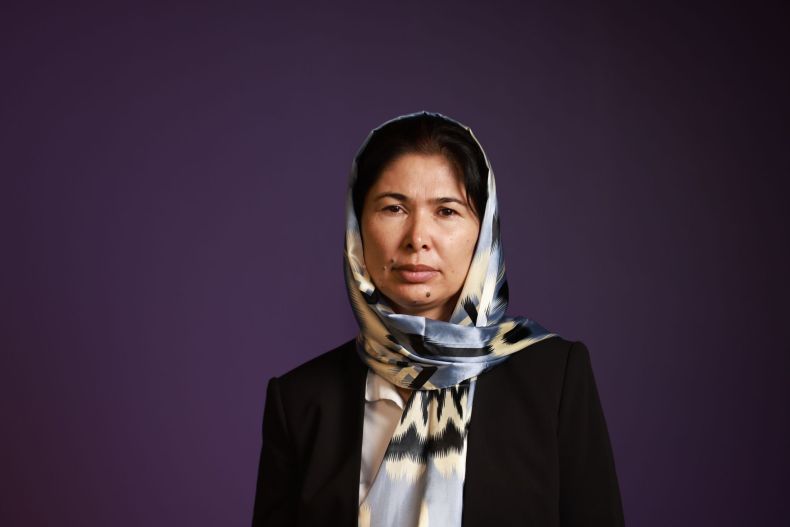
What are the prospects for halting China’s mass atrocities in the Uyghur region, which are now entering their fifth year since the start in 2017? This video features special guest, Tursunay Ziyawudun, a survivor of the Chinese concentration camps in the region known in Chinese as Xinjiang.
Additional Information
CCCI: Everyday Erotics with Denise Tang

Everyday Erotics: Ethnographies of Older Lesbians and Bisexual Women in Hong Kong, Singapore and Taiwan Denise Tang, Associate Professor, Department of Cultural Studies, Associate Dean, Arts Department Lingnan University, HK Denise Tang writes: This talk presents the life stories of older Chinese lesbians and bisexual women (born in the 1940s and 50s) in Hong Kong, Singapore, and Taiwan through an interdisciplinary ethnography combining fieldwork and cultural analysis of inter-Asia mediations of femininities and masculinities.
Additional Information
The Annual Hu Shih Distinguished Lecture with Tim Brook
"Government for the People: Troubling Legacies of the Confucian Statecraft Tradition" was the title of The 2021-2022 Hu Shih Distinguished Lecture given by Tim Brook of the University of British Columbia. Americans are familiar with Lincoln’s “of the people, by the people, for the people,” just as the Chinese are familiar with Sun Yatsen’s “three principles of the people.”
Additional Information
CCCI: Is China Part of Taiwan? with Shelley Rigger
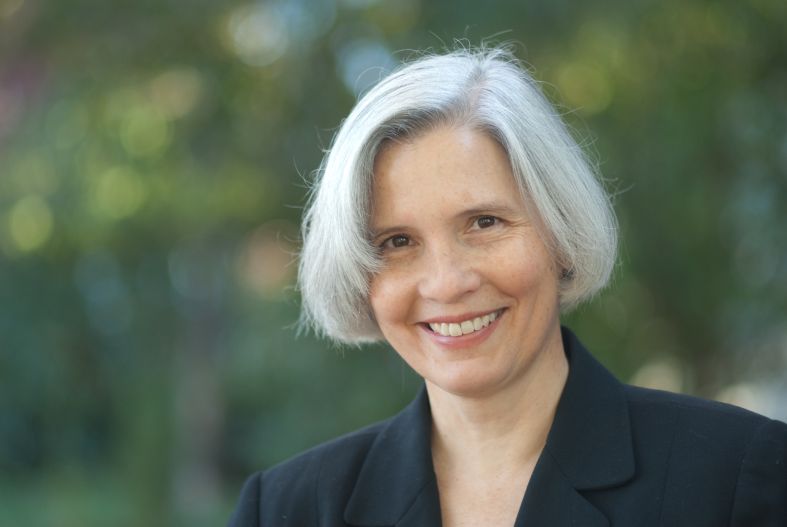
There is a long-standing debate over whether Taiwan is part of China. Beijing insists that not only is Taiwan part of China, it is part of the People’s Republic of China. Most Taiwanese reject the idea that the island they live on is part of the PRC, and they would prefer to remain outside the PRC state’s jurisdiction. But when it comes to China – the abstract, cultural, historical idea of China – the situation is more interesting. This lecture with Shelley Rigger was recorded on 11/15/2021.
Additional Information
CCCI: Decolonizing Chinese Historiography with James Milword
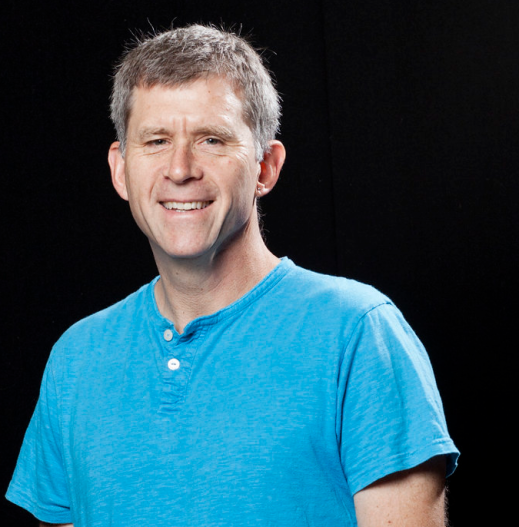
Professor James Millward, Georgetown University gave this talk titled, "Decolonizing Chinese Historiography with special attention to Xinjiang." This talk focuses on the use of history, and, more broadly, examines how common concepts and vocabulary used by nearly all China scholars teaching and writing in English not only mischaracterize the past of states and peoples on the East Asian mainland, but reinforce PRC justifications for its colonialism, now egregiously oppressive and verging on genocidal. The problematic terminology we all use includes the idea of "dynasties," "borderlands," "minorities," and even, as it is often employed, the word "China" itself.
Additional Information
CCCI: At the Edge of China-Life in a Tibetan Town with Barbara Demick
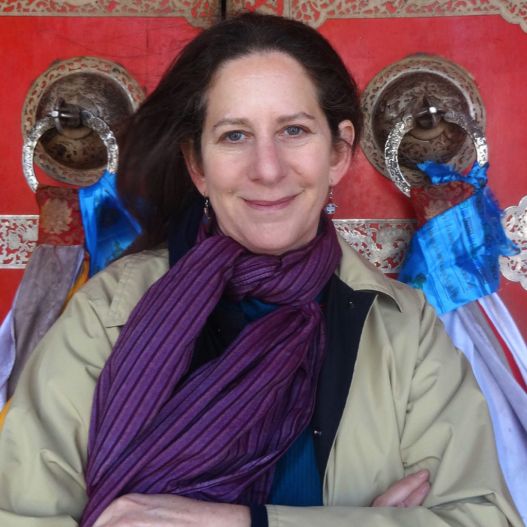
Under Xi Jinping, the Chinese Communist Party has exhibited zero tolerance for any slippage at the edges of the empire. Journalist Barbara Demick looks at life in Ngaba (Aba in Chinese), a small Tibetan county, which became the engine of Tibetan resistance to Chinese rule with a wave of self-immolations that started in 2009.
Additional Information
2022 Korean Language Program Showcase
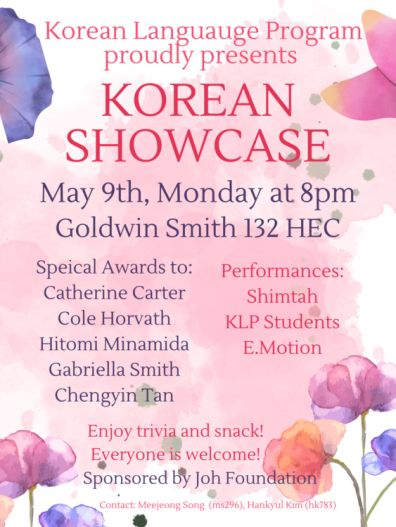
May 10, 2022
8:00 pm
Goldwin Smith Hall, HEC auditorium
Come to our annual Showcase event and join us congratulating these 5 students who will receive Achievement Award! Shimtah and E.Motion will perform for us and students from 6 different courses will present their projects. Also, enjoy trivia and Korean snack! Invite your friends and let's celebrate the end of the semester together!
5/9/22 (Monday) at 8pm, Goldwin Smith 132 HEC auditorium
Certificate awardees:
Catherine Carter
Cole Horvath
Hitomi Minamida
Gabriella Smith
Chengyin Tan
Additional Information
Program
East Asia Program
"Why Do Buddhist Caves Feature Meditation Images?"
May 3, 2022
2:00 pm
Please join us for a talk by Eugene Wang (Harvard).
A Buddhist cave decorated with scenes of meditation at once makes perfect sense and no sense at all. It makes sense in view of the centrality of meditation in Buddhist imagination and practice. It makes no sense in that nowhere in Buddhist discourse do we ever find the instruction that meditation involves looking at wall paintings about meditation. Current scholarship is also polarized into camps of either affirmer and deniers. Affirmers regard meditation as the central function of decorated caves. Deniers see them as sites of mortuary function, having nothing to do with meditation. Meditation and memorial are thus seen as mutually exclusive. It will be shown that they are actually mutually dependent. Meditation is not the function of decorated Buddhist caves, but its narrative frame; memorial is essential to such caves, only that it often takes the narrative form of meditation.
The Cornell Buddhist Studies Seminar Series is co-sponsored by the GPSA-FC, the Departments of Anthropology, Asian Studies and Philosophy, by the South Asia Program, and by the Society for the Humanities. The Department of the History of Art and Visual Studies also generously co-sponsors Prof. Wang's talk. The talk is open to all members of the Cornell community; for accessibility queries please contact buddhiststudies@cornell.edu
Additional Information
Program
East Asia Program
Southeast Asia Program
South Asia Program