
East Asia Program
Faculty: Apply Now

Seed Grant Applications Due Oct. 29
Einaudi's seed grants support faculty-led international research, activities, and events. Find out more.
Additional Information
Cornell Classical Chinese Colloquium: Nathan Vedal, University of Toronto

December 3, 2021
3:30 pm
The Cornell Classical Chinese Colloquium welcomes Nathan Vieal, University of Toronto to lead the final text reading for the semester. He will present on Fan Zongshi's "Jiang shouju yuanchi ji" and the Reception of an Impossible Text
Cornell Classical Chinese Colloquium 古文品讀
The Cornell Classical Chinese Colloquium (CCCC) 古文品讀 is a reading group for scholars interested in premodern Sinographic (古文) text. The group typically meets monthly during the semester to explore a variety of classical Chinese texts and styles. Other premodern texts linked to classical Chinese in Japanese, Korean, and Vietnamese have been explored. Presentations include works from the earliest times to the 20th century. Workshop sessions are lead by local, national, and international scholars.
All are welcome, with any level of experience with classical Chinese.
At each session, a participant presents a classical Chinese text. Attendees discuss historical, literary, linguistic, and other aspects of the text, working together to resolve difficulties in comprehension and translation.
No preparation is required, all texts will be distributed at the meeting.Contact eap-guwen@cornell.edu for more information.
Or subscribe to CCCC news for updates about events. Please make sure to send your subscription request from the email address at which you wish to receive CCCC updates.
Additional Information
Program
Einaudi Center for International Studies
East Asia Program
Paul Robeson, "The Black King of Songs, " and China
December 1, 2021
12:00 pm
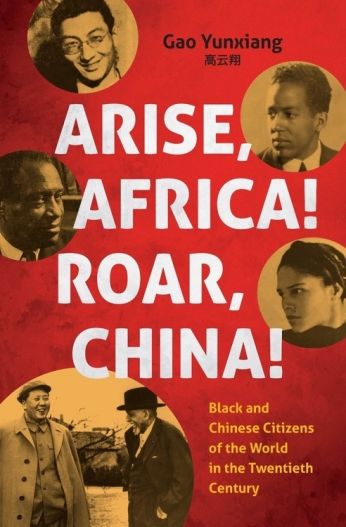
"Arise! Ye Who Refuse to be Bond Slaves:" Paul Robeson, "The Black King of Songs, " and China
Professor Gao Yunxiang, History, Ryerson University
This lecture is adapted from a chapter in Gao Yunxiang’s new book Arise, Africa! Roar, China! Black and Chinese Citizens of the World in the Twentieth Century (UNC Press, December 2021). In this lecture, Gao unpacks the dynamic yet scarcely noted relations between Paul Robeson (1898-1976), the world famous African American singer, actor, athlete, lawyer, and political activist, and China throughout most of the twentieth century.
Sponsored by the East Asia Program, EAP Graduate Student Steering Committee, The Mario Einaudi Center for International Studies, and the Global Racial Justice initiative.
Additional Information
Program
Einaudi Center for International Studies
East Asia Program
Institute for African Development
Seymour Lecture: The 1940 and 1964 Tokyo Olympics and Japan's National Identity
October 15, 2021
2:30 pm
A.D. White House, Guerlac Room
Seymour Lecture Focuses on Japan’s Olympic History
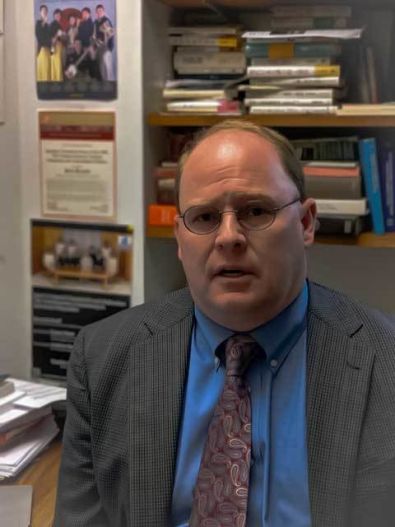
ITHACA, NY: This summer, Japan hosted the Olympics for the first time since 1964; before that, the country was awarded the 1940 Olympics and intended to use them to promote a jingoistic national identity, until it had to forfeit the games as a result of war with China. Historian Ken Ruoff will discuss the Japan that was on display in 1940 and 1964 at this year’s Harold Seymour Lecture in Sports History. The talk, “The 1940 and 1964 Tokyo Olympics and Japan’s National Identity” is hosted by Cornell’s Department of History and will be held at 2:30 p.m. on Friday, Oct. 15, in the Guerlac Room in the A.D. White House on Cornell’s campus.
The event is free and open to the public. Campus visitors and members of the public must adhere to Cornell’s public health requirements for events, which include wearing masks while indoors and providing proof of vaccination or a recent negative COVID-19 test.
“Engaging, knowledgeable, and an insightful historian on post-World War II Japan, Ken Ruoff will explore the way Japan tried to use its role in the 1964 Olympics to showcase ‘New Japan,’” says Kristin Roebuck, assistant professor of history in the College of Arts & Sciences. “Ruoff will examine how stubborn transwar continuities were present at the 1964 Olympics and examine continuities traced back to Japan’s forfeiture of hosting the 1940 Tokyo Olympics in the context of war with China.”
Ruoff is a professor in the modern history of Japan and director of the Center for Japanese Studies at Portland State University. His publications include “Japan’s Imperial House in the Postwar Era, 1945-2019,” and “Imperial Japan at Its Zenith: The Wartime Celebration of the Empire’s 2600th Anniversary Celebration.”
The Harold Seymour Lecture in Sports History is presented annually by the Department of History and brings distinguished historians to Cornell each year. Harold Seymour was one of the first baseball historians in the country, known for his three-volume book detailing the development of the sport from an amateur pastime into a professional sport.
###
Additional Information
Program
Einaudi Center for International Studies
East Asia Program
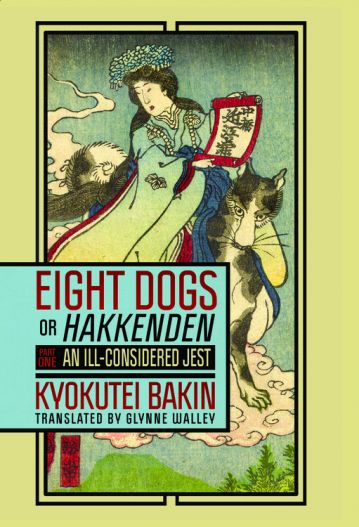
CEAS Book talk: Eight Dogs, or Hakkenden: Part One—An Ill-Considered Jest.
October 20, 2021
1:30 pm
CEAS welcomes author Glynne Walley to talk about his book Eight Dogs, or Hakkenden: Part One—An Ill-Considered Jest, a translation of Kyokutei Bakin's Nansō Satomi hakkenden. This multigenerational samurai saga was one of the most popular and influential Japanese books of the nineteenth century and has been adapted many times into film, television, fiction, and comics. Part One tells the story of Princess Fuse of the Satomi clan, whose tragic and heroic sacrifice leads to the creation of the Eight Dog Warriors.
Glynne Walley is an Associate Professor of Japanese Literature at the University of Oregon. His research interests involve popular literature and how it negotiates the requirements of industry and genre, the demands of a mass audience, and the aspirational pull of “serious” literature. His main focus is popular fiction of the late Tokugawa period, particularly Hakkenden. He is also the author of Good Dogs: Edification, Entertainment and Kyokutei Bakin's Nansō Satomi hakkenden (CEAS, 2017).
Housed in the East Asia Program, CEAS is an internationally known, award-winning scholarly press. CEAS publishes on subjects relative to the cultures of East Asia, covering topics in history, culture, and society, and translations of literary works.
Since its inception in 1973 as a venue for publishing papers that were submitted to the East Asia Program, the Series has grown into its current status as a publisher with a reputation for quality and specialized academic titles. More than 200 volumes have been published to date, with hundreds of titles in print and dozens of titles available digitally for free through the Cornell University Library.
Contact
For all publication matters, please contact the managing editor at ceas@cornell.edu.
Additional Information
Program
Einaudi Center for International Studies
East Asia Program
Tong Yang-Tze Immortal at the River

By Our Faculty
Over a long career spanning four decades, Tong Yang-Tze has received critical acclaim for her large-scale, unrestrained cursive script. The subject of this 54-meter long calligraphic work is Immortal at the River, the poem by Yang Shen (1488–1559) that forms the preface to the standard edition of the Chinese historical novel Romance of the Three Kingdoms (San guo yan yi). The Herbert F. Johnson Museum originally intended to exhibit this monumental calligraphic artwork from February through June of 2020 but due to the pandemic, it closed on March 15.
Other
20.00
Additional Information
Program
Type
- Other
Publication Details
Publication Year: 2020
ISBN: 978-1-934260-30-2
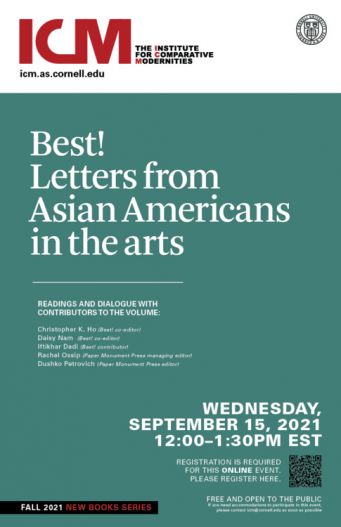
Best! Letters from Asian Americans in the arts
September 15, 2021
12:00 pm
A panel discussion and series of readings from the 2021 anthology Best! Letters from Asian Americans in the arts. Readings, annotations, and dialogue with editors and contributors Christopher K. Ho, Daisy Nam, Iftikhar Dadi, Rachel Ossip, and Dushko Petrovich.
This collection of seventy-three letters written in 2020 captures an unprecedented moment in politics and society through the experiences of Asian-American artists, curators, educators, art historians, editors, writers, and designers. The form of the letter offers readers intimate insights into the complexities of Asian American experiences, moving beyond the model-minority myth. Chronicling everyday lives, dreams, rage, family histories, and cultural politics, these letters ignite new ways of being, and modes of creating, at a moment of racial reckoning.
Registation is required to attend this online event. The registration link is:
https://cornell.zoom.us/webinar/register/WN_09xS16fkTcmiiQc3Kvge2g
Additional Information
Program
East Asia Program
Einaudi Center for International Studies
Dexter Thomas awarded ACLS Emerging Voices Fellowship

Alumnus EAP fellow, 2020 Ph.D., Fulbright-Hayes fellow, and more.
Congratulations Dexter. We are proud to share that Dexter Thomas, 2020 Ph.D. in Asian Literature, Religion, & Culture, has been named an Emerging Voices Fellow by the American Council of Learned Societies (ACLS). This postdoctoral fellowship program “identifies and assists a vanguard of scholars whose voices, perspectives and broad visions will strengthen institutions of higher education and humanistic disciplines in the years to come,” according to an ACLS press release.
During his Cornell graduate career, Dexter has been an EAP fellow with an R.J. Smith Fellowship in Japanese Studies, an EAP and Einaudi Center Research Travel Grant awardee, and a Fulbright-Hayes Research Fellow, all for his research in Japan on underground Japanese hip-hop cultures and the paradox of affinity and xenophobia toward Black cultures and histories. His dissertation work, by examining what “blackness” means in Japan, challenges assumptions about what “black” music means everywhere.
Dexter has also been an award-winning reporter for the LA Times and Vice Media (check out his great Vice News Tonight segment on labor in AI technology industry in China). This past year Dexter joined us on the EAP Mapping Area, Figuring Race and Ethnicity panel, presenting a complex story of Black liberation themes in a long-running Japanese manga.
He will use the award to join the faculty of the Humanities Council at Princeton as a postdoctoral research associate.
Additional Information
Program
Cornell Classical Chinese Colloquium's Fall '21 schedule

Unlock fascinating history through Classical Sinographic texts
Join the Cornell Classical Chinese Colloquium to discover the fascinating history and meaning embedded in Sinographic texts. All language levels are welcomed and no experience is necessary. No pre-reading is required - all of the texts will be shared at the reading session.
Click on the links below for more information and registration. All events are virtual (ET). Email: eap-guwen@cornell.edu to subscribe for news or if you have any questions.
JOSEPH DENNIS, University of Wisconsin | Songs to Encourage the Cessation of Litigation (Xisong ge 息訟歌) in Ming and Qing.
October 1 at 3:30 p.m.
Registration via Zoom
TIM BROOK, University of British Columbia | Qiu Jun's "Daxue yanyi bu"
October 29 at 3:30 p.m.
Registration via Zoom
HE BIAN, Princeton University
November 12 at 3:30 p.m.
Registration via Zoom
NATHAN VEDAL, University of Toronto | Fan Zongshi's "Jiang shouju yuanchi ji" and the Reception of an Impossible Text"
December 3 at 3:30 p.m.
Registration via Zoom
Additional Information
Program
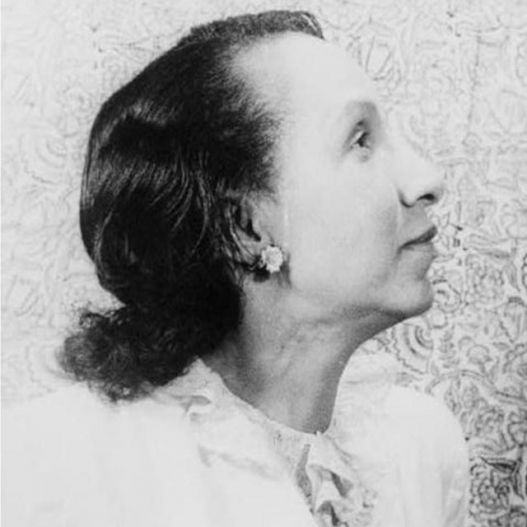
ROUGH WORK “Translating Black Left Feminism: Shirley Graham Du Bois and Mao’s China”
November 17, 2021
12:00 pm
Zifeng Liu, Ph.D. candidate and Diverse Knowledge East Asia Fellow presents an excerpt from his dissertation: “Translating Black Left Feminism: Shirley Graham Du Bois and Mao’s China”
This presentation examines Shirley Graham Du Bois’s engagement with China in the long 1960s. It explores how she cautiously navigated the rapids of the unfolding Sino-Soviet split and sought to manipulate antagonistic geopolitical forces to aid global decolonial efforts. This presentation also argues that, through multilateral transnational practices of quotation, translation, exchange, and distribution, her own publications and China’s state-controlled mouthpieces fostered for her Black left feminist discourse a broad reading public that transgressed nation-states’ boundaries and created followers, who (re)interpreted and (re)activated her messages of Afro-Chinese solidarity.
Rough Work is research in progress and the main purpose of the session is to provide feedback and insight for the presenter. This session is hosted by EAP's Graduate Student Steering Committee. We encourage grad students who are engaged in East Asia-related research or who are from or connected to East Asia to get involved. GSSC provides a welcoming community for academic, creative, professional, and personal development.
Additional Information
Program
Einaudi Center for International Studies
East Asia Program