
East Asia Program
Info Session: Migrations Studies Minor
February 11, 2021
4:30 pm
The Migration Studies minor is a university-wide, interdisciplinary undergraduate minor that prepares students to understand the historical and contemporary contexts and factors that drive international migration and shape migrant experiences around the globe. This minor draws on the rich course offerings found across the humanities and social sciences at Cornell, and is designed to draw students outside of their major fields and to extend their knowledge beyond a single country.
Contact: migration-minor@einaudi.cornell.edu, https://einaudi.cornell.edu/migration-studies-minor
Additional Information
Program
Einaudi Center for International Studies
Reppy Institute for Peace and Conflict Studies
East Asia Program
Southeast Asia Program
Latin American and Caribbean Studies
Institute for African Development
Institute for European Studies
South Asia Program
Info Session: Einaudi Center International Research Travel Grants
February 9, 2021
4:30 pm
The Einaudi Center International Research Travel Grants provide travel support for Cornell graduate students conducting short-term research and/or fieldwork outside the United States. They also provide travel support for professional students engaged in various academic experiences in the international arena.
Contact: einaudi_center@einaudi.cornell.edu; https://einaudi.cornell.edu/funding/travel-grants
Additional Information
Program
Einaudi Center for International Studies
Reppy Institute for Peace and Conflict Studies
East Asia Program
Southeast Asia Program
Latin American and Caribbean Studies
Institute for African Development
Institute for European Studies
South Asia Program
CCCI: From Compradors to Hacendados
February 22, 2021
9:30 am
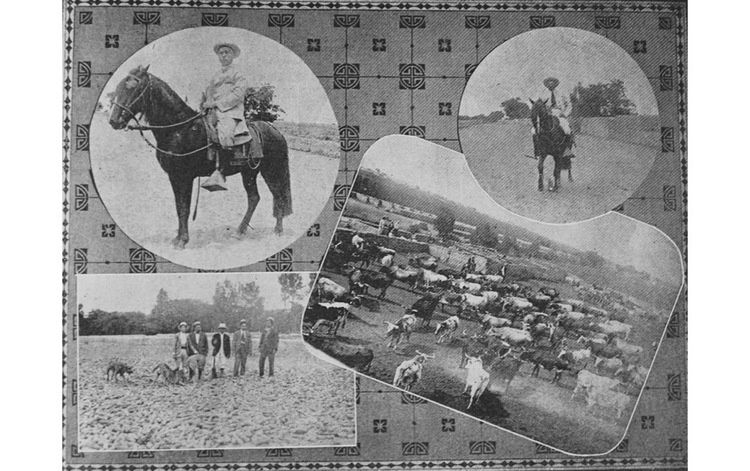
The Cornell Contemporary China Initiative (CCCI) welcomes Ana Candela, Assistant Professor of Sociology at Binghamton University to speak and discuss her extensive research on
From Compradors to Hacendados:
Cantonese Merchants In Peru and the Expanding Settler Colonial Frontiers of the Cantonese Pacific
Embracing the gendered and racialized settler colonial imaginaries that animated Peruvian nation-making, Cantonese merchants deployed new ideas about nature, labor, and technology to position themselves as ideal colonos chinos (Chinese settlers) and overseas Chinese pioneers (xianqiao). Through these activities and imaginaries, Cantonese merchants brought greater coherence to a broader Cantonese Pacific world that linked South China and northern coastal Peru through migration and commerce during an era of expanding industrial capitalism.
Eli Friedman, Chair, ILR School and Director of the CCCI for Spring '21 hosts and moderates. Professor Friedman teaches the course that is linked to this lecture series, ILRIC 4395, Empire of Migrants.
CCCI was established to create a forum for scholars, researchers, and students with contemporary China interests in any aspect of contemporary China. CCCI is a collaborative effort of the East Asia Program, CAPS, and Asian Studies.
Additional Information
Program
Einaudi Center for International Studies
East Asia Program
Latin American and Caribbean Studies
Rough Work: A New Look at Chinese Paper-making Communities
April 7, 2021
11:30 am
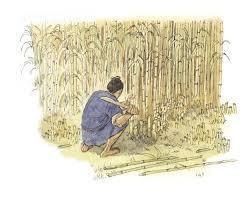
ROUGH WORK with Yiyun Peng, Ph.D. Candidate, Cornell, History
Beyond Workshops: Spatial Distribution of Paper-making Communities and Properties in Upland Southeast China, 1700-1950
Paper-making was a prevalent and profitable industry in upland Southeast China in the late imperial and republican periods. Previous analyses have largely focused on paper workshops and studied their output, paper-making skills, and so forth. In other words, the paper industry was depicted as an agglomerate of paper-workers in small workshops. But the activities of paper-makers in the workshops were only part of the industry. This paper looks beyond the workshops and reveals the spatial distribution of various components, including its communities and properties, of the whole industry.
In all, this new way of looking at the industry provides a new perspective on the interactions of production and environment and of different groups of producers, and demonstrates the heterogeneity of utilizing the highlands and the ways in which people across space stretched their influence to the remote uplands to make the most of their living environment.
Please read the paper in advance - when you register, you'll receive a link to it via the registration confirmation email.
ROUGH WORK: Discussing research in progress, hence the term, rough work. This rough work session is hosted by the East Asia Program's Graduate Student Steering Committee (GSSC).
Additional Information
Program
Einaudi Center for International Studies
East Asia Program
Cornell Classical Chinese Colloquium: Yuanyaun Duan
February 12, 2021
3:30 pm
Writing and Printing for Praying: Colophons of Dali Buddhist Scriptures
Yuanyuan Duan, Ph.D. student, Cornell
This presentation introduces the colophons of the Sinitic Buddhist scriptures from Dali, Yunnan dating back to the 12th-17th centuries. These colophons usually consist of the information of the patrons who had the text copied or printed, the prayers stating their motivations to do so, and the date of manufacture. By examining the form and content of the colophons, especially the benediction directed at specific individuals, we will get a glimpse of what people believed that they could gain through engaging in writing or printing Buddhist scriptures, and how monastic and lay communities in Dali handled their everyday existence from the independent Dali Kingdom era (937-1253) to the period of being incorporated as the southwestern frontier of the Ming empire.
The Cornell Classical Chinese Colloquium (CCCC) 古文品讀 is a reading group for scholars interested in premodern Sinographic (古文) text. The group typically meets monthly during the semester to explore a variety of classical Chinese texts and styles. Other premodern texts linked to classical Chinese in Japanese, Korean, and Vietnamese have been explored. Presentations include works from the earliest times to the 20th century. Workshop sessions are lead by local, national, and international scholars. No prior experience or preparation is necessary.
Additional Information
Program
Einaudi Center for International Studies
East Asia Program
Muslims in Tang, Song and Yuan China, by Angela Schottenhammer - CMS Seminar Series

March 3, 2021
4:30 pm
The seminar will introduce some examples of activities and transregional relations of Muslims in Tang, Song, and Yuan China (618-1279 CE). The talk will specifically concentrate of traders and physicians, and also introduce a few of the more important names that we know from this period. The scope of our inquiry here is intentionally kept wide, so that we can tap into various aspects of Muslim activities in the social, economic, and political life of then- contemporary China. The topics discussed in this seminar cover a period of some six hundred years, during the Medieval/Early Modern period of Chinese History.
Additional Information
Program
Einaudi Center for International Studies
East Asia Program
Continuing Presence of Discarded Bodies with Eunjung Kim, Syracuse U
February 11, 2021
4:30 pm
Continuing Presence of Discarded Bodies: Occupational Harm, Necro-Activism, and Living Justice with Eunjung Kim, Syracuse University.
Starting from the two activist campsites set up in Seoul, one by the coalition of disability organizations and the other by the Supporters for the Health and Rights of People in the Semiconductor Industry, Kim explores a history of occupational health movements and their intersections with disability rights movements in South Korea. Against the bureaucratic technology of rating the degree of disability and harm, necro-activism emerges in the form of persistent involvements of dead bodies, mourning, and other-than-human presence, making claims for justice as an ongoing practice of everyday life and afterlife.
Bio: Eunjung Kim is an Associate Professor of women’s and gender studies and disability studies at Syracuse University.
Julia Chang (Assistant Professor in the Department of Romance Studies and core faculty in Feminist, Gender, and Sexuality Studies at Cornell) will be serving as respondent to Eunjung’s talk.
Andrew Campana (Associate Professor, Department of Asian Studies) hosts and moderates.
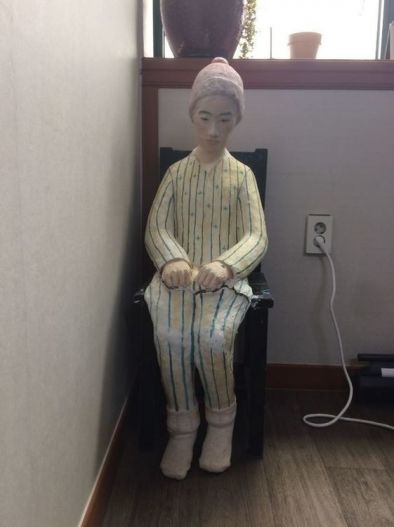
The event image is of a statue by Pak Yujin (박유진). Description: A statue of Hwang Yumi is sitting in a chair in the corner of the room below the window with daylight shining through. After working at a Samsung Electronics semiconductor plant, Hwang Yumi died of acute myeloid leukemia. She is wearing striped hospital pants, a top, a pink cap, and pink socks. She is looking down toward the floor and her two hands are on her thighs in fists. There are two potted plants on the windowsill. Next to the chair is an outlet with a single white plug and cord trailing out of the frame of the image.
(Co-)Sponsored by the Central New York Humanities Corridor from an award by the Andrew W. Mellon Foundation
Co-sponsored by the Society for the Humanities
Additional Information
Program
Einaudi Center for International Studies
East Asia Program
Feminist Futures and Ecological Sense in South Korea
April 26, 2021
4:30 pm
Kimberly Chung, McGill University Kimberly Chung, McGill University
Faculty host: Ivanna Yi, Assistant Professor, Asian Studies
Professor Chung writes: This paper examines the interrelationship of feminism, ecological sense and art practice in the context of contemporary South Korea. Since 2018, the Me Too movement brought systemic gendered discrimination in all areas of South Korean political, cultural, and social life into focus, with books, like Kim Ji-Young, Born 1982, becoming a cultural touchstone for a generation of women who came into adulthood at the turn of the 21st century. While most discussions about South Korean feminism have had an anthropocentric focus, this paper focuses on the productive and often fraught relationship between feminism and ecological movements in South Korea, best exemplified by writers, artists, and art collectives who interrogate capitalist patriarchalism and patriarchal urban planning through an employment of ecological sense. Ecological sense frameworks like microbes, symbiosis and the “women’s work” of knitting and DIY are ways in which artists/art collectives like Rice Brewing Sister’s Club, Listen to the City, and Soyo Lee have exemplified an emerging feminist ecology that situates the exploitation of women within a wider web of human/nonhuman interrelations. This paper will utilize cultural works by South Korean artists, writers, and activists as important analytical tools for making sense of the consumption of nature, urban redevelopment, globalization, and dislocation of life. A particular line of questioning will focus on framings of landscape without nature, an aesthetics of dislocation, post pastoral perspectives, and science fiction futurist orientations.
Co-sponsored by the Departments of Asian Studies and Comparative Literature
Additional Information
Program
Einaudi Center for International Studies
East Asia Program
Cornell Classical Chinese Colloquium: Sophie Volpp, UC Berkeley
April 2, 2021
3:30 pm
This month's CCCC welcomes Sophie Volpp to lead a text reading on Qianlong Emperor’s Poem, “On the Mirror”
In 1763, the Qianlong emperor composed a poem entitled, “On the Mirror” (Jing yu (鏡 喻) that examines the novel properties of the western plate glass mirror in tandem with those of plate glass windows. In the poem, the emperor sits in a pavilion, observing the glow of the setting sun. The first half of the poem is dedicated to a prosaic examination of the technology of the glass mirror, while the second half launches in a different direction, exploring the novel capacity of the plate glass windows of the pavilion to act as mirrors once darkness sets in. Ultimately, the mirror's capacity for perfect and passive reflection becomes a metaphor for good government.
The Cornell Classical Chinese Colloquium (CCCC) 古文品讀 is a reading group for scholars interested in premodern Sinographic (古文) text. The group typically meets monthly during the semester to explore a variety of classical Chinese texts and styles. Other premodern texts linked to classical Chinese in Japanese, Korean, and Vietnamese have been explored. Presentations include works from the earliest times to the 20th century. Workshop sessions are led by local, national, and international scholars.
No previous experience with Classical Chinese or preparation is required.
Additional Information
Program
Einaudi Center for International Studies
East Asia Program
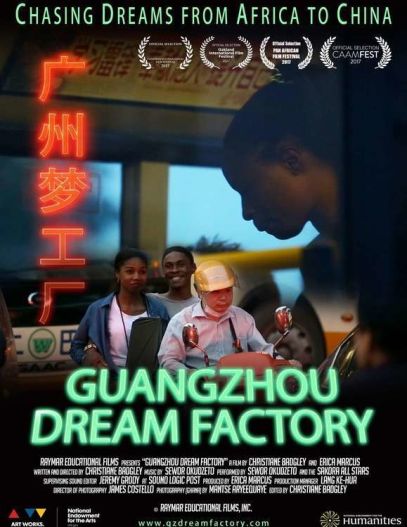
Chasing Dreams from Africa to China - "Guangzhou Dream Factory"
February 19, 2021
3:00 pm
"Guangzhou Dream Factory" Film discussion (participants watch the film on their own) with filmmakers Christiane Badgley and Erica Markus. Watch a film trailer here: https://vimeo.com/197863673
Featuring a dynamic cast of men and women from Cameroon, Kenya, Nigeria and, Uganda, Guangzhou Dream Factory is a provocative story of immigration, globalization, and the pursuit of “Made in China” African dreams.
Immigration, globalization, Chinese factories, and African dreams… Guangzhou Dream Factory weaves stories of Africans chasing alluring, yet elusive, “Made in China” dreams into a provocative critique of 21st-century global capitalism.
Guangzhou, a.k.a. Canton, is southern China's booming commercial center. A mecca of mass consumption, the city’s vast international trading centers attract more than half a million Africans each year. Most are doing business – in China to buy goods they’ll sell back in Africa. But some choose to stay, and for these Africans, China looks like the new land of opportunity, a place where anything is possible. But is it?
Discussants:
Tristan Ivory, Assistant Professor at the School of Industrial and Labor Relations (ILR);Tao Leigh Goffe, Assistant Professor at Africana Studies and Research Center and Program in Feminist, Gender, and Sexuality Studies.This event is hosted by the East Asia Program Graduate Student Steering Committee (GSSC) and co-hosted by the Afro-Asia Group. Kun Huang, a Ph.D. candidate in Comparative Literature, and GSSC officer will moderate.
Cornell Cinema also co-sponsors this event as part of their Migrations Stories film series in conjunction with Global Cornell's Global Grand Challenges Migrations Initiative.
How to view the film:
Cornell students, faculty, and staff and those with library access to Kanopy may view the film here: https://cornell.kanopy.com/video/guangzhou-dream-factory.
A time-limited screening link will be made available one week in advance to other community members who have registered for the event.
All participants need to register to receive the Zoom link for the discussion with the filmmakers.
Additional Information
Program
Einaudi Center for International Studies
East Asia Program
Institute for African Development