
Einaudi Center for International Studies
Weak, Uneven Global Economic Recovery

Eswar Prasad, SAP
Eswar Prasad (SAP) analyzes economic growth in the United States, India, and China in this April op-ed: "The adverse effects of economic nationalism and trade protectionism are likely to hit smaller developing countries the hardest."
Additional Information
‘Donald Trump Did This’: Biden Strikes GOP Weakness on Abortion

Landon Schnabel, GPV
“Polling consistently shows a majority of Americans support legal abortion in most/all cases, especially early in pregnancy. There is no public majority for strict bans,” says Landon Schnabel, assistant professor of sociology.
Additional Information
Riedl to Direct New Global Democracy Center

Launching in July 2024, a new center at the Cornell Jeb E. Brooks School of Public Policy will bring together leading experts to tackle fundamental questions facing democracy around the globe.
Additional Information
The Culture Trap: Ethnic Expectations and Unequal Schooling for Black Youth

April 30, 2024
5:00 pm
Uris Hall, G08
In The Culture Trap, Derron Wallace argues that the overreliance on culture to explain Black students' achievement and behavior in schools is a trap that undermines the historical factors and institutional processes that shape how Black students experience schooling. This trap is consequential for a host of racial and ethnic minority youth in schools, including Black Caribbean young people in London and New York City.
Since the 1920s, Black Caribbeans in New York have been considered a high-achieving Black model minority. Conversely, since the 1950s, Black Caribbeans in London have been regarded as a chronically underachieving minority. In both contexts, however, it is often suggested that Caribbean culture informs their status, whether as a celebrated minority in the US or as a demoted minority in Britain.
Drawing on rich observations, interviews and archives in London and New York City schools, Wallace suggests that the use of culture to justify Black Caribbean students’ achievement obscures the very real ways that school structures, institutional processes, and colonial conditions influence the racial, gender and class inequalities Black youth experience in schools. Wallace reveals how culture is at times used as an alibi for racism in schools, and points out what educators, parents and students can do to change the beliefs and practices that reinforce racism.
Derron Wallace is the Jacob S. Potofsky Chair in Sociology and Associate Professor of Sociology and Education at Brandeis University in Boston, USA. He is also a Research Fellow at the Centre on the Dynamics of Ethnicity at the University of Manchester. From 2022 to 2023, Wallace was a Fulbright Scholar in the Department of Sociology at Durham University. A sociologist of race, ethnicity and education, Wallace’s research focuses on structural and cultural inequalities in urban schools and neighbourhoods as experienced by Black youth. In 2023, Wallace received the American Educational Research Association’s Early Career Award for research on the social context of education. He also received the Doris Entwisle Early Career Award from the American Sociological Association for research on the sociology of education.
Additional Information
Program
Einaudi Center for International Studies
Latin American and Caribbean Studies
Agrarian Studies, Climate Change, and the Future of Work
April 26, 2024
9:00 am
Cornell University
This inter-disciplinary conference brings together experts on questions of climate change, agrarian transformations and labor to help us reflect on the future of work.
Overview
The future of work is hot. Literally. Unpredictable seasons, droughts, floods, warming temperatures, rising seas, and a host of other climatic factors are changing what work is, what it means, and what it does to the body. These effects are unevenly felt across geographies and forms of difference.
These effects spill out beyond the factories, fields, and construction sites scholars conventionally associate with legible acts of labor. Self-employed or “informal” workers in cities face new threats from the compounding factors of rising heat and air pollution. Ecotourism sectors have been reconfigured to make climate crisis, extinction, and other consequences of planetary change into sites for “disaster tourism” and consumption. A low-paid service industry coalesces around climate dystopia. The bodily effects of heat and work are newly burdening women, who disproportionately perform unremunerated, devalued reproductive labor in domestic spaces. Questions about the future of work in the context of climate crisis, then, are as much about techno-fixes as they are about home and family.
See the full list of speakers on the registration page.
Additional Information
Program
Einaudi Center for International Studies
Latin American and Caribbean Studies
South Asia Program
Explorations of Global Free Speech: Faculty Roundtable

May 2, 2024
5:30 pm
Mann Library, 102
Join the Mario Einaudi Center for International Studies's Global Public Voices fellows for a roundtable discussion exploring global free speech as part of Cornell's freedom of expression theme year.
This year's fellows are seasoned media voices, ready to advocate on global free speech questions central to current events, public policy, and their international research expertise.
Freedom of Expression Faculty Fellows
Oumar Ba, Assistant Professor, GovernmentAlexandra Dufresne, Professor of the Practice, Cornell Brooks School of Public PolicySharif Hozoori, IIE-SRF Fellow and Visiting Scholar Karim-Aly Saleh Kassam, International Professor of Environmental and Indigenous StudiesThe Einaudi Center's undergraduate global scholars will present their freedom of expression capstone projects at an accompanying event at 4 p.m. in Mann 112 (CALS Zone) prior to this event.
Additional Information
Program
Einaudi Center for International Studies
Reppy Institute for Peace and Conflict Studies
South Asia Program
Explorations of Global Free Speech: Student Showcase

May 2, 2024
4:00 pm
Mann Library, 112, CALS Zone
Join the inaugural cohort of the Mario Einaudi Center for International Studies's undergraduate global scholars for a showcase of their capstone presentations exploring global free speech as part of Cornell's freedom of expression theme year.
Undergraduate global scholars advocate for freedom of speech on campus and around the world. They have partnered with the Einaudi Center's Global Public Voices faculty mentors to design their capstone projects on global free speech.
The Global Public Voices fellows will present discuss their research at an accompanying event at 5:30 p.m. in Mann 102.
Additional Information
Program
Einaudi Center for International Studies
A Transnational History of Art in India
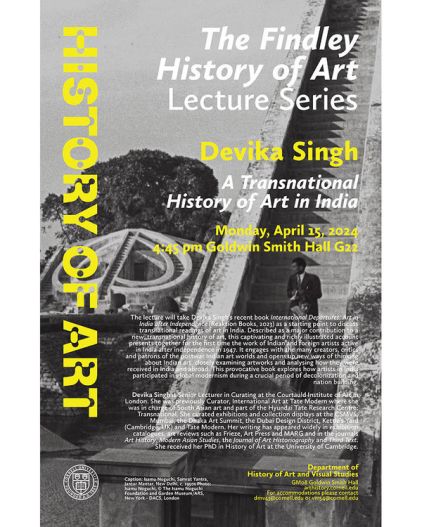
April 15, 2024
4:45 pm
Goldwin Smith Hall, G22
Department of History of Art & Visual Studies Findley Lecture Series
Join us for a talk by Devika Singh, (Senior Lecturer in Curating at the Courtauld Institute of Art in London).
This Findley Lecture will take place in Goldwin Smith Hall G22.
Reception to follow.
Abstract
The lecture will take Devika Singh’s recent book International Departures: Art in India after Independence as a starting point to discuss transnational readings of art in India. Described as a major contribution to a new, transnational history of art, this captivating and richly illustrated account presents together for the first time the work of Indian
and foreign artists active in India after independence in 1947. It engages with the many creators, critics and patrons of the postwar Indian art worlds and opens up new ways of thinking about Indian art, closely examining artworks and analysing how they were received in India and abroad. Featuring a wealth of rare and previously unpublished images, this provocative book explores how artists in India participated in global modernism during a crucial period of decolonization and nation building.
Speaker Biography
Devika Singh is Senior Lecturer in Curating at the Courtauld Institute of Art in London. She was previously Curator, International Art at Tate Modern where she was in charge of South Asian art and part of the Hyundai Tate Research Centre: Transnational. She curated exhibitions and collection displays at the CSMVS, Mumbai, the Dhaka Art Summit, the Dubai Design District, Kettle’s Yard (Cambridge, UK) and Tate Modern. Her writing has appeared widely in exhibition catalogues, art reviews such as frieze, Art Press and MARG and in the journals Art History, Modern Asian Studies, the Journal of Art Historiography and Third Text. Her book International Departures: Art in India after Independence (Reaktion Books) was released in early 2024 in the United States.
Additional Information
Program
Einaudi Center for International Studies
South Asia Program
Book Talk with Vanessa Chan

April 26, 2024
12:00 pm
Kahin Center
Join us for a discussion with Vanessa Chan about her book, “The Storm We Made” - a dazzling saga about the horrors of war; the fraught relationships between the colonized and their oppressors, and the ambiguity of right and wrong when survival is at stake.
Participants should ideally have read the book, where possible!
About the Speaker
VANESSA CHAN is the Malaysian author of internationally bestselling The Storm We Made (Marysue Rucci Books, Jan 2024), Good Morning America Book Club Pick and BBC Radio 2 Book Club pick. The novel, her first, will be translated into more than twenty languages worldwide. Her other work has been published in Vogue, Esquire, and more. Vanessa grew up in Malaysia and is now based mostly in Brooklyn.
Additional Information
Program
Einaudi Center for International Studies
East Asia Program
Southeast Asia Program
Prestigious Carnegie Awards
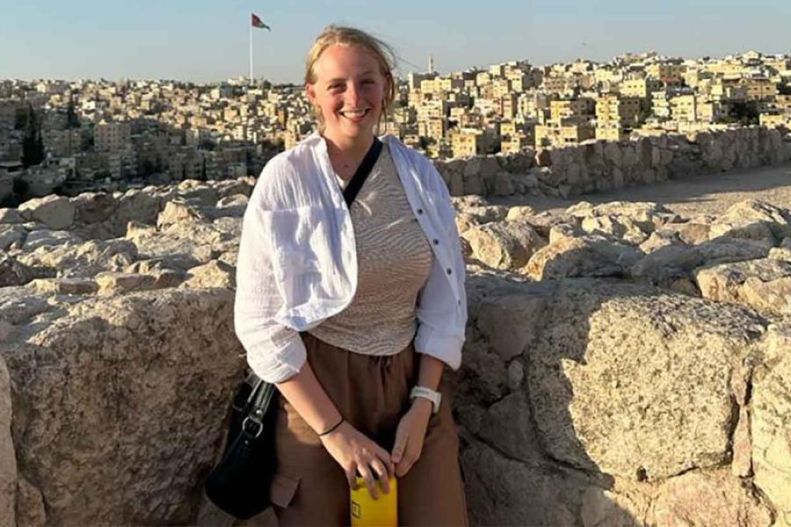
Einaudi Students Chosen as Junior Fellows
McKenzie Carrier ’24 (Laidlaw, migration minor) and Margot Treadwell ’24 (IRM) will conduct democracy research with Carnegie scholars.