
Einaudi Center for International Studies
Africa, China, and the Middle East: Trade, Financing, and Development

November 3, 2023
1:00 pm
Statler Hotel
November 3-4, 2023 Statler Hotel, Cornell University Open to the Public
The symposium will explore investment and development finance which is an important area of policy discussions in Africa and other developing areas of the world, as well as those that will give a brief overview of the scale of both Chinese and Middle Eastern investment in Africa. Multifaceted and multidisciplinary analytical approaches that will consider the role of Chinese and Gulf State investments in the development of Africa, especially Africa’s efforts to create a free trade area are welcomed. Furthermore, the symposium will look at the role foreign investment can play in resource mobilization for infrastructure development as well as the links between law, trade, and regional integration.
Sponsored by the Institute for African Development and the Clarke Initiative for Law and Development in the Middle East and North Africa
Co-sponsored by the East Asia Program
Funded by the Einaudi Center for International Studies Cross Program Initiative
Additional Information
Program
Einaudi Center for International Studies
Institute for African Development
Icaros

October 26, 2023
5:00 pm
Uris Hall, G08
LACS Film Series
‘Icaros: a vision’ is a story about fear and the release from fear – the fear of illness and of death, but also the fear of life and living. It’s about the possibility of living through one’s fear – which is what the Amazonian plant Ayahuasca is good at getting you to do. Centered on the nightly ceremonies that are the main feature of shamanic retreats, Icaros revels in darkness, replicating a shamanic journey. Set in the Peruvian Amazon among the Shipibo-Conibo community, the film is also driven by the conviction that acknowledging the power of plants is the best way to change the jeopardized future of the Amazon – itself like a dying patient.
Directors:
Matteo Norzi: Artist, designer, filmmaker and indigenous rights activist, currently serving as Executive Director at Shipibo Conibo Center in New York City. Co-founder of Cobino Productions with Leonor Caraballo and Abou Farman, which aims to promote the creativity and knowledge of the Amazonian Shipibo Conibo communities through a range of media.
Leonor Caraballo: Worked as a photographer and video artist between Buenos Aires and New York. She won a number of fellowships and grants, including the Latin American Guggenheim Fellowship, a New York Foundation for the Arts grant, and an Eyebeam Art and Technology Center residency. Aspects of the film are based on co-director Leonor Caraballo’s true experiences. Although she dedicated herself to the project until the very end, sadly she died before she could see the film finished.
There is an installation of the Shipibo-Conibo artist Celia Vasquez Yui at the Johnson Museum right now, so we recommend visiting the exhibit before going to the screening.
Presented by Kanopy
There'll be free pizza!
Additional Information
Program
Einaudi Center for International Studies
Latin American and Caribbean Studies
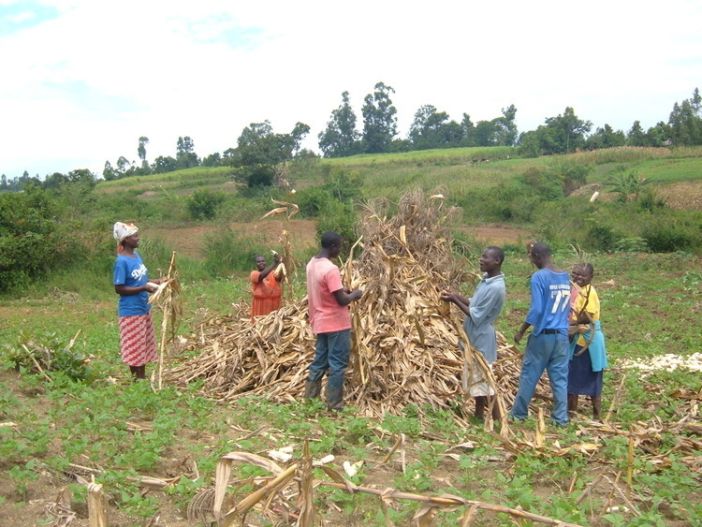
Institute for African Development: Multisectoral Support of Rural Food Systems in Ghana
October 18, 2023
2:30 pm
Uris Hall, G-08
Register
The seminar series for fall 2023 explores the future of African land, agriculture and food, digging into the contestations, conflicting and converging visions from a wide range of perspectives. How might land be used, valued and lived in, across cities, rural communities, forests, deserts and grasslands on the continent in the future? Who is proposing different visions of land futures in Africa, what are the histories, politics, socio-cultural, environmental and economic implications of these potential visions? In one of the regions with the most youthful populations, how are young people considering possible futures? What are ways that land, agriculture and food systems could be resilient, healthy, ecological, thriving and just? Can there be a decolonial agriculture and food future in Africa that celebrates Indigenous and local foodways?
Additional Information
Program
Einaudi Center for International Studies
Institute for African Development
Bartels Lecturer N. K. Jemisin
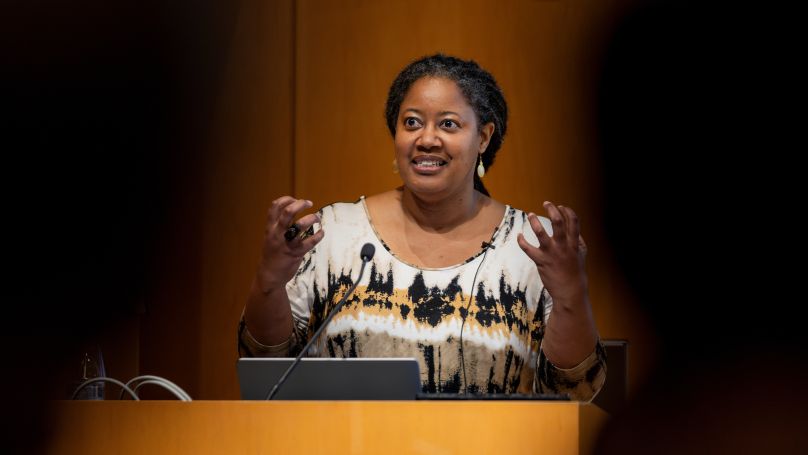
"Build the World from Scratch"
"In building these other worlds, I am able to talk about the reality of ours," Jemisin said at the Oct. 4 Bartels lecture.
Additional Information
Fall conference: Africa, China, and the Middle East.

November 3, 2023
12:00 pm
Statler Hotel
Organized by the Institute for African Development and the Clarke Initiative for Law and Development in the Middle East and North Africa
cosponsored by the East Asia program
Additional Information
Program
Einaudi Center for International Studies
East Asia Program
Institute for African Development
Is There a Case for Farmer Cooperation Today? Lessons from India and Europe with Bina Agarwal, University of Manchester
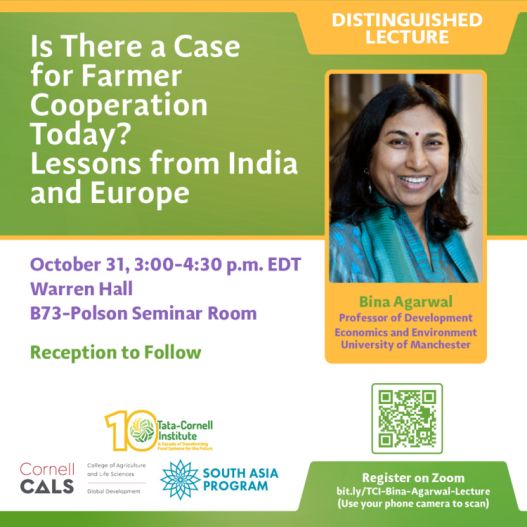
October 31, 2023
3:00 pm
Warren Hall, B73
Bina Agarwal teaches part-time as a Professor of Development Economics and Environment at the Global Development Institute, The University of Manchester, UK. She lives mainly in India where her research projects are predominantly based. She continues to be affiliated with the Institute of Economic Growth at Delhi University, where she was earlier Director and Professor of Economics. Educated at the Universities of Cambridge and Delhi, she has held distinguished teaching and research positions at many universities, including Cambridge, Harvard, Princeton, Michigan, Minnesota (as the Winton Chair), and the New York University School of Law. She was Harvard's first Daniel Ingalls Visiting Professor and later a Research Fellow at the Ash Institute, Kennedy School of Government. She has also been a fellow of Radcliffe's Bunting Institute at Harvard.
Additional Information
Program
Einaudi Center for International Studies
South Asia Program
Panel Explored Reported Rights Violations of Uyghur Children

Oct. 27 from 1-5
A hybrid symposium from EAP will explore reported violations of Uyghur children’s rights in China.
Additional Information
The Universal meets the Himalayan Particular: Interrogating Race, Caste, and Environmental Determinism in India

October 30, 2023
12:15 pm
Uris Hall, G08
Talk by Mabel Denzin Gergan
Covered with dense forests, seismically active, landslide-prone, and receiving the bulk of monsoonal rains, the Indian Himalayan Region has long been characterized as a “difficult landscape” with an “inhospitable terrain” in both colonial British and Indian state discourse. More recently, in reports from state and international development institutions like the IPCC, akin to charismatic, endangered megafauna, the Hindu-Kush Himalayan region occupies a central place within apocalyptic forecasts of a ruinous future wherein climatic and geological volatility are set to destabilize regional ecology and geopolitical security. In this talk, I place these discourses of vulnerability and crisis in the Himalayan region within broader, universal framings of Euro-Western epistemologies, dominant climate change frameworks, and Hindutva (Hindu nationalism). Drawing on empirical and theoretical discussions from my research on hydropower and the Lepcha Indigenous anti-dam movement in the Eastern Himalayan state of Sikkim, I show how interrogating race, caste, and environmental determinism might help us better understand the great geographic and racial unevenness of anthropogenic climate change in the Indian context. I argue that such an interrogation requires we develop fluency in regional particularities, what geographer Tariq Jazeel (2011: 88) refers to as decolonial orientation, one that is attentive to “indeterminate categories, events, and experiences” that are not “immediately comprehensible by the violent normalization of a universal claiming to speak for the particular.” In the last half of the talk, I center the experiences of the region’s Indigenous and tribal communities and ask how these groups imagine and speak of their homelands, past, and the future to come.
Mabel Denzin Gergan is an Assistant Professor in the Department of Asian Studies at Vanderbilt University. She has a Ph.D. in Geography from the University of North Carolina at Chapel Hill and an M.A. from the Tata Institute of Social Sciences, Mumbai. Her research is based in the Indian Himalayan region. It examines its relationship with ‘mainland’ India, characterized on the one hand by state-led development and climate change interventions and, on the other, through the movement of racialized bodies from the borderland to India’s urban heartland. She is a scholar of environmental justice, indigeneity, and race with special interests in political ecology, environmental humanities, and decolonial theorizing.
Additional Information
Program
Einaudi Center for International Studies
South Asia Program
The Global State of Women in 2023
October 12, 2023
12:00 pm
ILR Conference Center, King-Shaw Hall 423
Empirical Study of Gender Research Network (EGEN) in collaboration with the Gender and the Security Sector Lab, and the Reppy Institute for Peace and Conflict Studies presents the Global Status of Women Talk.
Speakers
Dawn Teele, Co-founder of EGEN, the Empirical Study of Gender, Johns Hopkins UniversityTiffany Barnes, Professor, University of KentuckySoledad Prillaman, Assistant Professor of Political Science, Stanford University.
Additional Information
Program
Einaudi Center for International Studies
Reppy Institute for Peace and Conflict Studies
Resisting Exclusion: Women’s Defense of Democracy in India

October 23, 2023
4:30 pm
ILR Conference Center, 423 King-Shaw Hall
Please join us for the 2023 Alice Cook-Lois Gray Distinguished Lecture. Our honored speaker is Amrita Basu, Amherst College's Domenic J. Paino 1955 Professor of Political Science, and Sexuality, Women's and Gender Studies. This year's lecture will be held in 423 King-Shaw Hall, ILR Conference Center, and live on Zoom.
Amrita Basu
We hear many stories about Muslim women’s subservience as a result of victimization by Muslim men. Less common are stories of Muslim women’s resistance, as a result of exclusionary state policies. This talk, on Muslim women in Shaheen Bagh, New Delhi, in 2019, tells a story about how marginalization can inspire demands for inclusive, secular, democratic citizenship rights.
This lecture is co-sponsored by: Feminist, Gender, and Sexuality Studies, Center for the Study of Inequality, Cornell Center for the Social Sciences, Cornell Population Center, Brooks School of Public Policy and the South Asia Program.
Additional Information
Program
Einaudi Center for International Studies
South Asia Program