
Einaudi Center for International Studies
Prof. Chiara Formichi Explores Islam, Asian Cultures Through Research
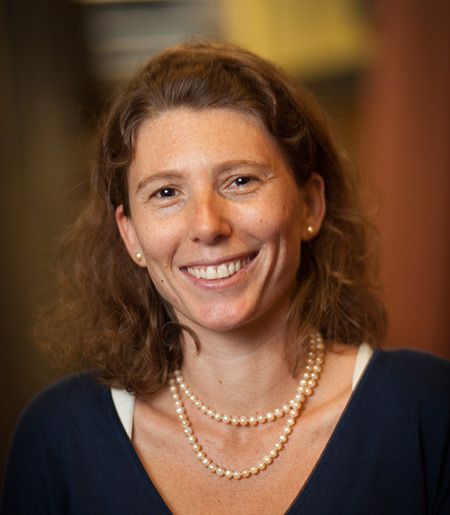
Chiara Formichi, CMSP/SEAP
Chiara Formichi, associate professor of Asian studies and world religions, is featured in the Cornell Sun's Professor Profiles series.
Additional Information
Furor Over Chinese Spy Balloon Leads to a Diplomatic Crisis
Jessica Chen Weiss, EAP
Jessica Chen Weiss, professor of government and public policy, says that the cancellation of Secretary of State Antony Blinken’s trip to Beijing “reflects the unfortunate triumph of symbolism over substance."
Additional Information
Where U.S.-China Relations Stand after Suspected Spy Balloon Was Shot Down

Jessica Chen Weiss, EAP
Jessica Chen Weiss, professor of government and public policy, discusses U.S.-China relations after the U.S. shot down what is thought to be a Chinese spy balloon.
Additional Information
LACS Film Series: Elena
April 20, 2023
7:30 pm
Uris Hall, G08
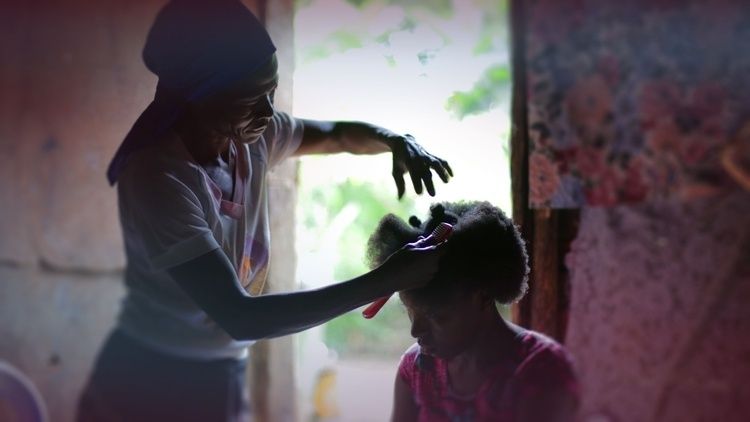
Director Michèle Stephenson’s documentary follows Elena and her family through their despair and small joys, as they struggle to remain in the country they’ve called home for generations. In 1937, tens of thousands of Haitians and Dominicans of Haitian descent were exterminated by the Dominican army, on the basis of anti-black racism. Fast-forward to 2013, the Dominican Republic’s Supreme Court stripped the citizenship of anyone with Haitian parents, retroactive to 1929, rendering more than 200,000 people stateless.
Elena, the film's young protagonist, and her family stand to lose their legal residency in the Dominican Republic if they don’t get their documents in time. Negotiating a mountain of opaque bureaucratic processes and a racist, hostile society, Elena becomes the face of the struggle to remain in a country built on the labor of her father and forefathers.
***
Pizza will be served.
About the Film Director
Filmmaker, artist, and author, Michèle Stephenson pulls from her Haitian and Panamanian roots to think radically about storytelling and disrupt the imaginary in non-fiction spaces. She tells emotionally driven personal stories of resistance and identity that are created by, for, and about communities of color and the Black diaspora. Her stories intentionally reimagine and provoke thought about how we engage with and dismantle the internalized impact of systems of oppression. She draws on fiction, immersive and hybrid forms of storytelling to build her worlds and narratives.
Her feature documentary American Promise was nominated for three Emmys and won the Jury Prize at Sundance. Her current documentary Stateless has been nominated for a Canadian Academy Award for Best Feature Documentary. Most recently, Stephenson collaborated as co-director on the magical realist immersive series on racial terror, The Changing Same, which premiered at Sundance Film Festival’s New Frontiers and won the Grand Jury Prize at the Tribeca Film Festival 2021. Along with her writing partners Joe Brewster and Hilary Beard, Stephenson won an NAACP Image Award for Excellence in a Literary Work for their book Promises Kept.
She is a member of the Academy of Motion Picture Arts and Science, a Guggenheim Artist Fellow, and a Creative Capital Artist.
*****
We are happy to credit Kanopy for using the film, Elena, including its title and film image, on our website and for promotional posters across campus.
Additional Information
Program
Einaudi Center for International Studies
Latin American and Caribbean Studies
How to Navigate AAS (The Association for Asian Studies Conference)

March 8, 2023
7:00 pm
A virtual workshop from GETSEA.
Are you a first-time attendee of the Association for Asian Studies annual meeting? A PhD student or early career researcher with questions about how AAS works, how to navigate such a large event, and how to build community with people who share your interests? Join GETSEA for an informal discussion with Tom Pepinsky (Cornell) about the ins-and-outs of the AAS for students and scholars of Southeast Asia.
All students and scholars interested in Southeast Asia are welcome to attend.
Additional Information
Program
Einaudi Center for International Studies
Southeast Asia Program
"Recalling CLR James: Decolonization, Socialism, and the Good Life" by Gary Wilder
March 2, 2023
5:00 pm
Uris Hall, G08
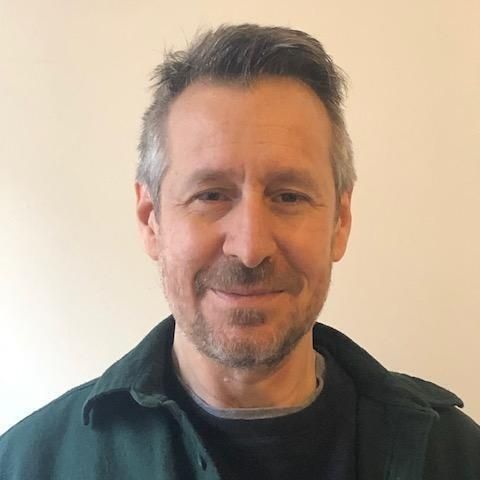
Gary Wilder is a Professor in the Ph.D. Program of Anthropology, with cross-appointments in History and French, at the Graduate Center of the City University of New York, where he is also Director of the Committee on Globalization and Social Change.
Professor Wilder is the author of Concrete Utopianism: The Politics of Temporality and Solidarity (Fordham University Press, 2022), Freedom Time: Negritude, Decolonization, and the Future of the World (Duke University Press, 2015) and The French Imperial Nation-State: Negritude and Colonial Humanism Between the World Wars (University of Chicago Press, 2005). Other publications include Theses on Theory and History, an open-source digital publication, co-authored with Ethan Kleinberg and Joan Wallach Scott and two co-edited volumes, The Fernando Coronil Reader: The Struggle for the Life is the Matter (Duke University Press 2019 and The Postcolonial Contemporary: Political Imaginaries for the Global Present (Fordham University Press, 2018). He is currently working on a manuscript provisionally entitled “Revolutionary Refractions: CLR James for Our Times”
Additional Information
Program
Einaudi Center for International Studies
Latin American and Caribbean Studies
Institute for African Development Seminar Series: Curating the scientific evidence : the art and science of conducting a systematic review
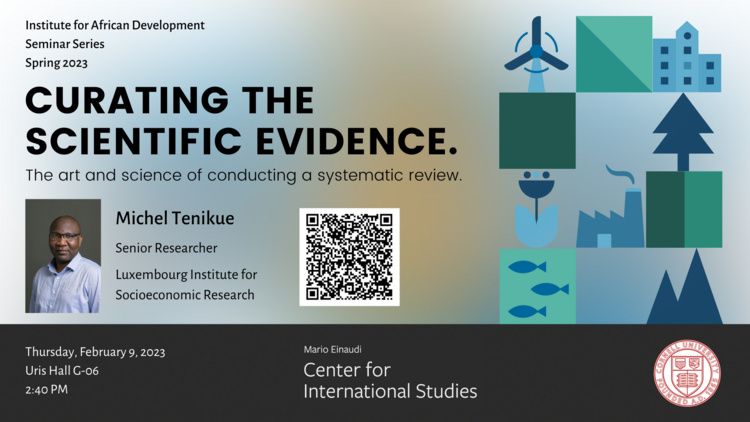
February 9, 2023
2:40 pm
Uris Hall, G-02
Thursday, Feb. 9, 2023 G-02 Uris Hall 2:40pm
Register
Most professional policy makers agree that sound policy must be based on scientific evidence. Yet, how do we get the evidence out of a large quantity of scientific information? How do we know that the evidence is accurate? Or that it will apply to our special circumstances? Or, what to do when different studies seem to point into different directions? A systematic review of the literature is the way to go. When conducted properly, it produces a concise synthesis of a large body of research on a given topic. The purpose of this session is to offer an introduction to the process of conducting a systematic review. We will (i) distinguish between systematic review and other forms of literature review; (ii) describe and illustrate the basics steps in a systematics review; (iii) discuss some examples and (iv) highlight the strengths and weakness of these reviews. Illustrations from Africa will be presented to illustrate how reviews can be incorporated into to the broader process of designing evidence-based policy..
Additional Information
Program
Einaudi Center for International Studies
Institute for African Development
ICM Symposium: Reparations for Colonization/Carbonization
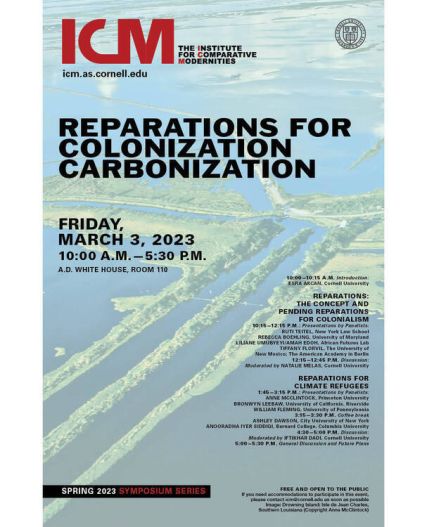
March 3, 2023
10:00 am
A.D. White House
Given the intertwined history of industrial capitalism, extraction and colonialism, this symposium will explore the pending reparations to their victims from a multidisciplinary perspective. Acknowledging the accountability of the first industrializing countries of the Global North to the previously colonized countries of the Global South, the symposium will address the importance of material and moral reparations in bringing justice to the residual inequalities caused by slavery and racism, environmental extraction and pollution. The intention is to explore the intersections between colonialism and climate change, de-colonization and de-carbonization, transitional justice and energy transition.
This symposium will continue the discussion from the “Repair and Reparations” panel series organized by Esra Akcan as director of the Institute for European Studies, at the Einaudi Center for International Studies at Cornell. Information and links to the recordings of the panels are included below.
PROGRAM
10:00—10:15 A.M. Introduction: ESRA AKCAN, Cornell University
REPARATIONS: THE CONCEPT AND PENDING REPARATIONS FOR COLONIALISM
10:15—12:15 P.M.: Presentations by Panelists:
RUTI TEITEL, New York Law School
REBECCA BOEHLING, University of Maryland
LILIANE UMUBYEYI/AMAH EDOH, African Futures Lab
TIFFANY FLORVIL, The University of New Mexico; The American Academy in Berlin
12:15—12:45 P.M. Discussion: Moderated by NATALIE MELAS, Cornell University
REPARATIONS FOR CLIMATE REFUGEES
1:45—3:15 P.M.: Presentations by Panelists:
ANNE MCCLINTOCK, Princeton University
BRONWYN LEEBAW, University of California, Riverside
WILLIAM FLEMING, University of Pennsylvania
3:15—3:30 P.M. Coffee break
ASHLEY DAWSON, City University of New York
ANOORADHA IYER SIDDIQI, Barnard College, Columbia University
4:30—5:00 P.M. Discussion: Moderated by IFTIKHAR DADI, Cornell University
5:00—5:30 P.M. General Discussion and Future Plans
PANELIST BIOGRAPHIES
Ruti Teitel is the Ernst C. Stiefel Professor of Comparative Law, the Director of the Institute for Global Law, Justice, and Policy, and a co-director of the Center for International Law at New York Law School. She is one of the world’s leading experts on international human rights and the foremost thought-leader of transitional justice. She is the author of a wide body of work, including three books: Globalizing Transitional Justice (2014), Humanity’s Law (2011), Transitional Justice (2000), all published by Oxford University Press. Prof. Teitel is the founding co-chair of the Interest Group on Transitional Justice and Rule of Law at the American Society of International Law. She is also a life member of the Council on Foreign Relations.
Rebecca Boehling is Professor Emerita of History at the University of Maryland, Baltimore County (UMBC). She is the author of the study, A Question of Priorities: Democratic Reform and Economic Recovery in Postwar Germany, as well as numerous articles on Germany under U.S. occupation. She is also the co-author of a personal history told through letters, Life and Loss in the Shadow of the Holocaust: A Jewish Family’s Untold Story . From 2013 to 2015 she directed the International Tracing Service in Germany, co-editing multiple volumes of its yearbook. In 2016, she was a fellow at the American Academy in Berlin where she researched comparative histories of denazification.
Liilian Umubyehi is the Co-founder and Executive Director of African Futures Lab, an organization which aims at tackling the lack of accountability regarding historical and contemporary racial injustices in Europe and Africa, by investigating these injustices and by supporting the efforts of racial justice actors to hold States accountable. Prior to establishing AfaLab, Liliane worked in the field of international development (United Nations, Lawyers without Borders, and the American Bar Association, International Centre for Transitional Justice) on projects concerning access to justice for marginalized groups, transitional justice, and gender justice. This professional background and her lived experience in Africa (Rwanda, South Africa, Central African Republic) and in Europe (Belgium, France) inform her thinking about the decolonization of development policy and practice, the decolonization of international law and justice systems, and the possibilities for repairing historical and contemporary racial violence. Liliane holds a PhD in Social Sciences from the Ecole Normale Supérieure de Cachan (France) and in Law from the Université Saint Louis Bruxelles (Belgium), and her dissertation focused on apartheid victims' mobilizations in South African and American courts.
Amah Edoh is the Homer A. Burnell Assistant Professor of Anthropology and African Studies at Massachusetts Institute of Technology, and co-founder of the African Futures Lab. Her research takes as its focus the circulation of material and visual objects across West Africa and Europe to interrogate the production of Africa as a category of thought. Edoh has conducted ethnographic fieldwork in Togo and the Netherlands. is an anthropologist interested in how “Africa” as a category of thought is produced through material practices across African and non-African sites.
Tiffany N. Florvil is Associate Professor, Department of History, at the University of New Mexico. She specializes in the histories of post-1945 Europe, the African diaspora, Black internationalism, as well as gender and sexuality. She has published pieces in the Journal of Civil and Human Rights, APuZ, Signs, and The German Quarterly. Florvil has also co-edited the volume, Rethinking Black German Studies: Approaches, Interventions and Histories (2018 hardback and 2022 paperback), as well as published chapters in Gendering Post-1945 German History (2019) and To Turn this Whole World Over (2019). Her manuscript, Mobilizing Black Germany: Afro-German Women and the Making of a Transnational Movement (University of Illinois Press 2020), offers the first full-length institutional and intellectual history of the modern Black German movement of the 1980s to the 2000s. Her book won the Waterloo Centre for German Studies First Book Prize in 2021 among other honors. She is on the editorial boards of the Journal of Women’s History and Central European History and the founding editor of the “Imagining Black Europe” book series at Peter Lang Press. Currently, Florvil is working on an intellectual biography of Black German activist and author May Ayim and is the Anna-Maria Kellen Fellow at the American Academy in Berlin.
Anne McClintock is the A. Barton Hepburn Professor of Gender and Sexuality Studies and High Meadows Environmental Institute at Princeton University. McClintock’s interdisciplinary and transnational work—both scholarly and creative—explores the intersections between race, gender and sexualities; imperialism and globalization; visual culture and mass media; sexual and gender violence; and environmentalism and animal studies. Her work includes Imperial Leather: Race, Gender and Sexuality in the Colonial Contest; Dangerous Liaisons: Gender, Nation and Postcolonial Perspectives (co-edited), as well as creative non-fiction and photographic essays. She has won many awards, including two MacArthur-SSRC fellowships, Columbia Human Rights Distinguished Fellowship, Feminist Scholars Fellowship, Woodrow Wilson Fellowship, and numerous artists residency fellowships. Her public writing and photographs have appeared in The New York Times, The Guardian, Guernica Magazine of Arts and Politics, The Nation, The Times Literary Supplement, Women’s Review of Books, and Truth Out, among others. Her writing has been translated into 13 languages.
Bronwyn Leebaw is Associate Professor of Political Science at University of California, Riverside, where she teaches courses on human rights, transitional justice, political theory, international politics and ethics, and environmental justice. Leebaw has published articles on human rights, humanitarianism, and transitional justice. Her research critically examines how human rights and transitional justice practices have conceptualized, documented, judged, and avoided various forms of resistance to the abuses that they confront. Anotherproject, entitled, Scorched Earth: Environmental Justice and the Legacies of War, traces efforts to distinguish between legitimate and illegitimate wartime environmental devastation from just war theory through the contemporary environmental justice movement.
Billy Fleming is the Wilks Family Director of the Ian L. McHarg Center in the Weitzman School of Design at the University of Pennsylvania, a senior fellow with Data for Progress, and co-director of the "climate + community project at Penn. Fleming is also co-author of “The Indivisible Guide”, co-editor of “Design With Nature Now” and “The Adaptation Blueprint”, author of Drowning America: The Nature and Politics of Adaptation”, and co-founder of Data Refuge. His writing has been published in The Atlantic, Jacobin, Dissent, CityLab, The Guardian, Landscape Journal, and LA+. Before joining Penn, Fleming worked on urban policy development in the White House Domestic Policy Council during the Obama Administration. Before joining the faculty at Penn, Fleming worked on urban policy development in the White House Domestic Policy Council during the Obama Administration.
Ashley Dawson is Professor of English at the Graduate Center / City University of New York and the College of Staten Island. Recently published books of his focus on key topics in the Environmental Humanities, and include People’s Power: Reclaiming the Energy Commons (O/R, 2020), Extreme Cities: The Peril and Promise of Urban Life in the Age of Climate Change (Verso, 2017), and Extinction: A Radical History (O/R, 2016). Dawson is the author of a forthcoming book entitled Environmentalism from Below (Haymarket) and is co-editor of a soon-to-be-published volume of essays called Decolonize Conservation! (Common Notions).
Anooradha Iyer Siddiqi is an architectural historian and Assistant Professor of Architecture at Barnard College, Columbia University. She is the author of Architecture of Migration: The Dadaab Refugee Camps and Humanitarian Settlement (Duke UP, 2023), which conceptualizes architectures of migration and histories of settlement through spatial politics, visual rhetoric, and ecologies of the UNHCR-administered camps at Dadaab, Kenya. She is completing the book A Modern Architecture of the Past, on heritage politics understood through the work and intellectual career of Sri Lankan architect Minnette de Silva and art historian Anil de Silva-Vigier. Siddiqi’s scholarship aims to create collaborative practices of mutual support to foreground histories of those systematically marginalized or silenced. Among many written and edited publications, Siddiqi co-edited the online collection Feminist Architectural Histories of Migration (ABE: Architecture Beyond Europe, Canadian Centre for Architecture, and Aggregate, 2019-2022). She is a director of the Columbia University working group Insurgent Domesticities and a co-chair of the University Seminar Studies in Contemporary Africa.
New Perspectives on Postwar and Postcolonial Reparations
Panelists: Ruti Teitel, Rebecca Boehling, Nicholas Mulder, Tiffany Florvil
https://www.youtube.com/watch?v=IlT5e6q4M1M
This panel brought together scholars who provided new perspectives on the material and moral reparations of the postcolonial, post-Nazi and post-communist eras in Germany, as well as the significance of these restitutions in serving as a model for transitional justice and international law. It explored both material and moral reparations, such as return and restitution of property that had been confiscated, monetary payments as compensation, and educational steps to take accountability for the past. The panel not only acknowledged these reparations to ex-citizens and refugees, but also questioned the limits of established formulas and the lack or inequality of restitutions throughout the history of today’s Germany.
Colonialism Reparation and Truth & Reconciliation Commissions
Panelists: Pablo de Greiff, Amah Edoh, Pedro Monaville, Liliane Umubyeyi
https://www.youtube.com/watch?v=PtGaN2A_tC4
This panel explored the theme of reparations and restitutions to bring justice to the residual inequalities caused by slavery and colonization. It focused on the recent developments to institute a sort of a Truth and Reconciliation Commission in Belgium, which was approved in Summer 2020 in the form of a parliamentary Special Commission to scrutinize the country’s colonial past. The multidisciplinary panel put into conversation scholars who commented on the history of Belgium’s colonization in Congo, on the recent movements in conjunction with Black Lives Matter including the toppling of the King Leopold II Monument that sparked the demand for accountability, and on the current debate around truth and reconciliation in Belgium, as well as its place in other transitional justice processes around the world.
Repatriation of Museum Objects
Panelists: Souleymane Bachir Diagne, Jonathan Fine, Cécile Fromont
https://www.youtube.com/watch?v=9V7H4J30nig
This panel was organized to bring together museum curators and scholars to comment on the recent discussions on repatriation and restitution as a form of reparation to colonized and looted lands. While museums in Europe and North America have occasionally returned objects to their native communities or lands of arrival, the issue of repatriation gained an accelerated epistemological and ethical momentum at the end of 2018. What is the responsibility of museums to objects taken into their collections by violence or deceit during the colonial times or wars? What is the role of museum-object-repatriation in the recognition of colonial and military violence? What are the legal structures that prohibit or allow deaccession in the museums of different countries? Once the objects are parted from their communities and no longer serve their original sacred functions, where are they to be returned? What determines how far back museums consider repatriation claims legitimate and why? What is the future of “universal museums” around the world?
Repair and Reparations for Climate Refugees?
Panelists: Anne McClintock, Ashley Dawson, Bronwyn Leebaw, Anooradha Siddiqi, Billy Fleming
https://www.youtube.com/watch?v=96KAQHK-ztc
The displacement of populations due to climate change forecasts an unprecedented phenomenon in human history. Neither international law nor nations are prepared to face up to this challenge in a way that would secure refugee’s human rights or their appropriate resettlement. This panel brought together different academic disciplines to bear on the question of rehabilitation and resettlement as a form of reparation to current and future climate refugees. How, if at all, is it possible to think of restitutions to climate refugees by acknowledging the accountability of the first industrializing countries of the Global North in imposing this displacement on the peoples of the Global South? Can we think of subsidized resettlement as one form of reparation to climate refugees? The intention was to start a conversation with scholars working in the areas of migration, transitional justice, architecture, activist art and environmental history on the possibility of a just response to the displacement of climate refugees.
Additional Information
Program
Einaudi Center for International Studies
South Asia Program
Institute for European Studies
EMERGING MARKETS INSTITUTE’S ANNUAL REPORT

February 10, 2023
10:00 am
Registration Link: Keynote: Emerging Markets Institute's Annual Report | eCornell
The global economy has experienced rapid shocks, shifts, and disruptions over the past few years. From the ongoing effects of the Russian war on Ukraine to the enduring stresses of the COVID-19 pandemic, macroeconomic events have forced businesses and industries to adapt and evolve. The backbone of globalization, global value chains have sparked growth in production and manufacturing, but the recent pandemic has exposed many of their vulnerabilities, resulting in the need for innovation. As the growth of many emerging economies is based on the strength of their value chains, this webinar will present the Emerging Markets Institute’s 2022 Annual Report, “Reinventing Global Value Chains.”
Join us as experts from Cornell University and beyond outline the key findings of the report, including the performance of various economies’ value chains as well as the drivers for their growth. Our panelists will further highlight the transformation of value chains over the past two decades as well as how value chains have reacted to external pressures, like sustainability initiatives.
Registration Link: Keynote: Emerging Markets Institute's Annual Report | eCornell
Additional Information
Program
Einaudi Center for International Studies
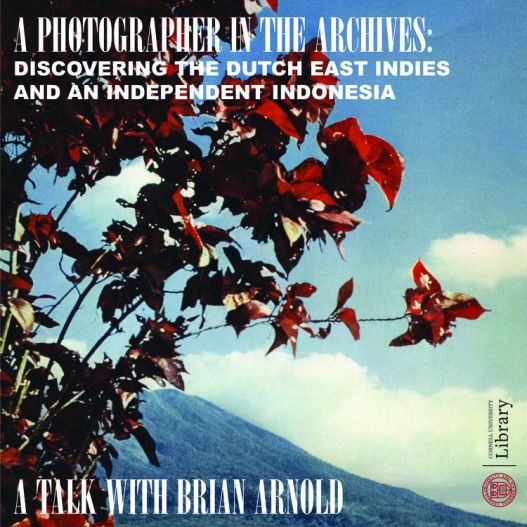
A Photographer in the Archives: Discovering the Dutch East Indies and an Independent Indonesia with Brian Arnold
February 16, 2023
2:00 pm
Carl A. Kroch Library, Rare and Manuscripts Collection, Room 2B48
This lecture coincides with the publication of A History of Photography in Indonesia: From the Colonial Era to the Digital Age (Afterhours/Amsterdam University Press 2022). The book is a selection of essays compiled by Brian Arnold that collectively piece together the development of photography in Indonesia, from the inception of the medium in the 1840s to the present day. In compiling the book, Brian worked as editor, contributor, and translator. Two chapters in the book are based on collections in the Rare and Manuscript Collections in the Cornell University Library, and this will be in an informal lecture about these two chapters, emphasizing the importance of archives and a material-based approach to research. The lecture will include both a slide presentation as well as an opportunity for in-person attendees to look at some of the original materials.
Additional Information
Program
Southeast Asia Program
Einaudi Center for International Studies