
Einaudi Center for International Studies
Undergraduates: Apply Now to Go Abroad
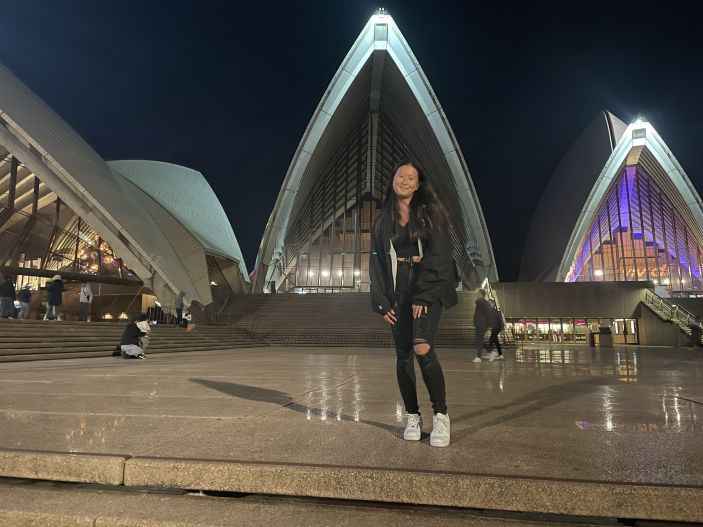
LACS and SEAP January Programs
Short-term and semester options include new Cornell Global Hubs and winter opportunities in Ecuador and Cambodia facilitated by Einaudi programs.
Additional Information
Institute for African Development Seminar Series: Digital Humanities as Platform for Reconfiguring and Retooling Humanities Research and Scholarship in Africa
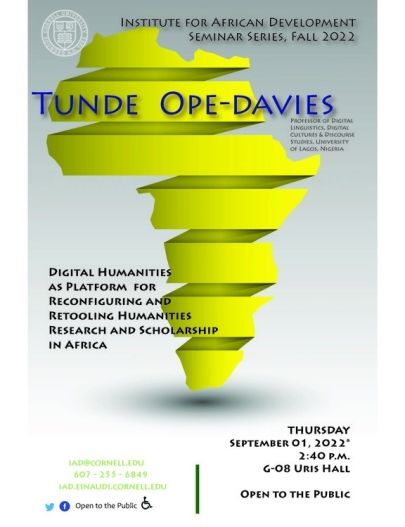
September 1, 2022
2:40 pm
Uris Hall, G-08
The Issues in African Development Seminar Series examines critical concerns in contemporary Africa using a different theme each semester. The seminars provide a forum for participants to explore alternative perspectives and exchange ideas. They are also a focal activity for students and faculty interested in African development. In addition, this seminar series prepares students for higher level courses on African economic, social, and political development. The presentations are designed for students who are interested in development as well as Africa’s place in global studies, want to know about the peoples, cultures, and societies that call Africa home, and wish to explore development theories and alternate viewpoints on development practice.
Additional Information
Program
Einaudi Center for International Studies
Institute for African Development
Fall 2022 Student Info Sessions
Einaudi student information sessions are here! Join us to get the inside scoop about Einaudi minors, funding opportunities, Fulbright, summer language programs, and much more.
Additional Information
Dos Estaciones

September 18, 2022
7:00 pm
Willard Straight Theatre
2022 > Mexico > Directed by Juan Pablo Gonzalez
With Teresa Sanchez, Rafaela Fuentes, Manuel Garcia-Rulfo
Fifty-year-old businesswoman Mar’a Garc’a is the owner of Dos Estaciones, a once-majestic tequila factory now struggling to stay afloat as the last Mexican-owned plant in a business dominated by foreign corporations. When a persistent insect plague and an unexpected flood cause irreversible damage, Mar’a is forced to do everything she can to save her community's primary economy and source of pride. Subtitled. More at www.cinemaguild.com/theatrical/dosestaciones.html
1 hr 37 min
Additional Information
Program
Einaudi Center for International Studies
Info Session: Fulbright Opportunities for Undergraduates

October 12, 2022
4:45 pm
The Fulbright U.S. Student Program supports college graduates conducting research or teaching in any field in more than 150 countries. Join this Einaudi Center Student Info Session to find out if Fulbright is right for you!
Applications are due in the fall. Students who wish to begin the program immediately after graduation should start the application process in their junior year.
The Einaudi Center administers the Fulbright program at Cornell. As the home of Cornell’s Fulbright program, we offer all the resources that students need to apply for prestigious Fulbright international study and research funding. Learn more about Fulbright at Cornell.
***
Contact: fulbright@einaudi.cornell.edu
Additional Information
Program
Einaudi Center for International Studies
Reppy Institute for Peace and Conflict Studies
East Asia Program
Southeast Asia Program
Latin American and Caribbean Studies
Institute for African Development
Institute for European Studies
South Asia Program
Info Session: Laidlaw Leadership and Research Program

September 13, 2022
4:45 pm
The Laidlaw Undergraduate Leadership and Research Program promotes ethical leadership and international research around the world—starting with the passionate leaders and learners found on campuses like Cornell.
Open to first- and second-year students, the two-year Laidlaw program provides generous support to carry out internationally focused research, develop leadership skills, engage with community projects overseas, and become part of a global network of like-minded scholars from more than a dozen universities.
Join this Einaudi Center Student Info Session to learn more about the program and application process. We’ll also share tips for approaching potential faculty research mentors and writing a successful application.
***
Contact: laidlaw.scholars@cornell.edu
Additional Information
Program
Einaudi Center for International Studies
Reppy Institute for Peace and Conflict Studies
East Asia Program
Southeast Asia Program
Latin American and Caribbean Studies
Institute for African Development
Institute for European Studies
South Asia Program
Info Session: Einaudi Research Travel Grants
November 9, 2022
4:45 pm
The Einaudi Center's Research Travel Grants for Graduate Students provide international travel support for Cornell graduate students conducting short-term research or fieldwork outside the United States.
If you’re traveling between the United States and a host country for activities directly related to your dissertation or thesis research, Einaudi can help you get there. Join this Einaudi Center Student Info Session to find out more.
Additional Information
Program
Einaudi Center for International Studies
Reppy Institute for Peace and Conflict Studies
East Asia Program
Southeast Asia Program
Latin American and Caribbean Studies
Institute for African Development
Institute for European Studies
South Asia Program
Info Session: Foreign Language and Area Studies Fellowships and Rare and Distinctive Language Fellowships
November 2, 2022
4:45 pm
Uris Hall, G-08
If you love languages, our funding opportunities are for you! Learn one of more than 50 languages offered at Cornell with a Foreign Language and Area Studies Fellowship or Rare and Distinctive Language Fellowship. Opportunities are open to both undergraduate and graduate students.
FLAS fellowships support students studying modern South Asian and Southeast Asian languages and related area studies. Funding is offered in collaboration with the Einaudi Center’s South Asia and Southeast Asia Programs.
RAD fellowships support students studying modern languages that are less frequently taught in the United States. Funding is offered by the Einaudi Center for intensive summer language study.
Join this hybrid Einaudi Center Student Info Session in person in Uris Hall G-08 or virtually (link below).
Additional Information
Program
Einaudi Center for International Studies
Reppy Institute for Peace and Conflict Studies
East Asia Program
Southeast Asia Program
Latin American and Caribbean Studies
Institute for African Development
Institute for European Studies
South Asia Program
Info Session: Fulbright Opportunities for Graduate Students

October 19, 2022
4:45 pm
The Fulbright U.S. Student Program provides full funding for graduate and professional students conducting research or teaching in any field in more than 150 countries. (Open to U.S. citizens only.)
The Fulbright-Hays Doctoral Dissertation Research Abroad program supports doctoral students conducting research in modern languages or area studies for six to 12 months. (Open to U.S. citizens and permanent residents of the United States. Travel to Western European countries is not eligible.)
The Einaudi Center administers the Fulbright program at Cornell. As the home of Cornell’s Fulbright program, we offer all the resources that students need to apply for prestigious Fulbright international study and research funding. Learn more about Fulbright at Cornell.
Join this Einaudi Center Student Info Session to find out if Fulbright is right for you!
***
Contact: fulbright@einaudi.cornell.edu
Additional Information
Program
Einaudi Center for International Studies
Reppy Institute for Peace and Conflict Studies
East Asia Program
Southeast Asia Program
Latin American and Caribbean Studies
Institute for African Development
Institute for European Studies
South Asia Program
Info Session: Einaudi Dissertation Proposal Development Program

October 13, 2022
4:45 pm
Develop your dissertation on global issues with a toolkit of resources!
The Einaudi Dissertation Proposal Development Program (DPD) supports 12 PhD students annually. Applicants’ research projects must focus on global issues, but the proposed research setting may be international or domestic.
Over the course of the year, you’ll participate in seminars, workshops, and mentoring sessions and receive up to $5,000 for summer research. Join this Einaudi Center Student Info Session to find out how to apply!
***
Contact: programs@einaudi.cornell.edu.
Additional Information
Program
Einaudi Center for International Studies
Reppy Institute for Peace and Conflict Studies
East Asia Program
Southeast Asia Program
Latin American and Caribbean Studies
Institute for African Development
Institute for European Studies
South Asia Program