
Einaudi Center for International Studies
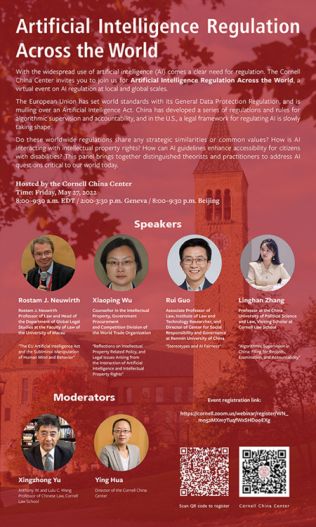
Artificial Intelligence Regulation Across the World
May 27, 2022
8:00 am
With the widespread use of artificial intelligence (AI) comes a clear need for regulation. The Cornell China Center invites you to join us for Artificial Intelligence Regulation Across the World, a virtual event on AI regulation at local and global scales.
The European Union has set world standards with its General Data Protection Regulation, and is mulling over an Artificial Intelligence Act. China has developed a series of regulations and rules for algorithmic supervision and accountability, and in the U.S., a legal framework for regulating AI is slowly taking shape.
Do these worldwide regulations share any strategic similarities or common values? How is AI interacting with intellectual property rights? How can AI guidelines enhance accessibility for citizens with disabilities? This panel brings together distinguished theorists and practitioners to address AI questions critical to our world today.
Panelists:
Rostam J. Neuwirth, Professor of Law, Head of the Department of Global Legal Studies at the Faculty of Law of the University of Macau, “The EU Artificial Intelligence Act and the Subliminal Manipulation of Human Mind and Behavior”
Xiaoping Wu, Counsellor in the Intellectual Property, Government Procurement and Competition Division of the World Trade Organization, “Reflections on Intellectual Property Related Policy, and Legal Issues Arising from the Interaction of Artificial Intelligence and Intellectual Property Rights”
Rui Guo, Associate Professor of Law, Institute of Law and Technology Researcher, and Director of Center for Social Responsibility and Governance at Renmin University of China, “Stereotypes and AI Fairness”
Linghan Zhang, Professor at the China University of Political Science and Law, Visiting Scholar at Cornell Law School, “Algorithmic Supervision in China: Filing for Records, Examination, and Accountability”
Moderators:
Xingzhong Yu, Anthony W. and Lulu C. Wang Professor of Chinese Law, Cornell Law School
Ying Hua, Cornell China Center Director
Language: English
Event time: Friday, 27 May 2022, 8:00–9:30 a.m. NY / 2:00–3:30 p.m. Geneva / 8:00–9:30 p.m. Beijing
Additional Information
Program
Einaudi Center for International Studies
East Asia Program
Institute for European Studies
June Opportunities for Faculty
ICC Grants and Fulbright-Hays FRA
Get funding support for your international teaching and research. Letters of intent due in June! Find out how to apply.
Additional Information
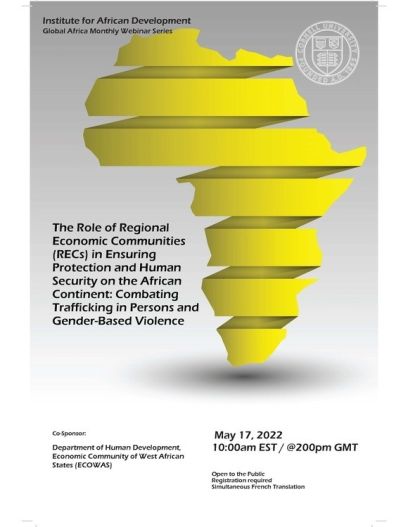
Ensuring Protection and Human Security on the African Continent
May 17, 2022
10:00 am
Tuesday, May 17, 202
10:00am EST / 2:00pm GMT Registration link
The importance of human protection and security as the foundation of human development cannot be over emphasised. The entire DSAG/DHD essentially has a “Prevention and Protection” mandate which covers issues of Humanitarian Affairs, Disaster Risk Reduction, Drug Prevention and Control and Social Affairs; Gender and Development which addresses, among others, Gender and climate change, women and trade, Gender and migration, Gender and Political participation ; Counter Trafficking In Persons; Child Rights/ Protection and Child Labour (which addresses Violence Against Children –VAC) ; Emergency Protection which covers Refugees and IDPs, Mixed-Migration and International Humanitarian Law Programs. Critically, the Women Peace and Security and Civil Society Programme are of central importance from the perspective of women’s equality and agency and in terms of a social mobilization approach embracing Civil Society and other Non-State Actors.
To advance its protection mandate and promote the institutionalisation of protection and human security in the ECOWAS region, the DSAG/DHD in 2021 introduced an integrated Human Security programming approach which considers the interconnection of all the above mentioned themes. The integrated approach supports Member States to institutionalise a whole of Government/ State and society coordinated approach and shared responsibility to ensuring the protection and human security of every individual citizen and especially people in vulnerable situations.
Additional Information
Program
Einaudi Center for International Studies
Institute for African Development
Putin’s Perilous Imperial Dream

Cristina Florea, Global Public Voices and IES
A Foreign Affairs op-ed from Cristina Florea (IES) explains why empires and nativism don’t mix:
"From history, Putin has recycled not those qualities that made the Russian Empire endure, but those that destabilized it and contributed to its dissolution by fostering nationalist resentment and resistance. It is little surprise, then, that Putin’s imperial project in Ukraine is already weakening Russia from within and without."
Additional Information
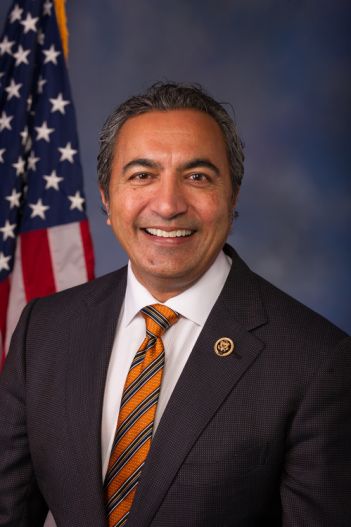
Development in the U.S./China Relationship: A Conversation with Rep. Ami Bera
May 17, 2022
7:00 pm
This event is canceled due to a change in the House voting schedule. The Congressman must be on the floor of the Capitol to vote.
We welcome Rep. Ami Bera to discuss China and nonproliferation moderated by Rep. Steve Israel and Vice Provost Wendy Wolford.
Speaker
Rep. Ami Bera, M.D., U.S. House of Representatives (CA-7th); Chairman, House Subcommittee on Asia, the Pacific, Central Asia, and Nonproliferation
Moderators
Wendy Wolford, Vice Provost for International Affairs; Robert A. and Ruth E. Polson Professor, Department of Global Development
Steve Israel, Director, Institute of Politics and Global Affairs at Cornell University and former U.S. Representative (D-NY)
The Institute of Politics and Global Affairs is a non-partisan institute dedicated to elevating public discourse and stimulating civic engagement.
Additional Information
Program
Einaudi Center for International Studies
East Asia Program
Storm Still Blowin’: Critical Jewish Studies Now

May 24, 2022
10:00 am
A. D. White House, Guerlac Room
Register by May 13 to attend. Space is limited.
This workshop is a unique two-day international workshop being held on the occasion of the thirtieth anniversary of the publication of Jonathan Boyarin’s "Storm from Paradise: The Politics of Jewish Memory." In that book, Professor Boyarin notes the evident reality in which the “storm [is] still blowing” and Benjamin’s “Angel of History” not only resists the still unfolding global crisis, but also marks a proximity to a redemptive, utopian potentiality: “Part of the import of Benjamin’s image is the lesson that we are always once again being driven out; in some sense we have always just lost paradise, hence we are always close to it.” This sense that “something precious is eternally being lost” points to a fugitive alternative politics that is even more relevant today than it was thirty years ago.
The workshop will reflect on three decades of intersecting threads of critical scholarship in postcolonial studies, critical race theory, feminist studies, experimental approaches to the poetics and politics of literary form in academic writing, and the critique of secularism, and collaboratively project these critical possibilities into the future. Storm from Paradise was one of the earliest introductions of these intersecting critical paradigms to the field of Jewish Studies, and we look forward to revisiting and expanding on these questions 30 years later.
Register by May 13 to attend. Space is limited.
Participants will receive pre-circulated works in progress by Jonathan Boyarin, Daniel Boyarin, J. Kameron Carter, Joyce Dalsheim, Nancy Ko, Elad Lapidot, Laura Levitt, Amnon Raz-Krakotzkin, Naomi Seidman, Noah Tamarkin, Raef Zreik, Itamar Haritan, and Re’ee Hagay.
Co-sponsored by the Jewish Studies Program, Mario Einaudi Center for International Studies, Department of Anthropology, Department of Near Eastern Studies, Society for the Humanities, Department of History, Department of Literatures in English, Department of German Studies, Institute for German Cultural Studies, Africana Studies and Research Center, and Institute for Comparative Modernities.
Please adhere to Cornell University’s COVID-19 guidelines. Stay informed at covid.cornell.edu.
Workshop schedule:
Monday, May 23
10:30-11:00 Reception
11:00-12:20 Session I
Opening remarks“Between Exile and Diaspora: Two Dimensions of Jewish Counter-Histories” Amnon Raz-Krakotzkin, Ben-Gurion University and the Van Leer Institute
12:20-1:20 Lunch Buffet
1:30-4:20 Session II
“Palestinian Question as Jewish Question?” Raef Zreik, Tel Aviv University and the Van Leer Institute
“The Angel of OTD History” Naomi Seidman, University of Toronto
“The Diaspora Politics of Memory: What the Storm Provides” Daniel Boyarin, University of California, Berkeley
4:45-5:35 Session III
“When Benjamin Met Mackey: A Fugitive Angelology” J. Kameron Carter, Indiana University, Bloomington
“Follow the Sponges: Towards an Environmental History of Jewish Memory and Racial Capitalism in the Global Mediterranean” Nancy Ko, Columbia University
6:35 Dinner at A.D. White Dinning Room
Tuesday, May 24
10:00 Gathering
10:15-12:05 Session IV
“Anonymous Remains: Between The Arcades Project and the Cairo Geniza” Re'ee Hagay, Cornell University
“Angelus Altnovus: Critique of Postcolonial Zionism” Elad Lapidot, Bern University, Switzerland
12:05-12:55 Lunch Buffet
12:55-2:45 Session V
“Memory and Double-Consciousness” Itamar Haritan, Cornell University
“Household Tales or Unheimliche Mayses” Joyce Dalsheim, University of North Carolina, Charlotte
3:10-5:30 Session VI
“Angels and Lost Overcoats: Letting Go of Certitude with Christa Wolf” Laura Levitt, Temple University
“Other Angels/Planetary Conversions” Jonathan Boyarin, Cornell University
6:00-7:00 Reception
Additional Information
Program
Einaudi Center for International Studies
Ukraine: War, Economy, Path to Rebuilding
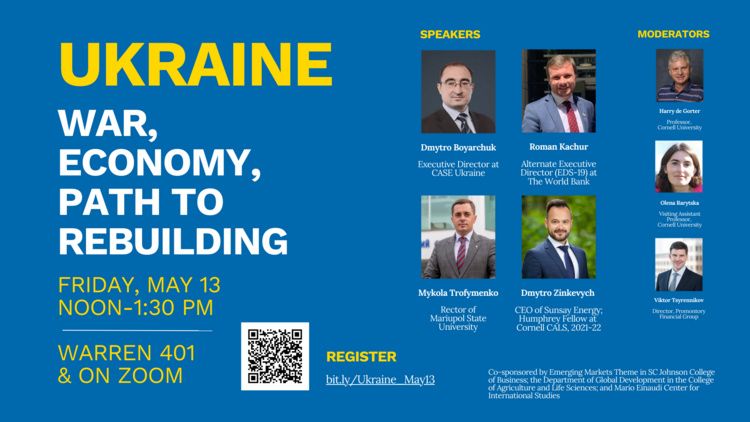
May 13, 2022
12:00 pm
Warren, 401
Hybrid event: Warren 401 and on Zoom. Now in its third month, the unfolding crisis in Ukraine has killed thousands, displaced millions, and destroyed civil infrastructure throughout the country. The damages to Ukraine's economy exceed $1 trillion by some estimates. While the war is far from the end, a panel of Ukrainian experts will converge at Cornell for a hybrid event to discuss the war, economy, and the path to rebuilding. This is a hybrid event. Guests are welcome to attend the event at Warren 401 on the Cornell campus or take part on Zoom. Speakers: Dmytro Boyarchuk will be speaking from Ukraine, where he is executive director at CASE Ukraine. He has extensive expertise in macro-economic forecasting, social policy and fiscal sector. He will be speaking from UkraineRoman Kachur is alternate executive director at the World Bank. Before the World Bank, Roman worked as a deputy finance minister in Ukraine and is an expert on international finance. He will be speaking from the United StatesMykola Trofymenko is the rector at Mariupol State University. He will be speaking from UkraineDmytro Zinkevych is the CEO of Sunsay Energy, a company that provides solar energy solutions in Ukraine, and he is a current a Humphrey fellow at Cornell studying challenges and solutions in the renewable energy sector. He will be speaking from the United States.Moderators: Harry de Gorter, professor at CornellOlena Rarytska, visiting assistant professor at CornellViktor Tsyrennikov, director at the Promontory Financial Group Co-sponsors: Emerging Markets Theme in the SC Johnson College of Business, the Department of Global Development in the College of Agriculture and Life Sciences, and the Mario Einaudi Center for International Studies.
Additional Information
Program
Einaudi Center for International Studies
Institute for European Studies
Reppy Institute for Peace and Conflict Studies
Interview: Cornell Professor Talks Healthcare Inequality

Landon Schnabel, GPV
Landon Schnabel, assistant professor of sociology, discusses how gender and socioeconomic status impact healthcare access.
Additional Information
Fearful of Getting Cut Off, China Pushes for Self-Reliance

Eswar Prasad, SAP
“One lesson that China is probably taking from the fallout is it remains vulnerable to financial, economic and technological sanctions,” says Eswar Prasad, professor of international trade policy and economics.
Additional Information
The Long History of Disinformation During War

Barry Strauss, PACS
Barry Strauss, professor of humanistic studies, writes this piece about the history of disinformation during war.