
Einaudi Center for International Studies
Language Resource Center Speaker Series - Christina Rocha

February 15, 2022
12:30 pm
Stimson Hall, G25
"Inquiry-Based Language Learning"
Christina Rocha
ACS Athens
This talk will focus on inquiry-based learning within the language classroom, more specifically WHY it is important as well as HOW we can successfully engage our students to ask more questions, sparking their curiosity and motivation to learn more about the language, culture, and people we teach about. Inquiry-based learning helps build intercultural communicative awareness and competence while fostering student agency and a sense of connection to our community through conscious global citizenship.
Bio: Christina Rocha has been teaching languages (ESL, Greek, French, and Spanish) since 1999. She started her career in the U.S. public school system before moving internationally; she currently teaches Spanish and ESL at the American Community Schools (ACS) in Athens, Greece. She is a Ph.D. candidate in Applied Linguistics and Language and Communication with a research interest and focus on inquiry-based language learning and global citizenship. She has recently authored two chapters in the 2021 IGI publication on this topic in the Handbook of Research on K-12 Blended and Virtual Learning Through the i²Flex Classroom Model.
This event will be held in person in G25 Stimson and will also be streamed live over Zoom. Join us at the LRC or on Zoom.
The event is free and open to the public. Campus visitors and members of the public must adhere to Cornell's public health requirements for events, which include wearing masks while indoors and providing proof of vaccination or a recent negative COVID-19 test.
Additional Information
Program
Einaudi Center for International Studies
Latin American and Caribbean Studies
‘Bitcoin Itself May Not Last that Much Longer,’ Cornell Professor Says

Eswar Prasad, SAP
Eswar Prasad, professor of economics and trade policy, discusses the pros and cons of Bitcoin as a currency.
Additional Information
Chinese Users Don’t Need a Central Bank Digital Currency, But There’s Good Reason for It: Professor

Eswar Prasad, SAP
Eswar Prasad, professor of economics and international trade policy, talks about why the People’s Bank of China wanting a digital currency.
Additional Information
The Most Important Meeting Yet for Global Pandemic Response — and Drugmakers

Kaushik Basu, SAP
In this op-ed, Kaushik Basu, professor of economics, and Nicole Hassoun, a former Einaudi Center visiting scholar, argue that global health leaders must adopt a treaty on pandemic preparedness and response and that it must prioritize new incentives for pharmaceutical companies and equity between nations.
Additional Information
The Trial Strategy that Binds Kyle Rittenhouse, Elizabeth Holmes and Travis McMichael

Valerie Hans, Law
This piece on a common trial strategy among Kyle Rittenhouse, Elizabeth Holmes and Travis McMichael references research co-written by Valerie Hans, professor of law, finding that defendants are almost evenly divided on the decision to testify.
Additional Information
Afghan Students Find Haven at Cornell
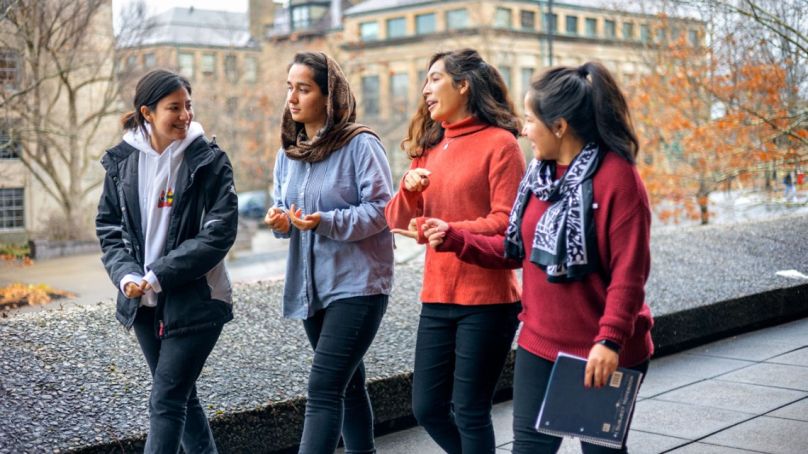
Einaudi Center Welcomes Women Scholars
“The events that brought these students here are traumatic, but their stories demonstrate real bravery and leadership,” said VP Wendy Wolford.
Additional Information
Alex Nading
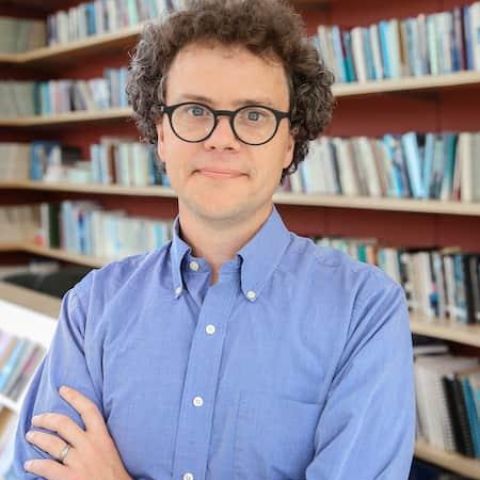
Associate Professor, Anthropology
Alex Nading is a medical and environmental anthropologist in the College of Arts and Sciences. His research, mostly focused on Nicaragua, has examined transnational campaigns against dengue fever, bacterial disease, and chronic kidney disease, as well as grassroots movements to address these issues.
He is the former editor (2021-24) of Medical Anthropology Quarterly and author of two books, "Mosquito Trails: Ecology, Health, and the Politics of Entanglement" (2014) and "The Kidney and the Cane: Planetary Health and Plantation Labor in Nicaragua" (2025).
Additional Information
Program
Role
- Faculty
- LACS Core Faculty
- LACS Director
- LACS Steering Committee
Contact
Email: amn242@cornell.edu
Conferences
Einaudi Center conferences gather faculty experts and researchers, students, policymakers, and the local, national, and international community for conversations about world challenges and how we can work together to meet them.
Join Us
Global engagement and problem-solving are more important than ever. Join the conversation! We invite you to attend our in-person and virtual events and watch videos of past events.
Caricaturing Religious Difference and the Pop Culture Muslim
February 21, 2022
12:15 pm
Uris Hall, G08
Talk by Samah Choudhury (Religious Studies, Ithaca College)
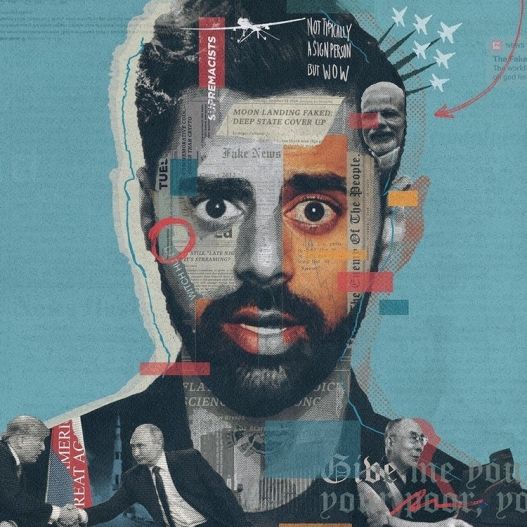
Our contemporary moment has witnessed a precipitous rise in the presence of American Muslim comedians in pop culture - on television, movies, and on the stage. I map their unprecedented popularity to the contemporary moment when American “Muslim” humor is named as such, as well as the complications that arise from imposing a religious referent interchangeably with terms like “racial” or “ethnic” as they relate to the constitution of the 21st-century Western subject. This gendering, racialization, and a growing progressive consensus on issues of intersectionality have come to provide a common language for comedians to identify as Muslim over strictly racial and ethnic nomenclature. Yet this humor replicates a subjugating racialized, religionized, and "masculine" vision of Islam – outside of themselves – by limiting its articulation to normative Sunni ideals and injunctions. For comedians like Hasan Minhaj, there is an inconsistent stepping in and out in of language that names him as Muslim, Indian, Desi, or simply “brown” that relies on aesthetics of American Blackness to register an opposition to white secularity.
Samah Choudhury is an Assistant Professor of Religious Studies at Ithaca College. Her research surrounds Islam, humor, and the politics of social legibility in the United States. Her current book manuscript looks at the ways that Islam and Muslims are articulated through standup comedy and how they speak back to broader transnational practices and discourses of race, masculinity, and secularism. She holds a PhD from UNC Chapel Hill in Religious Studies.
Co-sponsored by the Asian American Studies Program and the Religious Studies Program.
Photo: Netflix/Patriot Act with Hasan Minhaj
Additional Information
Program
Einaudi Center for International Studies
South Asia Program
Info Session: Migrations Grants for Faculty

December 13, 2021
4:00 pm
Uris Hall, Einaudi Conference Room G-08
Join us for an information session to learn more about the new cycle of Migrations grants, open to all PI-eligible faculty (including tenured, tenure-track, professors of practice, senior research associates, and clinical-track faculty), irrespective of their college or school. Faculty-led programs and centers within the university are also welcome to apply.
With support from the Mellon Foundation Just Futures Initiative and Global Cornell, we are funding U.S.-focused work that has long-term and discernible benefits addressing racial and immigrant justice on campus and beyond. Research that has a broader international focus may apply for multispecies, interdisciplinary Migrations grants on any subject related to migration. We offer two tracks, based on our funding sources.
Track 1: Mellon Foundation Just Futures Initiative: Supports research and engagement focused on the United States and centered on the connections between racism, dispossession, and migration in interdisciplinary, innovative, and impactful ways.
Just Futures Team Research Grants, three grants of up to $150,000.Just Futures Small Grants, up to five grants of up to $10,000.Just Futures Engagement Grants, four to eight grants of up to $25,000.Track 2: Migrations: A Global Grand Challenge: Researching, Teaching, and Building for a World on the Move. Supports innovative, multispecies, and interdisciplinary approaches to key international migration issues. Aims to cultivate collaborations that advance science, scholarship, teaching, outreach, and engagement in ways that generate new insights into critical problems.
Migration Cross-Disciplinary Research (Team Research Grants) and Migrations Research (Individual Faculty): $10,000–$50,000 maximum awards. The objective of this funding opportunity is to promote path-breaking research on migrations at Cornell and, in particular, research with an impact that might resonate across multiple fields of study.The Cornell Migrations co-directors will address any questions about priorities, selection criteria, budgets, and other guidance on how to prepare a successful application. Proposals are due January 31, 2022.
This is a hybrid event. Please join us in person in Uris Hall G08 or register via Zoom for virtual.
Additional Information
Program
Einaudi Center for International Studies
Institute for European Studies