
Einaudi Center for International Studies
Who's Afraid of Saule Omarova?

Saule Omarova, Cornell Law
This piece features the life and work of Saule Omarova, professor of law, and the banking lobby’s campaign against Omarova after she was nominated to lead the Office of the Comptroller of the Currency.
Additional Information
Biden Sells Infrastructure Improvements as a Way to Counter China

Eswar Prasad, SAP
“It’s an important step, although it’s not a huge one, if one thinks about the progress China has made in building up its physical and soft infrastructure,” says Eswar Prasad, professor of economics and trade policy. Prasad also discusses President Biden’s meeting with President Xi Jinping of China in The Wall Street Journal.
Additional Information
Don't Let Them Tell You Inflation is Good For The Poor. It's Not.

Gustavo Flores-Macias, Government
Gustavo Flores-Macias, associate vice provost for international affairs, writes this opinion piece arguing that inflation levels are likely to be most consequential for the poor, women and underrepresented minorities.
Additional Information
IAD Seminar: COVID-19, Poverty and the Role of Social Protection Systems in Africa
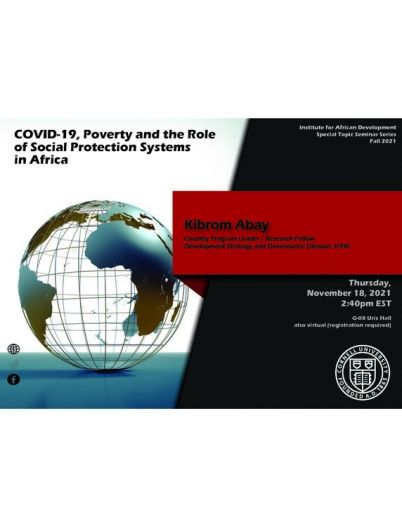
November 18, 2021
2:40 pm
Uris Hall, G-08
Issues in African Development Seminar Series examines critical concerns in contemporary Africa using a different theme each semester. The seminars provide a forum for participants to explore alternative perspectives and exchange ideas. They are also a focal activity for students and faculty interested in African development. In addition, prepares students for higher level courses on African economic, social and political development. The presentations are designed for students who are interested in development, Africa’s place in global studies, want to know about the peoples, cultures and societies that call Africa home, and explore development theories and alternate viewpoints on development.
Register in advance for this meeting:
https://cornell.zoom.us/meeting/register/tJwucOmprzIsEtzZgxPFIM5z1yRRqJ…
Additional Information
Program
Einaudi Center for International Studies
Institute for African Development
Twenty Years of War: Coalitions of War and Anti-War (Class, Race, Global)
December 7, 2021
3:00 pm
In 2001, the Global War on Terror (GWOT) was inaugurated under U.S. leadership. Since then, U.S. Armed Forces have conducted significant operations in at least ten countries and been implicated in military operations and incarceration in dozens more. Several other countries have also waged their own GWOT security-state campaigns. But to what ends? This year's 20th anniversary of the GWOT is an opportunity for timely, nuanced reflection.
In this webinar, a panel of leading scholars, journalists, and activists take stock of the GWOT era and its widespread consequences. In the U.S. and elsewhere, “homeland security” has intersected with struggles over official Islamophobia, cross-border migration, Indigenous dispossession, and mass incarceration. Join us as war reporter Anand Gopal, Judith LeBlanc (Native Organizers Alliance), veteran and writer Lyle Jeremy Rubin, Samar Al-Bulushi (UC Irvine), and Tejasvi Nagaraja (ILR School) look back on the previous two decades and ahead to the future.
This is the second of two sessions offering expert reflection on the Global War on Terror, hosted by Tejasvi Nagaraja and cosponsored by Cornell’s Mario Einaudi Center for International Studies, American Studies Program, and the ILR School. See the first session on November 30.
***
Class, Race, Global: An event series sponsored by Cornell’s Mario Einaudi Center for International Studies
Class, Race, Global brings together scholars, journalists, and activists for dynamic conversations on diverse topics in history and politics. We ask: How do class, race, and global inequalities and struggles intersect with one another? What links can be revealed between “domestic” issues and “foreign” regions?
The series is part of the Einaudi Center’s inequalities and social justice global research priority. Email ClassRaceGlobal@gmail.com for more information.
Additional Information
Program
Einaudi Center for International Studies
Reppy Institute for Peace and Conflict Studies
Twenty Years of War: The Global War on Terror, Security Statecraft, and Racial Justice (Class, Race, Global)
November 30, 2021
3:00 pm
In 2001, the Global War on Terror (GWOT) was inaugurated under U.S. leadership. Since then, U.S. Armed Forces have conducted significant operations in at least ten countries and been implicated in military operations and incarceration in dozens more. Several other countries have also waged their own GWOT security-state campaigns. But to what ends? This year, the 20th anniversary of the GWOT is an opportunity for timely, nuanced reflection.
In this webinar, a panel of leading scholars, journalists, and activists take stock of the GWOT era and its widespread consequences. In the U.S. and elsewhere, “homeland security” has intersected with struggles over official Islamophobia, cross-border migration, Indigenous dispossession, and mass incarceration. Join us as Adam Hanieh (University of Exeter), Rachel Herzing (Center for Political Education), writer Richard Seymour, Rozina Ali (New York Times Magazine), and Tejasvi Nagaraja (ILR School) look back on the previous two decades and ahead to the future.
This is the first of two sessions offering expert reflection on the Global War on Terror, hosted by Tejasvi Nagaraja and cosponsored by Cornell’s Mario Einaudi Center for International Studies, American Studies Program, and the ILR School. See the second session on December 7.
***
Class, Race, Global: An event series sponsored by Cornell’s Mario Einaudi Center for International Studies
Class, Race, Global brings together scholars, journalists, and activists for dynamic conversations on diverse topics in history and politics. We ask: How do class, race, and global inequalities and struggles intersect with one another? What links can be revealed between “domestic” issues and “foreign” regions?
The series is part of the Einaudi Center’s inequalities and social justice global research priority. Email ClassRaceGlobal@gmail.com for more information.
Additional Information
Program
Einaudi Center for International Studies
Reppy Institute for Peace and Conflict Studies
Quechua Returns to Cornell
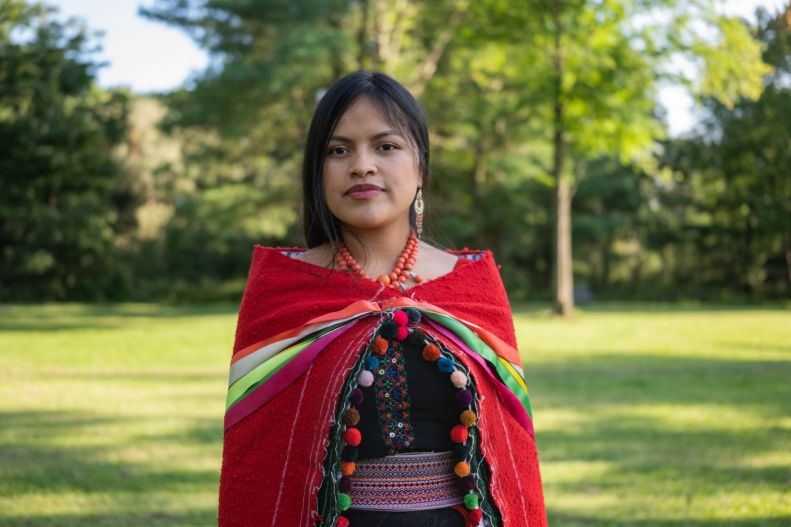
LACS Hosts Instructor Soledad Chango of Ecuador
The most widely spoken Indigenous language in the Americas is back this fall. Meet Chango—and celebrate #IEW2021 with Einaudi, Nov. 15-19!
Additional Information
UISFL Grant Boosts Latin America & Caribbean Studies
Go Global Ed Podcast
Thank you to the International and Foreign Language Education (IFLE) office for talking to us about our UISFL grant on their new Go Global Ed podcast! We enhance the study of Latin America and the Caribbean at Cornell with internships, community college partnerships, language learning, travel opportunities, and more.
Additional Information
Annual Celebration of Gratitude Dinner on Thanksgiving Day
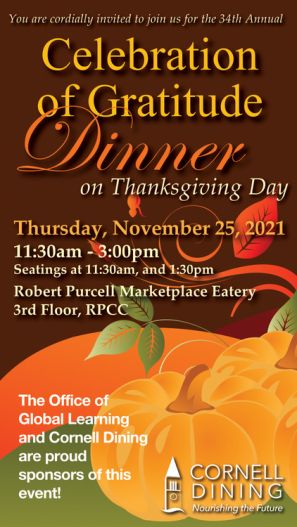
November 25, 2021
11:30 am
Robert Purcell Marketplace Eatery, 3rd Floor
THIS EVENT IS SOLD OUT.
We welcome Cornell's international community, all Cornellians, and friends in the local community for the 34th Annual Celebration of Gratitude Dinner on Thanksgiving Day at Robert Purcell Marketplace Eatery.
Seatings are at 11:30 am and 1:30 pm.
Additional Information
Program
Einaudi Center for International Studies
The Work of Economics: How a Discipline Makes Its World
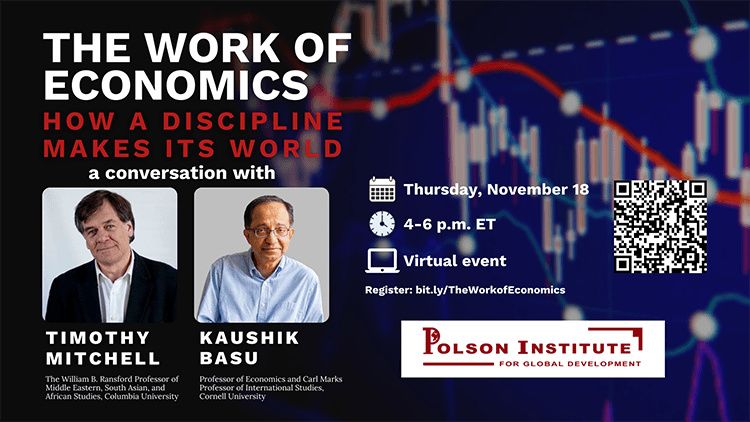
November 18, 2021
4:00 pm
A Conversation with Timothy Mitchell, William B. Ransford Professor of Middle Eastern, South Asian, and African Studies at Columbia University and Kaushik Basu, Professor of Economics and Carl Marks Professor of International Studies at Cornell University.
Additional Information
Program
Einaudi Center for International Studies
South Asia Program