
Einaudi Center for International Studies
Programmer as Translator, AI as Poet
March 9, 2026
4:30 pm
Uris Hall, G-08
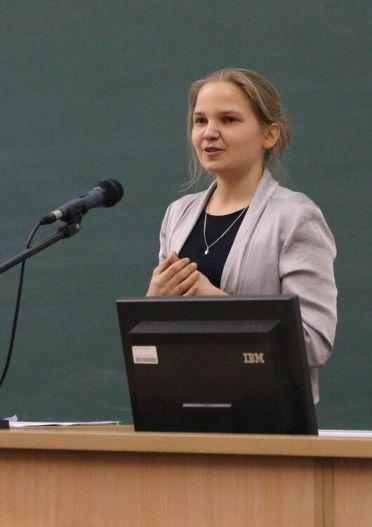
A workshop with Joanna Krenz to discuss two papers she authored:
Programmer as Translator: The LHC of Chinese Artificial Intelligence Poetry
Virtual Conciliation: (Un-)Coding the Split between Tradition and Modernity in Chinese Artificial Intelligence Poetry
The workshop will focus on artificial intelligence (AI) poetry as a form of translation, understood here as the translation of a particular paradigm of poeticity operative within Chinese society into virtual reality. We will address three dimensions of this process—linguistic, human, and cultural—while identifying moments of unavoidable failure and examining their artistic and social consequences. The discussion will be preceded by a general introduction to the history and context of AI poetry in China, based on my research to date.
Joanna Krenz is Assistant Professor of Modern Chinese Language and Literature at the Institute of Oriental Studies, Adam Mickiewicz University in Poznań, Poland. She translates and publishes widely on Chinese poetry and prose. She is the author of In Search of Singularity: Poetry from Poland and China Since 1989 (Brill, 2022). She is currently working on the project The World Re-Versed: New Phenomena in Chinese Poetry as a Challenge and Inspiration to Literary Studies.
About the East Asia Program
As Cornell’s hub for research, teaching, and engagement with East Asia, the East Asia Program (EAP) is a forum for the interdisciplinary study of historical and contemporary East Asia. Part of the Mario Einaudi Center for International Studies, the program draws its membership of over 45 core faculty and numerous affiliated faculty, graduate, and undergraduate students from across Cornell's colleges and schools.
Additional Information
Program
Einaudi Center for International Studies
East Asia Program
India’s Economy Is Still in Search of a Plan

Rohit Lamba, SAP
Rohit Lamba writes: “Government deserves credit for aggressively pursuing FTAs. But they cannot be a substitute for structural reforms, which cannot be delivered in ‘campaign mode’.”
Additional Information
Mapping Migration Data with GIS: A Hands-On Workshop
February 25, 2026
12:00 pm
Mann Library, Mann 103, Stone Computer Classroom
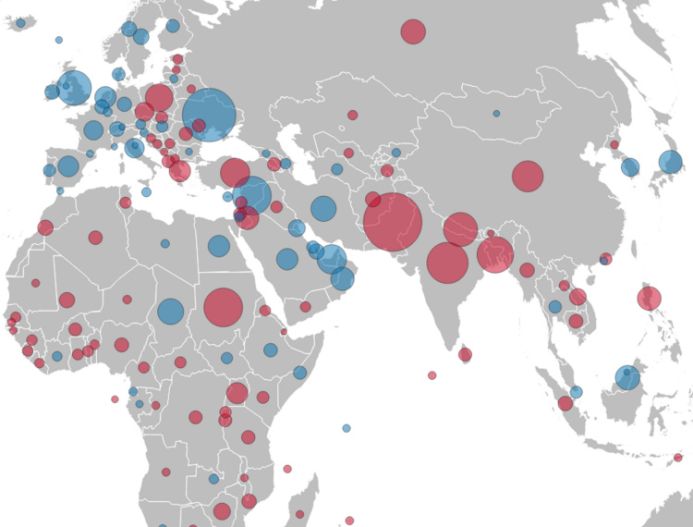
What can maps reveal about movement, displacement, and mobility? What are applications and limits of migration data? And how can we use digital tools to map migration?
This hands-on workshop introduces participants to using Geographic Information Systems (GIS) to visualize and analyze human migration data. We will begin with an overview of key migration data sources and discuss why mapping is a tool for understanding migration patterns, drivers, and impacts. Participants will then learn how to use GIS tools to create visualizations, explore spatial relationships, and conduct basic analyses using real migration datasets. We will conclude with a discussion of how mapping techniques can support your own research or professional work, along with the possibilities and limitations of using GIS to study migration.
Speakers
Keith Jenkins, GIS & Geospatial Applications Librarian
John Zinda, Associate Professor, Global Development
This event is hosted by the Migrations Program's graduate fellows, part of the Einaudi Center for International Studies. For questions, please contact Kate Foster (kef72@cornell.edu) and Nicole Venker (ntt22@cornell.edu).
Additional Information
Program
Einaudi Center for International Studies
Migrations Program
Southeast Asia Program
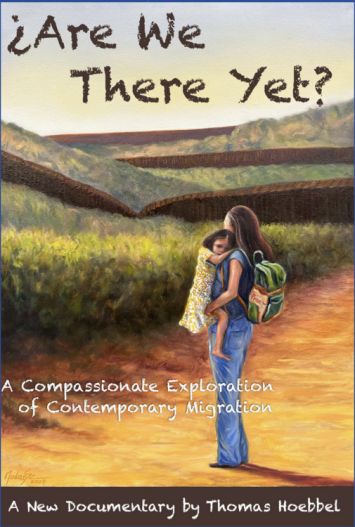
¿Are We There Yet?: A Compassionate Exploration of Contemporary Migration
March 4, 2026
6:00 pm
Willard Straight Theatre
Asylum seekers and refugees from many areas of the world and specifically from Central and South America are desperately trying to immigrate to the United States. These migrants are traveling through dangerous areas and difficult terrain to reach the southern border of the US with the hopes of making a better life for themselves and their families.
When they arrive at the southern border they face danger, uncertainty, and a very large wall. Even after treacherous journeys to reach the Mexico/U.S. border, there are countless other, possibly insurmountable, obstacles. If they do reach the U.S. to seek asylum, they face arrest, detention, and possibly even deportation back to Mexico or the country from which they tried so hard to escape.
This debut documentary feature from local filmmaker Thomas Hoebbel explores contemporary challenges to immigration in the United States in 2024.documents their stories and the challenges they face on their journeys and explore possible remedies to what has become a broken system of immigration in the United States.
Filmmaker Thomas Hoebbel will join for a conversation after the film.
Free admission! Reserve your free ticket through Cornell Cinema. Sponsored by the Migrations Program at the Einaudi Center for International Studies.
Additional Information
Program
Einaudi Center for International Studies
Migrations Program
Trump Announces Initial Trade Deal with India, Cutting Tariffs to 18%

Eswar Prasad, SAP
Eswar Prasad, professor of trade policy, provides analysis on the consequences of the India-U.S. trade deal.
Additional Information
World in Focus: Immigration Enforcement as Political Punishment

February 10, 2026
4:00 pm
Uris Hall, G08
Join Einaudi Center experts for World in Focus Talks on global events in the news and on your mind. Our faculty's research and policy insights put the world in focus.
This year we’re hosting informal campus discussions on many Tuesday afternoons. This week’s topic:
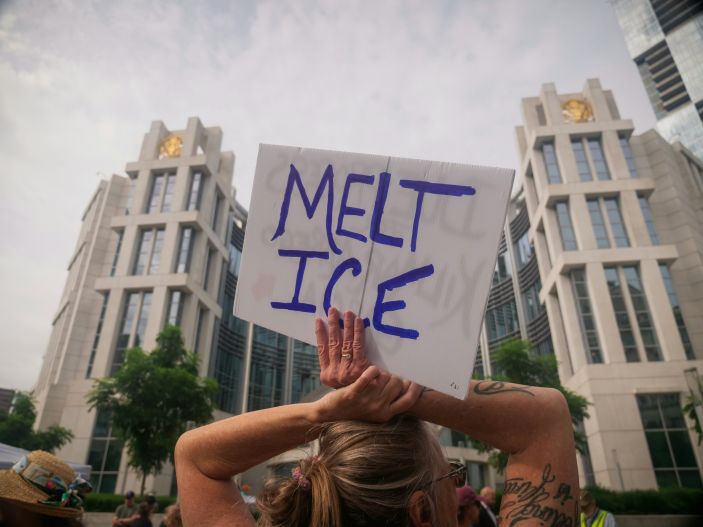
In the United States and around the world, strict immigration enforcement and violence are being wielded as political tools. Recent U.S. actions include surveillance of communities, indiscriminate detainment, and violence against protestors. Despite being framed as necessary for the safety of citizens, these tactics are rooted in histories of slavery, the prison industrial complex, and xenophobia.
Does this type of enforcement infringe on rights? How can we understand current events through the lens of global and historical contexts? Do present-day immigration policies make communities safer?
***
Featured Faculty
Shannon Gleeson (Migrations) | Industrial and Labor RelationsTristan Ivory (EAP, IAD) | International and Comparative LaborJaclyn Kelley-Widmer | LawNatasha Raheja (SAP) | AnthropologyIan Kysel | Law
***
Conversations Matter at Einaudi
This conversation is hosted by the Mario Einaudi Center for International Studies and its regional and thematic programs. Find out what's in store for students at Einaudi!
Additional Information
Program
Einaudi Center for International Studies
Reppy Institute for Peace and Conflict Studies
East Asia Program
Southeast Asia Program
Latin American and Caribbean Studies
Institute for African Development
Institute for European Studies
South Asia Program
Migrations Program
Southwest Asia and North Africa Program
An American Family Caught in the Immigration Crackdown

Marielena Hincapié, Migrations
Marielena Hincapié, an immigration scholar at Cornell University, explains the need for federal immigration reform to keep mixed-status families like the Della Valles together.
Additional Information
US Immigration Crackdown Has Europeans Rethinking 'America'
Mabel Berezin, IES
Mabel Berezin, director of the Institute for European Studies at Cornell University, provides a perspective on the erosion of trust between Europe and the U.S.
Additional Information
Translucent Atmospherics: Media as Utility in China
February 27, 2026
4:30 pm
Uris Hall, G-08
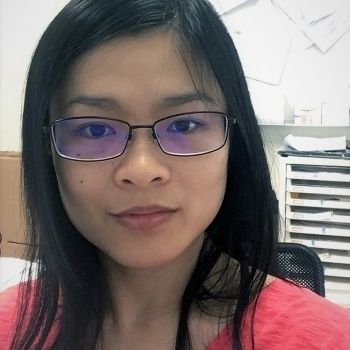
East Asia Program Lecture Series presents Translucent Atmospherics: Media as Utility in China
Speaker: Angela Xiao Wu, Associate Professor in the Department of Media, Culture, and Communication, New York University
Abstract
Utilities provide essential services like water, electricity, railroads, which societies strive to make affordable and widely accessible. As legacy media lose advertising revenue and “news deserts” proliferate, proposals to treat journalism as a public utility have reemerged. While liberal capitalist societies approach this idea through fragmented evidence and speculative hypotheticals, China has long treated news as a state-supplied, nonproprietary good, akin to earthquake alerts. Since 1978, the state’s stubborn commitment to this utility model has interacted with China's social, economic, and technological transformations, producing surprising configurations of public finance, intellectual property, distribution politics, journalistic forms, and popular culture.
In this talk, I introduce my book-length research tracing the evolution of China’s administration of the socialist press into its regulation of private digital platforms. Reframing media history as utility history, I disaggregate the Chinese state into its lesser-studied roles—as lawmaker, owner, investor, licensor, thinly stretched administrator, and purported guarantor of collective welfare—beyond propaganda and censorship. This perspective sheds new light on post-reform Chinese governance and offers the utility system as a broader framework for thinking about our digital present: What happens to public culture when it is governed through unified computing regimes?
Bio
Angela Xiao Wu is an Associate Professor in the Department of Media, Culture, and Communication at New York University. Her research sits at the intersection of media and communication studies and science and technology studies (STS), with broader interests in the politics and infrastructures of knowledge production. Her work spans critical data studies, platform studies, the political economy of media, political cultures, and post/socialism studies. Her book project has received support from the American Council of Learned Societies (ACLS), the Henry Luce Foundation, the Chiang Ching-kuo Foundation, the American Association of University Women (AAUW), and the Berkman Klein Center for Internet & Society at Harvard University, among others.
About East Asia Program
As Cornell’s hub for research, teaching, and engagement with East Asia, the East Asia Program (EAP) serves as a forum for the interdisciplinary study of historical and contemporary East Asia. The program draws its membership of over 45 core faculty and numerous affiliated faculty, graduate, and undergraduate students from eight of Cornell’s 12 schools and colleges.
Additional Information
Program
Einaudi Center for International Studies
East Asia Program
The Doom Loop — An Economic Portrait of a World on the Brink

Eswar Prasad, SAP
Eswar Prasad, a Cornell University professor, provides expert analysis of global economic instability and policy challenges.