
Einaudi Center for International Studies
Language, Identity, and Education in South Asia, by Chaise LaDousa and Christina Davis

September 29, 2020
4:30 pm
As schools around the United States think about how to best teach English language learners and parents explore a growing number of language immersion programs for their children, it is clear that the language of instruction and positive educational outcomes are inextricably linked. The same is true in South Asia. On September 29 at 4:30PM we will host Professors Christina Davis (Western Illinois University) and Chaise LaDousa (Hamilton College) for a virtual conversation on issues of language and education in South Asia.
Just like in the United States, many languages are spoken in the nations of South Asia. And just like in the United States, differences between languages spoken at home and at school can become a burden for some students and contribute to their problems in school. However, school systems rarely consider the ways that students themselves reflect on these dynamics.
We draw on interviews conducted at a prestigious institute of higher education in India to show how students relate language to their home life, transition to school, and future career ambitions. Students talk about links between language and social identity through the concept of “mother tongue” – literally, the tongue of one’s mother to whom one has an absolute bond. They note that the languages they speak at home rarely correspond to the standardized language varieties found in school materials. Higher education offers students unique challenges as it exposes them to environments where they must exhibit varieties with which they are not entirely comfortable. We focus on the dynamics of linguistic alienation in our interviews. By alienation, we mean the profoundly unsettled quality that emerges from students’ reflections on the place of languages in their lives.
By taking seriously students’ own reflections on language and identity, teachers and administrators might better understand what challenges their students face as they seek educational opportunities.
Additional Information
Program
Einaudi Center for International Studies
South Asia Program
Nilgiris Field Learning Center during a Pandemic

September 21, 2020
11:15 am
The Nilgiris Field Learning Center (NFLC) is a transdisciplinary joint program of the Keystone Foundation, India, and Cornell, now in its ninth year. Undergraduates from across the university and young people from the Adivasi communities that Keystone works with, live, study, and conduct community-based research each spring in Kotagiri, India. There are other ongoing collaborations, which will be briefly described by three Cornell faculty who are involved. However, everything ended abruptly with the pandemic, whose effects are amplified in the regions where NFLC research teams are located. The second half of the presentation will focus on the effects that the pandemic has had on the Keystone Foundation’s work, as well as on the NFLC in Kotagiri. We will discuss next steps to take as the pandemic is brought under control.
List of Panelists:
Neema Kudva is Associate Professor of City & Regional Planning, Associate Dean of the Faculty, and Kouse Professor and Dean at Becker House, a living-learning residential community, at Cornell University. Her research focuses on small cities and their regions, and on institutional structures for equitable planning and development, primarily in South Asia.
Andrew C. Willford is Professor of Anthropology at Cornell University. His current research focuses upon mental health, psychiatry, neurology, and religious healing traditions in North America and India. He has previously worked on the politics of language, religion, identity, and belonging in Bangalore, and on forms of Tamil and Hindu displacement, revivalism, and identity politics in Malaysia.
Steven A. Wolf is Associate Professor of Natural Resources at Cornell University. He teaches and conducts research on environmental governance with a specific focus on efforts to secure public goods from private landscapes. While most projects address socioecological dynamics in industrialized societies of Europe and USA, he has current projects in India and China.
Pratim Roy is Founder and Director of Keystone Foundation. He was instrumental in setting up the Keystone Foundation with a vision of clarity and focus on eco-development initiatives.
Anita Varghese is Director at Keystone Foundation, and leads the Biodiversity Programmes. She holds a Ph.D. in Botany from the University of Hawaii.
Additional Information
Program
Einaudi Center for International Studies
South Asia Program
We are Little Zombies

September 10, 2020
12:01 am
2019 > Japan > Directed by Makato Nagahisa
With Keito Ninomiya, Satoshi Mizuno, Mondo Okumura, Sena Nakajima
When four young, newly-minted orphans first meet, the bodies of their parents are being cremated at a funeral home, and yet none of them can shed a tear. They are like zombies; devoid of all emotion. With no family, no future, no dreams, and no way to move forward, the young teens decide that the first level of this new existence involves salvaging a gaming console, an old electric bass, and a charred wok from their former homes - just enough to start a band...and then conquer the world. "A rainbow-colored scream into the Abyss." (Vulture) Subtitled. More at littlezombies.oscilloscope.net
2 hrs
Additional Information
Program
Einaudi Center for International Studies
Cornell Classical Chinese Colloquium with Meir Shahar
October 17, 2020
10:00 am
Cornell Classical Chinese Colloquium with Meir Shahar, Tel Aviv University
Description of Texts for the Cornell Classical Chinese Colloquium
Written materials from late-imperial rural China are relatively rare. I have chosen two specimens for the Cornell Classical Chinese Colloquium. The first is the diary of a temple association from Shanxi Province. The second is a ritual text that likely originated in Guizhou province.
The two texts alike were written by people who received no more than rudimentary education, and as such, they shed light on the functional literacy that was enjoyed by at least some late-imperial villagers. It is fascinating to see how these villagers manipulated the limited number of characters with which they were familiar to write relatively complex and informative texts. The linguistic interest of these texts is joined by their social, economic, cultural, and religious significance. The texts offer rare insights into the social organization, financial activities, cultural performances, and religious beliefs of late-imperial villagers.
Meir Shahar, Brief Bio
Meir Shahar is the Shoul N. Eisenberg Chair for East Asian Affairs at Tel Aviv University. He received his undergraduate degree from the Hebrew University in Jerusalem, and his PhD from Harvard University. His research interests cover the fields of Chinese religion and literature, Chinese martial-arts history, the impact of Indian mythology upon Chinese culture and, most recently, Chinese animal studies.
Meir Shahar is the author of several monographs including: Crazy Ji: Chinese Religion and Popular Literature; Oedipal God: The Chinese Nezha and his Indian Origins; and the Shaolin Monastery: History, Religion, and the Chinese Martial Arts, which has been translated into numerous languages. He is the coeditor of several volumes including: Unruly Gods: Divinity and Society in China; India in the Chinese Imagination: Myth, Religion, and Thought; Chinese and Tibetan Esoteric Buddhism; and Animals and Human Society in Asia.
The CCCC is a reading group for students and scholars with an interest in premodern Sinographic text.
All are welcome, at any level of experience with classical Chinese. Please email us to register and receive the log-in credentials.
At each session, one participant presents a text in classical Chinese. Attendees discuss historical, literary, linguistic, and other aspects of the text, and work together to resolve difficulties in comprehension and translation.
Presentations include works of all sorts, from the earliest times to the twentieth century.
No preparation required: all texts will be distributed at the meeting.
Additional Information
Program
Einaudi Center for International Studies
East Asia Program
The Annual Hu Shih Distinguished Lecture with Meir Shahar "Chinese Animal Gods"
October 16, 2020
12:00 pm
The Annual Hu Shih Distinguished Lecture with Meir Shahar, History, Tel Aviv University
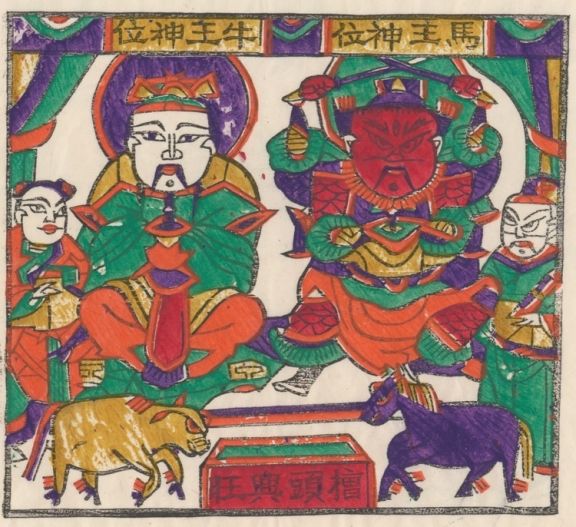
Chinese Animal Gods
Abstract: Our ancestors depended upon beasts of burden for a living. In the Chinese case this dependence was reflected in the religious sphere. Chinese religion featured deities responsible for the wellbeing of draft animals. The two principal ones were the Horse King (divine protector of equines) and the Ox King (tutelary deity of bovines). This lecture will examine the ecological background and historical evolution of these animal-protecting cults. I will survey the Horse King's and Ox King's diverse clientele, from peasants who relied upon the water buffalo to plough their rice fields to cavalrymen whose success in battle depended upon their chargers' performance. Particular attention will be given to the theological standing of animals as reflected in their tutelary divinities' cults. In some cases, the animal itself was regarded as a deity who sacrificed himself for humanity’s sake. Chinese Buddhist scriptures described the ox as a bodhisattva who out of pity for the toiling peasant chose to be incarnated as his beast of burden.
Bio:
Meir Shahar is the Shoul N. Eisenberg Chair for East Asian Affairs at Tel Aviv University. He received his undergraduate degree from the Hebrew University in Jerusalem, and his PhD from Harvard University. His research interests cover the fields of Chinese religion and literature, Chinese martial-arts history, the impact of Indian mythology upon Chinese culture and, most recently, Chinese animal studies.
Meir Shahar is the author of several monographs including Crazy Ji: Chinese Religion and Popular Literature; Oedipal God: The Chinese Nezha and his Indian Origins; and the Shaolin Monastery: History, Religion, and the Chinese Martial Arts, which has been translated into numerous languages. He is the co-editor of several volumes including Unruly Gods: Divinity and Society in China; India in the Chinese Imagination: Myth, Religion, and Thought; Chinese and Tibetan Esoteric Buddhism; and Animals and Human Society in Asia.
On the 100th anniversary of the world-changing philosopher and statesman’s graduation from Cornell, EAP initiated an annual distinguished lecture in honor of Hu Shih. Leading scholars of Chinese and East Asian studies are invited to give a lecture on critical issues in their field of research. These lectures are archived as a resource for the Cornell community and beyond.
Full-length lecture videos and highlights
Hu Shih Distinguished lecture videos and programs are also permanently archived in the Cornell eCommons archive.
Renowned historian and feminist scholar, Dorothy Ko was the Hu Shih distinguished lecturer for 2019–20.
Additional Information
Program
Einaudi Center for International Studies
East Asia Program
Institute for African Development Special Topic Seminar Series:Environment, Sustainability and Health Challenges in Africa: Managing Human-Nature Interactions

September 10, 2020
3:00 pm
Issues in African Development Seminar Series examines critical concerns in contemporary Africa using a different theme each semester. The seminars provide a forum for participants to explore alternative perspectives and exchange ideas. They are also a focal activity for students and faculty interested in African development. In addition, it will prepare students for higher level courses on African economic, social and political development. The presentations are designed for students who are interested in the Africa and development, and Africa’s place in global studies, want to know about the peoples, cultures and societies that call Africa home, and explore development theories and alternate viewpoints on development.
Register in advance: https://cornell.zoom.us/meeting/register/tJctcO6trj0iHdIc7M96Z5RtNGSfwL…
Additional Information
Program
Einaudi Center for International Studies
Institute for African Development
Beauty Regimens: Disciplining Filipina Labor Under U.S. Empire
October 29, 2020
12:40 pm
Part of the Ronald and Janette Gatty series
Genevieve Clutario, Andrew W. Mellon Assistant Professor of American Studies, Department of American Studies, Wellesley College
Co-sponsored by Comparative Literature and American Studies
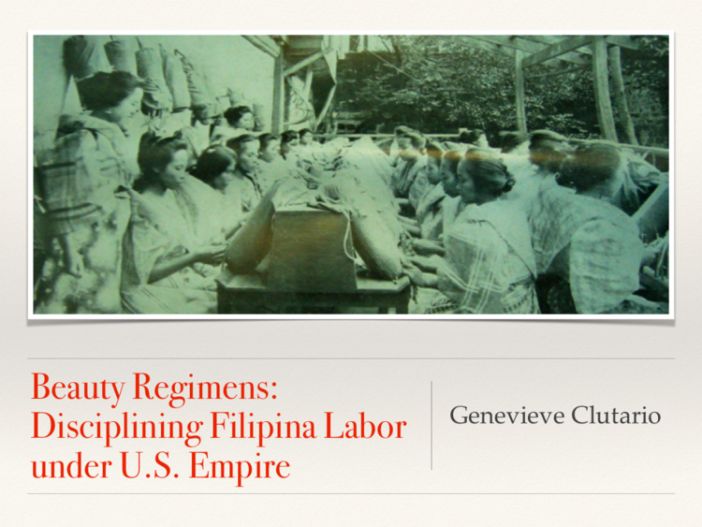
This talk investigates the formation of a transpacific industry of Philippine embroidery during the early twentieth century and focuses on four locations of modern imperial beauty regime: the American department store; home workshops in the Philippines; colonial industrial schools; and Bilibid Prison. During the 1910s, American consumers increasingly demanded "Philippine Lingerie" sold in catalogues and urban department stores throughout the continental United States. Exporting Filipina-made fine needle work relied on the adoption and adaptation of racial and gendered ideologies as well as already long-established labor practices in the archipelago. Such market forces were also inextricably tied to the making of a colonial state. From the 1910s to the 1930s, industrial schools and prisons, both of which fell under the jurisdiction of the director of education, instituted strict regimens touted as educational and reformatory modes of uplifting Filipino women and girls. An examination of this alliance between private industry and reformatory public institutions sheds light on the contradictions of their promises of uplift while relying on exploitative labor, as well as on the racial and gendered logics of beauty production and consumption in the making of liberal empire.
Additional Information
Program
Einaudi Center for International Studies
Southeast Asia Program
Badges without Borders: How Global Counterinsurgency Transformed American Policing

October 29, 2020
11:30 am
Peace and Conflict Studies Institute Reading Group for October 29. Stuart Schrader, Associate Director of the Program in Racism, Immigration; and Citizenship and Lecturer/Assistant Research Scientist, Department of Sociology, Johns Hopkins University, will join us for a discussion of Badges without Borders: How Global Counterinsurgency Transformed American Policing (University of California Press, 2019), Introduction and Chapter 1. Please note that the author will not give a formal presentation of their work, so it is best to read in advance.
Please pre-register at https://cornell.zoom.us/meeting/register/tJMpce6rqz4iH9wGwby_PUjGIrxKeM…, and a link to the reading will be sent to you with the registration confirmation. Please contact pacs@cornell.edu with any questions.
Additional Information
Program
Einaudi Center for International Studies
Reppy Institute for Peace and Conflict Studies
Indonesia's Im/moral Turn: Drivers and Consequences, Especially in a Covid-19 World

October 23, 2020
8:00 pm
Part of the Ronald and Janette Gatty series
Sharyn Davies, Associate Professor, Director of the Herb Feith Indonesian Engagement Centre, Monash University
Indonesia is experiencing an im/moral turn. We see this in the push to make all sexual activity outside heteronormative marriage illegal. If that bill is passed, it would be a radical move for a country that’s never criminalised homosexuality, and that has for the most part considered private consenting adult sexual activities a matter for individuals not the state. Other examples of the im/moral turn include the 2016 ‘LGBT crises’ and the 2020 proposed Family Resilience bill. Such more are stark clues revealing the direction Indonesia is taking when it comes to punitive sexual surveillance. The antecedents of these moves—which we might collectively call Indonesia’s im/moral turn—are much deeper and can be traced to the early years of democratic reform.
This talk will explore the drivers and consequences of Indonesia’s im/moral turn, with reflection on the impact of Covid-19. In particular I will focus on the impact of Covid-19 and the increasing punitive surveillance of sexuality on the provision of healthcare.
Additional Information
Program
Einaudi Center for International Studies
Southeast Asia Program
Give Peace a (Second) Chance: A Theory of Nonproliferation Deals
October 22, 2020
11:30 am
Peace and Conflict Studies Institute Reading Group for October 22. Muhammet Bas, Associate Professor of Political Science, New York University Abu Dhabi and Andrew Coe, Assistant Professor, Department of Political Science, Vanderbilt University, will join us for a discussion of “Give Peace a (Second) Chance: A Theory of Nonproliferation Deals,” International Studies Quarterly (2018) 62, 606–617. Note that only Andrew Cole will join us. Please note that the author will not give a formal presentation of their work, so it is best to read in advance.
Please pre-register at https://cornell.zoom.us/meeting/register/tJEode2qqz4oHNTEw3FCWJlH1fPV2U…, and a link to the reading will be sent to you with the registration confirmation. Please contact pacs@cornell.edu with any questions.
Additional Information
Program
Einaudi Center for International Studies
Reppy Institute for Peace and Conflict Studies