
Einaudi Center for International Studies
Decentralization in the Middle East and North Africa
Ellen Lust in World in Focus
Einaudi Center director Ellen Lust is coeditor of a new open-access book examining how decentralization affects communities in the Middle East and North Africa.
“Particularly during political transitions, citizens are accustomed to the central state playing an outsized role in governance; the state has encouraged their passivity and even ignorance.... For decentralization policies to strengthen democratic governance, all must reconceptualize their relationship with each other and actively participate in governance.”
Policymakers and development practitioners often view decentralization as a path to increased political participation and social welfare. Decentralization, Local Governance, and Inequality in the Middle East and North Africa (University of Michigan Press, 2025) gathers new research on communities in Lebanon, Morocco, Syria, and Tunisia to explore the ways decentralization policies affect citizens’ everyday lives.
Governance processes and outcomes vary significantly, even within countries. Focusing on changes on the ground since the 2011 Arab Spring uprisings, this edited volume shows how citizens of the MENA region are experiencing decentralization locally today.
The book's chapters demonstrate the influences of individual factors like gender and education and local contexts—including relationships between central and local actors, how citizens engage in political processes, and whether representatives reflect communities' interests.
The volume offers important insights into governance, participation, and representation in the MENA region and suggests new questions for researchers. Policymakers and development practitioners will find practical directions for program design and implementation.
“We call for close attention to the design of decentralization policies—considering local networks, social structures and institutions, and the resultant power balances, as well as education for citizens and officials alike to understand their rights and responsibilities,” write Lust and coeditor Kristen Kao (University of Gothenburg). “Only by unpacking governance at the local level can we understand how decentralization policies affect citizens’ lives and, ultimately, the welfare and stability of their nation-states and communities.”
The project was supported by the Hicham Alaoui Foundation. The introduction and chapter five are available in Arabic.
Ellen Lust joined the Einaudi Center as director in January. She is Einaudi's John S. Knight Professor of International Studies and a professor in the Cornell Jeb E. Brooks School of Public Policy and Department of Government (College of Arts and Sciences).
Featured in World in Focus Briefs
Additional Information
Topic
- World in Focus
Program
From Where We Stand

March 18, 2025
2:30 pm
Uris Hall, G08
Film Screening of "From Where We Stand" and discussion with Lucy Kaye and Adrian Favell
Lucy Kaye's one hour documentary and deep dive into the life and times of residents of three post industrial towns in the North of England is at once moving, visually haunting, and (in parts) disturbingly raw. It is part of a 4 year project run at the University of Leeds which took a sociological look at political disaffection -- and issues of austerity, deprivation, race and nation -- in the North of England after Brexit and during COVID.
With a direct and spontaneous approach, filmmaker Lucy Kaye creates intimate portraits of diverse individuals in three post-industrial northern English towns. Through the stories of people connected by place, the film explores our relationship with where we’ve come from, what we’ve left behind and where we live. Amongst the people we meet are Bini, a former asylum seeker from Eritrea trying to root himself in Middlesbrough; Stella, a Polish woman stuck in the UK after a relationship breakdown, making a life for herself and her daughter; and Yan, a former power station worker enveloped in nostalgia for the past. We also get to know Yubi, a Pakistani immigrant mourning the passing of his father in Wakefield; and Lisa, another Halifax resident determined to make sure the voices of her community are heard. In pared-back verité style that deploys music and lingering shots of the landscapes that define these lives, From Where We Stand offers the people portrayed time and space to express how they feel about their lives and their towns.
Background:
From Where We Stand is made in collaboration with the Northern Exposure research project at the University of Leeds. Adrian Favell, is Director of the Radical Humanities Laboratory at University College Cork and is PI of the Northern Exposure Project at University of Leeds. The research explores notions of identity, place and disaffection in post-industrial towns in the North of England after Brexit. More information can be found here: https://northernexposure.leeds.ac.uk/.
https://fromwherewestand.co.uk/
Host
Institute for European Studies
Cosponsors
Sociology
Migrations
Additional Information
Program
Einaudi Center for International Studies
Institute for European Studies
Migrations Program
The Orders and Borders of Global Inequality: Rethinking Migration and Mobilities in the Era of Neoliberalism and Beyond
March 17, 2025
4:30 pm
Uris Hall, G08
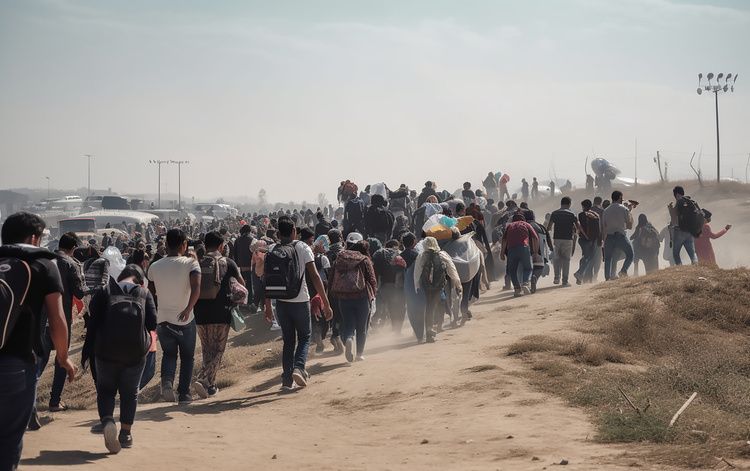
In a world of massive inequalities between nations, and where citizenship at birth is the biggest determining factor of anyone's life chances, migration and international mobility are often seen as dramatic mechanisms of change. Yet strict borders and hierarchies between nations persist. The recently initiated five year ERC Advanced Grant project, MIGMOBS - The Orders and Border of Global Inequality: Migration and Mobilities in Late Capitalism (2024-28) investigates how and why global inequalities are reproduced through the shifting classification of mobile populations. In opening a new vision by seeing "international migration" as only a narrow and symbolically overcharged slice in a continuum of "mobilities", both human and non-human, it effects a paradigm shift in conventional migration studies, in both theoretical and operational terms. Building a global database with case studies across 23 sending and receiving countries, MIGMOBS charts how nation-states have preserved power through the era of neoliberalism by selectively opening and closing channels of mobility: making immigration and asylum the obsessive target of sovereign control while rendering invisible and fluid the mass mobilities of tourism, students, business and commuter travel. For more information, contact the PI, Adrian Favell (adrian.favell@ucc.ie), or see: https://www.ucc.ie/en/migmobs
Adrian Favell is Professor of Social and Political Theory and Director of the Radical Humanities Laboratory, University College Cork. He directed the Bauman Institute at the University of Leeds, and was also Professor at Sciences Po, Paris, Aarhus University and UCLA. He is the author of various works on migration, multiculturalism, cosmopolitanism and cities, notably a recent book with Polity Press (2022) The Integration Nation: Immigration and Colonial Power in Liberal Democracies. He directs the ERC AdG Project MIGMOBS - The Orders and Border of Global Inequality: Migration and Mobilities in Late Capitalism (2024-28) . Website: www.adrianfavell.com
Host
Institute for European Studies
Cosponsors
Migrations Program, part of the Mario Einaudi Center for International Studies, and the Mellon Foundation’s Just Futures Initiative
Comparative Muslim Societies Program
Sociology
Additional Information
Program
Einaudi Center for International Studies
Institute for European Studies
Migrations Program
Aquaculture in the Amazon

Lessons for Food Security and Sustainability
A new paper advocates for five key principles to enable sustainable expansion of aquaculture in the Amazon. The project received a 2021 seed grant.
Additional Information
What Does USAID's Demise Mean for Western Allies?

Rachel Beatty Riedl, IAD/Migrations
“Undercutting long-established relationships … weakens America's diplomacy and ability to compete with other global powers,” past Einaudi Center director Rachel Beatty Riedl told CBC News.
Additional Information
Central New York Sheriffs Commit to State Law on Immigration While Exploring Other Tools

Estelle McKee, Migrations
Estelle McKee, clinical professor of law, explains why a federal warrant is not a binding order.
Additional Information
USAID Cuts in Kenya Reveal Risks to Lives and American Influence Worldwide

Rachel Beatty Riedl, IAD
“Undercutting long-established relationships with partner countries around the world weakens America’s diplomacy and ability to compete with other global powers, such as Russia and China, for critical resources, markets, and geostrategic alliances,” says Rachel Beatty Riedl, director of the Center on Global Democracy.
Additional Information
Will El Salvador’s Prisons House Trump’s Deportees?

Gustavo Flores-Macías, LACS
Gustavo Flores-Macías (A&S, Brooks School) says the announcement is a public relations win for President Trump because it may dissuade undocumented migration.
Additional Information
A Plea for Pluralism: Difference Matters!

Karim-Aly Kassam, GPV SAP/PACS
"This is the time not only to dream dangerously but to act strategically with tactics that conserve difference. Pluralism opens up possibilities for action in resolving the climate crisis, eliminating poverty traps, achieving environmental justice, creating mutual understanding and engaging a free society of the twenty-first century." - Karim-Aly Kassam
Additional Information
Trump’s Tariffs: What Consumers Can Expect in the Future

Wendong Zhang, GPV
Wendong Zhang, assistant professor of applied economics and policy, says “You also need to bear in mind that when the tariff happens, if not most of the tariff will be passed on to the consumers. The significant proportion of the tariff hikes will be passed on and reflected in your grocery and gas pump prices and/or the new car and used car purchase prices, too.”