Institute for African Development

IAD Africa Community Grant

The deadline for this opportunity has passed.
Application Deadline: April 10, 2024
Application Timeframe: Summer
African women

Details

The Institute for African Development (IAD) is accepting proposals for innovative community development projects to be implemented in Africa during the summer/winter of 2024-25.

Awards are made exclusively to Ph.D., M.S., or M.P.S. candidates across all Cornell colleges for overseas fieldwork expenses associated with their impact projects. Proposals should be for the actual implementation and travel expenses rather than for academic research. Undergraduates may apply for future internships communicated via our website. Projects in West Africa are highly encouraged to apply.

Continuing graduate students (alumni) are also eligible to submit proposals for projects that engage Cornell students (undergraduate or graduate) in the area of community development throughout the African continent. Applicants are broadly encouraged to submit proposals for ideas that will have tangible impacts on improving the well-being of African communities. Prospective applicants should take note of the following themes in crafting project ideas and proposals:

  • Grassroots & Community-Driven: Projects should demonstrate a clear community support measure. Local communities should be engaged in the planning and implementation of the proposed projects. The project grant will not fund start-up projects or academic research. 
  • Commitment: Local community must demonstrate their commitment to the project and their ability to manage it successfully, openly, and honestly. The project’s budget must also include a 25% community contribution helping to ensure longevity and buy-in.
  • Sustainability: The proposed project must be achievable within a reasonable time frame, and include a plan for the local community to continue in the future without the support of outside partners. Proposals should highlight any knowledge transfer needed to aid in sustainability.

Deadline

April 10, 2024

Amount

$7,000 - $10,000

How to Apply

Completed proposals and supporting documents should be submitted electronically to the Institute for African Development’s grant committee at iad@cornell.edu in Microsoft Word/PDF formats. Applicants are encouraged to submit proposals in advance of the deadline as late proposals will not be accepted. All applicants will be notified regarding the status of their submissions by May 1, 2024.

Project Proposal Format

  1. Title Page (1 Page)
    • Project Description (250 words maximum)
  2. Applicant(s) Information (1 Page)
    • Names | Contact Information | Department and College Affiliations | Background | Organizational/Community Role (include personnel names, titles, and contact information if included in the proposal)
  3. Affiliation Letter(s) (1-3 Pages)
    • Whom this Project will be implemented with (i.e. NGOs, Community Groups, Institution)
      • Outlining community participation, contribution, and desire for the project to be implemented within agreed upon timeline
  4. Proposal Narrative (3 Pages)
    • Define the problem statement and project objectives
    • Outline and explain the methodology (e.g. outlining the process for proposed project/outreach)
    • Required inputs, outputs, and expected outcomes
    • References, if any (1 page)
  5. Project Time Frame (1 Page)
    • A brief description reflecting a current timeline and responsible personnel
  6. Budget (1 Page)
    • Explain and justify the project budget. The proposed budget must give a complete and accurate assessment of all item costs and amounts. Costs should include items such as: personnel, travel, supplies, and activities as required for project competition.
    • The budget must also reflect any outside funding already received through another institution or college, and include previous awards or grants.

Assessment Criteria 

  • Relevance, Significance, and Sustainability: Does the proposed project support the five research priorities of IAD? Will the proposed project have a meaningful and sustainable impact on the local community? 
  • Strength and Feasibility of Methodology: Is the project design clear? Do the inputs, outputs, and outcomes have a tangible impact on the proposed community project?
  • Clarity of Work Plan and Outputs: Does the proposal clearly state the output/outcomes and deliverables? Does it provide guidelines on how to meet milestones? How is the local community involved in the project? 
  • Feasibility of the proposed budget: Does the budget account for reasonable expenses, and add up to the amount available ($7,000 - $10,000)? How much detail does the budget include? Is the 25% community contribution included?

Requirements

If selected to receive funding, the Grant Committee will request the appropriate bank account to transfer funds into. We encourage Cornell students to avoid receiving funds through their individual bursar accounts or personal checking accounts. If the organization is internationally registered, our team can work with you throughout the process to ensure funds are dispersed in a timely manner.

Grant recipients will be expected to maintain ongoing communication with IAD regarding progress in completing projects. Recipients will also be expected to produce at least two articles highlighting the work completed, a final report, photos/videos of their proposed project, and include a brief summary of their work on the IAD website.

Resources

The following resources may be used to better assist you with the submission process. Please note that these are simply recommendations and not strict requirements. 

Additional Information

Funding Type

  • Award

Role

  • Student

Program

Grad Chats: Best Practices and Challenges in International Field Research (Rescheduled Event)

March 30, 2023

4:30 pm

Uris Hall, G-02

Conducting international fieldwork provides significant value for dissertation research in various disciplines. Panelists will share information, guidance, and lessons learned related to planning, preparing, and conducting fieldwork overseas. Topics include factors shaping field site location(s) and/or partner(s), handling the logistics of fieldwork, data accumulation and protection in varied contexts, models and practices of in situ collaborations, and planning for and getting acclimated to living and working in a new environment and culture.

Moderator

Chris Barrett (Dyson School)Panelists

Emily Dunlop (Government, A&S)Samantha Lee Huey (Nutritional Sciences, CHE)Stacey Langwick (Anthropology, A&S)***

Grad Chats: Conversations on International Research and Practice is a series hosted by the Mario Einaudi Center for International Studies to support graduate students with interdisciplinary training and planning around conducting international research.

Spring 2023 Schedule

From Plan A to Plan B: Designing Research for a Changing World (Thursday, February 16, 4:30 pm – 6:00 pm, Uris Hall G02)Beyond the IRB: Ethics and International Research (Wednesday, March 29, 4:30 pm – 6:00 pm, Uris Hall G08)Best Practices and Challenges in International Field Research (Thursday, March 30, 4:30 pm – 6:00 pm, Uris Hall G02)Finding a Research Focus through Creative Writing (Tuesday, April 18, 4:30 pm – 6:00 pm, Uris Hall G08)Travel Health and Safety Awareness for Conducting Research Abroad (Tuesday, May 9, 4:30 pm – 6:00 pm, Uris Hall G08)

Additional Information

Program

Einaudi Center for International Studies

East Asia Program

Southeast Asia Program

Latin American and Caribbean Studies

Institute for African Development
Institute for European Studies

South Asia Program

IAD Special Lecture: Bògòlanfini: cloth and culture

Bogolan

"Bògòlan is a very important component of Bamana culture as this cloth is an essential part of most Bamana initiation and ritual events.  . . .  No two pieces are the same, even when dyed by the same artist. - Kassim Kone

Kassim Kone is a professor in the Department of Anthropology at the State University of New York at Cortland.  He teaches ntroduction to Cultural Anthropology, Peoples of Africa, Introduction to Linguistics, Language in Culture and Society, Development Anthropology, Anthropological Theory, Research Methods.  Professor Kone belongs to the select few academic experts  knowledgeable in all areas of Mande cultures and of West African Sahelian countries.   

IAD Distinguished Africanist Scholar , Spring 2023

Cameroon

Thursday, March 16, 2023       2:40pm      G-08 Uris Hall

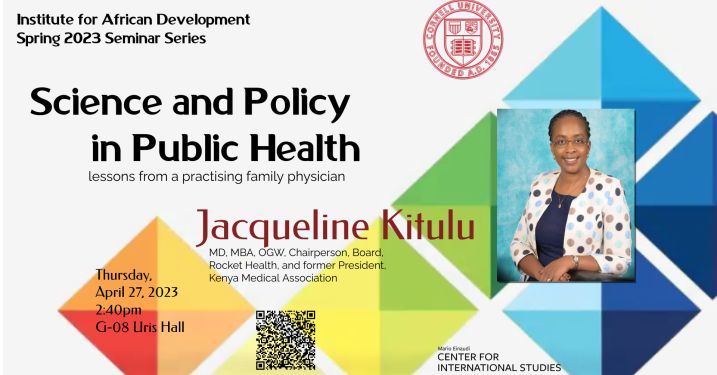
In his dual role as Under-Secretary of Education as well as Department Chair of a Political Science Department in Cameroon,  Pr Nkot is among the few professionals who regularly cross the boundary between science and policy. Prof. Nkot's lecture on March 16 will recount the many opportunities but also the challenges involved in bridging these two worlds. He will illustrate these difficulties based on his leadership in recent projects to address school-based violence, education under the Covid-19 pandemic, and China-Africa relations in education. 

IAD Africa Project Grant

Mara

The Institute for African Development (IAD) is accepting grant applications for innovative 
community development projects (up to $10,000) to be implemented in Africa during the summer/winter of 2023/24. Continuing graduate students are eligible to submit proposals for projects that engage Cornell students (undergraduate or graduate) in the area of community development throughout the Africa continent. Applicants are broadly encouraged to submit proposals for ideas that will have tangible impacts on improving the well-being of communities in Africa.

Awards are made to exclusively to Ph.D., M.S., and M.P.S. candidates across all Cornell colleges for overseas fieldwork expenses associated with their impact projects. Proposals should be for the actual implementation and travel expenses of their project rather than for academic research.
 

Democracy and Its Opposites: Challenges in a Global World

April 24, 2023

5:00 pm

Alice Statler Auditorium

Lund Critical Debate

Democracies worldwide—even many wealthy democracies long considered safely consolidated—are at risk today. Governments, policymakers, and voters face new conflicts over democratic institutions, checks and balances, which citizens can compete for office or deserve representation, and what rules of accountability apply.

This year's Lund debate from the Mario Einaudi Center for International Studies examines the threats democracies around the world are confronting, both from external forces and from within—and what governments and citizens can do to fight back.

Join Thomas Garrett of the Community of Democracies and Damon Wilson of the National Endowment for Democracy for a conversation on democratic backsliding, strategies for resilience, and the conditions and practices that undermine democracy: democracy ... and its opposites.

A reception with refreshments will follow the conversation.

Lund Debate: 5:00–6:30 p.m. | Alice Statler AuditoriumFree ticket required for in-person attendance. Reserve your ticket today! Join the lecture virtually by registering at Cornell.

Reception to follow.

***

Panelists

Thomas E. Garrett is secretary general of the Community of Democracies, a global intergovernmental coalition comprised of the Governing Council member states that support adherence to the Warsaw Declaration's common democratic values and standards. Garrett previously worked for the International Republican Institute for 12 years overseas in Ukraine, Mongolia, and Indonesia, returning to Washington, DC, in 2005 as director of Middle East programs and then as vice president for global programs.

Damon Wilson is president and CEO of the National Endowment for Democracy (NED), a nonprofit grant-making foundation supporting freedom around the world. Prior to joining NED, he helped transform the Atlantic Council into a leading global think tank as its executive vice president. He previously served as special assistant to the president and senior director for European affairs at the National Security Council. Wilson also served at the U.S. Embassy in Baghdad as the executive secretary and chief of staff, where he helped manage one of the largest U.S. embassies during a time of conflict.

Moderator

Rachel Beatty Riedl has served as the Einaudi Center's director since 2019. She is the Einaudi Center's John S. Knight Professor of International Studies and professor in the Department of Government and Cornell Jeb E. Brooks School of Public Policy. Her research interests include institutional development in new democracies, local governance and decentralization, and authoritarian regime legacies in Africa.

***

About the Debate

The Lund Critical Debate is a signature event of the Mario Einaudi Center for International Studies. This year's dialogue is part of Einaudi's work on democratic threats and resilience. Established in 2008, Einaudi's Lund Critical Debate series is made possible by the generosity of Judith Lund Biggs '57.

Additional Information

Program

Einaudi Center for International Studies

Reppy Institute for Peace and Conflict Studies

East Asia Program

Southeast Asia Program

Latin American and Caribbean Studies

Institute for African Development

Institute for European Studies

South Asia Program

Subscribe to Institute for African Development