Institute for African Development
Bartels Video on YouTube
Leymah Gbowee's May 3 Lecture
Miss the Bartels lecture? Watch Nobel peace laureate Leymah Gbowee speak at Cornell.
Additional Information
IAD Global Africa Monthly Webinar Series
Covid 19 Diagnosis and Vaccine Challenges: What Strategy for Africa?
Join for this discussion about covid-19 surveillance, diagnosis and vaccination efforts in West Africa, featuring public health and medical experts from Ivory Coast and Cameroon.
Introduction of the Series: N’Dri Assie-Lumumba, Professor, Africana Studies and Director, Institute for African Development
Discussant:
Dr. Kouame Kouadio, PhD Researcher, Environment and Health Department, Eco-Epidemiology Unit, Institut Pasteur of Côte d'Ivoire. Kouamé Kouadio is an Ivorian senior researcher and is the Head of the eco epidemiology unit within the Department of Environmental Health at Pasteur Institute (Abidjan, Côte d’Ivoire). He has been a medical doctor since 2000 and received a PhD in Medical Science, Option Preventive and Environmental Medicine from the University of Ryukyus, Okinawa, Japan in 2005. In 2008, he also obtained a Diploma in Vaccinology from Pasteur Institute, Paris (France), then another diploma in Epidemiology, Statistics and Computer Science from Université Libre de Bruxelles, Belgium in 2017. Dr. Kouadio is an Air pollution and health specialist. He is also the Head of the Master of Research in Social Science Applied to Health (MRSS) at the University Institute of Abidjan, IUA, Abidjan, Côte d’Ivoire. Since 2014, he has been the Health Focal Point Côte d’Ivoire of the DACCIWA Project (Dynamics Aerosol Chemistry Cloud Interactions in West Africa).
Panelists:
Professor Mireille Dosso, MD, PhD, Professor of Microbiology, Director of the Institut Pasteur of Côte d'Ivoire. She is a Full Professor of Microbiology at the Medical Sciences Training and Research Unit at Felix Houphouet-Boigny University and Director of the Institut Pasteur de Côte d’Ivoire, a position she has held since 2004. She has extensive experience in infectious disease research, biosecurity, and the development of laboratory capacity and standards. Her contributions to science have recently been recognized by the African Union through the award of the Kwame N’Krumah Scientific Prize.
Dr. Hervé Albéric Adjé Kadjo, MD, PhD, Head of the Respiratory Viruses Unit, Institut Pasteur of Cote d'Ivoire. Previously, Dr. Kadjo was at the Faculty of Medicine (2003-2004) at CES Microbiologie. He is an expert on influenza surveillance and co-author of several scientific articles about infectious disease, including Kadjo et al, "Epidemiology of rubella infection and genotyping of rubella virus in Cote d’Ivoire, 2012-2016" (Jul 2018) and "Influenza surveillance capacity improvements in Africa during 2011‐2017" (Sep 2020).
Richard Njouom, PhD, Head of the Virology Department, Centre Pasteur of Cameroon. Richard Njouom has a PhD and a Habilitation to Direct Research (HDR) in Virology from the University of Toulouse III in France, obtained in 2003 and 2013, respectively. He currently holds the rank of Research Director of the International Network of Pasteur Institutes and serves as Head of the Virology Department at the Centre Pasteur of Cameroon. He also has teaching responsibilites at the Department of Microbiology of the University of Yaounde in Cameroon. Njouom’s research focuses on general and molecular epidemiology of hepatitis and respiratory viruses in Central Africa and its impact on diagnostic, treatment response and pathogenesis. He has published more than 190 peer-reviewed papers and one book, and he has given more than 100 scientific presentations in international meetings. He is Principal Investigator of about five ongoing international research and public health projects. Dr. Njouom was member of the WHO Guidelines Development Group for the diagnostic of Viral Hepatitis and also member of the WHO Pandemic Influenza Preparedness (PIP) Advisory Group.
Dr. Harvey Attoh Touré, MD, MPH, Head of Immunization Service, National Institute of Public Hygiene, Cote d'Ivoire (Ivory Coast) and Assistant Professor in Public Health - Preventive Medicine, specializing in preventive medicine, health promotion, health assessment. He is also an expert in vaccinology at the National Institute of Public Hygiene and is a member of the National Task Force for the Deployment of Vaccines against Covid-19 in Ivory Coast. Dr. Touré also works as Assistant Professor in Public Health and Preventive Medicine at Félix Houphouët-Boigny University's Department of Public Health and medical doctor at the National Institute of Public Hygiene (INHP), Head of the Research and Training Department, and Head of Support Unit for Vaccine Activities. He serves as an international consultant (WHO, FHI, HKI, Sanofi Pasteur, UCPS-World Bank); Member of the Ivorian Society of Public Health (SISP); Member of the French Society of Public Health (SFSP); member of the Ivorian Society of Nutrition (SIN); member of the European Public Health Association (EUPHA); and member of the American Thoracic Society (ATS).
Additional Information
IAD Global Africa Monthly Webinar Series
Covid 19 Diagnosis and Vaccine Challenges: What Strategy for Africa?
Friday, April 29, 2022 @10:00am - 12:00pm EST/2:00pm - 4:00pm GMT Virtual Event
Introduction of the Series: N’Dri Assie-Lumumba, Professor, Africana Studies, Director, Institute for African Development
Discussant: Dr. Kouame KOUADIO, PhD Researcher, Environmental and health Department, Eco Epidemiology Unit, Institut Pasteur of Côte d'Ivoire
Professor Mireille Dosso, MD, PhD, Professor of Microbiology, Director of the Institut Pasteur of Côte d'Ivoire
Dr. Hervé Albéric Adjé Kadjo, MD, PhD, Head of the Respiratoy Viruses Unit, Institut Pasteur of Cote d'Ivoire
Richard Njouom, PhD, Head of the Virology Department, Centre Pasteur of Cameroon
Attoh Touré Harvey, MPH, Head of Immunization Service, National Institute of Public Hygiene, Cote d'Ivoire
Additional Information
Domestic and Global Politics of Police Violence
Sabrina Karim, PACS/SAP/IAD
Awarded an NSF Career award, Professor Sabrina Karim in the Government Department is developing research on the domestic and global politics of police violence to confront the challenge of excessive and/or illegitimate violence around the world.
Additional Information
How The Global Food Shortage Helps US Farmers
Chris Barrett, IAD/SEAP
“It will be interesting to see what happens in the real wheat belt in North Dakota and Minnesota,” says Chris Barrett, professor of applied economics and policy. “They still have some time to decide what to plant. A deciding factor might be wheat prices shooting up.”
Additional Information
Topic
- Development, Law, and Economics
Program
Institute for African Development Global Africa Monthly Webinar Series: Covid 19 Diagnosis and Vaccine Challenges: What Strategy for Africa?
April 29, 2022
10:00 am
IAD Global Africa Monthly Webinar Series
Friday, April 29, 2022
@10:00am - 12:00pm EST/2:00pm - 4:00pm GMT
Register:
Introduction of the Series
N’Dri Assie-Lumumba
Professor, Africana Studies
Director, Institute for African Development
Discussant: Dr. Kouame KOUADIO, PhD Researcher, Environmental and health Department, Eco Epidemiology Unit, Institut Pasteur of Côte d'Ivoire
Professor Mireille Dosso, MD, PhD, Professor of Microbiology, Director of the Institut Pasteur of Côte d'Ivoire
Dr. Hervé Albéric Adjé Kadjo, MD, PhD, Head of the Respiratoy Viruses Unit, Institut Pasteur of Cote d'Ivoire
Richard Njouom, PhD, Head of the Virology Department, Centre Pasteur of Cameroon
Attoh Touré Harvey, MPH, Head of Immunization Service, National Institute of Public Hygiene, Cote d'Ivoire
Additional Information
Program
Einaudi Center for International Studies
Institute for African Development
Naminata Diabate
Associate Professor, Comparative Literature
A scholar of sexuality, race, biopolitics, and postcoloniality, Diabate’s research explores African, African American, Caribbean, and Afro-Hispanic literatures, cultures, cinema, and new media. Her book Naked Agency: Genital Cursing and Biopolitics in Africa (Duke UP, 2020) won the 2021 Best Book Award from the African Studies Association.
Additional Information
Bartels Explainer
How did Leymah Gbowee's protests lead to lasting peace?
Naminata Diabate outlines the movement's tactics and explains how womens' protests helped end the Liberian civil war.
This year's Bartels lecturer, Nobel laureate Leymah Gbowee, led an interfaith women's peace movement that played a pivotal role in bringing warlords to the peace table and ultimately ending Liberia's bloody 14-year civil war in 2003. The movement's historic achievement earned Gbowee the Nobel Peace Prize in 2011. She continues her work as a global leader and activist for peace and women's rights.
"We need to specify that both a sex strike and the threat to strip naked are not nonviolent forms of protest."
On this page: Naminata Diabate describes the tactics used by Women of Liberia Mass Action for Peace, the interfaith women's peace movement Gbowee led, and explains how the protests helped end the civil war. Diabate is an associate professor of comparative literature in the College of Arts and Sciences and member of the Institute for African Development's faculty steering committee.
Coming May 3: Reserve Your Free Ticket Today!
A Conversation with Naminata Diabate
What types of protests did Gbowee and the peace movement she led carry out?
Leymah Gbowee and the interfaith women wrote countless letters to major stakeholders, organized vigils, fasting, meetings, deliberations, sit-ins, dancing and chanting, a sex strike—and finally threatened to strip naked. Most importantly, they deployed determination to bring peace to their country.
Were these nonviolent protests?
We need to specify that both a sex strike and the threat to strip naked are not nonviolent forms of protest. In fact, they constitute the most violent types that women in specific communities (such as the ones Leymah Gbowee and her comrades worked in) can deploy against their menfolk, and by extension, their societies.
A sex strike—which we see organized around the world and even in the United States—is not peaceful because it reverses the gender expectation of the female body as available for procreation, male sexuality, and pleasure, and relatedly, it opposes procreation, which can endanger the life of the community.
As for defiant self-exposure—another name I use for naked protest—it constitutes the last resort in specific circumstances that allegedly cause the targeted males a myriad of misfortunes, including shame, impotence, infertility, incurable diseases, and literal or social death.
What were the protesters trying to accomplish?
With multiple strategies, both violent and nonviolent, the women tried to attract the attention of the international community and force the warring parties and strongmen such as Charles Taylor to understand the suffering of the Liberian people—and to bank on the women’s unfailing determination to bring about peace.
How was this group of women able to succeed against strongmen like Taylor?
This grassroots group of women was able to succeed against the warring factions and strongmen thanks to their unwavering resolve to matter as peace brokers in their country’s journey through war and toward peace. Additionally, their resourcefulness in deploying multiple conflict management tactics—both modern and indigenous—to make a difference remains remarkable.
Why do you think their protests were effective?
The women’s protest tactics were effective because they refused to be muzzled. Their journey was strewn with violent counterattacks, including verbal abuse, humiliation, dismissal, physical brutality, and even death threats. Although they were at times weakened, these exceptional women always came back with more tactics to achieve visibility. The stakeholders, including Charles Taylor, could not but work with these women who refused to go away.
Don't miss the Bartels World Affairs Lecture with Leymah Gbowee on May 3: Reserve your free ticket today!
Additional Information
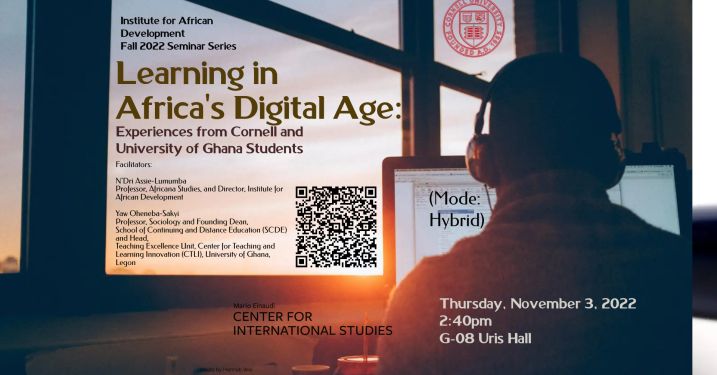
Institute for African Development Seminar Series: Emergence of Black Entrepreneurs in Eastern Africa
April 21, 2022
2:40 pm
Uris Hall, G-08
Register
Additional Information
Program
Einaudi Center for International Studies
Institute for African Development
Institute for African Development Seminar: University of Ghana, Department of Adult Education and Human Resource Studies Special Topic Seminar Series, Spring 2022
April 28, 2022
2:40 pm
Uris Hall, G-08
Register
Issues in African Development Seminar Series examines critical concerns in contemporary Africa using a different theme each semester. The seminars provide a forum for participants to explore alternative perspectives and exchange ideas. They are also a focal activity for students and faculty interested in African development. In addition, prepares students for higher level courses on African economic, social and political development. The presentations are designed for students who are interested in development, Africa’s place in global studies, want to know about the peoples, cultures and societies that call Africa home, and explore development theories and alternate viewpoints on development.
Additional Information
Program
Einaudi Center for International Studies
Institute for African Development