
Institute for African Development
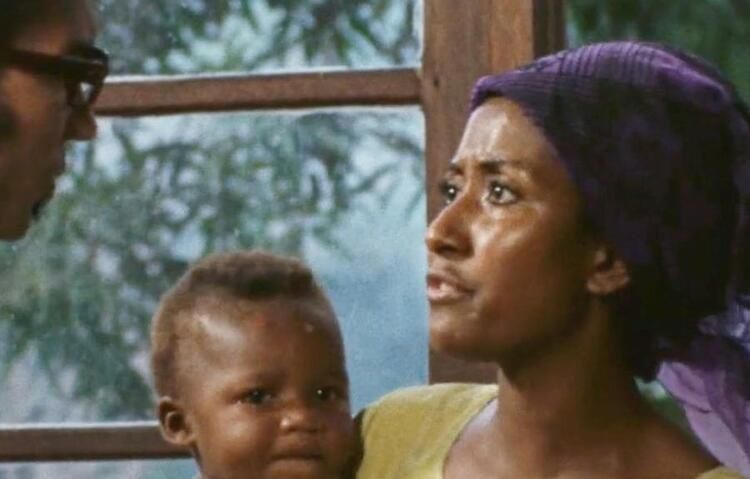
Sambizanga
October 23, 2022
4:30 pm
Willard Straight Theatre
1972 > Angola > Directed by Sarah Maldoror
With Domingos Oliveira, Elisa Andrade
A revolutionary bombshell by one of Africa's first female directors, Sarah Maldoror's electrifying chronicle of Angola's awakening independence movement is a stirring hymn to those who risked everything in the fight for freedom. Based on a true story, Sambizanga follows young resistance leader Domingos whose arrest by the Portuguese authorities helps ignite an anti-colonialist uprising and leads his determined wife Maria on an epic journey by foot to save him. Cosponsored by the Institute for African Development. Subtitled. More at www.janusfilms.com/films/2077
1 hr 37 min
Additional Information
Program
Institute for African Development
Institute for African Development Seminar Series: Cyberspace and the City: (Post)colonial Imaginaries and Eritrean Politics

November 17, 2022
2:40 pm
Uris Hall, G-08
The Issues in African Development Seminar Series examines critical concerns in contemporary Africa using a different theme each semester. The seminars provide a forum for participants to explore alternative perspectives and exchange ideas. They are also a focal activity for students and faculty interested in African development. In addition, this seminar series prepares students for higher level courses on African economic, social, and political development. The presentations are designed for students who are interested in development as well as Africa’s place in global studies, want to know about the peoples, cultures, and societies that call Africa home, and wish to explore development theories and alternate viewpoints on development practice.
Additional Information
Program
Einaudi Center for International Studies
Institute for African Development
Global Grand Challenges Symposium: Frontiers and the Future

November 17, 2022
8:00 am
How will we meet the most pressing demands of our time?
Join us for a two-day symposium that brings together the Cornell community and international partners to discuss the most urgent challenges around the world and how we can work together to address them.
Building on the first Global Grand Challenge, Migrations, symposium participants will help identify the next university-wide research, teaching, and engagement initiative to harness Cornell's global expertise.
The symposium, hosted by Global Cornell, will focus on five interdisciplinary themes, with panelists bringing their research and perspectives to bear:
Knowledge | Water | Health | Space | International Collaboration
Register today!
If you can't attend in person, please join us virtually:
Day 1: Wednesday, Nov. 16Day 2: Thursday, Nov. 17
Wednesday, November 16
Welcome: President Martha Pollack
Panel 1: Knowledge: What Counts, for Whom, and to What Ends?
4:30–6:00 ET, Klarman Hall, Rhodes-Rawlings Auditorium
A panel of Cornell faculty and Global Hubs partners discuss innovations in higher education, social media, and legal frameworks; new forms of knowledge production and inequalities in access; and security, privacy, disinformation, and the role of knowledge in democracies.
Read about the panelists.
Remarks, Provost Michael Kotlikoff
Reception, 6:00 ET, Klarman Hall Atrium
Thursday, November 17
8:00–5:00 ET, Clark Hall, room 700 (7th floor)
Breakfast, 8:00 ET
Panel 2: Water: Worldwide Challenges and Approaches
9:00–10:30 ET
Faculty from Cornell and partner universities explore the most critical challenges related to changing global water conditions, including access to clean drinking water; water governance, norms, and customs; trade-offs between drinking water, irrigation, and hydropower; rising sea levels and water-dependent communities; and new solutions for wastewater, ocean plastics, and pollution.
Read about the panelists.
Panel 3: Health: An Integrated Global Perspective
11:00–12:30 ET
Faculty from Cornell and partner universities explore vital issues related to health, including equity, nutrition, mental health and well-being, disease, communication, new technologies, sociocultural norms, One Health, sustainable agriculture and ecosystems, elder care, and the business of medicine/health.
Read about the panelists.
Lunch, 12:30 ET
Panel 4: Space: In a Galaxy Not So Far Away
1:30–3:00 ET
Faculty from Cornell and partner universities explore urgent topics related to our global engagements with outer space, including intergovernmental collaboration and defining a new space policy; private space travel and exploration; historical lessons for colonization; new technologies, materials, and visualizations; intelligent life; resources and extraglobal markets; and access and inequalities.
Read about the panelists.
Panel 5: International Collaboration:< /b>Taking Action for Our Global Future
3:30–5:00 ET
In this final session, panelists discuss opportunities and challenges for creating truly collaborative and mutually beneficial partnerships in an unequal world. Faculty from partner universities share ideas for collaborating on the four themes introduced earlier in the symposium, and participants explore the tension between respect for local cultures and universalisms implicated in scientific inquiry.
Read about the panelists.
Register in-person or virtually for one or all sessions!
Additional Information
Program
Einaudi Center for International Studies
Reppy Institute for Peace and Conflict Studies
East Asia Program
Southeast Asia Program
Latin American and Caribbean Studies
Institute for African Development
Institute for European Studies
South Asia Program
IAD Summer Africa Research Internships - Find Your Path

"I interned in Ghana with the OKB Foundation and conducted research on the Kayayei young female porters. My research focused on understanding their motives for migrating from northern Ghana to the city and their interaction with the local Kumasi population. The language barrier was a challenge for these young women, and my research findings listed strategies that could be useful for inclusion into the community." Amina Ba (College of Arts and Sciences)
The Institute and its partners view placements as an integral part of students’ education, immersing them in field experiences that seek to achieve awareness of developmental challenges and intercultural understanding.
IAD Special Topic Seminar: Digitalization of African Elections
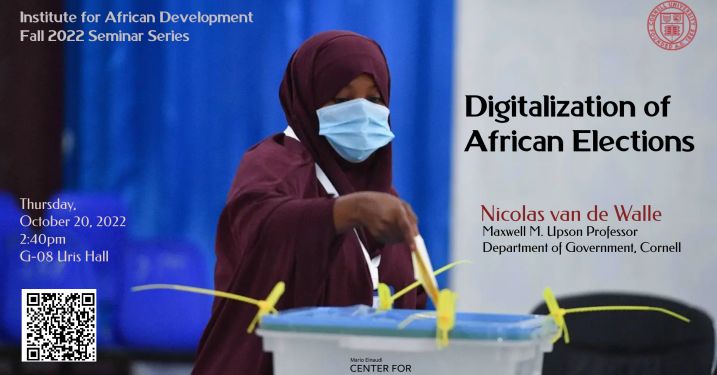
Thursday, October 20, 2022 @ 2:40pm G-08 Uris Hall Register
The Issues in African Development Seminar Series examines critical concerns in contemporary Africa using a different theme each semester. The seminars provide a forum for participants to explore alternative perspectives and exchange ideas. They are also a focal activity for students and faculty interested in African development. In addition, this seminar series prepares students for higher level courses on African economic, social, and political development. The presentations are designed for students who are interested in development as well as Africa’s place in global studies, want to know about the peoples, cultures, and societies that call Africa home, and wish to explore development theories and alternate viewpoints on development practice.
Institute for African Development Seminar Series: People, Practice, Power: Digital Humanities Outside the Center

November 10, 2022
2:40 pm
Uris Hall, G-08
The Issues in African Development Seminar Series examines critical concerns in contemporary Africa using a different theme each semester. The seminars provide a forum for participants to explore alternative perspectives and exchange ideas. They are also a focal activity for students and faculty interested in African development. In addition, this seminar series prepares students for higher level courses on African economic, social, and political development. The presentations are designed for students who are interested in development as well as Africa’s place in global studies, want to know about the peoples, cultures, and societies that call Africa home, and wish to explore development theories and alternate viewpoints on development practice.
Additional Information
Program
Einaudi Center for International Studies
Institute for African Development
Berger International Speaker Series with Marissa Jackson Sow – Reckoning With the Racial Contract in International Law

November 8, 2022
12:15 pm
Please join us for a virtual seminar given by our guest Professor Marissa Jackson Sow of the University of Richmond School of Law and moderated by Cornell’s Professor Desirée LeClercq.
SEMINAR: Reckoning With the Racial Contract in International Law
DATE: Tuesday, November 8, 2022
TIME: 12:15 p.m. to 1:15 p.m. ET
Click this link to sign up for the Zoom Webinar: https://cornell.zoom.us/webinar/register/WN_0kFc-HyiRISp6L-tpnTQfQ
The Seminar: Reckoning with the Racial Contract in International Law
Calls from scholars for anti-racist transformations within international law and international law scholarship and pedagogy have made the failure of international law to define, condemn, and combat racism increasingly ubiquitous, and to the human rights advocate, confounding. Despite the ongoing commemoration of the International Decade for People of African Descent and direct calls from UN member states for the United Nations to confront the issues of systemic racism and police brutality in liberal Western states, the United Nations has appeared to shy away from any measures beyond those which gently encourage States to aspire to eliminate racial discrimination. Moreover, despite international law’s formal guarantees of equality of access to justice and accountability for human rights violations, people of African descent and majority Black member states are systematically constructed out of international policymaking authority, and international legal protections—leaving them vulnerable to aggression, exploitation, and extraction.
Professor Jackson contends that the contemporary public international law regime, created and dominated by settler colonial states, has no ability to combat anti-Black racism because it has no intent or interest in dismantling racism; rather, the regime is both the manifestation of global racial contracting and the mechanism by which such contracting persists. The structure of the United Nations, along with the substance and procedure of international law, work together in coordinated fashion to guarantee that the racial contracts in force in racial states, are also performed, enforced, and protected within a global Racial Superstate.
About our Distinguished Guest: Professor Marissa Jackson Sow
Professor Jackson Sow is an Assistant Professor of Law at the University of Richmond School of Law. She teaches and writes in the areas of contracts, constitutional law, international law, human rights, and legal theory/jurisprudence. Her most recent work, Protect and Serve, was published in the California Law Review. Professor Jackson Sow earned her J.D. from Columbia Law School, her Master of Laws from the London School of Economics and Political Science, and her B.A. from Northwestern University. Immediately prior to returning to academia, Professor Jackson served as a Leadership in Government Fellow for the Open Society Foundations and a 2020 Fellow for the Fellowship Programme for People of African Descent hosted by the UN Office of the High Commissioner for Human Rights.
Additional Information
Program
Institute for African Development
IAD Webinar: MALARIA IN AFRICA: Thousands of Years of Persistent Prevalence, Ongoing Research Challenges, and Vaccine Promises and Breakthroughs in the 21st Century
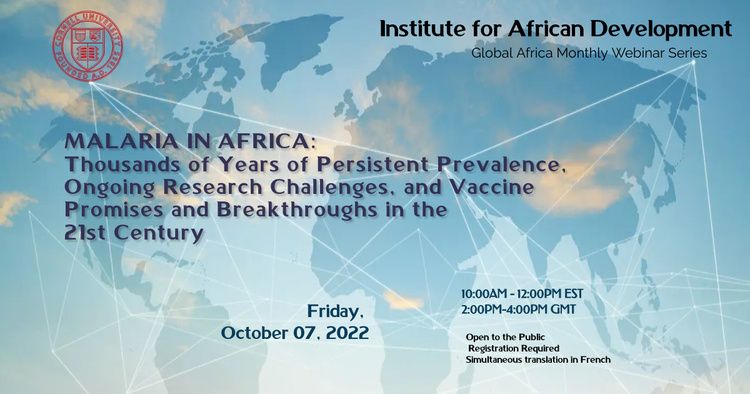
October 7, 2022
10:00 am
The Cornell Institute for African Development (IAD) hosts a monthly webinar on contemporary African issues. This webinar series features diverse voices from the African continent and the Diaspora on a wide range of themes, challenges, breakthroughs in cutting-edge research outcomes, innovations, and discoveries across all disciplines and area studies. The topics include climate change, the environment, gender, education, the economy, health, governance, creative arts, Indigenous knowledge systems, the youth, and the recent/ongoing COVID-19 pandemic. Other key topics deal with engaged research and academic issues on theory, critical thinking, approaches, methodologies, and fundamental and applied research in the development process. The webinar is open to the global academic public and all are welcome to participate.
Additional Information
Program
Einaudi Center for International Studies
Institute for African Development
IAD Special Topic Seminar: Technology and Internet Inequities in African Universities
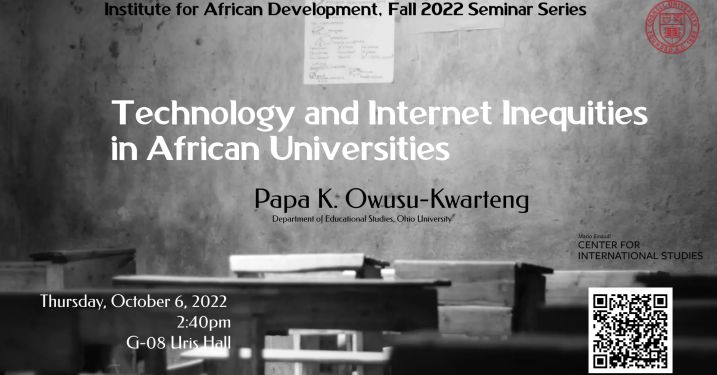
The Issues in African Development Seminar Series examines critical concerns in contemporary Africa using a different theme each semester. The seminars provide a forum for participants to explore alternative perspectives and exchange ideas. They are also a focal activity for students and faculty interested in African development. In addition, this seminar series prepares students for higher level courses on African economic, social, and political development. The presentations are designed for students who are interested in development as well as Africa’s place in global studies, want to know about the peoples, cultures, and societies that call Africa home, and wish to explore development theories and alternate viewpoints on development practice.
IAD Global Africa Monthly Webinar Series: MALARIA IN AFRICA: Thousands of Years of Persistent Prevalence, Ongoing Research Challenges, and Vaccine Promises and Breakthroughs in the 21st Century
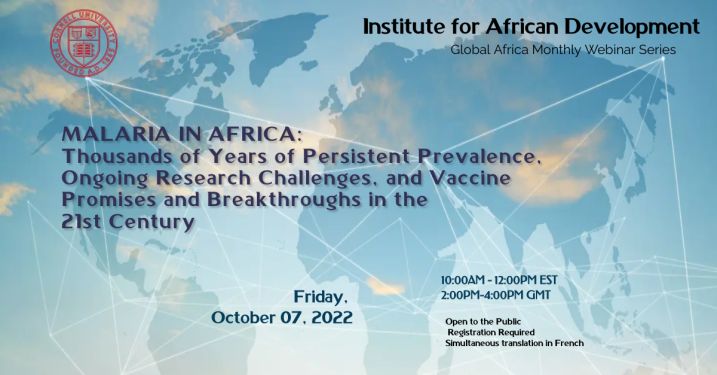
Friday, October 07, 2022
10:00AM - 12:00PM EST / 2:00PM-4:00PM GMT Open to the Public / Registration Required
Simultaneous translation in French
Discussant: Dr. Kouame Kouadio, Researcher, Environmental and Health Department, Eco Epidemeology, Unit Institut Pasteur of Côte d’Ivoire Panelists: Pr. Tinto Halidou (Burkina Faso) Title: Research Ongoing Challenges; Silvia Kariuki, KEMRI-Wellcome Trust Research Program, (Kenya) Title: Human Genetics and Malaria Susceptibility; Pr. Mamadou Ali Thera, (Mali) Title: Vaccine Promises and Breakthroughs in the 21st Century; Dr. Assi Serge-Brice (Cote d’Ivoire) Title: Thousands of Years of Persistent Prevalence; Prof. Offianan Andre TOURE, Malariology Department, Institut Pasteur of Côte d’Ivoire Title: Tackling Antimalarial Drug Resistance