
Institute for African Development
Information Session: Laidlaw Scholars Leadership & Research Program

January 6, 2026
11:00 am
The Laidlaw Scholars Leadership and Research Program promotes ethical leadership and international research around the world—starting with the passionate leaders and learners found on campuses like Cornell. Open to first- and second-year students, the two-year Laidlaw program provides generous support to carry out internationally focused research, develop leadership skills, engage with community projects overseas, and become part of a global network of like-minded scholars from twenty universities worldwide.
At this session, we'll share more information about the program, including independent international projects with the Einaudi Center’s trusted partners around the world for the summer 2026 leadership-in-action portion of the program, and tips for writing a successful application. Applications are due January 12, 2026.
Register here. Can’t attend? Contact programs@einaudi.cornell.edu.
Additional Information
Program
Einaudi Center for International Studies
Reppy Institute for Peace and Conflict Studies
East Asia Program
Southeast Asia Program
Latin American and Caribbean Studies
Institute for African Development
Institute for European Studies
South Asia Program
Southwest Asia and North Africa Program
Information Session: Laidlaw Scholars Leadership & Research Program

December 16, 2025
2:00 pm
The Laidlaw Scholars Leadership and Research Program promotes ethical leadership and international research around the world—starting with the passionate leaders and learners found on campuses like Cornell. Open to first- and second-year students, the two-year Laidlaw program provides generous support to carry out internationally focused research, develop leadership skills, engage with community projects overseas, and become part of a global network of like-minded scholars from twenty universities worldwide.
At this session, we'll share more information about the program, including independent international projects with the Einaudi Center’s trusted partners around the world for the summer 2026 leadership-in-action portion of the program, and tips for writing a successful application. Applications are due January 12, 2026.
Register here. Can’t attend? Contact programs@einaudi.cornell.edu.
Additional Information
Program
Einaudi Center for International Studies
Reppy Institute for Peace and Conflict Studies
East Asia Program
Southeast Asia Program
Latin American and Caribbean Studies
Institute for African Development
Institute for European Studies
South Asia Program
Southwest Asia and North Africa Program
IAD PhD Field Research Grant

Intended for students with a substantive research focus on Africa. The funds may supplement additional grants from the Einaudi Center Travel Grant but are not intended for international travel costs. Previous recipients of the IAD PhD Field Research Grant are not eligible for repeat awards.
World in Focus: Gaza–Israel Conflict: Regional and International Impacts

November 11, 2025
4:00 pm
Uris Hall, G08
Join Einaudi Center experts for World in Focus Talks on global events in the news and on your mind. Our faculty's research and policy insights put the world in focus.
This year we’re hosting informal campus discussions on many Tuesday afternoons. This week’s topic:
The Gaza–Israel conflict escalated dramatically in October 2023, following Hamas's attack on Israel and Israel's subsequent military campaign in Gaza. After intense fighting that caused massive Palestinian casualties and displacement, a ceasefire and the outline of a peace agreement have been announced. These events will have far-reaching consequences for the region and the world: heightening political and security tensions in the Middle East, disrupting international humanitarian and legal systems, and straining international relations.
How is the Gaza–Israel conflict transforming the Middle East and challenging the international order?
***
Featured Speakers
Sandra Babcock (SEAP) | Law SchoolAlexandra Blackman (SWANA) | GovernmentEsam Boraey (PACS, Migrations) | GovernmentPeter Katzenstein (IES, PACS) | GovernmentJoseph Margulies (PACS) | GovernmentJake Silver | Near Eastern StudiesChantal Thomas (IAD) | Law School
***
Conversations Matter at Einaudi
This conversation is hosted by the Mario Einaudi Center for International Studies and its regional and thematic programs. Find out what's in store for students at Einaudi!
Additional Information
Program
Einaudi Center for International Studies
Reppy Institute for Peace and Conflict Studies
East Asia Program
Southeast Asia Program
Latin American and Caribbean Studies
Institute for African Development
Institute for European Studies
South Asia Program
Migrations Program
Southwest Asia and North Africa Program
Einaudi Kicks Off Yearlong Conversation on Foreign Aid
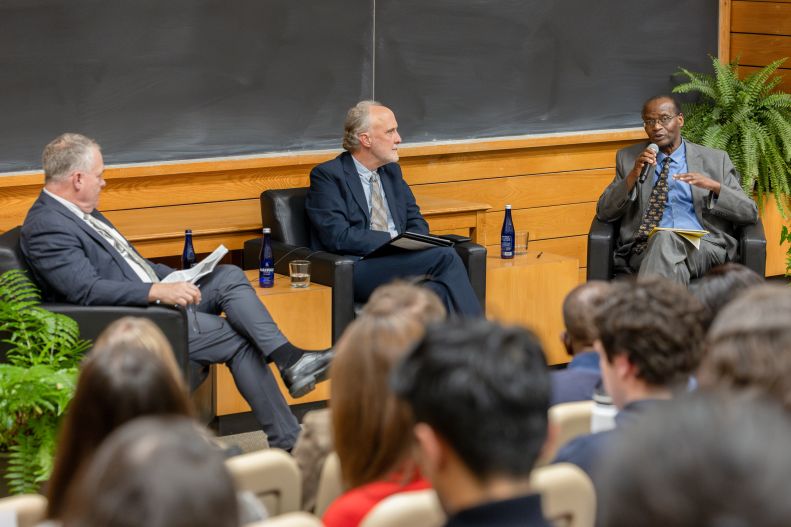
Lund Debate 2025
Undergraduate Global Scholars joined debaters to discuss “Is (Cutting) International Aid Good?”
For decades, international aid mainly flew under the radar of public opinion. Politicians from across the ideological spectrum lauded programs that saved lives, nurtured democracy, and promoted American values and interests. Except during wars and natural disasters, aid was rarely in the news.
That changed on January 20, 2025, when President Donald J. Trump issued an Inauguration Day executive order freezing all U.S. foreign assistance. Within weeks, Secretary of State Marco Rubio closed the headquarters of the U.S. Agency for International Development (USAID) and canceled 83% of the agency’s programs. Suddenly, foreign aid was at the center of an intense debate over national priorities and America’s place in the world.
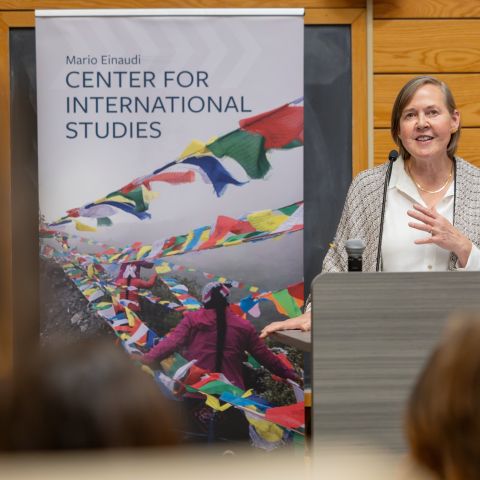
January 20 was also the day that political scientist Ellen Lust arrived at Cornell to direct the Mario Einaudi Center for International Studies as the John S. Knight Professor of International Studies. One of her first actions was selecting a theme to guide the center’s programming and provide a focus for its Undergraduate Global Scholars for the 2025–26 academic year.
Lust, who is also a professor in the Cornell Jeb E. Brooks School of Public Policy and the Department of Government in the College of Arts and Sciences, chose “Is (Cutting) International Aid Good?” She said she meant the simple, yes-or-no question to be provocative at a university where “everyone understands how complex these issues really are.”
“We have faculty, students, and staff engaged in food security, agriculture, development, public health, nutrition, education, economics, international relations, area studies, and so many other fields,” Lust said. “My hope was that this could provide an opportunity for us all to put our heads together and think about what can be done in the future.”
Lust recruited international development specialist Paul Kaiser to lead the conversation as the Einaudi Center’s practitioner in residence. Kaiser has worked on public policy and education reform in sub-Saharan Africa, South and Southeast Asia, and the Pacific Islands, with agencies including USAID, the Millennium Challenge Corporation, and the World Bank.
“There have always been legitimate questions about aid dependency and corruption and the effectiveness of aid, but we’re facing a much more existential question, which is should there be any aid at all?”
“For me, aid starts off as a moral issue, but it's also an economic issue, it's a political issue, it's a social issue,” Kaiser said. “There have always been legitimate questions about aid dependency and corruption and the effectiveness of aid, but we’re facing a much more existential question, which is should there be any aid at all?”
That question was on the table at Einaudi’s Lund Critical Debate, which Kaiser moderated on October 22 in a packed Lewis Auditorium in Goldwin Smith Hall. The debaters were Cornell faculty members Chris Barrett, an agricultural economist and food policy expert, and Muna Ndulo, an expert in international law and governance.
“We need more, not less aid,” argued Barrett, the Stephen B. and Janice G. Ashley Professor of Applied Economics and Management in the Dyson School of Applied Economics and Management and a professor in the Cornell Brooks School of Public Policy. “We need it for moral reasons, for security reasons, and for economic reasons. But it needs to be fundamentally different than it has been in the past.”
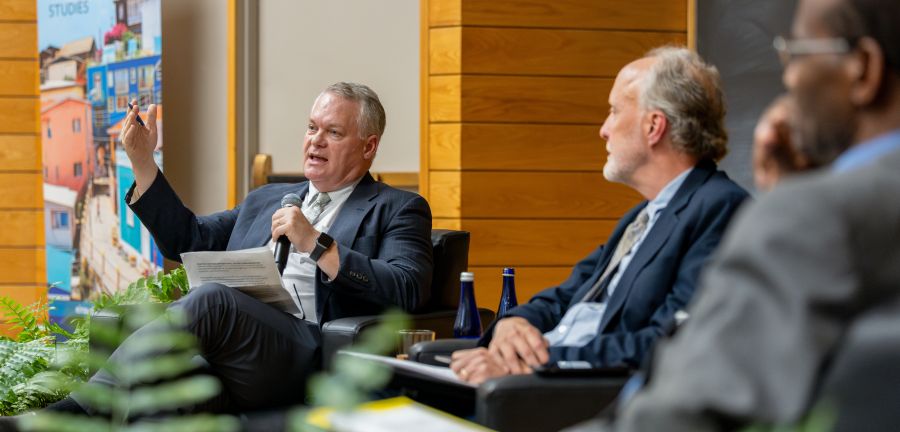
Specifically, he said, “we need less bilateral aid—that is, government-to-government aid to support country-specific things—and we need far more aid for what some of us term ‘international public goods’—for things that cut across the global community.”
“We need more, not less aid. We need it for moral reasons, for security reasons, and for economic reasons. But it needs to be fundamentally different than it has been in the past.”
Those include agricultural and biomedical research, infectious disease monitoring and prevention, emergency response, and climate change mitigation. “These are things that we underinvest in massively” despite their high long-term economic returns, Barrett said. Most are better delivered by multilateral agencies and organizations than by individual governments, he said.
Ndulo, the William Nelson Cromwell Professor of International and Comparative Law at Cornell Law School, agreed that aid can be helpful and sometimes essential, but he said it can also do damage. “A constant feature in the field of development is the firm belief that low-income countries will always be poor and desperately in need of foreign assistance,” he said. “This mentality shapes the sorts of solutions that get fostered in those countries.”
Ndulo and Barrett both observed that aid often prioritizes donor countries’ interests over those of the recipients. Increasingly, Ndulo said, donors are conditioning aid on recipients’ willingness to support their foreign policy objectives. Overall, Ndulo said, aid has less impact than international trade, foreign direct investment, or remittances from people working abroad.
“If we focus more on fairer ways of trading,” he said, “we might not need as much aid.”
The Future of Aid
Rethinking the future of aid is the assignment for the 15 Undergraduate Global Scholars selected by the Einaudi Center in October. Over the course of the year, they will meet with experts, conduct research, and take part in discussions and events.
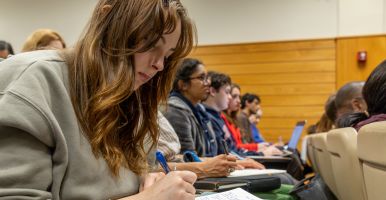
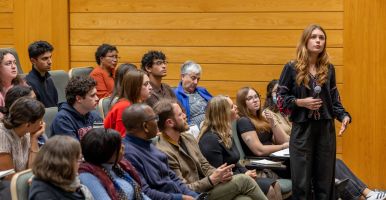
“For me, it’s personal,” said Sarvesh Prabhu ’28, who studies entomology and environmental sustainability in the College of Agriculture and Life Sciences. As a teenager, Prabhu worked at an international agricultural research center in his native India. He could see how important agriculture was to the nation’s development, but he also saw how aid could undermine the country’s sense of self-determination.
Ariela Asllani ’26 also feels a personal connection. A public policy major in the Brooks School, she grew up in Albania with parents who housed war refugees from Kosovo in the 1990s. She said Kosovars were grateful for U.S. aid, even erecting a statue of President Bill Clinton after the war ended. But many of the programs the Americans started collapsed after they left, and she has witnessed how aid can fuel corruption and crime. “My interest is the intersection of military, intelligence, law enforcement, and humanitarian aid actors,” she said.
“I’ve noticed a change in the conversation around aid,” said Iskander Khan ’26, a government major in the College of Arts and Sciences. “People will talk about it in a humanitarian sense, then when they’re pushed, they justify it as a security issue. I thought these were two very different things. But the discussions we’ve been having make me realize that they’re a lot more intertwined than I realized.”
The Einaudi Center’s Lund Critical Debate Series is made possible by the generosity of Judith Lund Biggs ’57. Watch the video of the debate below. The future of aid will also be the subject of Einaudi’s 2026 Bartels World Affairs Lecture, to be delivered by former USAID administrator Samantha Power in April.
Story by Jonathan Miller. All photos by Simon Wheeler.
Additional Information
International Research Showcase
November 19, 2025
4:30 pm
Atkinson Hall, Ground Floor
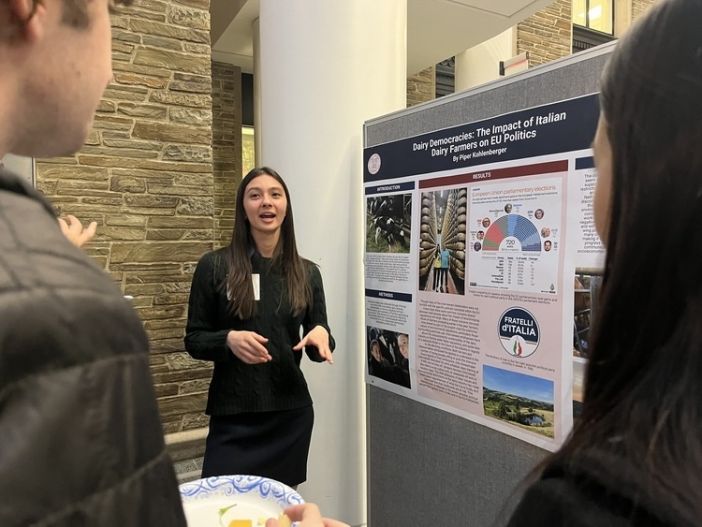
Come and explore the wide range of international work being done at Cornell! This annual showcase features a concurrent student poster session and speed talks by Einaudi Center graduate students and visiting scholars. Refreshments will be served.
Student Experience Poster Session
Over 70 undergraduates will present their international summer experiences. They conducted research, worked in Global Internships, and put leadership into action as Laidlaw scholars.
Applications are open now for Global Internships and the Laidlaw Leadership and Research Program.
Global Research Speed Talks
Graduate students and visiting scholars from the Mario Einaudi Center for International Studies will present three-minute speed talks on their interdisciplinary and international research. Speakers will address topics such as fascism in 20th century Spain, regenerative agriculture in England, migrant labor in India, and more.
***
The International Research Showcase is hosted by the Einaudi Center for International Studies and cosponsored by the Office of Global Learning. Both are part of Global Cornell.
Additional Information
Program
Einaudi Center for International Studies
Reppy Institute for Peace and Conflict Studies
East Asia Program
Southeast Asia Program
Latin American and Caribbean Studies
Institute for African Development
Institute for European Studies
South Asia Program
Migrations Program
Southwest Asia and North Africa Program
World in Focus: Drone Threats in Europe

October 28, 2025
4:00 pm
Uris Hall, G08
Join Einaudi Center experts for World in Focus Talks on global events in the news and on your mind. Our faculty's research and policy insights put the world in focus.
This year we’re hosting informal campus discussions on many Tuesday afternoons. This week’s topic:
Hostile drone activity has risen sharply in Europe this fall. The incidents have shut down airports, heightened military alertness, and triggered diplomatic responses from NATO and EU countries. Many analysts believe the incursions are part of a Russian-led hybrid warfare campaign designed to disrupt aviation and critical infrastructure, probe defenses, and test NATO’s resolve.
How will different parts of Europe react to drone threats? What could be the impacts on international relations and the conflict in Ukraine?
***
Featured Faculty
James Rogers | Brooks Tech Policy InstituteBryn Rosenfeld (IES) | GovernmentMagnus Fiskesjö (EAP, PACS, SEAP) | AnthropologyAgnieszka Nimark (PACS) | Affiliated ScholarChris Way (IES, PACS) | GovernmentDavid Cortright (PACS) | Visiting Scholar
***
Conversations Matter at Einaudi
This conversation is hosted by the Mario Einaudi Center for International Studies and its regional and thematic programs. Find out what's in store for students at Einaudi!
Additional Information
Program
Einaudi Center for International Studies
Reppy Institute for Peace and Conflict Studies
East Asia Program
Southeast Asia Program
Latin American and Caribbean Studies
Institute for African Development
Institute for European Studies
South Asia Program
Migrations Program
Southwest Asia and North Africa Program
Information Session: Global Internships

November 3, 2025
1:00 pm
Go global in summer 2026! Global Internships give you valuable international work experience in fields spanning global development, climate and sustainability, international relations, communication, business, governance, and more.
Applications are open now.
Register here. Can’t attend? Contact programs@einaudi.cornell.edu.
***
The Mario Einaudi Center for International Studies hosts info sessions for graduate and for undergraduate students to learn more about funding opportunities, international travel, research, and internships. View the full calendar of fall semester sessions.
Additional Information
Program
Einaudi Center for International Studies
Reppy Institute for Peace and Conflict Studies
East Asia Program
Southeast Asia Program
Latin American and Caribbean Studies
Institute for African Development
Institute for European Studies
South Asia Program
Migrations Program
Southwest Asia and North Africa Program
Io Capitano
October 29, 2025
6:00 pm
Cornell Cinema
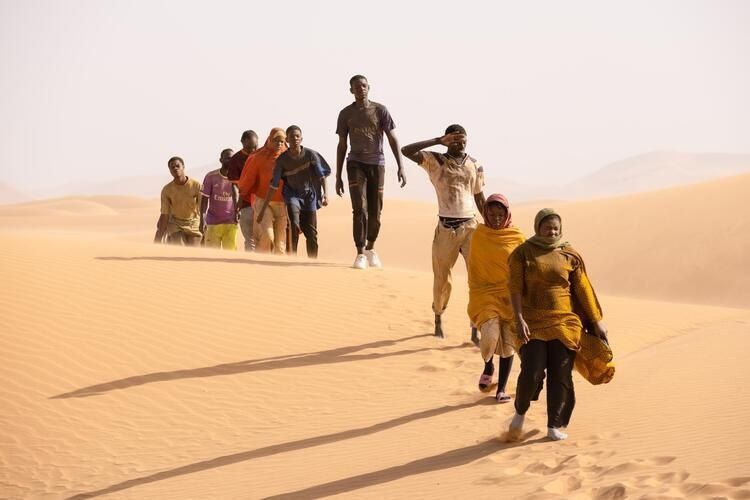
Io Capitano (translated as "I’m the Captain") is a contemporary drama capturing the journey of two young Senegalese men seeking a brighter future in Europe. Between their dreams and reality lies a treacherous journey through a labyrinth of checkpoints, the scorched Saharan desert, a fetid North African prison, and the vast waters of the Mediterranean where thousands have died packed inside vessels barely fit for passage. As they navigate dangerous sea crossings and uncertain borders, the film highlights the courage, desperation, and hope that drive migrants in search of safety and a better life.
Combining intimate storytelling with broader political context, Io Capitano offers a compelling look at modern migration challenges and the human stories behind the headlines.
Following the film, we will be joined by Tristan Ivory (assistant professor, global labor and work) and Gehad Madi (United Nations Special Rapporteur on the human rights of migrants).
Free admission! This event is part of the Migrations Program's film series at Cornell Cinema. Cosponsors include the Institute for African Development and the Institute for European Studies. All all are part of the Mario Einaudi Center for International Studies.
Additional Information
Program
Einaudi Center for International Studies
Institute for African Development
Institute for European Studies
Migrations Program
Information Session: Laidlaw Scholars Leadership & Research Program

October 29, 2025
5:00 pm
The Laidlaw Scholars Leadership and Research Program promotes ethical leadership and international research around the world—starting with the passionate leaders and learners found on campuses like Cornell. Open to first- and second-year students, the two-year Laidlaw program provides generous support to carry out internationally focused research, develop leadership skills, engage with community projects overseas, and become part of a global network of like-minded scholars from twenty universities worldwide.
At this session, we'll share more information about the program, including Cornell's cohort-based intercultural community-engaged learning summer experience in Ecuador, and tips for writing a successful application. Applications are due January 12, 2026.
Applicants are also strongly encouraged to attend a Q+A webinar about the summer experience in Ecuador. Q+A webinars are scheduled for November 5 and November 6.
Register here. Can’t attend? Contact programs@einaudi.cornell.edu.
***
The Mario Einaudi Center for International Studies hosts info sessions for graduate and for undergraduate students to learn more about funding opportunities, international travel, research, and internships. View the full calendar of fall semester sessions.
Additional Information
Program
Einaudi Center for International Studies
Reppy Institute for Peace and Conflict Studies
East Asia Program
Southeast Asia Program
Latin American and Caribbean Studies
Institute for African Development
Institute for European Studies
South Asia Program
Migrations Program