
Latin American and Caribbean Studies
Language Resource Center Speaker Series - Dan Nickolai - iSpraak: A Platform for Second Language Pronunciation Instruction, Assessment, and Research
April 16, 2024
4:30 pm
Stimson Hall, G25
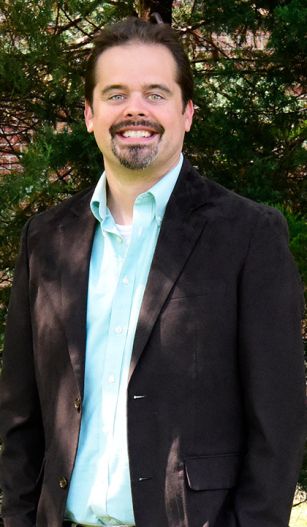
"iSpraak: A Platform for Second Language Pronunciation Instruction, Assessment, and Research"
Dan Nickolai
Associate Professor of French and Director of the Language Resource Center, Saint Louis University
This presentation will showcase the latest feature developments to the iSpraak platform. This free online tool incorporates multilingual Automatic Speech Recognition and Text-to-Speech technologies to both model and assess pronunciation in 36 different languages. Now generously funded by the National Endowment for the Humanities, iSpraak has significantly expanded on its previous feature set and has adopted new tools for learners, teachers, and researchers.
Bio: Dr. Dan Nickolai is an Associate Professor of French and the Director of the Language Resource Center at Saint Louis University. He has a professional and educational background in the fields of Computer Science, French, and Second Language Acquisition. His current work focuses on developing web-based applications that support language learning, assessment, and research. In addition to his roles at Saint Louis University, Dr. Nickolai serves as the President of the International Association for Language Learning Technology.
This event will be held in person in G25 Stimson and will also be streamed live over Zoom (registration required). Join us at the LRC or on Zoom.
The event is free and open to the public. Campus visitors and members of the public must adhere to Cornell's public health requirements for events.
Additional Information
Program
Einaudi Center for International Studies
Latin American and Caribbean Studies
Fractured Timelines: Strategic lessons from Latin American revolts to neofascism and back
February 14, 2024
6:00 pm
Autumn Leaves
Latin American and Caribbean Studies Program (LACS) Seminar Series
Due to storm-related travel delays, Pablo Abufom’s talk has been rescheduled. It will now take place in conjunction with his previously scheduled talk at Autumn Leaves (115 E. State St.) at 6pm on Wednesday, February 14. (Previously, it had been scheduled to take place at 12:20 pm in Uris G08).
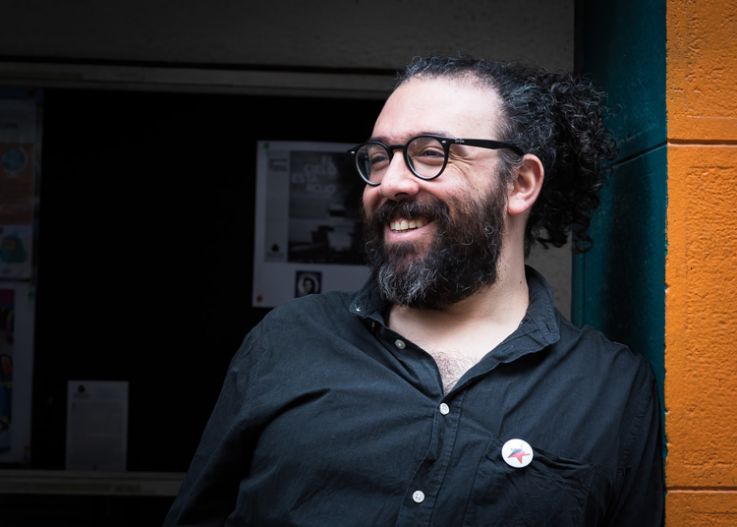
This talk will attempt to explain larger political and social phenomena on a global scale from the Latin American experience, considering there was a wave of revolts between 2018 and 2020, and then a deep dive into the rise of neofascism everywhere (Argentina is the most recent case), and how to find strategic lessons out of that situation and back to a new international antifascist movement.
Pablo Abufom is a philosopher, translator, director of Alternativa, Institute for Anticapitalist Studies and member of Movimiento Solidaridad, biology student and anarcho-communist in anarcho-capitalist times.
Additional Information
Program
Einaudi Center for International Studies
Latin American and Caribbean Studies
Retrieving an Asian Imaginary: Through the Prism of a Southasian Borderland

April 8, 2024
12:15 pm
Uris Hall, G08
Talk by Kavita Panjabi (Former Professor of Comparative Literature, Jadavpur University, Kolkata)
Turtuk is now an Indian village on the India-Pakistan border in the Karakoram mountains, in the contested zone of Baltistan. People in Turtuk who went to sleep in their homes in Pakistan on the 13th of December 1971, woke up on the 14th morning to find themselves in India. Unlike the people of the neighbouring village of Chalungka, who had fled en-masse further into Pakistan when the Indian army had arrived there a few days ago, the people of Turtuk had decided to stay with India. The Balti people of Turtuk, and its neighbouring villages Thang, Pachathang, and Tyakshi, were not compelled into any forced removal; they were subject to “in-situ displacements” (Feldman) in the conflict between Pakistan and India - staying within their homes, they had been displaced from one nation to another. Transitional spaces such as these that form the borderlands between nation-states are spaces of liminality, and the conditions inducing liminality in this region were severe. For the people of these villages, space had shrunk, and time stood still. Once situated at the crossroads of international trade and ideas on the silk route, they had become effectively sealed off from the rest of the world when the borders came up in 1948. Captive in the borderlands of Pakistan till 1971 and then in India, Turtuk finally opened to the rest of this country in 2010. For more than 60 years, the people here had found themselves in a literal “time capsule”, practically isolated within the borderlands of Pakistan and India. In this talk, Panjabi maps, through oral narratives of the Balti people of Turtuk, and the prism of their liminality, the cartographies of affective life pulsating beneath the officialese of borders. She tries to understand how the long duree of their liminality inflected their efforts both to preserve Balti culture across the borders of two nation-states and to safeguard their historical memory of an Asian internationalism. Thus, Panjabi hopes also to retrieve some of the strands of the politically shrouded webs of significance that once characterized the connectivities between Asian cultures.
Kavita Panjabi (Comparative Literature PhD '92) is a former Professor of Comparative Literature at Jadavpur University, Kolkata, where she taught for 33 years. Over three decades of activism in the Southasian women’s movement, a passion for oral history, and a lively interest in cross-border people’s perspectives inform her book Unclaimed Harvest: An Oral History of the Tebhaga Women’s Movement and her Pakistan diary, Old Maps and New: Legacies of the Partition. She has also edited anthologies on Sufism and Bhakti in South Asia, and on Feminist Culture and politics, as well as two volumes on borders with Debra Castillo namely, Cartographies of Affect: Across Borders in South Asia and the Americas, and Centering Borders in Latin American and South Asian Contexts: Aesthetics and Politics of Cultural Production.
Additional Information
Program
Einaudi Center for International Studies
South Asia Program
Latin American and Caribbean Studies
Latina/o Studies Fridays with Faculty luncheon seminar

April 26, 2024
12:00 pm
429 Rockefeller Hall, 429
The Latina/o Studies Program Fridays with Faculty luncheon seminar offers an opportunity for Latina/o and non-Latina/o students of all levels and disciplines to meet faculty and administrators from across the university for informal conversation about their current research/work in progress. All are welcome!
Fridays at 12 noon.
February 2
Camille Suárez
Assistant Profesor
Department of History
College of Arts and Sciences
February 9
Fernando E. Villegas Rivera
Visiting Assistant Professor
Department of Government/Latina/o Studies
February 16
Alexandra Dufresne
Director
State Policy Advocacy Clinic
Jeb E. Brooks School of Public Policy
March 1 NOTE: CANCELLED AND POSTPONED FOR FALL 2024
Tejasvi Nagaraja
Assistant Professor of Labor History
School of Industrial and Labor Relations
March 8
Victor Cuicahua
Associate Director for Student Empowerment, Undocumented and DACA Support
Student and Campus Life
Office of the Dean of Students
April 26
Gabriela S. Gómez Estévez
Assistant Professor
Director of Orchestras
Department of Music
College of Arts and Sciences
Additional Information
Program
Latin American and Caribbean Studies
Rebel Taxation
March 21, 2024
12:00 pm
Uris Hall, G08
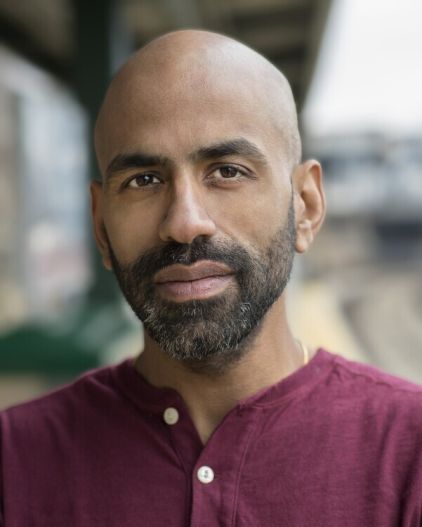
Payments made to non-state armed groups are often treated as predation. But rebels deploy multiple logics when constructing their taxation systems, many of which cannot be reduced to extortion. Rebels also use taxation as a “technology of governance” to resolve a number of social and political challenges related to constructing a wartime order. Drawing on field work in three different countries (Colombia, India, South Sudan), Zachariah Mampilly, Marxe School of Public and International Affairs, CUNY, looks at the distinct taxation systems established by armed groups in each.
In Colombia, the author focuses on the FARC-EP’s taxation of coca to reveal the ideological and political factors that shaped their taxation system. In India, he examines how the NSCN-IM implemented distinct taxation regimes across four distinct subnational areas of control. And finally, in South Sudan, he explores the role of external actors in shaping the nature of the rebel taxation system.
About the Speaker
Zachariah Mampilly is the Marxe Endowed Chair of International Affairs at the Marxe School of Public and International Affairs, CUNY and a member of the doctoral faculty in the Department of Political Science at the Graduate Center, CUNY. He is the Co-Founder of the Program on African Social Research. He is the author of Rebel Rulers: Insurgent Governance and Civilian Life during War and with Adam Branch, Africa Uprising: Popular Protest and Political Change. His writing has also appeared in Foreign Affairs, Jacobin, The Hindu, Africa's a Country, N+1, Dissent, Al Jazeera, The New York Times, The Washington Post and elsewhere.
HostJudith Reppy Institute for Peace and Conflict Studies
Additional Information
Program
Einaudi Center for International Studies
Reppy Institute for Peace and Conflict Studies
Latin American and Caribbean Studies
Institute for African Development
South Asia Program
Un-Checked, Un-Balanced: Constitutional & Political Crisis in Ecuador
March 5, 2024
12:20 pm
Uris Hall, G08
"Constitutions include systems of checks and balances to distribute power between government branches and guarantee accountability mechanisms for higher public officials. They also create relief valves in times of political conflict. The Ecuadorian Constitution of 2008 includes the classical impeachment process and what has been called "muerte cruzada" which allows the president to dissolve the National Assembly (the national legislative body) and call for new elections. The Assembly holds the same capacity but a limited version of it.
Politicians employed these mechanisms in 2022 and 2023. The Assembly tried to apply "muerte cruzada" against the president after the violent repression of protesting citizens in 2022 and initiated an impeachment process on corruption charges in 2023. President Lasso's response was the dissolution of the Assembly. By the end of 2023, Ecuadorians elected a new president and representatives.
Instead of enhancing power control and accountability, politicians are weaponizing the Ecuadorian Constitution against political rivals or to elude legal responsibility for corruption accounts. Amid the recent political conflict, the Constitutional Court was called to police the branches of state and the respect of the Constitution. Still, it could not stop the political and constitutional dispute that has put Ecuador in a severe economic and social crisis. Is the 2022 -2023 phenomena a sight of the future on how politicians will handle their conflicts? Or does the Constitution provide elements to prevent the abuse of the checks and balances mechanisms?"
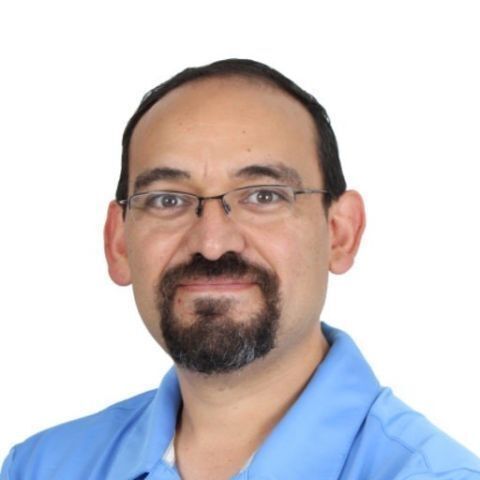
David Cordero-Heredia, J.S.D. ’18 is an Associate Professor of Law, at Universidad Católica del Ecuador currently visiting Cornell University as Visiting Fellow of the Latin American and Caribbean Studies Program. He is a Visiting Professor at the Andean University Simón Bolívar (UASB).
Additional Information
Program
Einaudi Center for International Studies
Latin American and Caribbean Studies
LACS RESEARCH SYMPOSIUM
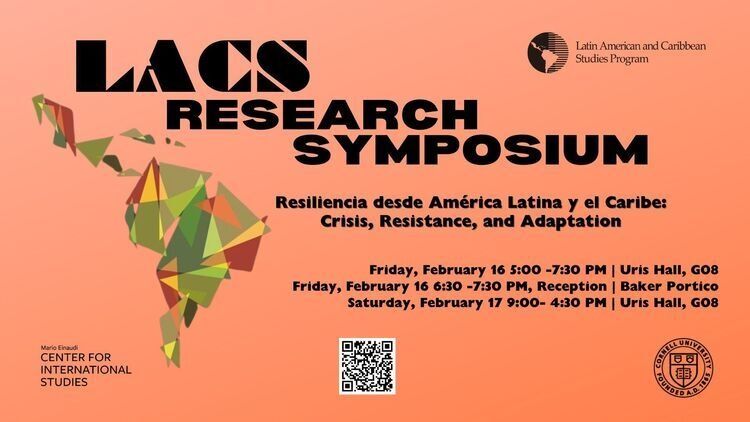
February 17, 2024
9:00 am
Uris Hall, G08
Resiliencia desde América Latina y el Caribe:
Crisis, Resistance, and Adaptation
Confronted by the ongoing consequences of colonialism, mercantilism, and imperial extraction, and more recently by the failed promises of global liberal democracy and political revolution, Latin American and Caribbean communities have created variegated landscapes and movements of crisis, resistance, and adaptation. Actors across Latin America and the Caribbean continue to act creatively to envision, enact, and experiment with a panoply of solutions, resistance strategies, and pre-figurative alternatives. Throughout history, and through alternative practices of community and kinship, art and performance, climate justice, technology, and a myriad of other examples, the friction generated during social, cultural, and economic predicaments have fueled healing processes for reconstruction and rebirth.
This symposium creates more spaces to discuss these pivotal and continuing cycles of crisis and adaptation. Above all, narratives and histories of Latin American and Caribbean resilience underscore the significant global role that these regions have had protecting and advocating for the health and well-being of their communities and shared ecosphere in the afterglow of crises relating to our rapidly changing climate, economies, and politics, among others. Forms of resistance and adaptation, broadly construed, are denoted by the effort to transform fundamentally the material and ideological conditions of quotidian existence. In an effort to rethink through our current moment as connecting with our past and future, we invite the Cornell community to think through some of the most salient practices and theories that index forms of resistance and adaptation during times of crisis in Latin America and the Caribbean.
Resiliencia desde América Latina y el Caribe:
Crisis, Resistencia y Adaptacion.
Frentes a las consecuencias actuales del colonialismo, el mercantilismo y la extracción imperial, y más recientemente a las promesas fallidas de una democracia liberal global y una revolución política, las comunidades latinoamericanas y caribeñas han creado paisajes y movimientos variados de crisis, resistencia y adaptación. Los actores de América Latina y el Caribe continúan trabajando creativamente para imaginar, implementar y experimentar con un abanico de soluciones, estrategias de resistencia y alternativas prefigurativas. A lo largo de la historia, y a través de prácticas alternativas de comunidad y solidaridad, arte y performance, justicia climática, tecnología y una infinidad de otros ejemplos, la fricción generada durante las dificultades sociales, culturales y económicas ha impulsado procesos de reconstrucción y renacimiento.
Este simposio crea más espacios para discutir estos ciclos fundamentales y continuos de crisis y adaptación. Las narrativas e historias de la resiliencia de América Latina y el Caribe subrayan el importante papel global que estas regiones han tenido en la protección y defensa de la salud y el bienestar de sus comunidades y la ecosfera compartida en el período posterior a las crisis relacionadas con el rápido cambio climático, económico, político, entre otros. Las formas de resistencia y adaptación, interpretadas en sentido amplio, se denotan por el esfuerzo por transformar fundamentalmente las condiciones materiales e ideológicas de la existencia cotidiana. En un esfuerzo por repensar nuestro momento actual como conexión con nuestro pasado y futuro, invitamos a la comunidad de Cornell a reflexionar sobre algunas de las prácticas y teorías más destacadas que demuestran formas de resistencia y adaptación durante tiempos de crisis en América Latina y el Caribe.
See Schedule here
Additional Information
Program
Einaudi Center for International Studies
Latin American and Caribbean Studies
People Like Me: A Student Panel about Navigating Identity Abroad

March 13, 2024
5:00 pm
Statler Hall, 165
Planning for study abroad? No matter how you identify or where you're studying, early planning is the key to a successful study abroad experience.
Join us for a facilitated discussion with fellow students about navigating your intersectional identities while studying abroad. A panel of returned study abroad students will share their experiences, knowledge, and advice for expressing your whole self in a different culture. This is a great opportunity to ask questions and think about your identity in a new context—outside the norms of Cornell, your hometown, or your home country.
This global freedom of expression event is an opportunity to explore critical issues related to free expression of your identity and how you encounter the world. As a student abroad, you have a deeply personal chance to experience cultural exchange, collaborate productively in a global context, and have challenging conversations while staying true to yourself—all vital skills for successful participation in democracy.
The Office of Global Learning is here to help as you think about your identity in a global context, learn about new norms and ways of life, and find the support you need.
In-Person Event
Attend the panel in Statler Hall 165
Additional Information
Program
Einaudi Center for International Studies
Reppy Institute for Peace and Conflict Studies
East Asia Program
Southeast Asia Program
Latin American and Caribbean Studies
Institute for African Development
Institute for European Studies
South Asia Program
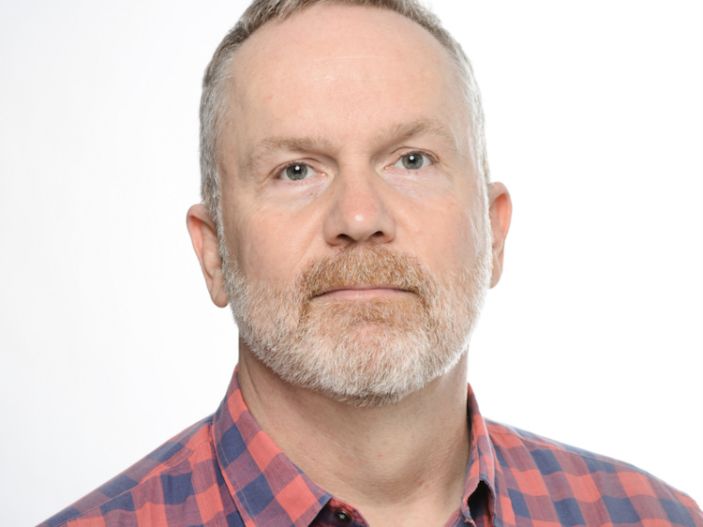
Language Resource Center Speaker Series - Jeff Bale - Language Policy, (Anti-)Racism, and Change
March 25, 2024
4:00 pm
Stimson Hall, G25
"Language Policy, (Anti-)Racism, and Change"
Jeff Bale
Associate Professor in the Department of Curriculum, Teaching and Learning, University of Toronto
This session begins with findings from a policy genealogy (Gale, 2001) of the Heritage Languages Program (HLP) in Ontario and the racialized conflicts over it between 1977–1987. Heritage-language education policies emerged across Canada in the 1970s, just after federal policies for official bilingualism (1969) and multiculturalism (1971) were established. As Haque (2012) argues, official bilingualism was only possible by excluding demands of Indigenous and other racialized communities for their own linguistic and cultural rights. The HLP challenged the logic of official bilingualism, and thus became the site of extended, racialized conflicts over fundamental questions of (1) whose language and culture can be included at school, (2) to what ends, and (3) who gets to decide? The session draws on notions of thick solidarity (Liu & Shange, 2018) to interpret the temporary alliances (Garland, 2014) formed among Black, Indigenous, South & East Asian, Italian, Portuguese, and Francophone communities in Toronto and their activism around the HLP.
The session then extends the lessons from this study to ask larger questions about the field of language policy. If racialized hierarchies of languages — and of the people who speak them — are often so stable over time, then under what conditions is it possible to work across difference and dismantle racial and linguistic stratification? Responses to this question, whether in language-policy scholarship or language-policy activism, require clear theoretical stances on (1) the relationship between language policy, (anti-)racism, migration and (settler-)colonialism (e.g., Bale, 2015; Flores & Chaparro, 2018), (2) the relationship between language-policy pasts and futures (e.g., Haque, 2012, 2019; Macías, 2014), and (3) what counts as change in language policy (Wiley, 1999, 2006).
Bio: Jeff Bale is Associate Professor of Language and Literacies Education at the University of Toronto, and serves as Vice President, University & External Affairs of the University of Toronto Faculty Association. His research applies political-economic, anti-racist, and critical perspectives to educational language policy and teacher education. From 2021-2022 he held a Humboldt Fellowship for Experienced Researchers at the Universität Bremen in Germany. He is PI of the project Language, Race, and Regulating Difference: The Heritage Languages Program in Ontario, 1977-1987, funded by the Social Sciences and Humanities Research Council of Canada. He is lead author of Centering Multilingual Learners and Countering Raciolinguistic Ideologies in Teacher Education (Multilingual Matters, 2023) and co-editor with Sarah Knopp of Education and Capitalism: Struggles for Learning and Liberation (Haymarket, 2012).
This event will be held in person in G25 Stimson and will also be streamed live over Zoom (registration required). Join us at the LRC or on Zoom.
The event is free and open to the public. Campus visitors and members of the public must adhere to Cornell's public health requirements for events.
Additional Information
Program
Einaudi Center for International Studies
Latin American and Caribbean Studies
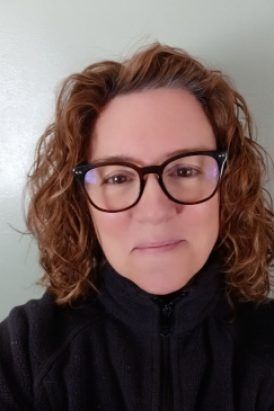
Language Resource Center Speaker Series - Julie Evershed - Copyright Basics: Understanding Copyright in the Context of Language Teaching
February 29, 2024
4:30 pm
Stimson Hall, G25
"Copyright Basics: Understanding Copyright in the Context of Language Teaching"
Julie Evershed
Language Resource Center Director, University of Michigan
The purpose of this session is to give you tools and strategies to become comfortable making basic decisions regarding materials usage and copyright considerations in the pursuit of language teaching and learning. There are many of the more traditional ways that copyright impacts our work: Public Performance Rights, conversion of "obsolete" materials, and duplication of language learning media. However, with the evolution of technology and the advent of the user as creator, we are facing many new situations where the law has not caught up with reality. The paradigm shift in publishing and distribution contributes to the confusing nature of this topic, leaving us with serious questions on how to deal with the online textbook, licensing, streaming media, and distance (as well as hybrid) education. In this session, the concepts presented will include: intent, protected rights, fair use, face-to-face teaching, "guidelines," right of first sale, the Berne Convention, and will touch on issues around generative AI.
Bio: Julie Evershed began her career at the Language Resource Center (LRC) at the University of Michigan in 1998 as the Information Specialist, taking the lead managing collections, student staff, and main-center operations. After many years’ experience, she was well prepared to step into the position of Director in 2010. Her first responsibility was leading the move from the Modern Languages Building where the LRC had been housed since 1971, to the facility in the newly built North Quad Academic and Residential Building. Julie came to the LRC with a strong administrative background, including experience in customer service, supervision, systems implementation, and integration of technology. She has a Masters in Information and Library Science from the University of Michigan School of Information, and a Bachelors of Art in French Language and Literature from the UM Department of Romance Languages. Julie has a love for languages and cultures, fostered by her experiences studying and living abroad. She participated in the Michigan study abroad program in Aix-en-Provence, obtaining a Certificat d'études politiques: Les Relations Internationales from the Université Aix-Marseille. She also spent 15 months in Istanbul Turkey, studying at Bogaziçi University and teaching English.
This event will be held in person in G25 Stimson and will also be streamed live over Zoom (registration required). Join us at the LRC or on Zoom.
The event is free and open to the public. Campus visitors and members of the public must adhere to Cornell's public health requirements for events.
Additional Information
Program
Einaudi Center for International Studies
Latin American and Caribbean Studies