
Reppy Institute for Peace and Conflict Studies
Video: IIE-Scholar Rescue Fellow Sharif Hozoori
Afghan political scientist and Global Public Voices fellow Sharif Hozoori joined Cornell in August 2021 as a visiting scholar at Einaudi’s South Asia Program. He describes his situation as a scholar under threat and his vision for an egalitarian Afghanistan.
Additional Information
Topic
- World in Focus
Program
White House Press Shop Adjusts to Proliferation of AI Deep Fakes

Sarah Kreps, PACS
“It’s not that one piece of content is going to be devastating; it’s the collective, scaled approach to inauthenticity that’s the problem. People can do this at scale now. It can look like massive numbers of citizens are supporting a particular issue when they’re not,” says Sarah Kreps, professor of government.
Additional Information
Hozoori Examines the Collapse of Democracy in Afghanistan

Sharif Hozoori, SAP
"Afghanistan is a country of ethnic minorities. No one can claim to be part of a majority," said Sharif Hozoori at a September 21 event on "Ethnocentrism and Democracy Failure in Afghanistan."
Hozoori is a visiting scholar at the South Asia Program (SAP), an Institute of International Education Scholar Rescue Fund fellow, and an expert on Afghanistan politics.

At the event, Hozoori analyzed the historical and social reasons behind the collapse of Afghanistan’s 20-year experiment in democracy which began in 2001. He noted the numerous overlapping reasons for the collapse of democracy in Afghanistan but focused primarily on the ethnocentrism exhibited by generations of Afghan leaders, who had consolidated power among their fellow Pashtuns.
While not the numerical majority, Pashtun leaders—as the largest ethnic and linguistic community—have gradually asserted their dominance in Afghanistan since the 1880s. Hozoori explained how "state and nation-building from the start was problematic," and was not solely the result of recent wars and intervention by great powers.
Hozoori also argued that the country was ripe for a federal system and had opportunities to do so in the early 2010s. Afghan leaders’ corruption and disinclination to share power let those chances slip away, he said.
In response to questions from students in the audience about the role of world powers in Afghanistan, he replied, "the U.S., Russia, and China all want to use Taliban for self-interest, which is unfortunately not in the benefit of Afghan people, particularly women of the country."
The event was hosted by SAP and the Reppy Institute of Peace and Conflict Studies, part of the Mario Einaudi Center for International Studies.
Additional Information
Information Session: Travel Grants & Global PhD Research Awards

November 15, 2023
4:45 pm
Uris Hall, G02
The Mario Einaudi Center for International Studies funds international graduate student research!
Research travel grants provide international travel support for graduate and professional students to conduct short-term research or fieldwork outside the United States. Global PhD Research Awards fund fieldwork for 9 to 12 months of dissertation research.
Contact einaudi_center@einaudi.cornell.edu for more information.
Register for the information session.
***
The Mario Einaudi Center for International Studies hosts info sessions for graduate and for undergraduate students to learn more about funding opportunities, international travel, research, and internships. View the full calendar of fall semester sessions.
Additional Information
Program
Einaudi Center for International Studies
Reppy Institute for Peace and Conflict Studies
East Asia Program
Southeast Asia Program
Latin American and Caribbean Studies
Institute for African Development
Institute for European Studies
South Asia Program
Elizabeth Warren Created a Federal Agency Once. Can She Do It Again?

Sarah Kreps, PACS
Sarah Kreps, professor of government, says, “Convince me that Apple having the largest market capitalization in the world is an inherent problem for consumers. And if you can convince me that that’s the case, next convince me that the FTC can’t address that problem.”
Additional Information
Rivals Elon Musk and Mark Zuckerberg Set to Discuss AI

Sarah Kreps, PACS
Sarah Kreps, professor of government, says, “They keep talking about wanting to be regulated; actions are speaking louder than their words and the actions are showing that they're investing billions of dollars trying to make the most advancements the fastest.”
Additional Information
Experts Envision Afghanistan’s Future

Next Generation’s Initiative Conference
“If you block peaceful politics, then you make room for unpeaceful politics,” said a presenter at the Sept. 9 conference at Cornell.
By Phoebe Wagner
The Next Generation's Initiative: Learning from the Past to Build the Future of Afghanistan – a conference held on Cornell campus on Saturday, Sept. 9 – brought together Afghan scholars and experts in politics and law to analyze Afghanistan’s recent past for clues about how to build a brighter future. The event was hosted by the South Asia Program (SAP), part of the Mario Einaudi Center for International Studies, and the Clarke Initiative for Law and Development in the Middle East and North Africa at Cornell Law School.
The nine presenters engaged in discussions about the future of Afghanistan on governance and constitutionality, the public sphere, rule of law, and public perspectives. The conference opened with a welcome from SAP visiting scholar Sharif Hozoori, an Institute of International Education Scholar Rescue Fund fellow and an expert on Afghanistan politics.
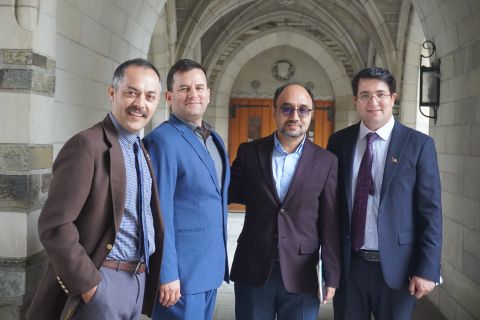
The first presenter, Farid Tookhy, a senior fellow at the Institute for Peace and Diplomacy, centered questions of how Afghans can work together to create the future of Afghanistan. Zinab Attai, a PhD student in comparative politics at Cornell, emphasized how “Afghanistan’s history is punctuated by recurrent instances of foreign intervention.”
Mirwais Balkhi, a fellow at the Wilson Center, spoke to the need to redefine Afghanistan as a nation state, and to “develop a country for ourselves.” How the new generation addresses this issue is crucial, he said. When Afghans come together and learn about the history of the country and talk about a shared destiny for their country, people can envision a homeland for themselves.
Another major issue is the system of governance, panelists argued. Anything could be possible in the current situation – even the collapse of the country or the fragmentation of Afghanistan into different local zones – which Afghanistan as a nation state could not easily recover from in the future.
A global development undergraduate asked, “How did the executive branch influence the legislative branch to exercise its power? Was it because of a constitutional flaw, or because the constitution wasn’t used at all?”
Shamshad Pasarlay of University of Chicago Law School responded, “Constitutions alone cannot be blamed on the failure of a state.” In the U.S., he said, it’s a document that works – even though it’s imperfect. It can be used as a focal point in the executive branch and legal system.
“If you block peaceful politics, he continued, “then you make room for unpeaceful politics.”
By creating a space for thoughtful discussions, there was room for respectful disagreement. Participants engaged with and challenged presenters, and the panels’ common themes created a rich dialogue. The discussion demonstrated the diversity of thought that is needed for envisioning new futures and generating change.
In his closing remarks, Tawab Danish of Cornell Law highlighted the conference’s breadth of topics, from nation-building to identity. When discussing Afghanistan and Afghans’ rights, he said, it’s important to have the people suggesting solutions to be of the place – and this insider perspective was part of what made the day’s conversation so productive.
“International scholars have often written about and presented on Afghanistan, but Afghan scholars know the country though their direct lived experiences,” said Danish.
The conference was cosponsored by the Einaudi Center's Comparative Muslim Societies Program and Reppy Institute for Peace and Conflict Studies and the Department of Near Eastern Studies, Department of Government, and Religious Studies Program in the College of Arts and Sciences.
Phoebe Wagner is an MPS student in the Department of Global Development (CALS) and a FLAS fellow in Hindi at the South Asia Program.
Additional Information
Information Session: Dissertation Proposal Development Program

October 23, 2023
4:45 pm
The Einaudi Dissertation Proposal Development Program (DPD) supports 12 PhD students annually by offering seminars, workshops, mentoring sessions, and up to $5,000 for summer research. Applicants’ research projects must focus on global issues, but the proposed research setting may be international or domestic.
In this session, you'll learn more about the details of the program and advice on the application process.
Register for event here.
***
The Mario Einaudi Center for International Studies hosts info sessions for graduate and for undergraduate students to learn more about funding opportunities, international travel, research, and internships. View the full calendar of fall semester sessions.
Additional Information
Program
Einaudi Center for International Studies
Reppy Institute for Peace and Conflict Studies
East Asia Program
Southeast Asia Program
Latin American and Caribbean Studies
Institute for African Development
Institute for European Studies
South Asia Program
Information Session: Fulbright for Undergraduates

October 26, 2023
4:45 pm
The Fulbright U.S. Student Program supports U.S. citizens to study, conduct research in any field, or teach English in more than 150 countries. Students who wish to begin the program immediately after graduation are encouraged to start the process in their junior year. Recent graduates are welcome to apply through Cornell.
The Fulbright program at Cornell is administered by the Mario Einaudi Center for International studies. Applicants are supported through all stages of the application and are encouraged to start early by contacting fulbright@einaudi.cornell.edu.
Register for the info session.
***
The Mario Einaudi Center for International Studies hosts info sessions for graduate and for undergraduate students to learn more about funding opportunities, international travel, research, and internships. View the full calendar of fall semester sessions.
Additional Information
Program
Einaudi Center for International Studies
Reppy Institute for Peace and Conflict Studies
East Asia Program
Southeast Asia Program
Latin American and Caribbean Studies
Institute for African Development
Institute for European Studies
South Asia Program
Information Session: Opportunities in European Studies

October 24, 2023
4:45 pm
Uris Hall, G-08
This information session for undergraduate and graduate students will provide more information on funding opportunities from the Institute for European Studies, as well as the requirements for the European studies minor.
Register here for in-person attendance, or here for virtual registration.
***
The Mario Einaudi Center for International Studies hosts info sessions for graduate and for undergraduate students to learn more about funding opportunities, international travel, research, and internships. View the full calendar of fall semester sessions.
Additional Information
Program
Einaudi Center for International Studies
Reppy Institute for Peace and Conflict Studies
Institute for European Studies