
Reppy Institute for Peace and Conflict Studies
Afghanistan: From the Inside Out

September 3, 2021
12:00 pm
The ill-fated American invasion in Afghanistan came to an abrupt end with the collapse of the Afghan government and the Taliban takeover of Kabul in mid-August. Images of the chaos that ensued as the U.S. and other NATO countries attempted to evacuate tens of thousands of people continue to play out on television screens around the world.
The collapse of the Afghan security forces in days and the withdrawal of European and American government personal left many Afghans vulnerable to the new regime’s policies and their future of the country in doubt. Much airtime has been devoted to analyzing this crisis in terms of American and European interests, yet we have learned little about how Afghans who have worked to rebuild their country’s institutions are faring, how they envision their future, and how the international community can help to secure a secure and prosperous future for all Afghans.
In this webinar, we ask two Afghan scholars to reflect on the state of their country, what they see taking place in the near and long terms, and possible ways to achieve a future they envision for their country.
Panelists:
Muska Dastageer is a political scientist specializing in peace and political theory. She is a lecturer at the American University of Afghanistan (AUAF) in Kabul, Afghanistan. Alongside her lecturing, she is also an Expert Advisor on the Atlantic Council’s Strategic Dialogues on Afghanistan.Up until December 2020 she also worked as a special anti-corruption advisor with the Joint Taskforce for Anti & Counter Corruption (JTACC). Prior to this she advised the USAID-funded Afghanistan's Measure for Accountability and Transparency (AMANAT) program and the Monitoring and Evaluation Committee, delivering several damning institutional assessments of ministries in Kabul in 2018 and 2019. She holds two MSc degrees from the University of Oxford and the University of Copenhagen. Her articles on the Afghan peace process and security in South Asia have been published by the Atlantic Council, The Diplomat and RÆSON and has participated in panels arranged by Brookings Institution and the Atlantic Council.
Haroun Rahimi obtained his B.A. in Law from Herat University, his LLM in Global Business Law from the University of Washington School of Law, and his Ph.D. from the University of Washington. Rahimi is Assistant Professor of Law at the American University of Afghanistan. Rahimi's research focuses on economic laws, institutional reform, and divergent conceptions of rule of law in the Muslim and modern thoughts. Rahimi's research has appeared in reputable local and international journals. Rahimi has also collaborated as an independent consultant with a number of research firms and policy think tanks conducting policy research on institutional development and good governance in the South Asia context. Most recently, at the Oxford Centre for Islamic Studies, Rahimi worked on the legal history of Afghanistan and the ways that legal transplantation is legitimized in Muslim countries.
Moderator:
Mostafa Minawi is an associate professor of history and the director of the Critical Ottoman and Post-Ottoman Studies, Cornell University. He is the author of The Ottoman Scramble for Africa: Empire and Diplomacy in the Sahara and the Hijaz (Stanford University Press, 2016) and several other publications on Ottoman imperialism in Africa. He held several fellowships over the past few years, including the Alfred Howell Chair in Archeology and History at the American University of Beirut in 2019-20 and was a Senior Fellow at the Institute for Advanced Studies at the Central European University in 2020-21.
Additional Information
Program
Einaudi Center for International Studies
South Asia Program
Reppy Institute for Peace and Conflict Studies
Info Session: Einaudi Dissertation Proposal Development Program
October 14, 2021
4:45 pm
This session will provide PhD students with information on the Einaudi Dissertation Proposal Development Program. The program offers seminars, workshops, and faculty mentoring to PhD students in the social sciences and humanities who are developing research projects abroad or domestic research projects on topics that connect to global issues. Students receive up to $5,000 for summer research. Workshop and seminar costs are also covered.
Contact: programming@einaudi.cornell.edu
Additional Information
Program
Einaudi Center for International Studies
Reppy Institute for Peace and Conflict Studies
East Asia Program
Southeast Asia Program
Latin American and Caribbean Studies
Institute for African Development
Institute for European Studies
South Asia Program
Info Session: Fulbright Opportunities for Graduate Students
September 29, 2021
4:45 pm
The Fulbright U.S. Student Program provides full funding for graduate and professional students conducting research or teaching in any field in more than 150 countries. Open to U.S. citizens only.
The Fulbright-Hays Doctoral Dissertation Research Abroad program supports doctoral students conducting research in modern languages or area studies for six to 12 months. Open to U.S. citizens and permanent residents of the United States. Travel to Western European countries is not eligible.
Contact: fulbright@einaudi.cornell.edu
Additional Information
Program
Einaudi Center for International Studies
Reppy Institute for Peace and Conflict Studies
East Asia Program
Southeast Asia Program
Latin American and Caribbean Studies
Institute for African Development
Institute for European Studies
South Asia Program
Info Session: International Relations Minor
September 22, 2021
4:45 pm
Is the Einaudi Center's International Relations minor for you? Here's a chance to find out. Graduates go on to successful careers in fields like international law, economics, agriculture, trade, finance, journalism, education, and government service.
Contact: irm@einaudi.cornell.edu
Additional Information
Program
Einaudi Center for International Studies
Reppy Institute for Peace and Conflict Studies
East Asia Program
Southeast Asia Program
Latin American and Caribbean Studies
Institute for African Development
Institute for European Studies
South Asia Program
Info Session: Migration Studies Minor
September 8, 2021
4:45 pm
The migration studies minor is a university-wide, interdisciplinary undergraduate minor that prepares students to understand the historical and contemporary contexts and factors that drive international migration and shape migrant experiences around the globe. This minor draws on the rich course offerings found across the humanities and social sciences at Cornell, and is designed to draw students outside of their major fields and to extend their knowledge beyond a single country.
Contact: migration-minor@einaudi.cornell.edu,
Additional Information
Program
Einaudi Center for International Studies
Reppy Institute for Peace and Conflict Studies
East Asia Program
Southeast Asia Program
Latin American and Caribbean Studies
Institute for African Development
Institute for European Studies
South Asia Program
Info Session: European Studies Minor and Undergraduate Funding Opportunities
September 7, 2021
4:45 pm
Through an interdisciplinary curriculum that you can mold to your interests, the European Studies (ES) Minor provides the opportunity to explore Europe’s past, present, and future. You will cultivate a knowledge of European languages, culture, history, politics, and international relations. The minor offers the chance to take courses across colleges on subjects that shape your understanding of a globalizing world, while also providing you with an area of expertise. You will gain critical thinking skills, language abilities, and helpful frameworks for assessing today’s most pressing issues in Europe and around the world.
Several funding opportunities are available for you to pursue undergraduate research projects focused on Europe. Join the information session to learn about application requirements, deadlines, and how to construct a strong proposal.
Contact: ies@cornell.edu
Additional Information
Program
Reppy Institute for Peace and Conflict Studies
Einaudi Center for International Studies
East Asia Program
Southeast Asia Program
Latin American and Caribbean Studies
Institute for African Development
Institute for European Studies
Margulies receives Levy faculty engagement award

Joseph Margulies, PACS
Professor Joseph Margulies ’82 has won the 2021 George D. Levy Engaged Teaching and Research Award for his work to break down barriers for previously incarcerated people in Tompkins County, New York.
Additional Information
President Biden Stands By Afghanistan Approach
Sarah Kreps, PACS
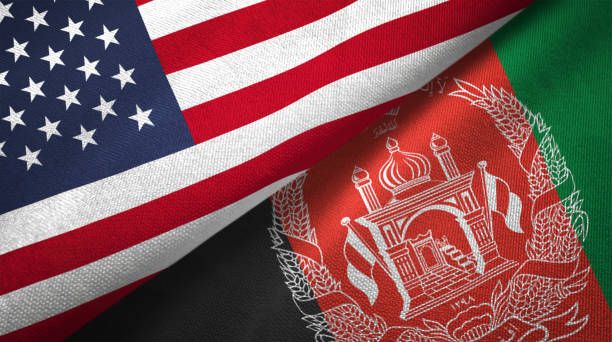
Kreps discusses President Biden’s address on Afghanistan and U.S. involvement in Afghanistan on WAMC/Northeast Public Radio.
Additional Information
International Fair 2021
September 1, 2021
11:30 am
Uris Hall, Terrace
The annual International Fair showcases Cornell's global opportunities for undergraduate and graduate students. Explore the fair and find out about international majors and minors, language study, fellowships, internships, study abroad, exchanges, service learning, and more.
Due to capacity limitations at the venue, we invite you to register now to reserve priority access to this event. Walk-ins are also welcome, but there may be a wait if we reach capacity. Please wear a face mask during the event.
The International Fair is sponsored by the Mario Einaudi Center for International Studies, the Office of Global Learning (both part of Global Cornell), and Cornell's Language Resource Center.
Additional Information
Program
Einaudi Center for International Studies
Reppy Institute for Peace and Conflict Studies
East Asia Program
Southeast Asia Program
Latin American and Caribbean Studies
Institute for African Development
Institute for European Studies
South Asia Program
PACS Faculty Appointed Dean of Cornell Law
Jens David Ohlin Begins "Labor of Love" on July 1
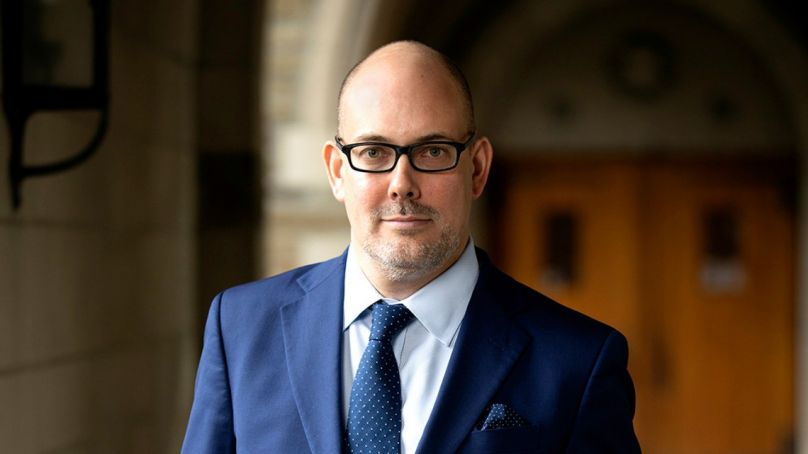
Cornell Law School's new Allan R. Tessler Dean is a core faculty member in Einaudi's Reppy Institute for Peace and Conflict Studies.