
South Asia Program
Afghan Women Behind the Wheel

March 7, 2024
7:00 pm
Willard Straight Theatre
Film screening with Sahraa Karimi (Director), followed by Q&A and conversation moderated by Iftikhar Dadi, John H. Burris Professor of History of Art
The desire for freedom is basic to human nature all over the world. Obtaining a driver's license is becoming a key factor towards attaining personal freedom for Afghan women. However, is the Afghan society prepared for women behind the wheel? In Afghan Women Behind the Wheel, director Sahraa Karimi, born and raised in Kabul, follows several Afghan women trying to obtain a driving license. Through personal interviews, Karimi discovers the motivations and desires of these women, which are often shaped by their age, social status, and family backgrounds. She taps into their lives and dreams and discusses religion and family traditions with them to better understand their journey toward their personal freedom.
Sahraa Karimi is an independent film director and screenwriter from Afghanistan. On August 15, 2021, she was forced to leave Afghanistan due to the sudden and unexpected fall of Kabul and the return of the Taliban to power. Currently, she is a Visiting Professor at Centro Sperimentale di Cinematographia (Rome National Film School) in Rome, Italy.
She belongs to the second generation of Afghan migrants in Iran. When she was 17 years old, she immigrated to the Slovak Republic. In August 2012, she returned to Kabul and established her own Film Production Company, Kapila Multimedia House, to support Afghan independent filmmakers and artists. Karimi received her PhD In Cinema (Fiction Film Directing & Screenwriting) from the Academy of Music and Performing Arts, Film and TV Faculty in Bratislava, Slovakia (FTF-VSMU).
Presented in collaboration with the Ithaca City of Asylum. Cosponsored by the Department of Near Eastern Studies, the Feminist, Gender and Sexuality Studies Program, the Department of Performing & Media Arts, and the Mario Einaudi Center for International Studies. Financial support is provided by a Title VI grant from the U.S. Department of Education.
Tickets are free, and can be reserved beforehand through Cornell Cinema.
Additional Information
Program
Einaudi Center for International Studies
South Asia Program
Summer Program in India Info Session
February 12, 2024
12:30 pm
Rockefeller Hall, 183
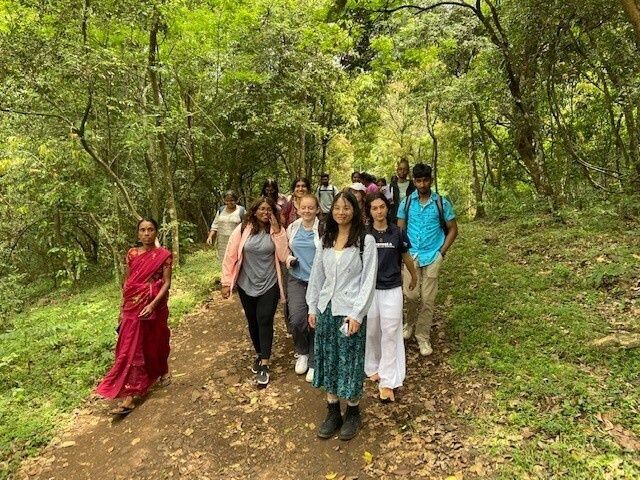
Are you interested in the intersection of mental health and culture, global health, and community engagement? Do you want to gain field research skills and learn about indigenous communities in South India’s beautiful and fragile Nilgiris Biosphere Reserve? If so, the Cornell-Keystone Nilgiris Field Learning Program might be for you!
Additional Information
Program
Einaudi Center for International Studies
South Asia Program
Faculty Info Session: Global Grand Challenge Call for Proposals

February 12, 2024
12:00 pm
Learn about Cornell's new Global Grand Challenge: The Future and how you can propose a research or curricular project.
Global Cornell is opening what will be The Future’s only call for proposals. Interdisciplinary teams of faculty and researchers from all Cornell colleges, schools, and departments are encouraged to identify a research issue of global importance and plan a path to a successful alternative future.
Teams may apply for research project support up to $150,000 per year for two years. Stand-alone curricular projects are eligible for up to $20,000 per year for two years.
Deadline for letters of intent to apply (1 page): February 26, 2024Deadline for full proposals (5–7 pages): May 6, 2024Register here to join the virtual info session. The session will include an opportunity to ask questions and network with others interested in finding collaborators.
The information session slides and Q&A will be posted online after the event.
Additional Information
Program
Reppy Institute for Peace and Conflict Studies
East Asia Program
Southeast Asia Program
Latin American and Caribbean Studies
Institute for African Development
Institute for European Studies
South Asia Program
Einaudi Center for International Studies
Religions on the Move series: "Diasporic Devotions"
March 21, 2024
5:00 pm
A. D. White House, Guerlac Room
Associate Professor Aliyah Khan from the University of Michigan will give a talk titled "Diasporic Devotions: The Indo-Caribbean Islamic Qasida and Gendered Performance" on Thursday, March 21.
The Indo-Caribbean Islamic qasida is a diasporic devotional song that propagates Indian subcontinental Islamic ritual practices and preserves the use of Urdu in the post-indentureship Caribbean through performances of religious authenticity. But it is simultaneously creolized in transliteration and translation, in part through Muslim women’s participation in public worship. This talk explores the gendered and racialized performances, songbook and vinyl record dissemination, and transliterated creolization of Urdu qasida poetic, devotional praise songs brought to Trinidad and Guyana by Indian Muslim indentured laborers in the nineteenth and early twentieth centuries.
In this lecture, Khan focuses on the evolution of women’s public devotional and competitive performances of qasidas in the Indo-Caribbean Muslim context of sectarian Sunni and Ahmadi differences, local engagement with global revivalist principles of bid’a (innovation), and the controversial emergence of women’s performance categories in new qasida competitions supported by nation-states and commercial interests. Indo-Caribbean women’s qasida performances, Khan argues, lie at the intersection of Indo-Caribbean postcolonial political identity—which is historically and continually defined by Indian women’s culturally “proper” dress, sexuality, and public behavior in visible opposition to Afro-Caribbean women—and worldwide Muslim debates and tensions over global and local iterations of Islam.
Dr. Aliyah Khan is an associate professor in the University of Michigan (U-M) Department of Afroamerican and African Studies and the Department of English Language and Literature. She is also the Director of the U-M Global Islamic Studies Center (GISC). Dr. Khan specializes in postcolonial Caribbean literature and the contemporary literature of the Muslim and Islamic worlds, with a particular focus on the intersections of race, gender, and Islam in the hemispheric Americas, including in immigrant communities in North America. She has also presented and taught widely in the field of Muslim representation in comics and graphic novel. She is on the editorial board of Bloombsbury Critical Guides in Comics Studies.
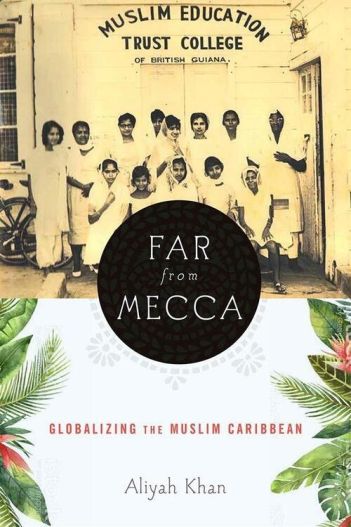
Far from Mecca: Globalizing the Muslim Caribbean (Rutgers University Press and University of the West Indies Press 2020), Dr. Khan’s first book, is the first academic monograph on the literature, history, and music of Caribbean Islam, focusing on Guyana, Trinidad, and Jamaica, and on enslaved Muslim West Africans, indentured Indian colonial sugar plantation laborers, and their Muslim Caribbean descendants. Far from Mecca garnered honorable mention in the 2020-2021 Modern Language Association Prize for a first book. Dr. Khan is currently conducting research for a literary and musical book project on Caribbean hurricanes and climate change, including religious responses, reparations debates, and other community-oriented environmental mitigation strategies.
This lecture is part of the 'Religions on the Move' lecture series sponsored by the Religious Studies Program which is supported by a grant from Cornell University’s Migrations Global Grand Challenge and the Mellon Foundation’s Just Futures Initiative. Additional support from the Latin American and Caribbean Studies Program, Society for the Humanities, Comparative Muslim Societies Program, and South Asia Program.
Additional Information
Program
Einaudi Center for International Studies
Latin American and Caribbean Studies
South Asia Program
FLIP Teacher Orientation

February 5, 2024
3:00 pm
Uris Hall, G02
The Einaudi Center’s Foreign Language Introduction Program (FLIP) is heading into local communities to teach children about world cultures and languages. FLIP aims to connect our diverse Cornell community to K-12 students at local schools, libraries and community centers in Upstate New York. Cornell volunteer teachers will have the opportunity to share short introductory lessons on the foreign languages and cultures they are passionate about. Volunteer teachers should have at least an intermediate knowledge of their chosen language.
Register to attend either the Feb. 1 orientation in person or the Feb. 5 orientation over Zoom.
Additional Information
Program
Einaudi Center for International Studies
East Asia Program
Southeast Asia Program
Latin American and Caribbean Studies
Institute for African Development
Institute for European Studies
South Asia Program
Information Session: Global Internships in Africa

January 30, 2024
4:45 pm
Uris Hall, G08
The Institute for African Development (IAD) offers 6-8 week summer internships that let you undertake challenging practical fieldwork in Ghana, Zambia, or Liberia. If you're a sophomore or junior, join this info session to find out how you can apply. Applications for Global Internships are due February 1.
Register for the information session.
***
The Mario Einaudi Center for International Studies hosts info sessions for graduate and for undergraduate students. To learn more about funding opportunities, international travel, research, and internships, view the full calendar for spring semester sessions.
Additional Information
Program
Einaudi Center for International Studies
Reppy Institute for Peace and Conflict Studies
East Asia Program
Southeast Asia Program
Latin American and Caribbean Studies
Institute for African Development
Institute for European Studies
South Asia Program
Cornell Concert Series presents: TISRA
March 22, 2024
7:30 pm
Bailey Hall
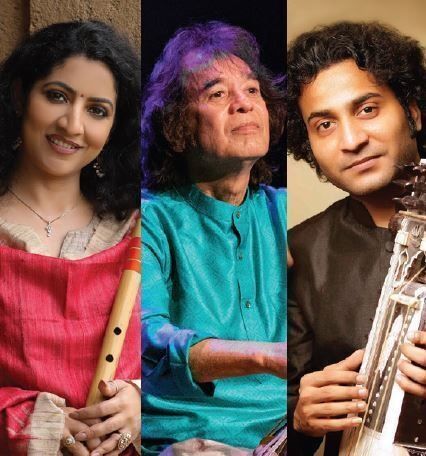
Tabla virtuoso Zakir Hussain is proud to present TISRA (three) with two of India’s finest young musicians, Sabir Khan and Debopriya Chatterjee. This trio is comprised of tabla (drum), sarangi (strings), and bansuri (bamboo flute), a combination not often heard on the classical stage. Sarangi and bansuri each have roots in ancient India and its mythology; both are also folk instruments. TISRA showcases rich folk and classical traditions: the musical influence of Rajasthani nomads has been heard far beyond the borders of India, and Uttar Pradesh incorporated folk music forms of Nepal, Bhutan, and Tibet into its music. This colorful mix, combined with Indian classical music and the rich rhythm repertoire of Punjab, makes for a compelling offering that TISRA brings to audiences in the United States.
“Zakir Hussain … Virtuosity that is barely to be believed.” – Washington Post
Additional Information
Program
South Asia Program
Jole Dobe Na / Those Who Do Not Drown (2020) Naeem Mohaiemen
March 28, 2024
4:45 pm
Cornell Cinema, Willard Straight Hall
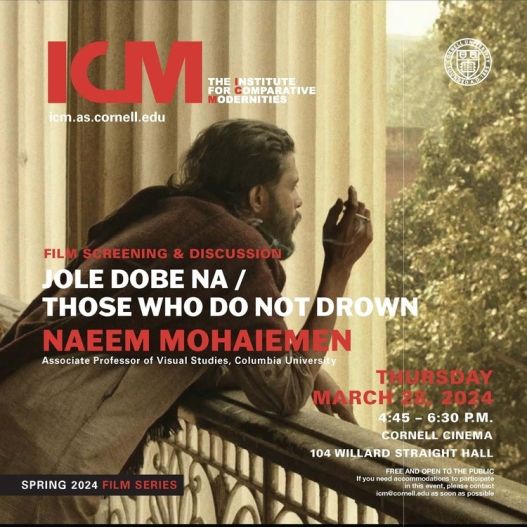
A screening of Jole Dobe Na / Those Who Do Not Drown (2020) followed by a conversation with filmmaker Naeem Mohaiemen.
Naeem Mohaiemen’s film Jole Dobe Na / Those Who Do Not Drown (2020) was conceived in response to a prompt given by Delhi-based artist group Raqs Media Collective to think about the afterlife of caregivers. The film was was commissioned in 2019 by the Yokohama Biennale and Bildmuseet Umea, and completed during the first months of 2020 lockdown.
In an empty hospital in Kolkata, a man faces protocols of blood, a subtly discriminatory office, and a vacant operating theater. His mind is on a loop of the last months of his wife’s life, when a quiet argument developed. When is the end of pharma-medical care; whose life is it anyway? They were an estranged couple, thrown back into intimacy by an unknown illness. Even in a dreamworld of his making, the paranoia of infection is twinned with a hesitant intimacy.
The film revisits themes from the earlier film Tripoli Cancelled (2017)–family unit as locus for pain-beauty dyads, abandoned buildings as staging ground for lost souls, and the necessity of small prevarications to keep on living. In Tripoli, the boredom of daily life is punctuated by letters to an invisible wife, and endless readings of Richard Adams’ dark children’s fable Watership Down (1972). In Jole, a looping memory of final days is obstinately kept alive by the husband, and the book readings are from Syed Mujtaba Ali’s stories of Europe between the two world wars.
See the trailer.
Naeem Mohaiemen combines films, photography, drawings, and essays to research utopia-dystopia slippage in decolonizing South Asia after 1945. He is Associate Professor of Visual Arts and Head of the Photography Concentration at the School of Arts, Columbia University.
Additional Information
Program
South Asia Program
Information Session: Fulbright U.S. Student Program for Undergraduates
March 13, 2024
4:45 pm
The Fulbright U.S. Student Program supports U.S. citizens to study, conduct research in any field, or teach English in more than 150 countries. Students who wish to begin the program immediately after graduation are encouraged to start the process in their junior year. Recent graduates are welcome to apply through Cornell.
The Fulbright program at Cornell is administered by the Mario Einaudi Center for International studies. Applicants are supported through all stages of the application and are encouraged to start early by contacting fulbright@einaudi.cornell.edu.
Register for the information session. Can’t attend? Contact fulbright@einaudi.cornell.edu.
***
The Mario Einaudi Center for International Studies hosts info sessions for graduate and for undergraduate students. To learn more about funding opportunities, international travel, research, and internships, view the full calendar for spring semester sessions.
Additional Information
Program
Einaudi Center for International Studies
Reppy Institute for Peace and Conflict Studies
East Asia Program
Southeast Asia Program
Latin American and Caribbean Studies
Institute for African Development
Institute for European Studies
South Asia Program
Information Session: Fulbright U.S. Student Program for Undergraduates

February 12, 2024
4:45 pm
The Fulbright U.S. Student Program supports U.S. citizens to study, conduct research in any field, or teach English in more than 150 countries. Students who wish to begin the program immediately after graduation are encouraged to start the process in their junior year. Recent graduates are welcome to apply through Cornell.
The Fulbright program at Cornell is administered by the Mario Einaudi Center for International studies. Applicants are supported through all stages of the application and are encouraged to start early by contacting fulbright@einaudi.cornell.edu.
Register for the information session. Can’t attend? Contact fulbright@einaudi.cornell.edu.
***
The Mario Einaudi Center for International Studies hosts info sessions for graduate and for undergraduate students. To learn more about funding opportunities, international travel, research, and internships, view the full calendar for spring semester sessions.
Additional Information
Program
Einaudi Center for International Studies
Reppy Institute for Peace and Conflict Studies
East Asia Program
Southeast Asia Program
Latin American and Caribbean Studies
Institute for African Development
Institute for European Studies
South Asia Program