South Asia Program
‘Huge Energy Challenges’: How Can India Make the Leap to Become a Green, Clean Country?
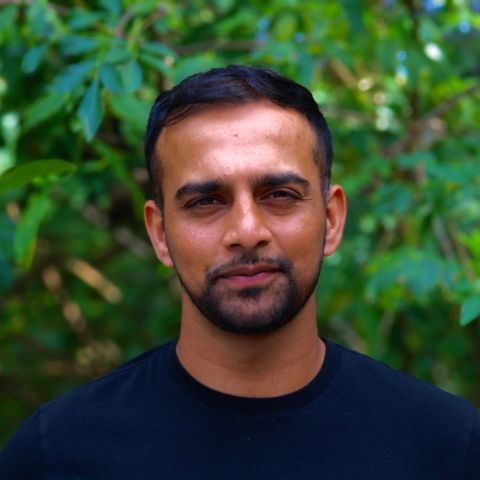
Arnab Basu, SAP and Nancy Chau, Einaudi
Researchers at Cornell University found that exposure to dirty cooking fuels in India contributes to a high rate of child mortality.
Additional Information
Trump Wades Into Bailout Politics in Offering a Lifeline to Argentina
Eswar Prasad, SAP
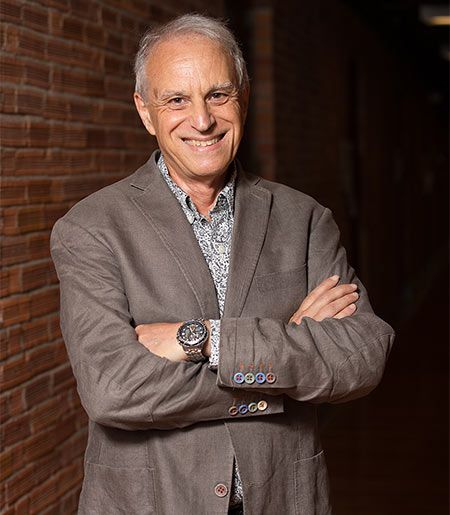
Eswar Prasad, Cornell University economics professor and former IMF official, comments on the economic risks and lack of a strong rationale for the proposed unconditional U.S. bailout to Argentina.
Additional Information
Warming Climate is Biggest Threat to Rangelands
Lund Debater Chris Barrett in World in Focus
Chris Barrett (Dyson/Brooks) analyzes climate impacts on Mongolian rangeland this month in Science. He joins Muna Ndulo (Law) on October 22 to debate the future of international aid.
Is (Cutting) International Aid Good?
This year's Lund Critical Debate explores the impact of aid on global communities, what makes aid effective—and how to move forward.
“It’s always struck me as puzzling, why people in suits and ties in capital cities seem to think that the pastoralists don’t understand very well how to manage these lands. And yet, there’s this common belief that you have to get them to reduce their herd sizes. That just hurts the herders.”
Overgrazing is commonly blamed as a key cause of rangeland degradation—yet policy measures designed to limit grazing damage, like herd-size restrictions and livestock taxes, can have devastating consequences on herders' livelihoods.
In Mongolia—where 70 percent of the land area is rangeland—the government revived a national livestock head tax in 2021 in response to perceived overgrazing impacts.
New research from Chris Barrett (IAD/SEAP) identifies a more significant factor: climate change.
Barrett's team analyzed longitudinal data on vegetation conditions and livestock population, collected annually by the Mongolian government across 40 years. They found that larger herds can slightly reduce rangeland productivity over the short term, but climate and weather have a much larger effect. The team published the findings on September 18 in Science.
“When we look really carefully at the equivalent of county scale over the whole country, over 41 years, we find that the longer-run changes in rangeland conditions are entirely attributable to changes in the climate,” said Barrett.
“Mongolian rangelands are affected more by the collective greenhouse gas–emitting behaviors around the globe than by local herders,” he wrote in the Science article. “Policymakers might therefore usefully focus attention on global mitigation and on international compensation for climate damages and less on taxing herders who … appear responsible for little if any of the change in Mongolia’s rangeland primary productivity over the past 40 years.”
The project began among Barrett's graduate students, including one who grew up on the Mongolian rangelands. Coauthors include two alumni from Mongolia—Tumenkhusel Avirmed ’21, MS ’23, now a research data analyst at Stanford University, and Avralt-Od Purevjav, PhD ’20, a consultant at the World Bank.
Chris Barrett is the Stephen B. and Janice G. Ashley Professor of Applied Economics and Management in the Dyson School of Applied Economics and Management and a professor in the Cornell Brooks School of Public Policy. He is a frequent commentator and policy advisor on food security and agricultural economics.
Featured in World in Focus Briefs
Additional Information
STS Colloquium with Prakash Kumar
October 20, 2025
3:30 pm
Morrill Hall, 423
Contextualizing the Silver Bullet
The high yielding variety seeds (or HYVs) are overwhelmingly depicted in current historiography as the silver bullet that solved the problem of hunger in many parts of the Global South in the 1960s. Developed by Rockefeller breeders, these seeds of wheat and paddy were globalized by cold warriors who wished to obtain agricultural yield increase in their fight against communism that assumedly was prone to spread among the world’s poor and hungry. Deviating from such self-assured perspectives on the efficacy of HYVs, this talk turns attention to the history of past efforts at yield enhancement that were folded into the decision to invite HYVs into India, the turbulent years in which HYVs arrived in India, and the technocratic belief that stood by these seeds and ensured that they were given a chance to succeed. The fact that the HYV revolution has remained a limited regional phenomenon despite efforts to extend it elsewhere in India beckons us to treat the HYVs as historical beings that have a particular and contingent past of their own.
Prakash Kumar is an associate professor of South Asian history at Pennsylvania State University. He specializes in the history of science, agrarian lives, epidemics, development, Indo-US relations, and Cold War era modernization. He is the author of two books, one on colonial science (Cambridge, 2012) and a recent one on the history of the Green Revolution in India (Cambridge, 2025). He is currently working on a history of public health and epidemics in India. His works have been funded twice by the National Science Foundation, by US Fulbright Commission, and the German Historical Institute.
Additional Information
Program
South Asia Program
After Gen Z Protests, Nepal Set for Fresh Elections in March
Kathryn March, SAP
Kathryn March, professor emerita of anthropology, offers insight into how social media highlighted privilege disparities in Nepal during recent youth-led protests.
Additional Information
Information Session: Fulbright U.S. Student Program

November 17, 2025
4:45 pm
The Fulbright U.S. Student Program supports U.S. citizens to study, conduct research in any field, or teach English in more than 150 countries. The program is open to graduate students, recent graduates, and young professionals. Undergraduate students who wish to begin the program immediately after graduation are encouraged to start the process in their junior year. Recent graduates are welcome to apply through Cornell.
The Fulbright program at Cornell is administered by the Mario Einaudi Center for International studies. Applicants are supported through all stages of the application and are encouraged to start early by contacting fulbright@einaudi.cornell.edu.
Register for the virtual session.
Can’t attend? Contact fulbright@einaudi.cornell.edu.
Additional Information
Program
Einaudi Center for International Studies
Reppy Institute for Peace and Conflict Studies
East Asia Program
Southeast Asia Program
Latin American and Caribbean Studies
Institute for European Studies
South Asia Program
Migrations Program
Institute for African Development
Southwest Asia and North Africa Program
Summer Program in India Info Session
November 12, 2025
10:00 am
Uris Hall, G08
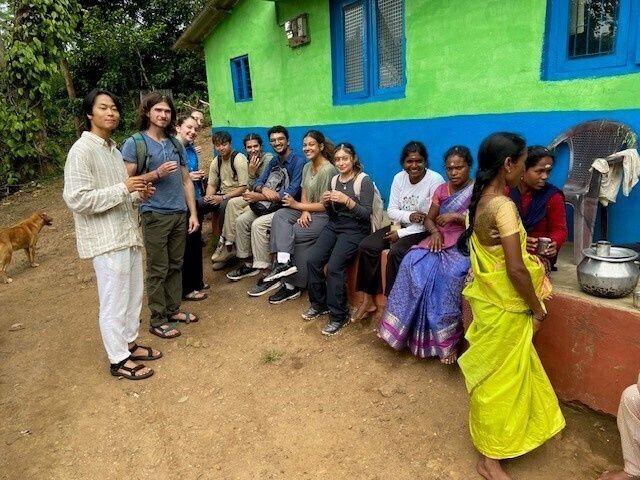
Are you interested in the intersection of mental health and culture, global health, and community engagement? Do you want to gain field research skills and learn about indigenous communities in South India’s beautiful and fragile Nilgiris Biosphere Reserve? If so, the Cornell-Keystone Nilgiris Field Learning Program might be for you!
Additional Information
Program
Einaudi Center for International Studies
South Asia Program
Summer Program in India Info Session
October 29, 2025
8:00 pm
Are you interested in the intersection of mental health and culture, global health, and community engagement? Do you want to gain field research skills and learn about indigenous communities in South India’s beautiful and fragile Nilgiris Biosphere Reserve? If so, the Cornell-Keystone Nilgiris Field Learning Program might be for you!
Additional Information
Program
Einaudi Center for International Studies
South Asia Program
Sandhya Shukla, “Cross-Cultural Harlem: Relations of Race, In Place”
October 23, 2025
4:45 pm
Goldwin Smith Hall, G64
This talk will discuss the theory, method, and material of “cross-cultural Harlem.” How can we remain alive to the grief of the political moment while also developing interpretive approaches that offer hope? Professor Shukla will begin to answer that question by exploring Harlem as a space for encounters among those of different backgrounds, producing important dialogues between Blackness and other forms of peoplehood, and their associated territories. The particular examples she considers involve a legendary exchange between Yuri Kochiyama and Malcolm X and the performance of a Bangladeshi comedian and playwright Alaudin Ullah. These occasions, she shall argue, produce their own dilemmas about encounter, in terms of both reading practices and affects of projection, identification and solidarity. Ultimately, this presentation proposes values of openness for our interdisciplinary enterprise.
Cosponsored by Africana Studies, American Studies, Anthropology, Literatures in English, and the South Asia Program
We strive to make all our programming accessible to everyone. For accommodation requests, please email aasp@cornell.edu as soon as possible.
Sandhya Shukla is Professor of English and Chair of American Studies at the University of Virginia, where she is also an affiliate faculty member of the Carter G. Woodson Institute for African American and African Studies. Her most recent work is Cross-Cultural Harlem: Reimagining Race and Place (Columbia University Press, 2024). She is also the author of India Abroad: Diasporic Cultures of Postwar America and England (Princeton University Press), and a co-editor of Imagining Our Americas: Toward a Transnational Frame (Duke University Press). Her work has appeared in publications such as American Quarterly, symploke, and Annual Review of Anthropology, as well as the news-oriented The Conversation.
Additional Information
Program
South Asia Program
Is (Cutting) International Aid Good?
October 22, 2025
5:00 pm
Goldwin Smith Hall, G76, Lewis Auditorium
Lund Critical Debate
Since January 2025, the United States has slashed billions in international aid—and effectively dismantled the U.S. Agency for International Development (USAID), responsible for administering U.S. development and humanitarian aid around the world. In what has become the largest restructuring of aid in the nation’s history, thousands of UN-administered programs have also lost funding, disrupting critical programs and services, breaking supply chains, and leading to widespread closures and layoffs.
These sweeping cuts affect food security, global health, democratic governance, and more—and the stakes have never been higher. As the landscape of international aid evolves, the world faces new questions about the impact of aid on communities, what makes international aid effective—and how to move forward.
This year's Lund debate from the Mario Einaudi Center for International Studies brings together policy and practice experts for an unfiltered look at the future of international aid. Join Einaudi Center faculty Chris Barrett (Dyson/Brooks) and Muna Ndulo (Law) as they tackle these questions: Who benefits from aid? Do some types of aid work better than others? Should we pursue new approaches to international development? What are the best ways to take strategic action in the world while investing in America’s security, economy, and global position?
***
Interested in attending? Complete this RSVP.
***
Panelists
Chris Barrett is the Stephen B. and Janice G. Ashley Professor of Applied Economics and Management in the Dyson School of Applied Economics and Management and a professor in the Cornell Brooks School of Public Policy. He is coeditor-in-chief of the journal Food Policy and a frequent commentator and policy advisor on food security and agricultural economics. Barrett won the USAID Science and Technology Pioneers Prize (2013), among many other awards for research, teaching, and public outreach. Read recent Chronicle coverage of Barrett's research.
Muna Ndulo is the William Nelson Cromwell Professor of International and Comparative Law at Cornell Law School and an internationally recognized scholar in the fields of constitution making, governance and institution building, international criminal law, African legal systems, and human rights. Ndulo has served as consultant to the African Development Bank, World Bank, Economic Commission for Africa, United Nations Development Program, and other international organizations. He led the Einaudi Center's Institute for African Development from 2001 to 2020.
Moderator
Paul Kaiser is the Einaudi Center's practitioner in residence in fall 2025. Kaiser has extensive experience in international development, with a focus on sub-Saharan Africa, South Asia, and the Pacific Islands. His career spans roles at USAID, the Millennium Challenge Corporation, and World Bank. Previously, Kaiser taught political science and African studies at Mississippi State University and the University of Pennsylvania.
***
About the Debate
The Lund Critical Debate is a signature event of the Mario Einaudi Center for International Studies. Established in 2008, Einaudi's Lund Debate series is made possible by the generosity of Judith Lund Biggs '57.
Additional Information
Program
Einaudi Center for International Studies
Reppy Institute for Peace and Conflict Studies
East Asia Program
Southeast Asia Program
Latin American and Caribbean Studies
Institute for African Development
Institute for European Studies
South Asia Program
Migrations Program
Southwest Asia and North Africa Program