
South Asia Program
Info Session: Fulbright U.S. Student Program for Undergraduates

February 20, 2023
4:45 pm
Over 500 Cornellians have crossed the globe with the Fulbright U.S. Student Program since the 1940s. You could be the next!
The program, administered by the Mario Einaudi Center for International Studies, supports college graduates conducting research or teaching English in more than 150 countries. The Einaudi Center's Fulbright advisor helps you get started early to submit a successful application.
Learn more about student information sessions from the Einaudi Center on minors, funding opportunities, Fulbright, summer language programs, and much more.
Additional Information
Program
Einaudi Center for International Studies
Reppy Institute for Peace and Conflict Studies
East Asia Program
Southeast Asia Program
Latin American and Caribbean Studies
Institute for African Development
Institute for European Studies
South Asia Program
Info Session: Graduate Fulbright Opportunities

February 7, 2023
4:45 pm
Learn more about Fulbright opportunities for graduate students that fund your international research or teaching from a Fulbright advisor at Cornell.
Fulbright at Cornell is administered by the Mario Einaudi Center for International Studies. The Einaudi Center's Fulbright advisor works with you to create and submit a competitive application for the Fulbright U.S. Student Program or the Fulbright-Hays Doctoral Dissertation Research Abroad program.
Learn more about student information sessions from the Einaudi Center on minors, funding opportunities, Fulbright, summer language programs, and much more.
Additional Information
Program
Einaudi Center for International Studies
Reppy Institute for Peace and Conflict Studies
East Asia Program
Southeast Asia Program
Latin American and Caribbean Studies
Institute for African Development
Institute for European Studies
South Asia Program
Info Session: Einaudi Center Minors Open House

February 1, 2023
4:30 pm
Mario Einaudi Center for International Studies, 163 Uris Hall
Stop by the Mario Einaudi Center for International Studies' Minors Open House to learn about adding an international minor to your degree.
The Einaudi Center offers minors in migration studies, international relations, European studies, and Latin American and Caribbean studies. The Department of Asian Studies will join us to share information about minors in East Asian studies, South Asian studies, Southeast Asian studies, Sanskrit studies, and global Asia studies.
Snacks will be provided!
Learn more about student information sessions from the Einaudi Center on minors, funding opportunities, Fulbright, summer language programs, and much more.
Additional Information
Program
Einaudi Center for International Studies
Reppy Institute for Peace and Conflict Studies
East Asia Program
Southeast Asia Program
Latin American and Caribbean Studies
Institute for African Development
Institute for European Studies
South Asia Program
Everyone Speaks Pali if Left Alone: The Buddhist Language Ideology in the Pali Commentaries Around 500 CE
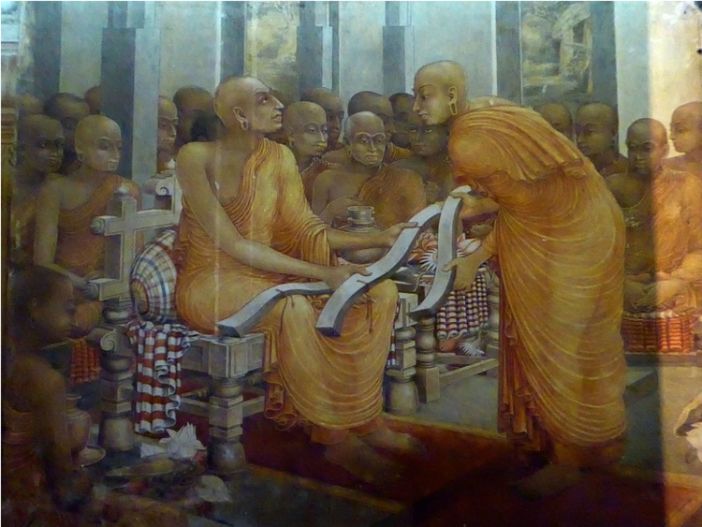
February 6, 2023
12:15 pm
Uris Hall, G02
Talk by Liyu Hua (Asian Studies, Cornell University)
This talk will address Pali language ideology in Buddhaghosa’s commentaries around 500 CE and the traces of its inheritance from Patañjali’s Mahābhāṣya. The often-quoted discussion of the Pali language as “the natural language” (Pali sabhāvanirutti) in the Path of Purification (Visuddhimagga) and the Dispeller of Delusion (Sammohavinodanī) presents an ideal speaker of a language who speaks a grammatically correct language without external intervention. Patañjali first referred to the model speakers of Sanskrit as people who speak from their own nature (Sanskrit svabhāvena). The concept of the natural language postulates a nonarbitrary or eternal relationship between word form (sadda/śabda) and meaning or objects (attha/artha). Thus, Pali language ideology in Buddhaghosa’s works resembles Sanskrit language ideology, which can be traced back to the tradition of Patañjali’s Mahābhāṣya. The formation of Pali language ideology not seen in other Buddhist schools is probably a result of the textual conservatism in the Mahāvihāra of fifth-century Lanka. It explains why the Theravada tradition shows less linguistic flexibility than other Buddhist schools in the early first millennium CE.
Liyu Hua is a Ph.D. candidate in Asian Literature, Religion, and Culture Program at Cornell University. Working on the history of Buddhism, he is interested in the interaction between various Indian religious traditions and premodern forms of knowledge. His dissertation project focuses on the Buddhist commentaries in various Indic languages and how commentaries shaped interpretative frameworks in the early first millennium CE.
Additional Information
Program
Einaudi Center for International Studies
South Asia Program
Should Local Police Department Deploy Lethal Robots?

Sabrina Karim, PACS/IAD/SAP
“If you receive a present at Christmastime, a new toy, you want to be able to use it. Well, this is kind of the same thing for a number of law-enforcement agencies,” says Sabrina Karim, an assistant professor of government.
Additional Information
A Gujarati in Mecca: Negotiating Piety, Politics, and Belonging in Ottoman Hejaz
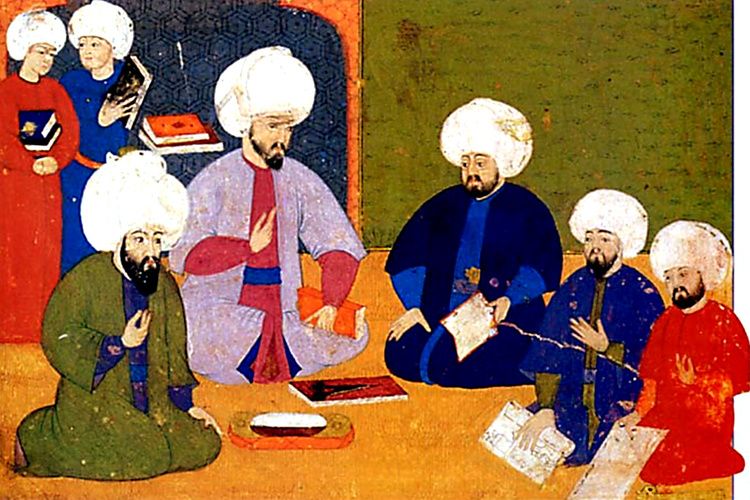
March 6, 2023
12:15 pm
Uris Hall, G08
Talk by Jyoti Balachandran (History, Pennsylvania State University)
This talk centers around the life and works of Qutb al-Din Muhammad al-Nahrawali (d. 1582), a Muslim intellectual from northern Gujarat who achieved tremendous professional success in Mecca. Over the course of his life, al-Nahrawali served the Gujarat Sultans, the Meccan Sharifs, and the Ottoman Sultans in several capacities – as a diplomat, legal scholar, and jurist. Apart from highlighting the intellectual and socio-political connections that tied Gujarat to the Red Sea region and beyond in the sixteenth century, al-Nahrawali’s life offers a window into the ways in which piety and politics intersected within a shifting political context in the Hejaz. Furthermore, al-Nahrawali’s success as a transregional scholar raises the question of how we grasp the particularities of place, of rootedness in a world on the move, of attachment to the local within the global interconnectedness of the western Indian Ocean.
Jyoti Gulati Balachandran is Edward J. and Eleanor Black Nichols University Endowed Fellow in History and Associate Professor of History at Pennsylvania State University. Her research focuses on the social and cultural histories of Muslim communities in Gujarat and the western Indian Ocean in the medieval and early modern period. She is the author of Narrative Pasts: The Making of a Muslim Community in Gujarat, c. 1400-1650 (OUP, 2020), a finalist for the British Association for South Asian Studies Book Prize 2022 and the Karwaan Book Prize 2022. Balachandran's current research focuses on the history of Muslim scholarly networks in the sixteenth-century western Indian Ocean using a variety of Arabic narrative texts produced in Gujarat and the Hejaz. She serves on the editorial board of the Indian Economic and Social History Review.
Additional Information
Program
Einaudi Center for International Studies
South Asia Program
When China and Saudi Arabia Meet, Nothing Matters More Than Oil

Eswar Prasad, SAP
“Stability of energy supplies, in terms of both prices and quantities, is a key priority for Xi Jinping as the Chinese economy remains heavily reliant on oil and natural gas imports,” says Eswar Prasad, professor of international trade policy and economics.
Additional Information
Iftikhar Dadi, Lahore Cinema: Between Realism and Fable
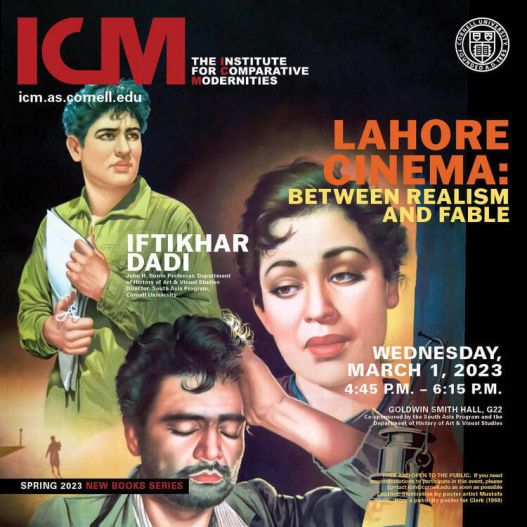
March 1, 2023
4:45 pm
Goldwin Smith Hall, G22
A new conversation with Iftikhar Dadi about his recently published book, Lahore Cinema: Between Realism and Fable (U of Washington P, 2022)
Commercial cinema has been among the most powerful vectors of social and aesthetic modernization in South Asia. So argues Iftikhar Dadi in his provocative examination of cinema produced between 1956 and 1969—the long sixties—in Lahore, Pakistan, following the 1947 Partition of South Asia. These films drew freely from Bengali performance traditions, Hindu mythology, Parsi theater, Sufi conceptions of the self, Urdu lyric poetry, and Hollywood musicals, bringing these traditions into dialogue with melodrama and neorealism. Examining this layered context offers insights into a period of rapid modernization and into cultural affiliation in the South Asian present, when frameworks of multiplicity and plurality are in jeopardy.
Lahore Cinema probes the role of language, rhetoric, lyric, and form in the making of cinematic meaning as well as the relevance of the Urdu cultural universe to midcentury Bombay filmmaking. Challenging the assumption of popular cinema as apolitical, Dadi explores how films allowed their audiences to navigate an accelerating modernity and tense politics by anchoring social change across the terrain of deeper cultural imaginaries. By constituting publics beyond social divides of regional, ethnic, and sectarian affiliations, commercial cinema played an influential progressive role during the mid- and later twentieth century in South Asia.
Lahore Cinema is freely available in an open access edition thanks to TOME (Toward an Open Monograph Ecosystem) and the generous support of Cornell University (from the publisher's website uwapress.uw.edu).
Additional Information
Program
South Asia Program
Faculty Seed Grants

Open now! Apply by March 1
Einaudi’s seed grants support the work of internationally engaged Cornell faculty, including research and events. Apply today!
Additional Information
Sarah F. Thompson

Assistant Professor of Government
Geographic Research Area: South Asia and Latin America
Teaching/Research Interests: Sarah Thompson utilizes causal inference methods (particularly field experiments and quasi-experimental methods) in her research on the politics of marginalized groups. She also works closely with policymakers in the field. She asks how key institutions can intervene to increase the political agency of women and indigenous populations, who are systematically excluded from state politics around the globe.