
South Asia Program
Tamil Conversation Hour

December 1, 2022
4:00 pm
Stimson Hall, G25
Come to the LRC to practice your language skills and meet new people. Conversation Hours provide an opportunity to use the target language in an informal, low-pressure atmosphere. Have fun practicing a language you are learning! Gain confidence through experience! Just using your new language skills helps you learn more than you might think. Conversation Hours are are open to any learner, including the public. Campus visitors and members of the public must adhere to Cornell's public health requirements for events.
Additional Information
Program
South Asia Program
CRADLE Hosts Global Economics Conference

100 Years of Economic Development
September 15–17: Kaushik Basu, Einaudi, and Cornell's Department of Economics welcome economists from around the world. Find out how to attend.
Additional Information
Bitcoin Bombed in El Salvador. It’s a Cautionary Tale for Crypto.

Eswar Prasad, SAP
“The Bitcoin experiment is working as well as one might have expected – which is not too well,” said Eswar Prasad, senior professor of trade policy.
Additional Information
Topic
- Development, Law, and Economics
Program
Cornell Global Hubs
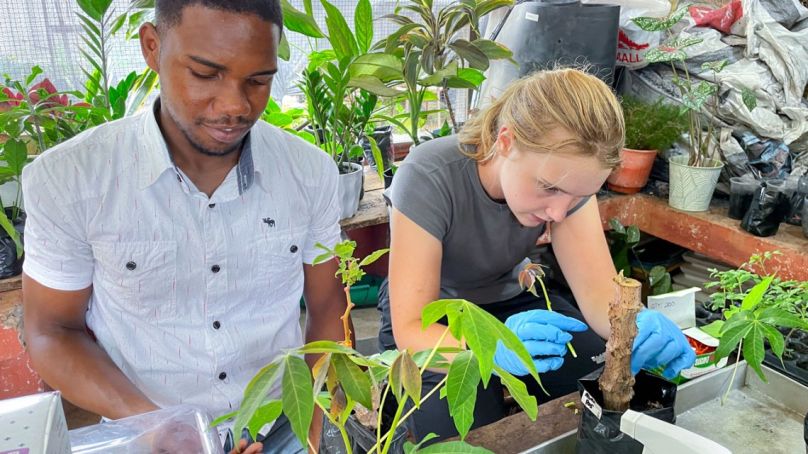
20 partner universities in 11 locations
New initiative expands opportunities, provides infrastructure, and greases the wheels for faculty, alumni, and students across the university.
Additional Information
The Evolution of Money – with Eswar Prasad

Eswar Prasad, SAP
Eswar Prasad, senior professor of trade policy, appears on this podcast to discuss the evolution of money.
Additional Information
Afghan Students Look to Future
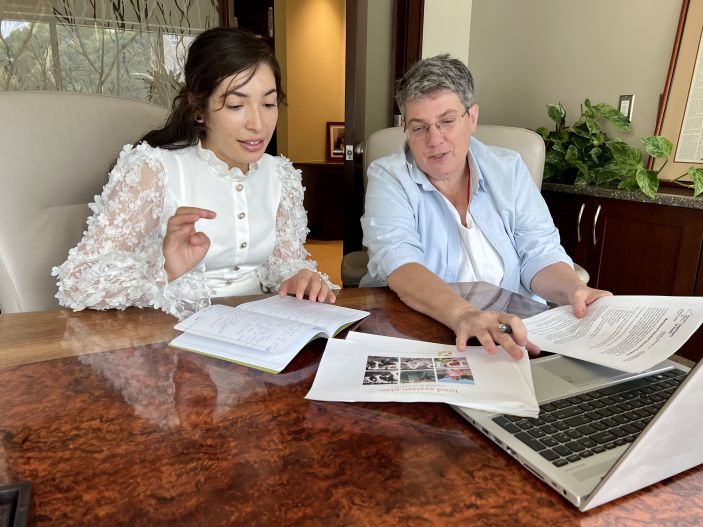
Nine Undergraduates Become Cornellians
"I’m now living in a bigger world, with a different view than the world I was in."
Additional Information
Kashmir in the Global Humanities: Genres, Poetics, Ecologies
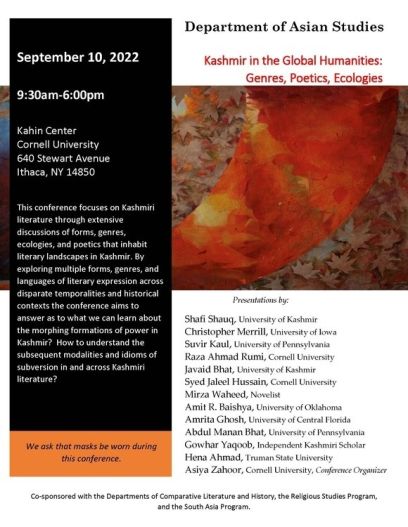
September 10, 2022
9:30 am
Kahin Center
This conference focuses on Kashmiri literature through extensive discussions of forms, genres, ecologies, and poetics that inhabit literary landscapes in Kashmir. By exploring multiple forms, genres, and languages of literary expression across disparate te mporalities and historical contexts the conference aims to answer as to what we can learn about the morphing formations of power in Kashmir? How to understand the subsequent modalities and idioms of subversion in and across Kashmiri
literature?
We ask that masks be worn during this conference.
Additional Information
Program
South Asia Program
Einaudi Center for International Studies
SAP 2022 Bulletin Now Available
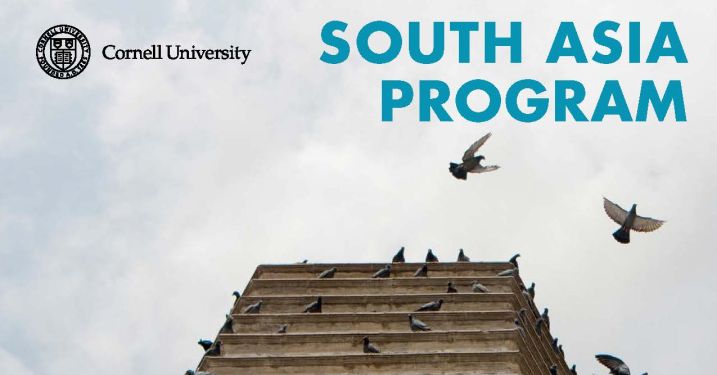
The 2022 Bulletin features many original articles, on Afghan scholars and students at Cornell, Visiting Scholars’ campus experiences, the Nilgiris Field Learning Program, new SAP grants, and more. In addition the bulletin reviews a series of exceptional events last year, such as the Tagore Lecture by Cheran, Genealogies of Anti-Asian/Asia Violences symposium at Syracuse, and several music and arts events, highlights our outreach to community colleges and K-12 teachers, and lists selected faculty publications. The cover photo is by Nipun Prabhakar, a 2019 South Asian Studies fellow at Cornell, of a large birdhouse in Gujarat, India.
Susan Koshy, "The New Diasporic Subject and the Empire of Finance in Mohsin Hamid's 'The Reluctant Fundamentalist'"
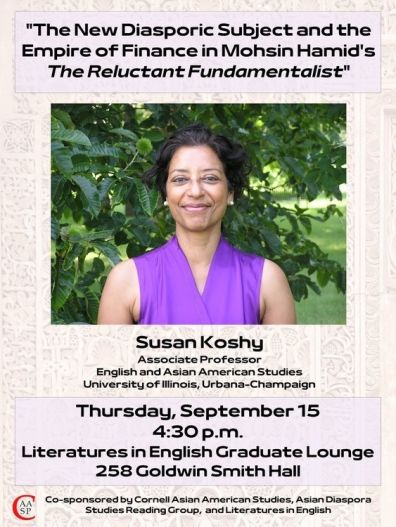
September 15, 2022
4:30 pm
Goldwin Smith Hall, Literatures in English Graduate Student Lounge, 258 Goldwin Smith Hall
This talk looks at the ways in which the new diasporic subject, drawn into circuits of economic migration to the West, both underwrites and pries open the settlements of neoliberal multicultural Empire. This analysis focuses on Mohsin Hamid's novel, The Reluctant Fundamentalist (2007), examining how in focalizing US racial formations through the lens of Pakistani new immigration and US-Pakistani neocolonial relations, the novel brings out the deep links between US racial forms and the global restructuring of capitalism after the 1970s and presses for new understandings of racial and postcolonial agency to reckon with these changes. Through its protagonist, the narrative insistently links financial developments in the metropolis to (under)developments in the South. In this way, the novel retools anti-colonial and anti-racist critique to better grapple with the global structures of the new imperialism, which works through “weapons of mass salvation” such as financial aid, liberalized immigration policies, and multicultural recognition, as much as through weapons of mass destruction such as structural adjustment, detention and deportation, and high-tech warfare.
Susan Koshy is associate professor of English and Asian American Studies, Faculty Fellow at the Office of the Vice Chancellor for Research and Innovation (OVCRI) and former director of the Unit for Criticism and Interpretive Theory at the University of Illinois, Urbana-Champaign. Her work on race, gender, sexuality, and diaspora is part of a larger theoretical interest in modernity, (neo)colonialism, and the processes of globalization. Her research is situated at the intersection of globalization theory, postcolonial studies, and ethnic studies and interrogates the boundaries of these disciplinary formations. She is the author of Sexual Naturalization (Stanford, 2004), winner of the Choice Outstanding Academic Title Award and co-editor of three edited collections, Transnational South Asians (Oxford, 2008), Colonial Racial Capitalism (Duke, 2022), and “Monolingualism and Its Discontents” (PMLA, 2022). She is currently completing work on her book titled Manifest Diversity. Her articles on Asian American literature, postcolonial studies, immigration and naturalization law, neoliberal racialization, human rights, transnational feminist theory, and diaspora studies, have appeared in PMLA, ALH, Yale Journal of Criticism, Boundary 2, Differences, Diaspora and Social Text. She completed her BA and MA from Delhi University and her PhD from UCLA.
Co-sponsored by the Asian Diaspora Studies Reading Group and Literatures in English
Graduate students: you are invited to participate in a workshop session with Prof. Koshy on Friday, September 16, 9-11 a.m., organized by Bonnie Chung (Ph.D. student, Literatures in English). There are only 7 slots available for the Friday morning session. To RSVP and for more details, please email Alexis Boyce (ab449@cornell.edu) ASAP.
Additional Information
Program
South Asia Program
2022 Bulletin

Bulletin