
South Asia Program
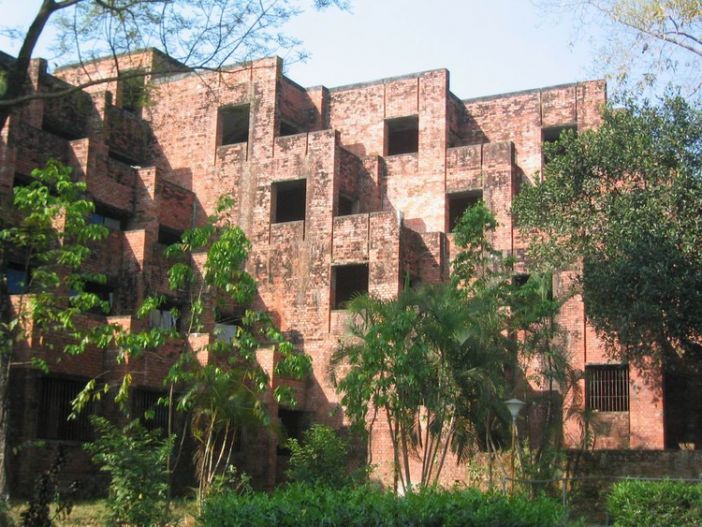
“An Uncharted Modernity”: The Architecture of Muzharul Islam, by Nurur Rahman Khan
April 12, 2021
11:00 am
As a witness to the famine caused by the British in India, Partition and the bloody aftermath, the futile East-West Pakistan relationship, the language movement, and the inevitable Liberation War, Muzharul Islam was not contained by the typical “postcolonial" hangover and neither was he an advocate of the “regional”. Islam saw “modernity” as a “politics” of nation-building and was therefore able to hold three otherwise opposed positions, without any conflict with each other: Marxist politics, the progressive attitude of the west, and the need for a strong a cultural identity. His architecture not only laid the foundation of modern architecture in the region but also set on to voice a perception of “modernity” that would fuse a solidarity of the thinkers, artist, writers and even politicians of his time. “An Unchartered Modernity” is journey of the works of Muzharul Islam, seen beyond the typical “gaze” of modern architecture. Muzharul Islam is considered one of the greatest architects of the Indian subcontinent and his work till date remains not only as a source for understanding “modernity” in Bengal, but also to look beyond the confinement of “regionalism” and charters a path in architecture where architecture is able to recalibrate its role.
Dr Nurur Rahman Khan is a partner of the renowned architectural practice of Tanya Karim N R Khan and Associates. He graduated from Bangladesh University of Engineering and Technology, and completed his Masters from the same institution with the honor of Ahsanur Rahman Gold Medal. He went on to do this Doctoral Degree at IUAV University of Venice. He is an educator who has taught and lectured in many Universities and Seminars and currently a Professor at Bangladesh University and adjunct faculty of Stamford University Dhaka, and visiting faculty at North South University. He also was a Masters studio guide at IUAV. He is a scholar on Muzharul Islam, Louis I Kahn’s work in the subcontinent and the critique of Modern Architecture in the region. He is the author of The Assembly Building, a book published on the occasion of the birth centennial of Louis I Kahn, and Muzharul Islam: Selected Drawings, the first book to be published on Muzharul Islam. .
Additional Information
Program
Einaudi Center for International Studies
South Asia Program
Spring 2021 Event Calendar
The South Asia Program is excited to announce our Spring 2021 Events Calendar. All our events this semester are virtual and open to the public, though advance registration is required. The online calendar, with links to register for each event, is available at bit.ly/SAP-Spring2021.
This semester features our weekly SAP seminars on most Mondays at 11:00 am Eastern Time, including two webinars co-sponsored by Oxfam India, speakers from Pakistan and Bangladesh, a panel on modern Indian art, and a presentation on “Kamala Harris and the History of South Asian America.”
For details about each event, please visit our website, or follow @SAPCornell on Twitter, Facebook or Instagram. Videos of SAP events are posted on our YouTube channel.
Additional Information
“Early Buddhist Multilingualism.” A talk by Peter Skilling.

February 26, 2021
9:00 am
Please join us for an invited talk by Prof. Peter Skilling, generously co-sponsored by the Departments of Asian Studies, History and Philosophy; the South Asia, Southeast Asia, East Asia and Religious Studies Programs; and the Graduate and Professional Student Assembly. The event is open to all interested, and special accommodations can be made for access upon request.
Peter Skilling is a Special Lecturer at Chulalongkorn University, Bangkok. Until his retirement in 2017, he was a Professor of the French School of Asian Studies (EFEO). He specializes in the literary and material history of Buddhism in South and Southeast Asia. He publishes widely and has been visiting professor at leading universities worldwide. His forthcoming book, Questioning the Buddha (Wisdom Books, 2021), introduces and translates twenty-five Buddhist sutras.
Due to COVID-era regulations, all attendees are required to register for this event here: http://cglink.me/2ee/r987790
Upon registration you should receive an automated email with the Zoom link. If for any reason you do not receive this email, please contact Bruno at bms297@cornell.edu.
Additional Information
Program
East Asia Program
Southeast Asia Program
South Asia Program
“Creative Dimensions of Early Buddhist Textuality: The Practice of Scripture.” A talk by Eviatar Shulman (Hebrew University of Jerusalem).
February 16, 2021
12:00 pm
Please join us for an invited talk by Prof. Eviatar Shulman, generously co-sponsored by the Departments of Asian Studies, History and Philosophy; the South Asia, Southeast Asia, East Asia and Religious Studies Programs; and the Graduate and Professional Student Assembly. The event is open to all interested, and special accommodations can be made for access upon request.
Eviatar Shulman teaches Buddhist Studies at the Hebrew University of Jerusalem. Prof. Shulman's early work was on Buddhist philosophy, and he has more recently worked on religious and literary aspects of Buddhism.
Due to COVID-era regulations, all attendees are required to register for this event here: http://cglink.me/2ee/r992584
Upon registration you should receive an automated email with the Zoom link. If for any reason you do not receive this email, please contact Bruno at bms297@cornell.edu.
Additional Information
Program
East Asia Program
Southeast Asia Program
South Asia Program
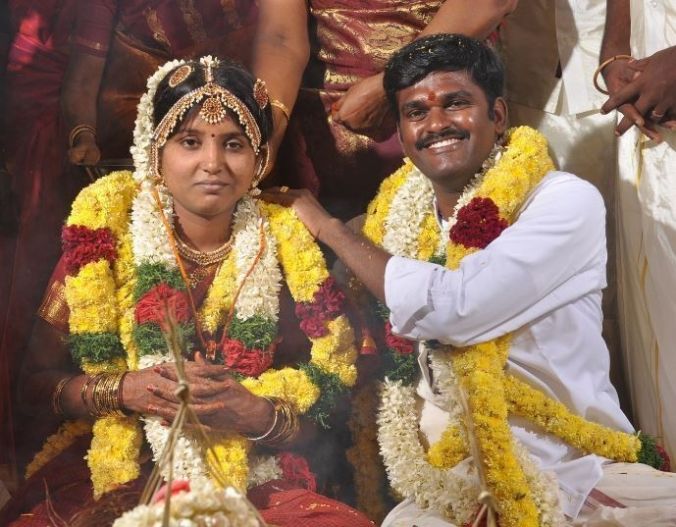
The Puzzle of Rising Education, Later Marriage, and Dowry Persistence in India: A Demographic Analysis, Alaka Basu
May 10, 2021
11:00 am
This paper records the rising age at marriage for women and men in India and discusses the possible contextual influences on these trends – government policy, economic and social development, aggressive social advocacy, and a marriage squeeze – and then goes on to discuss the potential implications of each of these influences. It cautions against the complacent assumption in international and domestic advocacy that rises in the age at marriage reflect only positive changes in underlying circumstances. Accordingly, it also cautions against the complacent assumption that rises in the age at marriage can have only positive consequences for the health and social welfare of society. These mixed conclusions mean that later marriage cannot be treated as an unequivocal indicator of progress on the development agendas of the Millennium Development Goals (MDGs) and the Sustainable Development Goals (SDGs).
Alaka M Basu is a professor in the Department of Global Development at Cornell University and a Senior Fellow at the United Nations Foundation in Washington, DC. For six years, she was also the Director of the South Asia Program at Cornell University. She has taught at Jawaharlal Nehru University in Delhi, the Harvard School of Public Health and Georgetown University. Her primary research publications are in the areas of reproductive health and family planning, gender and development, child health and mortality, the interface of fiction and demographic facts, and the politics of population policy. She is a regular contributor to national newspapers in India. She served/serves on the governing boards of the Population Association of America (PAA), the International Union for the Scientific Study of Population (IUSSP), the Population Council in New York and the Population Reference Bureau in Washington DC.. She was/is the chair of the IUSSP Scientific Committee on Anthropological Demography, a member of the Committees on Reproductive Health and on Population Projections of the National Research Council at the U.S. National Academy of Sciences and a member of the Lancet-Guttmacher Commission on Sexual and Reproductive Health and Rights. She is currently on the Editorial Advisory Boards of Population and Development Review and Asian Population Studies. She is the series editor of the Policy Briefs produced by the Sociology of Development section of the American Sociological Association.
Additional Information
Program
Einaudi Center for International Studies
South Asia Program
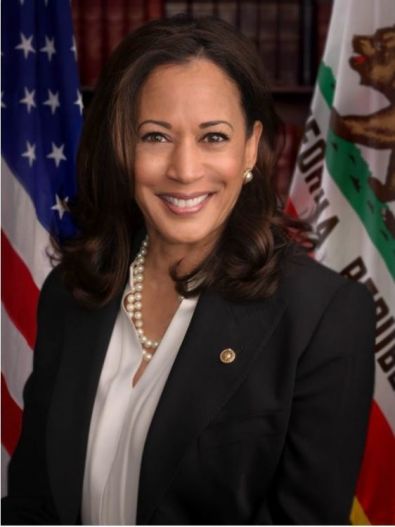
Kamala Harris and the History of South Asian America, by Nico Slate
May 3, 2021
11:00 am
When Madame Vice President, Kamala Harris, ran for president of the United States, news coverage focused on her unusual ethno-racial roots. Her Indian mother was from Chennai and her father, who is Black, was born in Jamaica. Some journalists also questioned whether progressive voters would be put-off by Harris’s past as a prosecutor and her reputation as something of a cautious centrist. The history of South Asian America offers a way to connect Harris’s family history to her politics—and to rethink what it means that Harris is now the Vice President of the United States. An important facet of her South Asian identity has been largely ignored: the fact that her mixed-race heritage connects Harris to the long history of South Asian Americans who never fit neatly in any one racial box. Put differently, it’s not just her mother who links Harris to the South Asian community; equally important is the fact that she has had to find her way outside conventional American racial categories. This talk will explore the racial borders of South Asian America by juxtaposing the life and career of Kamala Harris with the lives and activism of a range of other figures, including another famous Kamala: the feminist and anticolonial activist, Kamaladevi Chattopadhyay. Through such comparisons, we will explore together histories of race, migration, and social struggle that continue to have profound resonance—not only in the United States but also in contemporary South Asia.
Nico Slate is Professor in the Department of History at Carnegie Mellon University. His research examines the history of struggles against racism, imperialism, and caste oppression in the United States and South Asia. He is the author of four books: Colored Cosmopolitanism: The Shared Struggle for Freedom in the United States and India (Harvard University Press, 2012), The Prism of Race: W.E.B. Du Bois, Langston Hughes, Paul Robeson and the Colored World of Cedric Dover (Palgrave Macmillan, 2014), Gandhi’s Search for the Perfect Diet: Eating with the World in Mind (University of Washington Press, 2019), and Lord Cornwallis Is Dead: The Struggle for Democracy in the United States and India (Harvard University Press, 2019).
Additional Information
Program
Einaudi Center for International Studies
South Asia Program
Musicophilia in Mumbai: Performing Subjects and the Metropolitan Unconscious, by Tejaswini Niranjana

April 5, 2021
9:00 am
This book talk focuses on the manifestations of musicophilia in Mumbai from the late 19th century to the present. Love and madness come together in the metropolis as a condition of subjective excess, the condition of the musical subject’s simultaneous psychic and social habitation of modern urban space. I propose that the phenomenon of music-loving, and the concept of a lingua musica, help us grasp the workings of the metropolitan unconscious of a large port-city like Mumbai, throwing new light on the ‘subjective’ and the ‘social’ as they take shape under conditions of colonial and post-colonial modernity.
Tejaswini Niranjana is currently Professor and Head, Department of Cultural Studies, Lingnan University, Hong Kong. She is also Visiting Professor with the School of Arts and Sciences at Ahmedabad University, India. She is co-founder of the Centre for the Study of Culture and Society, Bangalore, which offered an innovative inter-disciplinary PhD programme from 2000-2012. During 2012-16, she headed the Centre for Indian Languages in Higher Education at the Tata Institute of Social Sciences, Mumbai, and was Indian-language advisor to Wikipedia. She is the author of Siting Translation: History, Post-structuralism and the Colonial Context (University of California Press, 1992), Mobilizing India: Women, Music and Migration between India and Trinidad (Duke University Press, 2006), and Musicophilia in Mumbai: Performing Subjects and the Metropolitan Unconscious (Duke University Press, 2020). Among her edited volumes is Genealogies of the Asian Present: Situating Inter-Asia Cultural Studies (Orient Blackswan, 2015), with Wang Xiaoming.
Image designed by Jugal Mody.
Additional Information
Program
Einaudi Center for International Studies
South Asia Program
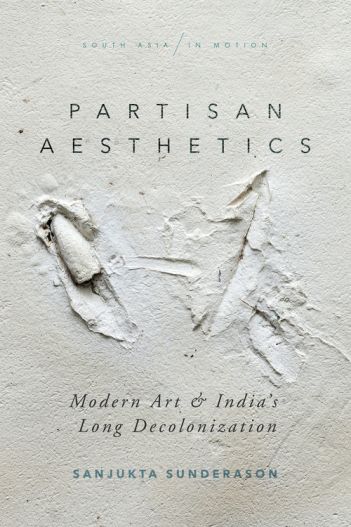
Partisan Aesthetics: Modern Art and India’s Long Decolonization
March 30, 2021
11:30 am
Partisan Aesthetics explores art's entanglements with histories of war, famine, mass politics and displacements that marked late-colonial and postcolonial India. Introducing "partisan aesthetics" as a conceptual grid, the book identifies ways in which art became political through interactions with left-wing activism during the 1940s, and the afterlives of such interactions in post-independence India. Using an archive of artists and artist collectives working in Calcutta from these decades, Sanjukta Sunderason argues that artists became political not only as reporters, organizers and cadre of India's Communist Party, or socialist fellow travelers, but through shifting modes of political participations and dissociations. Unmooring questions of Indian modernism from its hitherto dominant harnesses to national or global affiliations, Sunderason activates, instead, distinctly locational histories that refract transnational currents. She analyzes largely unknown and dispersed archives—drawings, diaries, posters, periodicals, and pamphlets, alongside paintings and prints—and insists that art as archive is foundational to understanding modern art's socialist affiliations during India's long decolonization. By bringing together expanding fields of South Asian art, global modernisms, and Third World cultures, Partisan Aesthetics generates a new narrative that combines political history of Indian modernism, social history of postcolonial cultural criticism, and intellectual history of decolonization.
This event is co-sponsored by the Columbia University South Asia Institute.
Debashree Mukherjee is Assistant Professor of film and media in the Department of Middle Eastern, South Asian, and African Studies (MESAAS) at Columbia University. Her first academic monograph, Bombay Hustle: Making Movies in a Colonial City (2020), approaches film history as an ecology of material practice and practitioners. In her new research she is developing a media history of indenture and South-South migrations, spanning photography, communications infrastructures, and film traffic. Debashree edits the peer-reviewed journal BioScope: South Asian Screen Studies and has published in journals such as Film History and Feminist Media Histories.
Iftikhar Dadi is Associate Professor and Chair of Cornell University’s Department of History of Art, Director of the South Asia Program, and Board Member of the Institute for Comparative Modernities. He researches art from a global and transnational perspective, with emphasis on questions of methodology and intellectual history.
Dwaipayan Banerjee is an Associate Professor of Science, Technology, and Society at the Massachusetts Institute of Technology. Banerjee's first monograph Enduring Cancer: Life, Death and Diagnosis in Delhi presents the efforts of the urban poor in Delhi to carve out a livable life with cancer, as they negotiate an over-extended health system struggling to respond to the disease. He has also co-authored Hematologies: The Political Life of Blood in India with Jacob Copeman. Banerjee's current research—Decolonizing Science: Towards a Cosmopolitics of Art, Physics and Computing in 1950s India—tracks scientific and aesthetic internationalisms in early postcolonial Bombay and Calcutta.
Sanjukta Sunderason is a historian of 20th century aesthetics, working with the interfaces of visual art and political thought. She is interested in particular in the ways in which art reflects and reframes struggles, imaginations, and dialogues around 20th-century decolonization. Her first book, Partisan Aesthetics: Modern Art and India’s Long Decolonization (2020) studied left-wing aesthetics in dialogue with formations of modern art in late-colonial and early postcolonial India. She is currently working on two book projects: a co-edited volume on the aesthetics of the postcolonial left in South Asia (with Lotte Hoek, University of Edinburgh); and a monograph on ideas/forms of the transnational in the art of decolonial liberation movements. Sunderason lives and works in the Netherlands, where she is Assistant Professor in the department of History of Art, University of Amsterdam.
Additional Information
Program
Einaudi Center for International Studies
South Asia Program
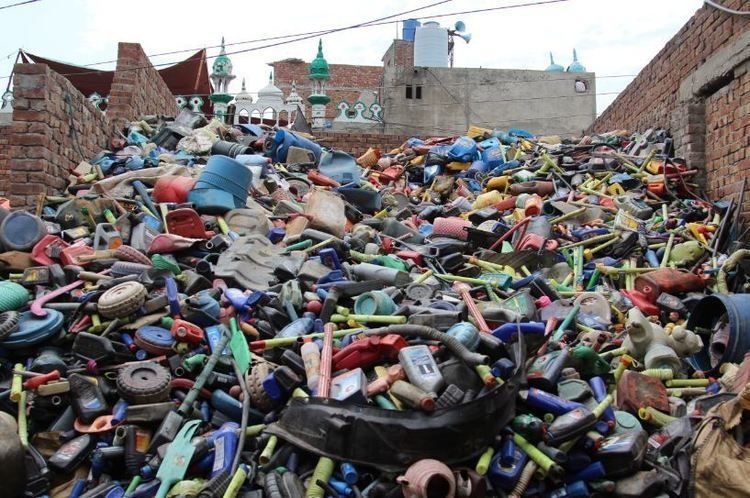
Figures of Surplus: Waste, Informality, and Caste in Urban Pakistan, by Waqas Butt
March 15, 2021
11:00 am
Waste work across South Asia is structured by caste, especially as low or non-caste groups (Dalits) have remained historically dominant in this form of labor. This continues to be true in contemporary Pakistan, where uneven urbanization driven by a consumption-based economy has shifted spatial relations along the lines of caste, class, and religion. Unsurprisingly, during this time, markets for waste materials and work have expanded rapidly, while creating renewed space for kabāṛīan (junkyard owners) and bīopārīan (middlemen or brokers) to enter this line of trade. This talk tracts through spaces—jhuggīān (huts), junkyards, warehouses, furnaces, manufacturing plants—where waste materials are worked with and exchanged, being procured and transformed into resources to be used in remaking commodities. Recent discussions of informality within South Asia have highlighted the contradictory situation faced by labor: excluded from formalized sectors of capitalist economies, relations of work and exchange have emerged to generate surpluses that are simultaneously directed at need and accumulation. By tracing the relations of work and exchange surrounding waste materials, this talk argues that informality undergird more formalized sectors of capitalist economies, uneven urbanization across much of Pakistan, and the reproduction of historical inequalities and interdependencies, in which caste-based forms of difference remain essential.
Waqas H. Butt is an anthropologist at University of Toronto Scarborough whose work focuses on the intersections of caste, labor, infrastructures, and waste in urban Pakistan. Based on long-term ethnographic fieldwork in Lahore and the Punjab, his current book project examines the ways in which waste workers, who are drawn predominantly from low or non-caste (Dalit) groups, have become essential components of urban life through the everyday and intimate workings of waste infrastructures. His research has been funded by the Wenner-Gren Foundation, the American Institute of Pakistan Studies, and the University of California, San Diego. His work has appeared in academic journals such as CITY, American Ethnologist, ILWCH, among others, as well as newspapers and magazines in Pakistan.
Additional Information
Program
Einaudi Center for International Studies
South Asia Program
The Cunning of Capital: Dalit and Queer Aesthetics of Resistance, by Nimanthi Perera-Rajasingham and Ani Maitra
March 8, 2021
11:00 am
Rajasingham’s talk will draw from her book, Assembling Ethnicities in Neoliberal Times, to argue that Sri Lanka’s thirty-year ethnic war, and post-conflict contexts must be understood as shaped by the forces of global capitalism. She makes her arguments through an examination of ethnographic fictions— work invested in documenting the external world—to unpack how war and neoliberalism intersect. The talk will turn to the work of Shobasakthi, a Paris-based Dalit writer and actor, who fled the Tamil Tigers as a child soldier during Sri Lanka’s separatist war. In his novel Gorilla and the film Dheepan, he depicts life in Sri Lanka and Paris as conditioned by, “neoliberalism in the shadows,” an economic form deeply entangled in ethnonationalism and racism. The talk will explore, further, how the characters in novel and film resist racial capitalism through formal aesthetic experiments and embedded forms of witnessing.
Maitra’s talk will argue for the need to see queer identity politics in contemporary India as a multiply mediated fragmentation regulated by neoliberal capital. The first half of the talk will scrutinize the neoliberal logic of diversity shaping the rhetoric of a queer film festival in India—the KASHISH Mumbai International Queer Film Festival—and its strategic cinephilic alliance with the corporatized language of LGBTQ+ rights. The second half of the talk will examine how the film Devi (Karishma Dube, 2017) troubles this logic of inclusion through a sustained aesthetic attention to the gendered and classed inequalities mediating and splitting lesbian identity in the post-colony.
Nimanthi Perera-Rajasingham is associate professor of English and Women’s Studies at Colgate University. She teaches Marxism, Postcolonial Studies, Critical Race and Ethnic Studies and Feminism. Her book, Assembling Ethnicities in Neoliberal Times: Ethnographic Fictions and Sri Lanka’s War was published in the series, Critical Insurgencies, out of Northwestern University Press. She is presently working on her second book project on Global Apartheid and the War on Terror, which discusses the ongoing and recalibrated forms of segregation that the War on Terror has enabled.
Ani Maitra is associate professor of Film and Media Studies at Colgate University. His teaching and research interests span the fields of postcolonial and diaspora media cultures and gender and sexuality studies. His essays have appeared in edited volumes and journals like Camera Obscura, Continuum, differences, Film Quarterly, Jindal Global Law Review and World Records. Maitra is the author of Identity, Mediation, and the Cunning of Capital (Northwestern University Press, 2020).
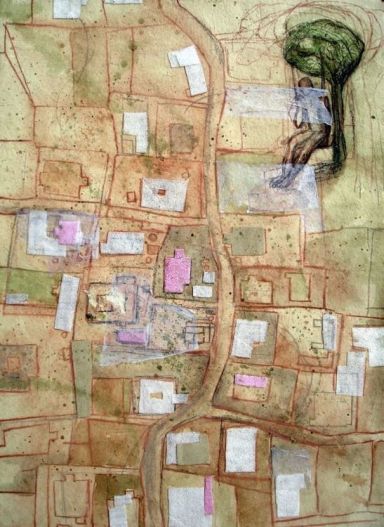
Image: Thamotharampillai Shanaathanan, Grandma’s Courtyard II, 2004. Copyright © by Thamotharampillai Shanaathanan.
Additional Information
Program
Einaudi Center for International Studies
South Asia Program