
South Asia Program
Info Session: Fulbright U.S. Student Program for Undergraduates
March 3, 2021
4:30 pm
The Fulbright U.S. Student Program supports college graduates conducting research or teaching in any field in more than 150 countries. Applications are due in the fall; students who wish to begin the program immediately after graduation are encouraged to start the process in their junior year.
United States citizens in any field of study are eligible.
Contact: fulbright@einaudi.cornell.edu, https://einaudi.cornell.edu/fulbright-us-student-program
Additional Information
Program
Einaudi Center for International Studies
Reppy Institute for Peace and Conflict Studies
East Asia Program
Southeast Asia Program
Latin American and Caribbean Studies
Institute for African Development
Institute for European Studies
South Asia Program
FLAS Applications Now Open!
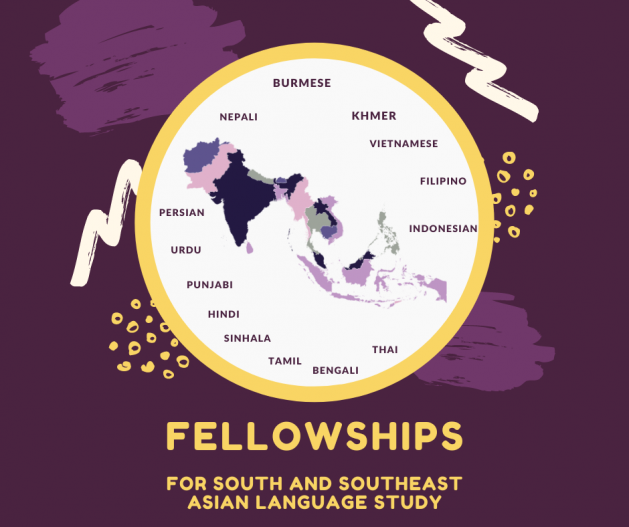
Applications now open for Summer 2020 and Academic Year 2021-202 Foreign Language and Area Studies (FLAS) Fellowships for Bangla, Hindi, Nepali, Persian, Punjabi, Sinhala, Tamil, Tibetan & Urdu.
Applications now open for Summer 2020 and Academic Year 2021-202 Foreign Language and Area Studies (FLAS) Fellowships for Bangla, Hindi, Nepali, Persian, Punjabi, Sinhala, Tamil, Tibetan & Urdu.
Additional Information
Info Session: Einaudi Center Regional and Thematic Minors
April 5, 2021
4:30 pm
Take your learning to the next level with regional and thematic minors from the Mario Einaudi Center for International Studies and our programs. Whatever your major and career goals, our wide geographical reach and interdisciplinary focus provide opportunities for you to expand your global knowledge and broaden your approach to your studies and the world. Find out if an Einaudi Center minor is right for you and how to apply.
Co-sponsored by the Tatkon Center for First-Year Students
Contact: einaudi_center@einaudi.cornell.edu; https://einaudi.cornell.edu/learn/minors-and-academics
Additional Information
Program
Einaudi Center for International Studies
Southeast Asia Program
Latin American and Caribbean Studies
Institute for European Studies
South Asia Program
East Asia Program
Institute for African Development
Info Session: Careers Beyond Academia - Resources for PhD students and Postdocs
March 24, 2021
4:30 pm
Explore options beyond academia and discover how to make informed decisions for career choices in government, non-profits and industry. Test-drive career opportunities through career panels, individual and group sessions, site visits and more. Visit website for more details.
Contact: sap@cornell.edu
Additional Information
Program
Einaudi Center for International Studies
East Asia Program
Southeast Asia Program
Latin American and Caribbean Studies
Institute for European Studies
South Asia Program
Institute for African Development
Info Session: International Relations Minor
February 25, 2021
4:45 pm
Is the Einaudi Center's International Relations minor for you? Here's a chance to find out. Graduates go on to successful careers in fields like international law, economics, agriculture, trade, finance, journalism, education, and government service.
Contact: irm@einaudi.cornell.edu; https://einaudi.cornell.edu/academics/international-relations-minor
Additional Information
Program
Einaudi Center for International Studies
Reppy Institute for Peace and Conflict Studies
East Asia Program
Southeast Asia Program
Latin American and Caribbean Studies
Institute for African Development
Institute for European Studies
South Asia Program
Info Session: Summer Language Programs and Funding Opportunities
February 17, 2021
4:30 pm
Want to learn a language this summer? Learn about Foreign Language and Area Studies fellowships and Critical Language Scholarships, which provide fully funded opportunities for Cornell undergraduate and graduate students to study South and Southeast Asian languages in the summer, and even in the academic year.
Additional Information
Program
Einaudi Center for International Studies
Southeast Asia Program
South Asia Program
Info Session: Fulbright Opportunities for Graduate Students
February 15, 2021
4:30 pm
The Fulbright U.S. Student Program provides full funding for graduate and professional students conducting research or teaching in any field in more than 150 countries. Open to U.S. citizens only.
The Fulbright-Hays Doctoral Dissertation Research Abroad Program supports doctoral students conducting research in modern languages or area studies for six to 12 months. Open to U.S. citizens and permanent residents of the United States. Travel to Western European countries is not eligible.
Contact: fulbright@einaudi.cornell.edu, https://einaudi.cornell.edu/fulbright-us-student-program
Additional Information
Program
Einaudi Center for International Studies
Reppy Institute for Peace and Conflict Studies
East Asia Program
Southeast Asia Program
Latin American and Caribbean Studies
Institute for African Development
Institute for European Studies
South Asia Program
Info Session: Migrations Studies Minor
February 11, 2021
4:30 pm
The Migration Studies minor is a university-wide, interdisciplinary undergraduate minor that prepares students to understand the historical and contemporary contexts and factors that drive international migration and shape migrant experiences around the globe. This minor draws on the rich course offerings found across the humanities and social sciences at Cornell, and is designed to draw students outside of their major fields and to extend their knowledge beyond a single country.
Contact: migration-minor@einaudi.cornell.edu, https://einaudi.cornell.edu/migration-studies-minor
Additional Information
Program
Einaudi Center for International Studies
Reppy Institute for Peace and Conflict Studies
East Asia Program
Southeast Asia Program
Latin American and Caribbean Studies
Institute for African Development
Institute for European Studies
South Asia Program
Info Session: Einaudi Center International Research Travel Grants
February 9, 2021
4:30 pm
The Einaudi Center International Research Travel Grants provide travel support for Cornell graduate students conducting short-term research and/or fieldwork outside the United States. They also provide travel support for professional students engaged in various academic experiences in the international arena.
Contact: einaudi_center@einaudi.cornell.edu; https://einaudi.cornell.edu/funding/travel-grants
Additional Information
Program
Einaudi Center for International Studies
Reppy Institute for Peace and Conflict Studies
East Asia Program
Southeast Asia Program
Latin American and Caribbean Studies
Institute for African Development
Institute for European Studies
South Asia Program
The Case for and Against Investing in Bitcoin

Eswar Prasad, SAP
“Making bitcoin a significant part of your portfolio would increase your risk substantially,” says Eswar Prasad, professor of economics and trade policy. “But a marginal amount seems worthwhile given recent dynamics.”